

The most cost-effective way to source Palmitoylethanolamide might actually be the least effective for your nerve health. It is a common frustration for many Australians who find themselves debating the merits of PEA powder vs capsules Australia while trying to manage persistent discomfort. You may have already realised that therapeutic PEA is not the same as pea protein; yet, the challenges of measuring precise dosages from a bulk bag remain. Dealing with a "soapy" texture or an unpleasant taste can quickly turn a health goal into a daily chore.
This article will help you discover the critical differences between these forms to optimise your nerve health and absorption in 2026. We explore the science of micronisation, the necessity of dosage precision, and the practical benefits of a stable capsule routine. By the end, you will have a clear path toward maximum bioavailability and a more dignified way to support your physical well-being. Our goal is to provide the clinical clarity you need to make an informed decision for your long-term comfort and vitality.
Key Takeaways
- Distinguish between common dietary pea protein and therapeutic Palmitoylethanolamide to ensure you are supporting your nerve health with the correct biological compound.
- Evaluate the practical trade-offs of PEA powder vs capsules Australia, specifically regarding the difficulty of measuring precise clinical dosages at home.
- Understand why micronisation is the essential scientific standard for overcoming the poor natural absorption of standard Palmitoylethanolamide.
- Discover how specialised capsule shells protect the active ingredients from stomach acid, ensuring maximum bioavailability and consistent results.
- Simplify your daily routine by choosing a pre-measured form that eliminates the unpleasant "soapy" texture and taste associated with raw bulk powders.
The PEA Confusion: Palmitoylethanolamide vs Pea Protein
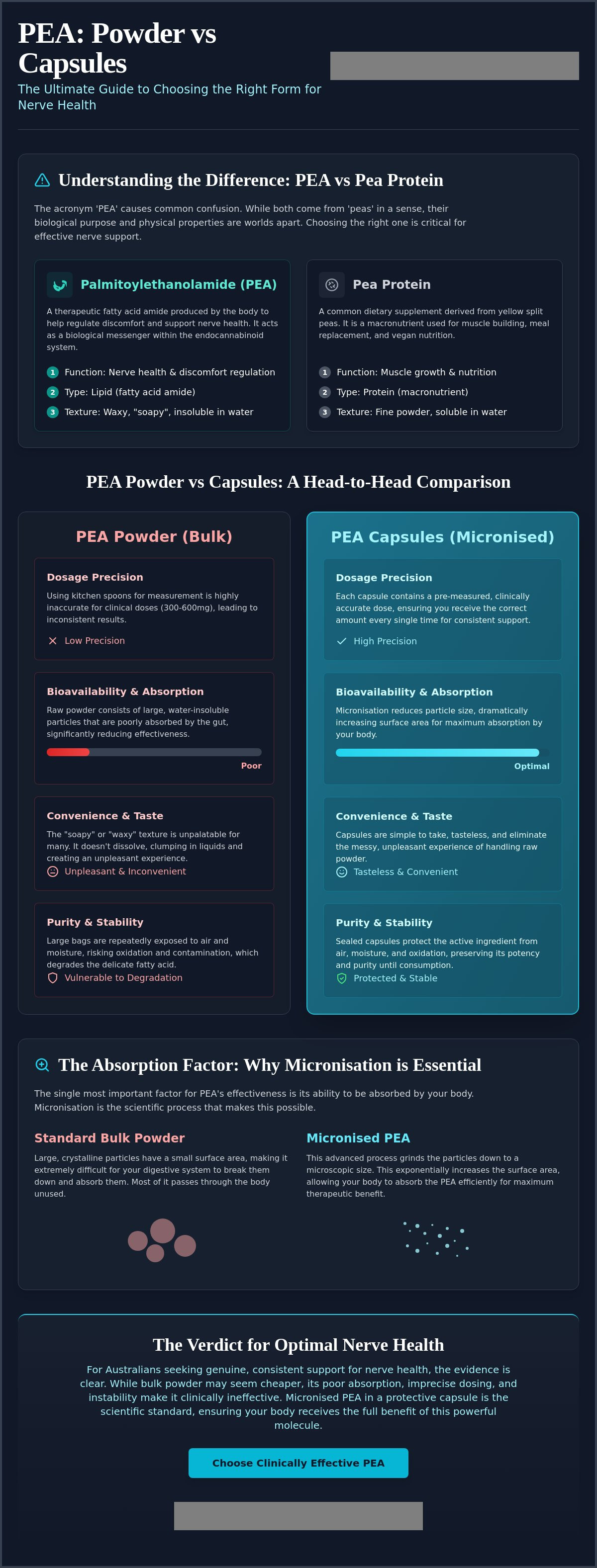
Australians searching for nerve health support often encounter a confusing linguistic hurdle. The acronym PEA is frequently used for two vastly different substances: pea protein powder and the therapeutic molecule Palmitoylethanolamide. While pea protein is a popular dietary supplement for muscle growth and vegan nutrition, those investigating PEA powder vs capsules Australia for nerve health are seeking a specific fatty acid amide. This molecule is not a source of macronutrients; it is a vital biological messenger that helps your body regulate persistent discomfort.
Palmitoylethanolamide (PEA) is produced naturally within our cells in response to physical stress or cellular injury. It belongs to the extended endocannabinoid system, acting as a resolving agent that helps the body return to a state of homeostasis. Because it is a lipid, it shares more in common with healthy fats than it does with the water-soluble proteins found in vegan shakes. This chemical nature is why raw powder often has a distinct, "soapy" texture that many find unpalatable. Understanding this biological distinction is the first step toward choosing a supplement that actually reaches your target tissues rather than just passing through your system.
What is Palmitoylethanolamide (Therapeutic PEA)?
PEA functions as a biological response modifier. Unlike traditional options that might simply mask symptoms, PEA works by "turning down" the volume of overactive glial cells and mast cells. These cells are often responsible for the cycle of persistent discomfort and neuro-inflammation. Since its discovery, clinical research has identified its unique ability to support the body's internal repair mechanisms without the heavy side effects common in synthetic alternatives. You can explore the Science Behind the Molecule to understand exactly how it interacts with your nervous system to promote long-term stability.
Why the Form of PEA Matters for Your Body
The physical structure of PEA presents a significant hurdle for absorption. As a lipid-based substance, raw PEA consists of large, water-insoluble particles. When you consume standard bulk powder, your gut often struggles to break these particles down, leading to poor bioavailability. In the Australian supplement market, the distinction between raw powder and refined capsules is critical for success. While a protein powder dissolves easily in a shaker, therapeutic PEA requires specific particle size reduction to be effectively absorbed by the human digestive tract. This challenge is why the debate over PEA powder vs capsules Australia is more than just a matter of convenience; it is a matter of clinical efficacy and ensuring your body can actually utilise the support you are providing.
PEA Powder: The Pros and Cons of Bulk Supplementation
Many Australians initially gravitate toward bulk powder because it appears to offer better value for money. While compounding pharmacies often provide large quantities at a lower entry price, the practical reality of using raw Palmitoylethanolamide can be challenging. When weighing up the benefits of PEA powder vs capsules Australia, it's vital to consider how these factors affect your daily compliance and the long-term stability of the product.
Raw PEA is not a standard powder; it is a lipid with a waxy, almost soapy texture. It does not dissolve in water or juice. Instead, it tends to clump or float on the surface, making the experience of taking it quite unpleasant for those with sensory sensitivities. There is also the risk of oxidation. Large bags of raw powder are frequently opened and closed, exposing the delicate fatty acid amide to air and potential moisture contamination over several months. This exposure can compromise the purity and potency of the supplement before you reach the bottom of the container.
Clinical research frequently emphasises the importance of micronized PEA for overcoming these physical limitations. Raw bulk powder rarely undergoes the intensive processing required to reach these therapeutic standards, often leaving the user with a product that is physically difficult to handle and biologically difficult to absorb.
The Challenge of Accurate Dosing
A level teaspoon is a dangerously imprecise measurement for a therapeutic lipid. Doses for nerve support typically range between 300mg and 600mg, which is a tiny physical amount. Without a high-precision milligram scale, you are essentially guessing your intake. This inconsistency can disrupt the steady state required for the molecule to interact effectively with your cellular receptors. For more detail on finding your ideal level based on clinical standards, consult our PEA Dosage for Pain Guide.
Portability and Discretion in Daily Life
Portability is another significant hurdle. Carrying a bag of white powder to work or while travelling across Australia is often inconvenient and lacks discretion. Powder residue easily sticks to the sides of containers or measuring tools, which leads to wasted product and unintentional under-dosing. This logistical challenge is a primary reason why the choice of PEA powder vs capsules Australia often comes down to lifestyle compatibility and the need for a reliable, mess-free routine.
If you find the "mess factor" of bulk powder is hindering your consistency, you might consider the streamlined nature of professional PEA capsules for a more dignified health journey.
PEA Capsules: Why Precision is the Clinical Standard
While bulk powder requires a meticulous weighing process, capsules offer a pre-measured, pharmaceutical-grade solution. Each capsule provides a precise dose, typically 300mg or 600mg, ensuring your intake remains consistent day after day. This level of accuracy is vital when managing nerve health, as biological messengers like Palmitoylethanolamide rely on steady concentration levels to interact effectively with your cellular receptors. When comparing PEA powder vs capsules Australia, the reliability of a capsule eliminates the risk of human error that often accompanies a set of milligram scales and a bag of raw lipid.
The capsule shell serves a critical biological function that competitors often overlook. It acts as a protective barrier against the harsh, acidic environment of the stomach. Because PEA is a lipid, it is susceptible to gastric degradation before it can reach the small intestine for absorption. A high-quality capsule ensures the active ingredient remains intact until it reaches the optimal site for uptake into your system. This protection is a primary reason why capsules are considered the clinical standard for those seeking maximum bioavailability and predictable results.
Practicality is equally important for long-term success. Capsules fit seamlessly into a modern Australian lifestyle. Whether you are at a desk in the city or travelling through the Outback, you can maintain your routine without the inconvenience of mixing powders or cleaning residue from a shaker. This ease of use fosters better compliance, which is often the deciding factor in whether a natural support programme succeeds or fails.
Comparing Stability and Shelf Life
The Australian climate, known for its varying levels of humidity, can be particularly harsh on bulk supplements. Raw powders are prone to "clumping" as the fatty acid amides attract moisture each time the bag is opened. This clumping not only makes measuring even more difficult but can also lead to premature spoilage. Sealed capsule bottles provide a stable, controlled environment that maintains the purity of the PEA for much longer. At Relieve Therapeutics, we focus on high-quality capsule delivery to ensure every dose is as fresh and potent as the first.
Standardising Your Daily Routine
Managing complex health needs often leads to "decision fatigue." A simple "one pill" routine reduces the psychological burden of daily management, allowing you to focus on your recovery rather than the logistics of supplementation. Establishing this habit is a powerful step toward long-term stability. If you are new to this approach, you may find that PEA 60 Capsules serve as the ideal starter for your natural support journey. This standardised form provides the clinical precision needed to assess how your body responds to the molecule without the variables introduced by PEA powder vs capsules Australia comparisons.
The Absorption Factor: Micronisation and Particle Size
The most significant scientific hurdle for Palmitoylethanolamide is its natural physical form. In its raw state, PEA is a lipid with large, water-insoluble particles. This is where the debate over PEA powder vs capsules Australia reaches a critical turning point. Standard bulk powder often fails to provide the support users expect simply because the particles are too large to cross the intestinal wall. To overcome this, the pharmaceutical industry uses a process called micronisation.
Micronisation involves reducing the particle size of the PEA molecule down to the micrometre range. By breaking these large clusters into smaller units, the total surface area increases exponentially. This is the "Surface Area Argument": smaller particles dissolve more rapidly in the digestive tract, allowing for a much higher rate of uptake into the bloodstream. Without this process, much of the supplement is simply excreted by the body before it can reach the overactive glial cells it's intended to support. It isn't just about how much you take; it's about how much your body can actually use.
Most bulk powders available in the Australian market are "standard" grade. This means they haven't undergone the intensive milling required to reach ultra-micronised status. In contrast, premium capsules are specifically designed to house ultra-micronised PEA. This distinction is the most important scientific differentiator for efficacy, yet it's rarely discussed by bulk suppliers who focus on volume over bioavailability.
Ultra-Micronised vs Standard PEA
Clinical evidence consistently supports the use of micronised and ultra-micronised forms for supporting nerve health. These smaller particles are more adept at bypassing the body's natural barriers. Additionally, the manufacturing process for ultra-micronised PEA creates a light, "fluffy" substance that's notoriously difficult to handle in bulk bags. It's far better suited to the controlled, sealed environment of a capsule, which prevents the powder from clumping and ensures the particle size remains stable until the moment of consumption.
Getting the Most from Your Supplement
Absorption can be further optimised through simple dietary choices. Because PEA is fat-soluble, taking your capsule with a meal containing healthy fats, such as avocado or olive oil, can boost uptake. Consistency is also key. Maintaining a "loading phase" is significantly easier with a pre-measured capsule than with the variable measurements of a bulk powder. For a step-by-step approach, you can read our Practical Australian Guide on timing and dosage. To ensure you're receiving the highest standard of absorption, explore our range of ultra-micronised PEA capsules designed for clinical precision and maximum bioavailability.
Verdict: Which Form is Right for Your Health Journey?
The decision between PEA powder vs capsules Australia ultimately rests on the balance between initial cost and clinical outcome. While bulk powder might appeal to those seeking the lowest price point, the practical hurdles often outweigh the savings. The lack of dosing precision, the unpleasant waxy texture, and the poor absorption of non-micronised lipids can hinder your progress. For those prioritising nerve health and long-term stability, micronised capsules represent the gold standard. They provide a dignified, mess-free, and scientifically sound way to support your body's endocannabinoid system.
In the Australian context, the ease of ordering specialised capsules locally has made bulk powders increasingly obsolete for therapeutic use. Sourcing your supplements from within Australia ensures you receive a product that meets local standards without the uncertainty of international shipping. At Relieve Therapeutics, we are committed to providing ultra-micronised Palmitoylethanolamide that adheres to strict purity protocols. Our focus is on ensuring that every dose is biologically active and ready to support your cellular health.
Choosing Your Supply: 60, 120, or 180 Capsules
Selecting the right quantity depends on where you are in your health journey. A 60-capsule bottle is often the best choice for those new to Palmitoylethanolamide, allowing for an initial assessment of how the molecule interacts with your system. As you move into a maintenance phase, larger counts provide better continuity and reduced "decision fatigue." Many of our regular users find that PEA 120 Capsules offer the most strategic balance of value and convenience. By opting for these larger specialised counts, the perceived price gap between capsules and bulk powders narrows significantly, making premium delivery a sustainable long-term option.
Next Steps for Australian Customers
When you are evaluating a product, the most important word to look for on a label is "micronised." This term confirms that the particle size has been reduced to a level the human gut can actually absorb. Without this distinction, you may be investing in a product that your body cannot fully utilise. Buying from a trusted Australian source like Relieve Therapeutics gives you the confidence that your supplement is backed by clinical authority and empathetic care. We invite you to browse our range of specialised PEA 60, 120, and 180 capsules to find the perfect fit for your daily routine and take the next step toward sustained physical comfort.
Empowering Your Path to Nerve Health
Your journey toward sustained comfort relies on choosing a supplement form that respects your body's biological needs. We have explored the critical distinctions between standard bulk options and clinical-grade delivery. The debate of PEA powder vs capsules Australia highlights that while powder may seem accessible, the precision of a capsule is essential for maintaining therapeutic levels and ensuring maximum bioavailability through micronisation. By choosing a pre-measured form, you eliminate the sensory barriers of "soapy" textures and the risk of inaccurate dosing.
As a specialised Australian retailer, Relieve Therapeutics is dedicated to providing clinical-grade Palmitoylethanolamide that meets the highest standards of purity. Whether you are just beginning your support journey or seeking long-term stability, we offer tailored solutions to fit your lifestyle. You can browse the Relieve Therapeutics range of high-quality PEA capsules today, available in 60, 120, and 180-count bottles to suit your specific needs. Taking control of your nerve health is a dignified step toward restoring your daily vitality. We are here to partner with you on that journey.
Frequently Asked Questions
Is PEA powder the same as pea protein powder?
No, Palmitoylethanolamide is a therapeutic lipid messenger, while pea protein is a dietary macronutrient derived from legumes. While they share the same acronym, their biological functions are entirely different. Pea protein is used for muscle repair and nutrition, whereas Palmitoylethanolamide is utilised specifically to support the endocannabinoid system and manage neuro-inflammation. It's essential to verify you're purchasing the molecule rather than the protein when seeking nerve support.
Can I open PEA capsules and mix the powder into food?
You can open the capsules, but it isn't recommended due to the waxy texture and "soapy" taste of raw PEA. Additionally, the capsule shell plays a protective role in ensuring the lipid reaches the small intestine for optimal absorption. If you choose to mix it, use a fat-containing food like yoghurt or avocado to assist with solubility, as PEA does not dissolve in water-based liquids.
Does PEA powder taste bad?
Raw Palmitoylethanolamide is often described as having a waxy, slightly soapy flavour profile that many find unpalatable. Because it's a lipid, it doesn't dissolve in the mouth but rather leaves a persistent residue. This is a primary reason why many prefer the capsule form when comparing PEA powder vs capsules Australia, as it allows for a neutral and dignified daily routine without the sensory challenges of raw bulk powder.
Why is micronised PEA better than standard PEA powder?
Micronised PEA is superior because it features a significantly smaller particle size, which increases the surface area for dissolution and absorption. Standard PEA powder often consists of large particles that the human digestive system struggles to process effectively. By reducing these particles to the micrometre range, the body can more easily transport the molecule across the intestinal barrier to reach the targeted nerve cells and provide the intended support.
How much PEA should I take daily if using capsules?
Most clinical studies suggest a daily intake of 300mg to 600mg, taken twice per day for optimal results. This consistency helps maintain steady levels of the molecule within your system. While individual needs vary, starting with a 600mg daily dose is a common clinical entry point. It's always best to consult with a healthcare professional to determine the specific dosage that aligns with your personal health journey and current requirements.
Are there any side effects to taking PEA capsules?
Palmitoylethanolamide is generally well-tolerated with an excellent safety profile, as it's a substance naturally produced by your own cells. Unlike many synthetic alternatives, it doesn't typically cause drowsiness or gastrointestinal distress. Some users report mild digestive changes when first starting, though these are rare. Because it doesn't interact with most common medications, it's considered a safe and reliable option for long-term nerve health support for most Australians.
Where can I buy high-quality PEA capsules in Australia?
You can purchase high-quality, ultra-micronised PEA capsules directly from specialised Australian retailers like Relieve Therapeutics. Choosing a local source ensures your supplements are stored in climate-controlled conditions and meet Australian quality standards. We offer various sizes, including 60, 120, and 180-count bottles, providing a convenient way to manage your PEA powder vs capsules Australia choice with a product designed for maximum clinical efficacy and bioavailability.
Can I take PEA capsules alongside other supplements?
Yes, PEA is highly compatible with most other supplements and doesn't have known negative interactions with common vitamins or minerals. In fact, it's often used in conjunction with B-group vitamins or magnesium to provide comprehensive support for the nervous system. Because it acts on the body's natural regulatory pathways rather than through aggressive chemical intervention, it's a versatile addition to most existing wellness routines without the risk of complicating your current regimen.