

Most people treat Palmitoylethanolamide (PEA) like a standard painkiller, but expecting instant results is the quickest way to miss its true benefits. If you're dealing with the relentless burning of nerve zaps or the heavy brain fog that often accompanies prescription options, you know how draining the search for relief can be. You've likely tried various methods only to find the discomfort persists. Learning how to take PEA for nerve pain isn't about finding a quick fix; it's about understanding how this fatty acid amide works as a cumulative biological modulator to stabilise your system over time.
We're here to help you move beyond the frustration of trial and error with a structured approach grounded in the latest 2026 TGA standards. You'll discover the precise dosing protocols, absorption secrets, and timing strategies required to manage your symptoms naturally and effectively. This guide provides a clear daily schedule and explains why micronised particles are essential for superior absorption. It's time to join the 100,000 Australians who have already found a more reliable, science-backed path to daily comfort and vitality.
Key Takeaways
- Understand how this naturally occurring lipid works within your body to calm overactive nerves and glial cells.
- Discover the specific 1200mg daily protocol and why a consistent four-week loading phase is essential when learning how to take PEA for nerve pain.
- Identify why micronisation is the gold standard for absorption and how it bypasses the body's natural bioavailability barriers.
- Set realistic milestones for your recovery, as the cumulative benefits of this biological modulator typically require two to eight weeks to reach full effect.
- Select the appropriate supply for your personal health journey with 60, 120, or 180 capsule variations designed for sustained nerve support.
Understanding PEA: Why This Fatty Acid Amide is Vital for Nerve Support
Palmitoylethanolamide (PEA) is not a synthetic drug. It is a bioactive fatty acid amide that your body produces naturally to manage physical stress, sensitivity, and inflammation. Think of it as a built-in repair mechanism. When tissues are damaged or under threat, your system synthesises PEA to protect cells and restore biological balance. However, for many Australians dealing with chronic inflammation, this natural reservoir can become depleted. The body simply cannot keep up with the demand created by long-term discomfort.
Understanding how to take PEA for nerve pain begins with recognising that it functions differently from traditional chemist-shelf options. Unlike NSAIDs (non-steroidal anti-inflammatory drugs) which inhibit specific enzymes, or opioids that mask pain signals in the brain, PEA works at the cellular level. It targets the underlying biological triggers of your discomfort. It is a more sophisticated, restorative approach. It focuses on resolution rather than temporary suppression.
The Role of Glial Cells in Neuropathic Pain
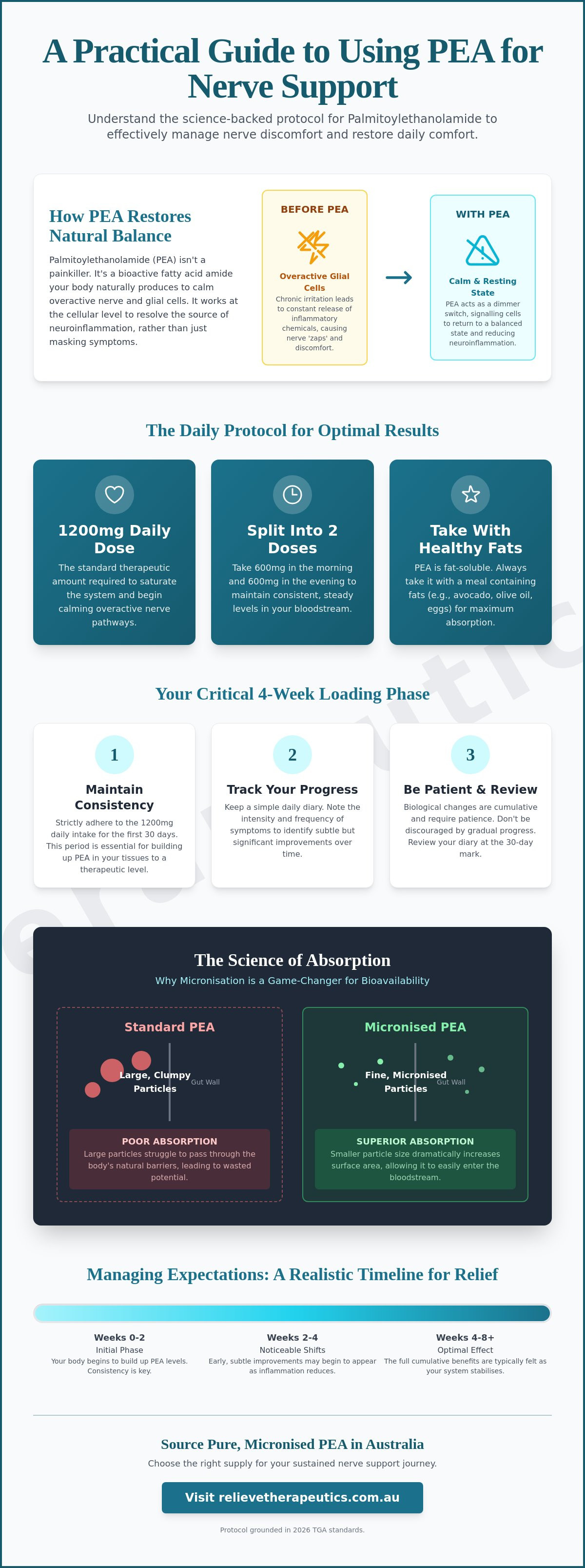
Glial cells are the immune cells of your central nervous system. While they usually protect nerves, chronic irritation can cause them to become overactive or "unhappy." This state leads to a constant release of inflammatory chemicals, manifesting as that familiar burning or tingling sensation. PEA acts as a biological dimmer switch. It signals these glial cells to return to a resting state, effectively lowering the volume of neuroinflammation at its source. By addressing the cellular environment, you are dealing with the cause of the "zaps" rather than just covering them up.
PEA and the Endocannabinoid System
While it is often grouped with cannabinoids, PEA is an endocannabinoid-like molecule. It contains no THC or CBD and produces no psychoactive effects. Instead, it works through what scientists call the "entourage effect." It enhances the activity of your body's own endocannabinoids by preventing their breakdown. This support helps your natural healing pathways function more efficiently. Because it is a substance your body already recognises, it maintains an excellent safety profile for long-term use. It provides a sustainable, evidence-based alternative for those seeking to reduce their reliance on heavy prescription medications.
A Step-by-Step Guide: How to Take PEA for Nerve Pain Effectively
Achieving success with Palmitoylethanolamide requires more than just occasional use. It demands a disciplined approach. The standard therapeutic baseline for managing persistent discomfort is typically 1200mg per day. While it might be tempting to start with a lower dose, clinical observations suggest that this specific amount is necessary to saturate the system and begin the process of calming overactive glial cells. Consistency is your most powerful tool. You aren't just masking a symptom; you are retraining your body's inflammatory response.
Timing and technique are just as vital as the dosage itself. PEA is a lipid, meaning it is fat-soluble. To ensure maximum absorption, you should always take your capsules with a meal that contains healthy fats, such as avocado, olive oil, or eggs. Without these fats, much of the supplement may simply pass through your system unused. Splitting your daily intake into two doses, one in the morning and one in the evening, helps maintain steady levels in your bloodstream throughout the day and night. This helps prevent the "trough" effect where pain might flare up between doses.
The 4-Week Loading Protocol
The first month of your journey is the loading phase. This period is critical for building up the molecule within your tissues. Evidence regarding PEA in the treatment of neuropathic pain highlights that the most significant changes often occur after several weeks of sustained use. To manage this phase effectively, follow these three steps:
- Step 1: Maintain a strict 1200mg daily intake. This usually equates to three 400mg capsules, split across your morning and evening meals.
- Step 2: Keep a daily pain diary. Track the intensity and frequency of "nerve zaps" to identify subtle improvements in your comfort levels.
- Step 3: Review your progress at the 30-day mark. Don't be discouraged if changes are gradual. The biological shifts are cumulative and require patience.
Maintenance Dosing for Long-Term Support
Once your symptoms have stabilised and you feel a consistent reduction in discomfort, you can consider transitioning to a maintenance dose. Many individuals find that 800mg daily is sufficient to keep neuroinflammation in check. However, if you are dealing with severe, chronic neuropathy, staying at the 1200mg level may be necessary for ongoing support. While PEA has no known ceiling effect where it becomes toxic, research suggests that efficiency typically peaks at 2400mg per day. For most people, finding the right balance between 800mg and 1200mg provides the best long-term outcome. If you are ready to begin your loading phase, you can order high-purity PEA capsules to start your journey today.
Micronisation and Absorption: Getting the Most Out of Your Supplement
Many Australians wonder why their supplement isn't working despite following the correct dosage. The answer often lies in the "Bioavailability Barrier." Standard Palmitoylethanolamide is a fatty substance that naturally forms large, crystalline structures. These particles are often too large to effectively pass through the intestinal wall. When you are learning how to take PEA for nerve pain, you must account for this physical limitation. If the molecule cannot reach your bloodstream, it cannot reach the glial cells that require stabilisation. It simply passes through the digestive tract without providing any therapeutic benefit.
This is where micronisation and ultra-micronisation become essential. These pharmaceutical processes involve reducing the particle size to between 2 and 10 microns. For context, a human hair is about 70 microns wide. By shrinking the particles, we significantly increase the surface area available for digestion. This isn't just a marketing term; it is a clinical requirement for efficacy. A systematic review of PEA for chronic pain confirms that micronised formulations consistently outperform standard powders in clinical settings. The smaller the particle, the more reliable the result.
Why Particle Size Matters for Nerve Pain
Smaller particles cross the intestinal wall with far greater efficiency. When you increase the surface area of the lipid, you allow your body to process the compound before it is excreted. This improved uptake means your system reaches therapeutic levels faster. It also means you can achieve better results with fewer capsules. Micronised capsules are far superior to generic bulk powders, which often lack the mechanical processing needed for human absorption. For a deeper look at technical specifications, consult our guide on high quality PEA capsules.
Choosing the Right Product in Australia
Identifying a high-quality supplement requires a discerning eye for Australian labels. You should look for transparency regarding purity, the absence of unnecessary fillers, and explicit mention of micronisation. Many "cheaper" international options available on marketplaces are non-micronised, which often results in zero relief for the user. It is a false economy to buy a product that the body cannot use. With the TGA increasing scrutiny on listed medicine advertising through 2026 and 2027, choosing a brand that prioritises evidence and manufacturing standards is more important than ever. Success in choosing the best supplement for neuropathy in Australia involves verifying lab certifications and ensuring the manufacturer adheres to strict quality controls. Reliability and science should always take precedence over price when managing chronic discomfort.
Managing Expectations: Timeline, Safety, and Monitoring Progress
One of the most common mistakes people make when learning how to take PEA for nerve pain is expecting immediate results. Unlike aspirin or other quick-acting analgesics, Palmitoylethanolamide does not provide instant relief. It is a biological modulator that requires time to accumulate within your tissues and stabilise overactive glial cells. Most users begin to notice subtle shifts within the first two weeks, but reaching the full therapeutic effect typically takes between two and eight weeks of consistent use. Patience is a vital component of your recovery journey.
Safety is a priority for any long-term support strategy. PEA is a TGA-approved listed medicine ingredient with a remarkable safety profile. Because it is a lipid your body already produces, it is generally well-tolerated. Rare side effects may include mild nausea or a slight stomach upset, which are often mitigated by taking the capsules with food. It is also safe to use alongside standard nerve medications, though you should always consult your Australian GP or a pain specialist before starting. They can help you integrate PEA into a broader, multimodal pain management plan tailored to your specific needs.
The "Slow and Steady" Recovery Curve
During the first fortnight, you might feel as though nothing is happening. This is normal. The shift from acute, sharp pain to more manageable discomfort is often gradual. You may first notice that your sleep is less interrupted or that the intensity of "nerve zaps" has softened slightly. To begin this process without a long-term commitment, many Australians start with the PEA 60 capsules starter pack. This provides a sufficient supply to navigate the initial trial period and observe these early biological changes.
When to Adjust Your Routine
If you don't see significant progress after the first month, you may need to adjust your routine under medical guidance. Some individuals require a higher dose for a longer period to overcome deep-seated neuroinflammation. If you miss a dose, don't double up the next time. Simply resume your regular schedule with your next meal. Consistency is more important than a single missed capsule. Remember that PEA works best when combined with healthy lifestyle choices, such as a balanced diet and gentle movement. If you are ready to take the next step in managing your comfort, you can view our range of high-purity PEA capsules to find the right fit for your daily routine.
Sourcing Pure PEA in Australia: Why Relieve Therapeutics?
Sourcing high-quality supplements in Australia requires more than just a quick search on an international marketplace. When you're committed to a long-term protocol and learning how to take PEA for nerve pain effectively, the source of your capsules becomes just as important as the dosage. Relieve Therapeutics specialises in providing high-purity, micronised PEA specifically for the Australian community. We prioritise transparency, scientific rigour, and local reliability. By choosing a local specialist, you ensure that the product you receive meets the stringent standards set by the Therapeutic Goods Administration (TGA) for 2026 and beyond.
Managing nerve pain is a marathon, not a sprint. It requires a partner who values substance over style and evidence over hype. With over 100,000 happy customers and a verified 4.7-star average rating, we're proud to be a trusted ally in your health journey. We understand the physical and emotional toll of persistent discomfort. Our role is to provide the high-purity tools you need to regain your daily function. We don't just sell supplements; we provide a science-backed pathway to restoration.
Local Quality Control and Fast Shipping
Ordering from overseas often involves risks that can compromise the efficacy of your supplement. Long-haul international shipping exposes lipids like PEA to extreme heat and fluctuating conditions, which can lead to degradation before the bottle even reaches your door. Relieve Therapeutics maintains local Australian stock to avoid these risks. Our products feature transparent ingredient lists and are free from unnecessary fillers that can interfere with absorption. We're deeply committed to the Australian chronic pain community, providing a reliable supply chain that ensures your loading phase is never interrupted by shipping delays.
Which Pack Size is Right for You?
Selecting the right quantity is a practical step in managing your recovery. We offer three distinct variations to support different stages of your journey:
- PEA 60 Capsules: This is the ideal "Starter" trial. It allows you to test the waters and observe initial biological shifts without a significant upfront commitment.
- PEA 120 Capsules: We recommend this as the "Consistency" pack. It provides a full 40-day supply at the 1200mg loading dose, ensuring you give your body enough time to respond.
- PEA 180 Capsules: This is our "Maintenance" value pack. Once you've stabilised your symptoms, this larger volume supports long-term management at a more cost-effective rate.
If you're ready to implement what you've learned about how to take PEA for nerve pain, explore our range of micronised PEA capsules and begin your path toward daily comfort today. We're here to support you at every step of your recovery.
Empower Your Recovery with a Science-Backed Protocol
Restoring your quality of life requires a move away from temporary fixes toward a disciplined, biological approach. Success with Palmitoylethanolamide is built on three essential pillars: a consistent loading phase, the use of micronised particles for superior absorption, and the patience to allow your system to stabilise over time. Now that you understand how to take PEA for nerve pain, you can approach your recovery with the quiet confidence of an informed partner in your own health journey. It's a steady process of retraining your body's inflammatory response.
Relieve Therapeutics remains dedicated to supporting the Australian community with high-purity, filler-free formulations. As a specialised local retailer, we offer focused 60, 120, and 180-count options to suit your specific stage of pain management. You don't have to navigate this path alone. Browse our range of high-purity PEA capsules and start your journey today. We're here to help you move toward a future defined by comfort, vitality, and renewed function. Your path to sustained relief begins with a single, scientifically grounded choice.
Frequently Asked Questions
How long does it take for PEA to work for nerve pain?
Most individuals begin to notice subtle changes within the first two weeks, but it typically takes between two and eight weeks to reach the full therapeutic effect. PEA is a cumulative biological modulator rather than a fast-acting analgesic. It requires time to saturate your tissues and effectively stabilise overactive glial cells. Consistency during this initial period is the most important factor in achieving a successful outcome.
Can I take PEA with my current prescription nerve pain medication?
PEA is generally safe to take alongside standard prescription medications as there are no documented drug-drug interactions. It is frequently used as a complementary component of a multimodal pain management strategy. While it has an excellent safety profile, you should always consult with your Australian GP or a pain specialist to ensure it fits appropriately into your specific healthcare plan.
Is it better to take PEA on an empty stomach or with food?
You should always take PEA with a meal that contains healthy fats, such as eggs, avocado, or olive oil. Because PEA is a lipid-soluble fatty acid amide, its absorption is significantly enhanced by the presence of dietary fats. Taking it on an empty stomach often leads to poor bioavailability, meaning much of the supplement may pass through your digestive system without being utilised.
Are there any long-term side effects of taking PEA supplements?
Long-term use of PEA is associated with a high level of safety and very few reported side effects. Since it is a substance your body already produces naturally, it is well-tolerated by the vast majority of users. Rare instances of mild nausea or stomach upset have been noted, though these are typically avoided by taking the capsules with food. There is currently no evidence suggesting adverse effects from sustained use over many months.
What is the maximum daily dose of PEA for chronic pain?
Clinical evidence suggests that the therapeutic efficiency of PEA typically peaks at 2400mg per day. While the molecule has no known "ceiling effect" where it becomes toxic, doses exceeding 2400mg rarely provide additional relief for chronic discomfort. Most people find that a daily intake of 1200mg provides the optimal balance between efficacy and sustainability for long-term nerve support.
Why is micronised PEA considered superior to standard PEA?
Micronised PEA is superior because it bypasses the body's natural bioavailability barrier. Standard PEA particles are naturally large and crystalline, making them difficult for the human gut to absorb. The micronisation process reduces these particles to between 2 and 10 microns, which dramatically increases the surface area. This smaller size ensures that the compound can actually reach your bloodstream and target the source of neuroinflammation.
Can PEA help with sciatic nerve pain specifically?
PEA is frequently used to manage sciatic nerve discomfort by addressing the underlying neuroinflammation. It works by calming the "unhappy" glial cells that surround the sciatic nerve, which can help reduce the persistent burning or radiating sensations in the lower back and legs. By lowering the volume of these inflammatory signals, it helps the body return to a more comfortable and functional state.
Do I need a prescription to buy PEA capsules in Australia?
You do not need a prescription to purchase PEA in Australia as it is available over-the-counter as a TGA-listed medicine. It can be sourced through specialised Australian retailers who focus on high-purity formulations. However, consulting a healthcare professional is still recommended to help you understand how to take PEA for nerve pain correctly according to your personal health requirements.