

According to Australian health data, over half of adults taking complementary supplements use them alongside pharmaceuticals, yet up to 50% never disclose this to their general practitioner. If you live with persistent discomfort, talking to your doctor about PEA (Palmitoylethanolamide) can feel daunting. You might worry your clinician has never heard of it, fear adverse drug interactions, or simply feel rushed within a standard 15-minute consultation window.
Your concerns are entirely valid, and bridging this clinical gap does not mean choosing between natural options and conventional medicine. In this guide, you will learn how to prepare for and confidently discuss Palmitoylethanolamide with your Australian GP to support chronic pain management. We will explore how to book the right consultation type, present published biological evidence respectfully, and establish a monitored trial that keeps your overall care collaborative, safe, and transparent.
Key Takeaways
- Book an extended consultation with your general practitioner to secure sufficient time for a detailed review of your persistent symptoms and current medication profile.
- When talking to your doctor about PEA, present it as an adjunctive, non-opioid lipid mediator supported by peer-reviewed evidence to foster a collaborative clinical discussion.
- Structure a formal 60-day monitored trial with your doctor to properly assess therapeutic response, allowing sufficient time for cellular accumulation.
- Maintain open clinical oversight to evaluate functional improvements, monitor symptom changes, and verify compatibility with your broader pain management plan.
- Select high-purity capsule formulations aligned with Australian dietary supplement standards, avoiding products with extraneous synthetic fillers or artificial colourings.
Why Discussing PEA With Your Doctor Matters
Living with persistent nerve irritation often prompts individuals to investigate supportive dietary solutions. Biologically, the endogenous fatty acid amide palmitoylethanolamide acts as a targeted lipid mediator within nervous tissue, helping modulate hyperactive mast cells and glial activation. While it is available as a listed complementary medicine in Australia, taking an unmonitored approach to supplementation carries distinct clinical drawbacks.
Before introducing any new compound, an accurate medical assessment is essential. Your GP must first rule out progressive underlying conditions or structural issues that demand urgent diagnostic investigations, such as nerve conduction studies or targeted scans. Talking to your doctor about PEA ensures your electronic medical file accurately reflects every bioactive substance in your routine, creating a secure environment for evaluating genuine functional progress.
The Value of Open Dialogue Regarding Complementary Support
Australian general practice increasingly embraces shared decision-making for complex, long-term discomfort. Rather than dismissing patient-led inquiries, many clinicians welcome evidence-informed conversations regarding non-opioid, complementary strategies. Transparent communication offers distinct clinical advantages:
- Prevents duplicative therapies: Sharing your intentions stops your doctor from adding redundant pharmaceutical agents targeting identical pathways.
- Avoids unnecessary prescription escalation: Discussing adjunctive dietary options can help maintain your current therapeutic plan without prematurely raising pharmaceutical doses.
- Validates your research: A supportive clinician helps contextualise published clinical trials against your personal health history.
Avoiding Interactions and Managing Existing Prescriptions
Clinical literature indicates that PEA demonstrates an exceptional safety profile, showing negligible recorded interactions with mainstream pharmaceuticals. Even so, professional oversight remains critical if you currently take gabapentinoids, tricyclic antidepressants, or anti-inflammatory drugs. Your GP needs to evaluate metabolic considerations and confirm how a lipid mediator complements your broader regimen.
Crucially, never adjust, taper, or stop prescription pain relievers without explicit medical direction. Sudden medication withdrawal can trigger severe rebound discomfort and complicate clinical tracking. Talking to your doctor about PEA allows you to establish a stable therapeutic baseline, ensuring any future adjustments occur safely under experienced clinical supervision.
Preparing for Your Appointment: Evidence, Symptoms, and Objectives
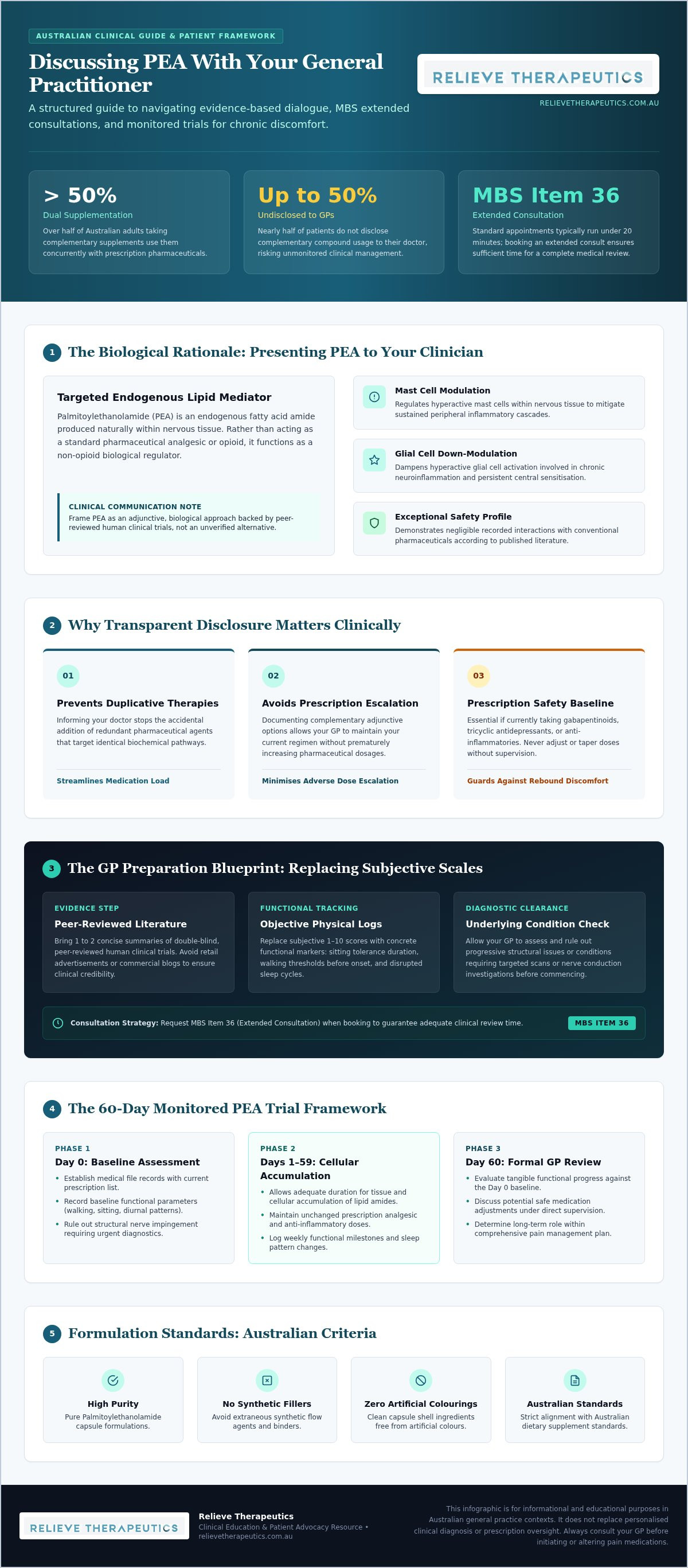
When talking to your doctor about PEA, preparation transforms a hurried consultation into a constructive clinical dialogue. Standard GP visits in Australia typically last under twenty minutes, leaving little time to unpack nuanced symptom histories. Booking an extended appointment (MBS Item 36) ensures you have dedicated space to evaluate complex nerve discomfort, discuss non-opioid strategies, and foster immediate clinical trust through shared decision-making.
Gathering Credible Clinical Research on Palmitoylethanolamide
Physicians respond best to high-grade scientific literature rather than commercial advertisements or retail blogs. Bring one or two concise summaries of double-blind, peer-reviewed human clinical trials. Highlight research detailing how PEA regulates hyperactive mast cells and down-modulates glial activation in chronic neuroinflammation. A one-page scientific overview allows a time-constrained clinician to grasp the biological rationale quickly without feeling overwhelmed.
Documenting Your Pain Patterns and Functional Impact
Subjective 1-to-10 pain scales provide little practical guidance for a clinician. Instead, present a concise functional log that translates your daily reality into objective clinical markers:
- Daily physical thresholds: Record specific limitations, such as sitting tolerance at your desk, walking distance before discomfort begins, or tasks you can no longer complete independently.
- Diurnal fluctuations: Document whether symptoms flare during early morning movement or disrupt restorative sleep cycles overnight.
- Current treatment response: Detail your exact medication schedule alongside existing physical therapies, highlighting where symptom relief remains incomplete.
Formulating Strategic Consultation Questions
Targeted inquiries help steer the conversation toward practical outcomes. Ask your practitioner how an endogenous lipid mediator fits into your broader multidisciplinary recovery plan. Inquire about an evidence-based PEA dosage for pain that considers your current kidney and liver health, and establish tangible benchmarks for reviewing progress over the coming weeks.
If your GP supports an initial trial, sourcing pure formulations from reputable local providers such as Relieve Therapeutics allows you to start with a manageable 60-capsule supply while your doctor monitors your functional response.
Navigating the Consultation: How to Discuss PEA Confidently
Approaching your appointment with clear intent sets a constructive tone. Begin the conversation early by stating your objective: you want to explore adjunctive, non-opioid strategies to support your current management plan. When talking to your doctor about PEA, framing the compound as an endogenous lipid mediator invites a measured, scientific discussion rather than an ideological debate about natural versus conventional therapies.
Medical consultations work best as collaborative partnerships. Listen attentively to your GP's feedback, diagnostic observations, and potential cautions. Their role is to look at the broader clinical horizon, ensuring your exploration of complementary options remains safe, structured, and clinically sound.
Explaining What PEA Is in Accessible Biological Terms
Doctors value precise biological descriptions over vague wellness claims. Explain that Palmitoylethanolamide is an endogenous fatty acid amide synthesised on demand within human tissues in response to cellular stress. Rather than binding directly to classic cannabinoid receptors (CB1 or CB2), it functions primarily as an agonist at nuclear Peroxisome Proliferator-Activated Receptor Alpha (PPAR-α). This mechanism down-regulates hyperactive mast cells and glial activation, calming localized neuroinflammation upstream. Crucially, PEA produces zero psychotropic effects, presents no risk of dependence, and causes no cognitive sedation.
Addressing Common Clinician Questions About Tolerability
Safety and tolerability are naturally your doctor's primary concerns. You can reassure them by presenting clinical trial data that highlights PEA's clean adverse-effect profile and high patient retention rates. Gastrointestinal upset remains exceedingly rare, particularly when selecting pure, unadulterated capsule options without synthetic binders. If your doctor wants to review standard administration protocols, you can share evidence-based guides on how to take PEA for nerve pain, which outline typical split-dosing strategies alongside meals to enhance absorption.
What to Do if Your GP Is Unfamiliar with PEA
Australian general practitioners manage hundreds of complex medical conditions across a typical working week. It is entirely understandable if your GP has not yet encountered Palmitoylethanolamide or its Australian Approved Name, Palmidrol. Handle this scenario with clinical poise:
- Acknowledge their broad scope: Validate that keeping up with every emerging complementary compound is unrealistic given their daily clinical demands.
- Leave scientific materials: Hand over your one-page summary of human clinical trials and mechanistic data for them to review in a quiet moment.
- Schedule a structured follow-up: Book a short review consultation in two to three weeks, giving your doctor adequate time to evaluate the evidence before talking to your doctor about PEA implementation details.
Establishing a Monitored PEA Trial Period
Palmitoylethanolamide does not behave like a fast-acting analgesic. Unlike acute pharmaceuticals that temporarily suppress pain signaling within thirty minutes, PEA relies on gradual cellular accumulation to calm neuroinflammatory pathways over time. Most clinical trials assess outcomes across four to twelve weeks. When talking to your doctor about PEA, proposing a structured 60-day evaluation window establishes an objective framework to determine whether the compound delivers meaningful relief.
To evaluate its efficacy cleanly, keep your physical activities, sleep routines, and existing medications constant throughout the trial. Modifying several therapies simultaneously clouds clinical observation, making it difficult for your GP to isolate what actually drove an improvement or a setback.
Setting Baseline Metrics and Functional Markers
Objective functional data provides the clearest evidence of whether a therapeutic trial is succeeding. Rather than relying on abstract pain scales, log tangible physical milestones in a dedicated notebook once a week:
- Sleep quality: Document reductions in nightly awakenings caused by aching or nerve irritation.
- Morning mobility: Measure how many minutes it takes for stiffness to ease after getting out of bed.
- Physical capacity: Track how long you can comfortably walk, garden, or sit at your desk without interruption.
- Symptom character: Note any decrease in the frequency or severity of sharp, burning sensations.
Structuring Daily Intake and Scheduling Follow-Ups
Consistency is vital when evaluating lipid-based compounds. Because Palmitoylethanolamide is fat-soluble, taking your daily capsule alongside meals containing dietary fats optimizes intestinal absorption. If you experience any unexpected bodily responses during the trial, contact your general practitioner promptly to review your progress.
Once your doctor approves a trial, you can order PEA 60 Capsules to supply your initial evaluation phase. Conclude your trial by attending a scheduled follow-up consultation. Reviewing your weekly functional logs alongside your clinician ensures that decisions regarding long-term maintenance rest on clear, demonstrable physiological improvements.
Choosing High-Purity Palmitoylethanolamide in Australia
Formulation integrity plays a pivotal role in biological performance. When evaluating an endogenous lipid mediator, low-grade products containing unverified fillers or heavy chemical lubricants can hinder uniform digestion and cloud your clinical findings. Sourcing cleanly manufactured options that adhere to rigorous Australian dietary supplement standards guarantees you assess the genuine effects of the molecule rather than adverse reactions to synthetic additives.
Reliable local sourcing also eliminates foreign customs delays and temperature-compromised international transit. Sourcing pure products domestically ensures that when you commit to talking to your doctor about PEA, your evaluation phase proceeds without interrupted routines or compromised batch quality.
Evaluating Pure Capsule Formulations Versus Bulk Powders
Precision is essential for structured therapeutic monitoring. While raw bulk powders might appear economical, they introduce significant dosing errors because measuring exact milligram weights at home is notoriously inconsistent. Encapsulated formats solve this challenge by delivering uniform, measured quantities in every serving. To protect your digestive comfort, avoid compressed tablets that rely on heavy magnesium stearates, talc, artificial colourings, or synthetic flow agents. Reading our comprehensive analysis on high quality PEA capsules clarifies the quality markers to inspect prior to purchase.
Initiating Your Monitored Regimen With Relieve Therapeutics
Starting an adjunctive health protocol should remain practical, measured, and collaborative. Australian retailer Relieve Therapeutics provides focused access to high-purity dietary supplements designed specifically for structured patient use:
- Structured pack sizes: Commencing your protocol with PEA 60 capsules supplies an ideal starting baseline for your initial multi-week evaluation before deciding whether to progress to larger 120 or 180-count formats.
- Local distribution: Direct, 100% Australian-based dispatch ensures dependable delivery without border delays or customs complications.
- Purity compliance: Every batch strictly adheres to national dietary supplement benchmarks, providing unadulterated formulations devoid of extraneous binders.
By bringing an uncompromised product into your health routine, talking to your doctor about PEA becomes a transparent, grounded step toward long-term physical comfort and restorative well-being.
Take the Next Step in Your Collaborative Pain Strategy
Approaching chronic nerve discomfort requires patience, structure, and reliable clinical teamwork. By scheduling an extended appointment, presenting peer-reviewed human research, and tracking functional daily markers, talking to your doctor about PEA shifts from an uncertain hurdle into a constructive clinical strategy. Establishing an agreed 60-day trial period ensures your progress is measured objectively while keeping your general practitioner firmly in the loop.
When you and your GP decide to proceed, formulation purity is paramount. Relieve Therapeutics provides 100% pure Palmitoylethanolamide in convenient capsule form, dispatched rapidly from within Australia for uninterrupted access. With pure PEA available in 60, 120, and 180-count sizes, you can match your supply precisely to your doctor-monitored trial window. Ready to start your collaborative regimen? Explore our pure Australian PEA capsules today and take proactive ownership of your daily comfort.
Frequently Asked Questions
Will my Australian GP be open to discussing Palmitoylethanolamide?
Yes, Australian GPs are increasingly receptive to evidence-based complementary strategies, particularly non-opioid options for persistent discomfort. Doctors operate within a shared decision-making framework and appreciate patients who present peer-reviewed human trials. When talking to your doctor about PEA, framing your inquiry around joint clinical oversight and functional goals encourages a respectful, collaborative discussion focused on keeping your overall care safe and transparent.
Can I take PEA capsules alongside my prescription nerve pain medication?
PEA generally exhibits an exceptional safety profile with negligible documented pharmaceutical interactions across published clinical trials. However, you should never combine it with prescription medications without explicit GP guidance. Your doctor needs to evaluate your full health background, review potential metabolic considerations, and ensure the compound complements therapies like gabapentinoids or anti-inflammatories. Never adjust or cease your prescribed medication doses on your own.
What should I do if my doctor has never heard of PEA?
Don't worry if your clinician isn't immediately familiar with Palmitoylethanolamide or its Australian Approved Name, Palmidrol. General practitioners manage thousands of clinical presentations daily. Acknowledge their broad scope graciously, leave a brief summary of published human trials, and explain its mechanism as an endogenous lipid mediator. Offer to book a follow-up visit in two weeks so they have ample time to review the clinical data thoroughly.
How long does a trial period of PEA take to show measurable results?
Clinical trials typically evaluate Palmitoylethanolamide over an eight to twelve-week period. Because PEA functions via cellular accumulation rather than providing rapid acute suppression, its biological effects develop gradually over time. Agreeing on an initial 60-day monitored trial gives your tissues adequate exposure while allowing you and your GP to assess objective functional changes, such as improved morning movement or uninterrupted nighttime sleep.
Do I need a prescription to buy Palmitoylethanolamide in Australia?
No, you do not need a prescription to purchase PEA in Australia. The Therapeutic Goods Administration (TGA) permits Palmitoylethanolamide, listed under the approved name Palmidrol, as an active ingredient in complementary medicines. It remains unscheduled for human consumer use, meaning you can legally order dietary supplement capsules online or over the counter without a script, though medical guidance is still strongly advised for persistent symptoms.
Are there any known side effects I should mention to my doctor?
Human clinical trials show that Palmitoylethanolamide is exceptionally well tolerated, with adverse events occurring at rates comparable to placebos. Mild, transient digestive discomfort or slight nausea has occasionally been reported, usually linked to synthetic additives in low-quality products. Choosing pure capsule formulations minimises this risk. If you notice any unusual physical sensations during your trial, inform your general practitioner immediately to ensure thorough clinical monitoring.
Why is an extended consultation recommended for this appointment?
Standard Australian consultations last less than twenty minutes, which is rarely enough time to discuss complex, longstanding discomfort alongside routine health checks. Booking an extended appointment (MBS Item 36) gives you dedicated space to review your complete medical profile. When talking to your doctor about PEA, this extra time ensures you can examine published clinical literature, agree on structured functional markers, and establish clear follow-up timelines together.