

Could you be compromising your wellness investment simply by taking your capsules at the wrong time of day? For many Australians seeking natural support for nerve health and comfort, the lack of clear guidance on supplement timing creates unnecessary stress and wasted potential. You likely want a routine that is effective, reliable, and gentle on your system, yet the conflicting advice found online often leaves you second-guessing your daily choices.
We understand that you don't want to risk gastric irritation or, worse, poor absorption that hinders your progress. This guide provides the definitive answer on whether to take your PEA supplement on an empty stomach or with food, grounded in the latest clinical understanding of how this fatty acid amide interacts with your biology. You will discover the scientifically optimal way to maximise bioavailability and achieve the best results for your long-term health journey.
We will examine the lipophilic nature of Palmitoylethanolamide, explain the role of healthy fats in nutrient transport, and provide a clear schedule that fits seamlessly into your daily life. By the end of this article, you will have the confidence to organise a supplement routine that prioritises efficacy, safety, and professional care.
Key Takeaways
- Understand why the lipophilic nature of Palmitoylethanolamide requires a specific dietary strategy to ensure these molecules are properly absorbed and utilised.
- Compare the biological impact of taking your PEA supplement on an empty stomach or with food to identify the timing that provides the highest peak plasma concentration.
- Discover how micronisation technology reduces particle size to enhance surface area, offering a more efficient delivery system for your daily routine.
- Learn how to adjust your protocol to prevent gastric irritation and maintain the long-term consistency essential for supporting your wellness journey.
- Establish a clear tracking method to evaluate your results over an eight-week period, ensuring your approach remains aligned with your personal health goals.
The Science of Solubility: Why Your PEA Supplement Needs a Strategy
Palmitoylethanolamide (PEA) is a fatty acid amide produced naturally within your body. It acts as a biological responder, synthesised on demand to support cellular balance and comfort. While your body makes its own supply, many Australians choose to supplement their levels to support long term wellness. However, the effectiveness of your supplement depends heavily on its physical properties. PEA is a lipophilic molecule, meaning it is fat soluble rather than water soluble. This characteristic presents a unique challenge during digestion. Because the human stomach is primarily a water based environment, standard PEA particles have a natural tendency to clump together. These large clusters are difficult for the digestive system to process, leading to poor absorption if you don't have a clear strategy for administration.
Bile salts play a vital role here. These are the body's natural detergents, released by the gallbladder to break down dietary fats into smaller, manageable droplets. Without the presence of these salts and accompanying lipids, the PEA remains in its clustered state. It often passes through the digestive tract before the body can fully utilise it.
What Happens When You Take PEA on an Empty Stomach?
When you decide whether to take your PEA supplement on an empty stomach or with food, the speed of your digestion plays a major role. Taking your supplement without a meal results in rapid gastric emptying. In this state, the stomach moves its contents into the small intestine very quickly. While this might seem efficient, it often bypasses the complex chemical signals required for optimal nutrient uptake. Without food to stimulate the production of bile and digestive enzymes, the formation of 'micelles', which are tiny transport vehicles for fats, is significantly reduced. Lipophilicity refers to the ability of a compound to dissolve in fats, oils, or lipids, which is a fundamental requirement for the transport of PEA across the intestinal membrane into the bloodstream. Without this fat based transport system, much of the supplement's value may be lost.
The Biological Advantage of Co-ingestion with Food
Consuming your dose during a meal triggers a coordinated digestive response. The presence of food signals the release of enzymes that specifically aid in fat breakdown, creating a hospitable environment for lipophilic nutrients. Dietary lipids act as a natural carrier, essentially escorting the PEA across the intestinal wall. For Australians, this doesn't require a heavy or unhealthy meal. Simply pairing your capsule with a source of healthy fats, such as a slice of avocado, a handful of macadamias, or a drizzle of extra virgin olive oil, provides the necessary biological nudge. This simple adjustment clarifies the debate over taking a PEA supplement on an empty stomach or with food by proving that lipids are the essential key to absorption. It ensures you aren't wasting your investment and helps you achieve the best possible outcomes for your health journey.
Empty Stomach vs. With Food: A Comparative Performance Review
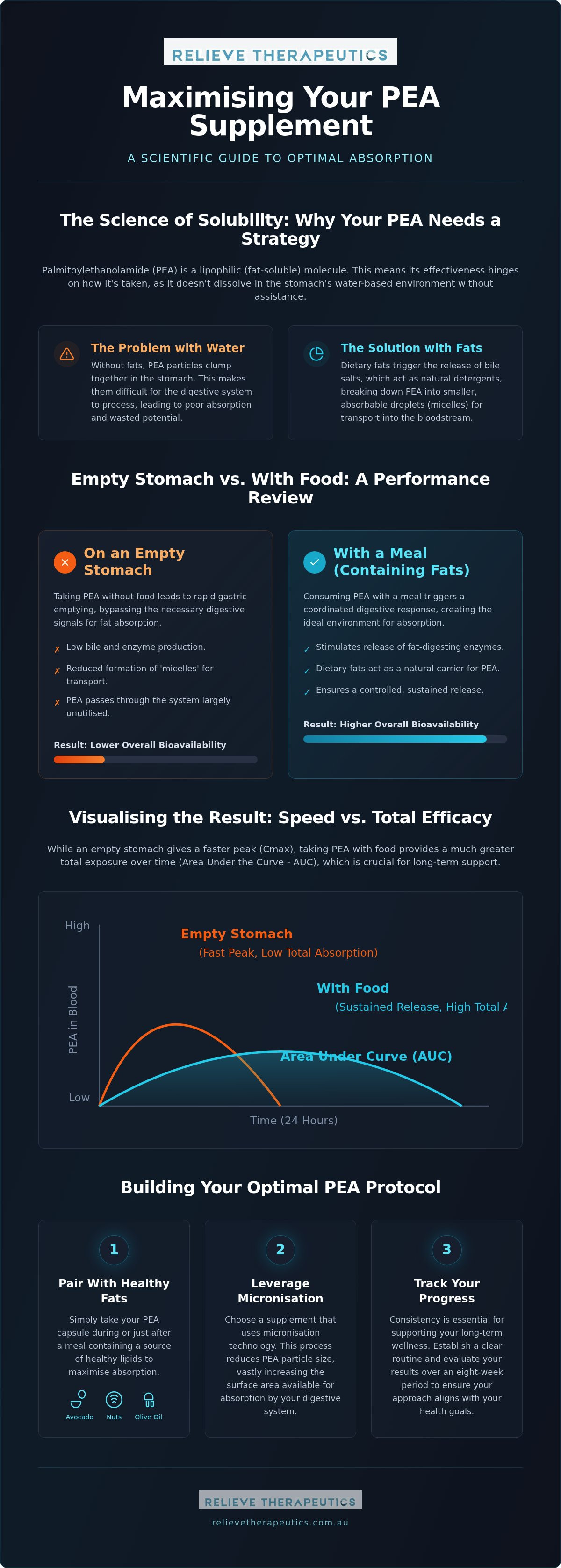
Speed is often confused with efficacy in the world of nutrient absorption. When choosing whether to take your PEA supplement on an empty stomach or with food, it's vital to distinguish between how fast a nutrient enters your system and how much of it actually remains there to be utilised. Clinical data often focus on two specific metrics: Peak Plasma Concentration (Cmax) and the Area Under the Curve (AUC). Cmax represents the highest level of the compound found in your blood after ingestion. AUC measures the total exposure your body has to the nutrient over a 24 hour period. While taking a dose on an empty stomach might result in a faster Cmax, the overall AUC is typically much lower. This indicates that your body absorbs less of the total dose, potentially leading to diminished results for your wellness journey.
Achieving a steady state concentration is the primary objective for most Australians seeking long term support. Rather than a sharp spike that quickly fades, you want a consistent presence of PEA in your system to support your body's natural regulatory processes. Taking your capsules with a meal ensures a more controlled and sustained release. This approach is particularly beneficial for those seeking chronic support, as it helps avoid the fluctuations associated with poor lipid transport. For those managing a busy lifestyle, maintaining a consistent supply of PEA capsules can help you preserve this steady state without interruption.
The Gastric Comfort Factor: Avoiding Upset
Consumer health reports suggest that mild digestive discomfort is a potential occurrence for some users when beginning a new supplement regime. This often occurs because the capsule dissolves in a vacuum, allowing the concentrated contents to interact directly with the sensitive stomach lining. Food acts as a physical and chemical buffer, slowing the dissolution process and protecting the gastric environment. If you experience mild queasiness, use this checklist to troubleshoot your routine:
- Did you consume at least 10 to 15 grams of healthy fats with your dose?
- Was the meal substantial enough to trigger a full digestive response?
- Are you taking your full daily amount in one go rather than splitting the dose?
Timing for Different Lifestyles: Intermittent Fasting and Keto
Many Australians now follow intermittent fasting or ketogenic protocols. If you practice time restricted eating, it's best to align your PEA intake with your eating window rather than taking it during your fast. The ketogenic diet actually offers a biological synergy with PEA, as the high intake of healthy lipids naturally boosts the compound's transport. If you only eat one or two large meals a day, recognise that your body can only process so much at once. Splitting your dose between these meals is often the most effective way to maintain that desired steady state throughout the day and night, ensuring you aren't taking your PEA supplement on an empty stomach or with food that lacks nutritional density.
Optimising Bioavailability: The Role of Micronisation and Diet
Standard PEA particles are naturally large and difficult for the body to break down. Micronisation and ultra-micronisation are advanced mechanical processes that reduce these particles to a microscopic scale, often between two and ten microns. This reduction dramatically increases the surface area available for interaction with your digestive system. While this technology makes the compound more "bio-ready", it doesn't change the fact that PEA is lipophilic. It still requires a lipid environment to move from the gut into the bloodstream. Therefore, even when using micronised palmitoylethanolamide, the decision to take your PEA supplement on an empty stomach or with food remains a vital factor in your success. The technology improves the efficiency of the process, but dietary fats provide the necessary transport vehicle.
Consistency in manufacturing is the foundation of a reliable wellness routine. Selecting high quality PEA capsules ensures that these particle size standards are met in every batch, allowing for predictable absorption. When your supplement is processed correctly, your body can focus on utilisation rather than struggling with digestion.
Top 5 Australian Foods to Pair with Your PEA
Selecting the right dietary companion can transform your results. In Australia, we have access to exceptional produce that serves as a perfect vehicle for lipid-based nutrients. Consider these five options:
- Avocado: A premier source of monounsaturated fats, making it the perfect plant-based lipid for morning doses.
- Full-fat Greek yoghurt: This provides a convenient, creamy base for mid-day administration that is gentle on the stomach.
- Macadamia nuts: A local favourite that offers high-quality fats for on-the-go support.
- Walnuts: These provide a rich profile of essential fatty acids to aid transport.
- Eggs: Specifically the yolks, which naturally contain small amounts of PEA, providing a unique biological bonus.
Does the Type of Fat Matter? Saturated vs. Unsaturated
The molecular structure of the fat you consume influences how transport vesicles, or micelles, form in the small intestine. These vesicles are essential for carrying the PEA across the intestinal barrier. Extra virgin olive oil is an excellent liquid vehicle because its oleic acid content facilitates efficient vesicle formation. It's best to avoid highly processed seed oils, as they don't offer the same level of stability or nutritional value. Whether you prefer saturated or unsaturated sources, the goal is to provide enough healthy lipids to ensure you aren't taking your PEA supplement on an empty stomach or with food that lacks nutritional substance. Quality fats lead to quality absorption.
Troubleshooting Your PEA Routine: Common Questions and Fixes
Adjusting your daily routine requires a methodical approach to ensure your body adapts without discomfort. If you've been taking your PEA supplement on an empty stomach or with food that lacks sufficient lipids, transitioning to a more effective protocol can be achieved in three simple steps. First, identify your most substantial meal of the day; for many Australians, this is dinner, though a breakfast featuring eggs or avocado is equally effective. Second, move your dose to the conclusion of that meal to ensure it mixes thoroughly with dietary fats. Finally, monitor your response over seven days. This gradual shift allows your digestive system to calibrate to the increased nutrient density without causing a sudden change in gastric rhythm.
Forgetting a dose during a meal is a common challenge for those with busy lifestyles. If you realise you've missed your window, don't feel the need to wait until the next day. While taking the capsule with a full meal is the gold standard for absorption, consuming it with a small, fat-rich snack; such as a handful of walnuts or a piece of cheese; is a far better alternative than skipping it entirely. Maintaining a steady presence of the compound in your system is more important for long-term support than achieving one "perfect" dose. To maintain this rhythm, you can order your PEA capsules online to ensure you never run out of your supply.
Managing Side Effects through Timing
Some individuals report a sensation of "repeating" or mild nausea when they first begin supplementation. This often occurs because the capsule dissolves too quickly in an empty stomach, allowing the concentrated contents to irritate the gastric lining. You can significantly reduce this risk by taking your PEA at the very end of your meal rather than the beginning. By placing the capsule on top of the food bolus, you ensure it is processed slowly alongside the meal. If digestive issues persist for more than two weeks despite these adjustments, it's advisable to consult your Australian GP to rule out other sensitivities.
Consistency vs. Perfect Timing: What Matters More?
While we focus heavily on whether you take your PEA supplement on an empty stomach or with food, consistency remains the most critical factor for success. PEA is a fatty acid amide that accumulates in the body's tissues over time, meaning the benefits are cumulative. Missing multiple doses because you "didn't have the right meal" is more detrimental than taking an occasional dose under less-than-ideal conditions. To ensure compliance, keep your PEA 120 capsules or bulk packs in a visible location, such as on the kitchen bench or next to your coffee machine. This simple visual cue helps integrate the supplement into your existing daily habits, making long-term wellness an effortless part of your Australian lifestyle.
Developing Your Personal PEA Protocol for 2026
The "Goldilocks" zone for administration involves finding the precise balance between gastric comfort and peak absorption. While we've discussed why taking a PEA supplement on an empty stomach or with food is a pivotal choice, the ultimate goal is to create a sustainable habit that aligns with your biology. For most Australians, this means a fat-rich meal that provides enough lipids to facilitate transport without being overly heavy. We recommend tracking your progress over a four to eight week period to allow the compound to reach a steady state in your system. For those managing long-term needs, opting for PEA 180 capsules provides the consistency required for this evaluation phase without the stress of frequent reordering.
Your ideal protocol should feel like a natural extension of your day. If you prefer a morning start, a breakfast featuring poached eggs or a slice of sourdough with avocado remains the gold standard for Australian consumers. This combination provides the high-quality lipids necessary to maximise the bioavailability of your capsules from the very first dose.
The Morning Routine: Setting Up for Success
A busy Australian professional or an active retiree often finds that a morning protocol is the easiest to maintain. If your breakfast is typically light, you might consider pairing your capsule with your morning coffee. However, black coffee lacks the lipids required for transport. Adding a splash of full-cream milk or a dash of coconut cream can provide just enough fat to aid absorption. This morning window is an ideal time to integrate how to take PEA for nerve pain into a wider wellness stack, ensuring you start your day with a focused approach to comfort and daily function.
Evening Administration: Supporting Restorative Sleep
Some users find that evening administration aligns better with their body's restorative cycles. Taking your dose with dinner ensures a significant lipid presence, which can lead to higher total absorption during the night. This timing is often preferred by those who experience heightened discomfort during rest, as it supports the body's natural nighttime regulatory processes. Ultimately, whether you take your PEA supplement on an empty stomach or with food in the morning or evening depends on your unique bio-rhythms. Listen to your body, observe how you feel after each dose, and adjust your timing to suit your lifestyle. The most effective protocol is the one you can follow with unwavering consistency.
Empowering Your Daily Wellness Protocol
Optimising your results begins with understanding the biological synergy between Palmitoylethanolamide and dietary lipids. While the choice to take your PEA supplement on an empty stomach or with food is a personal one, the evidence clearly shows that pairing your capsules with healthy fats provides a measurable advantage for total absorption. By prioritising consistency and selecting high-purity nutrients, you can build a stable routine that supports your long-term vitality and comfort.
Relieve Therapeutics provides pure Palmitoylethanolamide with no unnecessary fillers, ensuring you receive a premium product tailored to Australian standards. Our range includes 60, 120, and 180 capsule variations to suit your specific needs, all delivered with flat-rate shipping across Australia. This commitment to quality and transparency ensures you have a reliable partner for your health journey.
Secure your supply of high-purity PEA capsules from Relieve Therapeutics today and refine your daily protocol with confidence. It's time to put these scientific insights into practice to achieve the restorative outcomes you deserve.
Frequently Asked Questions
Can I take PEA with just a coffee in the morning?
Taking PEA with black coffee alone is generally not recommended because it lacks the dietary lipids required for optimal absorption. Since PEA is lipophilic, it needs fats to trigger the release of bile salts and form transport micelles. If you prefer a morning dose with your brew, simply add a splash of full-cream milk, a dash of coconut cream, or a small amount of butter to provide the necessary fat-based vehicle for the compound.
How long after eating should I wait to take my PEA supplement?
You don't need to wait long; the most effective time is during or immediately following a meal. Taking your capsule within 30 minutes of eating ensures that the digestive processes, including enzyme and bile secretion, are still active. This timing allows the PEA to mix thoroughly with dietary fats. This coordinated approach clarifies the common query regarding taking a PEA supplement on an empty stomach or with food by prioritising biological synergy.
Does taking PEA with food slow down how quickly it works for nerve support?
While food may slightly delay the time it takes to reach peak plasma levels, it significantly increases the total amount of the nutrient your body absorbs. For long-term nerve support, the total exposure is far more important than a rapid spike. A slower, more sustained release helps maintain the steady-state concentrations required for chronic wellness. Consistency with meals ensures you aren't wasting your investment on poorly absorbed nutrients that pass through too quickly.
Is it okay to open the PEA capsules and mix them with food?
It is perfectly acceptable to open your capsules and mix the contents with food if you have difficulty swallowing. However, you must ensure the food contains healthy fats to facilitate transport across the intestinal wall. Stirring the powder into full-fat Greek yoghurt, a spoonful of nut butter, or mashed avocado is an excellent strategy. This method maintains the efficacy of the supplement while providing a more convenient administration route for those who prefer it.
What happens if I take PEA on an empty stomach and feel nauseous?
If you experience nausea after taking your dose without a meal, it's a clear signal that your digestive system requires a buffer. Concentrated capsules can irritate the stomach lining when no other contents are present. To resolve this, transition to taking your dose at the very end of a substantial meal. This simple adjustment protects your gastric tissues and slows the dissolution process, allowing for a more comfortable and efficient absorption experience.
Are there any foods I should strictly avoid when taking PEA?
There are no specific foods that you must strictly avoid when taking PEA, but the quality of your dietary fats does matter. Highly processed seed oils can be pro-inflammatory, which may work against your general wellness goals. Instead, focus on high-quality Australian produce like extra virgin olive oil, macadamia nuts, or eggs. These whole-food fat sources provide a cleaner transport vehicle for the lipophilic molecules without introducing unnecessary artificial additives or inflammatory compounds.
Can I take PEA with a protein shake instead of a full meal?
A protein shake can be an effective vehicle, provided it contains a source of healthy fats. Standard whey or plant-based proteins mixed with water are often too lean to trigger full absorption. To make this work, blend your shake with full-cream milk, a tablespoon of flaxseed oil, or a handful of soaked cashews. This modification ensures you are not effectively taking your PEA supplement on an empty stomach or with food that lacks the necessary lipid profile.
Does the temperature of the food affect PEA absorption?
The temperature of your food does not significantly impact the absorption of PEA, provided it is not boiling. Extreme heat could potentially degrade the compound or the capsule shell if mixed directly into very hot liquids. Warm meals or room-temperature snacks are perfectly fine. Focus more on the fat content of the meal rather than its temperature, as the presence of lipids is the primary driver for successful transport into your system.