

Would you believe that over a ten-year period, the TGA’s Database of Adverse Event Notifications received only four reports of adverse events for one of the most researched natural compounds in the country? If you are managing persistent physical discomfort, you likely feel the weight of a difficult choice. You want relief, yet the fear of pharmaceutical side effects like brain fog, weight gain, or potential dependency often feels like a steep price to pay. It is exhausting to cycle through options that either feel too risky or simply do not work for your lifestyle.
Understanding PEA supplement side effects Australia is an essential step in finding a more balanced path toward vitality. This guide reveals the clinical safety profile of Palmitoylethanolamide (PEA) and explains why this bio-identical fatty acid is considered one of the most well-tolerated supplements available to Australians. We will examine the latest 2026 TGA safety standards, detail how to avoid minor digestive adjustments, and provide the clarity you need to start your new health journey with complete peace of mind.
This comprehensive safety guide provides the clinical clarity you need to integrate Palmitoylethanolamide into your wellness routine. You will discover:
- The biological reason PEA is so well-tolerated, focusing on its role as a bio-identical fatty acid that the body naturally produces, recognises, and processes.
- A transparent evaluation of PEA supplement side effects Australia, including practical steps to identify, manage, and prevent minor gastrointestinal adjustments.
- Evidence-based insights into drug interactions and the "synergistic effect" that may allow for more efficient management of physical discomfort.
- Expert strategies for optimising your regimen, such as the "start low, go slow" method and the importance of meal-time synchronisation for better absorption.
- How to ensure your supplement is free from reactive fillers, artificial colours, and unnecessary additives that can mimic adverse reactions.
Understanding the Safety Profile of Palmitoylethanolamide (PEA) in Australia
To understand the safety profile of Palmitoylethanolamide (PEA), one must first recognise that it is not a foreign chemical intervention. It is a fatty acid amide that your body produces endogenously. When your tissues experience stress or physical discomfort, your system synthesises PEA as a natural protective response. This biological origin is the primary reason why PEA supplement side effects Australia remain remarkably low compared to synthetic alternatives. Because PEA is bio-identical, your body already possesses the specific metabolic pathways required to process it. These include:
- FAAH (Fatty Acid Amide Hydrolase): A primary enzyme that regulates PEA levels.
- NAAA (N-acylethanolamine-hydrolysing acid amidase): A specialised enzyme that breaks down PEA within cells to prevent accumulation.
Traditional pharmaceuticals often work by forcing a specific reaction across multiple systems; this frequently leads to unintended consequences. In contrast, PEA belongs to an endocannabinoid-like system. It acts as a biological modulator, restoring balance, supporting recovery, and maintaining homeostasis. In Australia, the Therapeutic Goods Administration (TGA) classifies PEA as a listed medicine. This status reflects its role as a low-risk dietary supplement used to replenish natural levels that may be depleted by chronic physical strain or long-term inflammation.
The Biological Basis for High Tolerance
The high tolerance of PEA is largely due to its unique mechanism of action. Unlike many conventional treatments, PEA interacts primarily with the PPAR-alpha receptor. It does not bind to opioid receptors. This distinction is vital. It means PEA does not cause the sedation, respiratory depression, or addictive potential associated with stronger clinical interventions. Researchers have studied this compound for over 50 years. Throughout this half-century of clinical observation, the safety record has remained remarkably consistent. It provides a stable foundation for those seeking long-term support without the heavy metabolic burden of synthetic drugs.
Who Should Consider PEA Supplements?
The typical Australian seeking this support is often frustrated by the trade-offs of traditional care. They are frequently looking for non-opioid pain relief supplements that offer a gentler profile for daily use. PEA is particularly suited for individuals focused on supporting nerve health and managing systemic inflammation through natural pathways. It serves as a supportive dietary supplement. It is designed to work alongside your body’s existing recovery processes rather than acting as a replacement for specialised clinical therapy. When considering PEA supplement side effects Australia, most users find the risk-to-reward ratio highly favourable for ongoing wellness management.
Reported Side Effects: What the Clinical Research Indicates
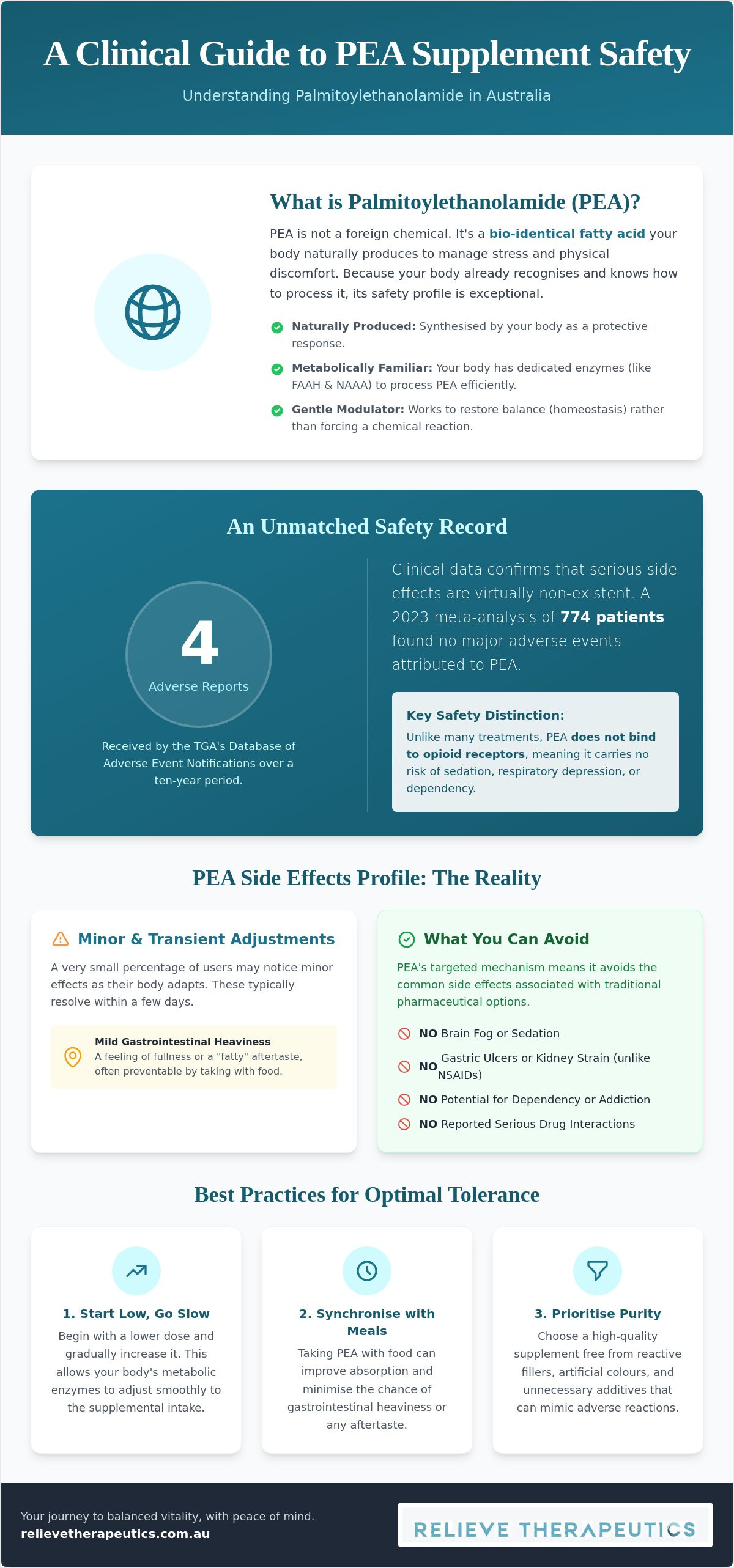
Transparency is the cornerstone of professional care. While many sources claim that Palmitoylethanolamide is entirely free from adverse reactions, a precise look at clinical data reveals a more nuanced and reassuring reality. The consensus across major clinical trials on PEA safety is that serious side effects are virtually non-existent. A 2023 meta-analysis involving 774 patients with chronic pain confirmed this, finding no major adverse events attributed to the compound. However, a small percentage of users may experience minor, transient adjustments as their system integrates this fatty acid.
These minor reactions typically include a mild sense of gastrointestinal heaviness or a "fatty" aftertaste shortly after ingestion. It is important to recognise that these symptoms are usually short-lived. They often disappear within the first few days as the body adjusts its metabolic enzymes to handle the supplemental intake. Unlike traditional non-steroidal anti-inflammatory drugs (NSAIDs), PEA does not cause gastric ulcers or place undue strain on the kidneys. It provides a protective profile that respects your long-term internal health while addressing your physical needs.
Gastrointestinal Tolerance and PEA
Because PEA is a lipid, or a fatty acid, its digestion follows the same pathways as the healthy fats in your diet. In sensitive individuals, taking high doses on an empty stomach might occasionally lead to mild loose stools. This is a mechanical effect of fat digestion rather than a toxic reaction. In major trials, such as the well-regarded Guida et al. study, the percentage of participants reporting any side effects was consistently less than 1%. This statistic highlights the exceptional safety of the compound for the vast majority of the population. If you are concerned about PEA supplement side effects Australia, starting with a smaller dose can help your digestive system adapt comfortably.
Does Micronisation Affect Side Effects?
Particle size plays a significant role in how your body handles the supplement. Standard PEA can sometimes be difficult for the small intestine to absorb efficiently due to its large, water-insoluble crystals. Switching to micronised palmitoylethanolamide can often mitigate the minor GI issues associated with standard powders. Smaller particles are absorbed more rapidly and completely in the upper digestive tract. This efficiency reduces the amount of unabsorbed lipid reaching the lower GI tract, which is where most "fatty" discomfort typically originates. High-quality capsules also help bypass the "soapy" taste sometimes reported with poor-quality bulk powders. If you are looking for a reliable starting point, you can browse our range of PEA capsules designed for maximum purity and tolerance.
Drug Interactions and Contraindications: Can PEA Be Combined?
One of the most frequent concerns for Australians is whether a new supplement will interfere with their existing prescriptions. The current evidence is highly encouraging. To date, there are no documented major drug-drug interactions involving Palmitoylethanolamide. This lack of interference is a significant factor in why PEA supplement side effects Australia are considered minimal. Rather than clashing with other substances, PEA often demonstrates a "synergistic effect." This means it may actually support the efficacy of certain medications, potentially allowing for better outcomes at standard or even lower doses over time.
Despite this excellent safety profile, you should always consult your GP before starting a new regimen. This is especially vital if you are managing complex health conditions or taking multiple scripts. A Systematic Review of PEA Side Effects underscores that the compound is remarkably well-tolerated across diverse populations. However, professional oversight ensures your specific health history is respected and that your supplement routine is perfectly aligned with your clinical care.
PEA and Standard Pain Medications
Many Australians choose to integrate PEA into their routine while continuing with over-the-counter options like paracetamol or ibuprofen. It is generally safe to combine these, as they target different biological pathways. For those on more specific scripts, learning how to take PEA for nerve pain can provide a valuable layer of support without the risk of drug-induced sedation. PEA is entirely non-addictive. It does not cause withdrawal symptoms if you decide to stop use, making it a flexible addition to a long-term wellness plan.
Special Considerations: Pregnancy and Children
In the Australian health landscape, we follow the "precautionary principle" for certain demographics. While PEA is a substance found naturally in human breast milk, the safety of concentrated supplemental doses has not been formally established for infants or during pregnancy. For this reason, we advise pregnant or breastfeeding women to avoid use unless specifically directed by a specialist. Similarly, paediatric use requires a consultation with a healthcare professional to ensure appropriate dosing and safety for younger systems. This cautious approach ensures that PEA supplement side effects Australia are avoided in populations where clinical data is still emerging.
Managing Your Supplement Routine: Best Practices for Tolerance
Establishing a structured routine is the most effective way to ensure your body accepts and utilises Palmitoylethanolamide efficiently. While we have established that PEA supplement side effects Australia are rare, the way you ingest the compound can influence your initial comfort. Because PEA is lipophilic (fat-soluble), it requires the presence of bile and digestive enzymes for optimal absorption. We recommend taking your capsules with a meal that contains healthy fats, such as avocado, olive oil, or eggs. This simple step facilitates smoother lipid digestion and significantly reduces the chance of any mild gastrointestinal heaviness.
For those with particularly sensitive systems, a "start low, go slow" approach is the gold standard for tolerance. Begin with a single daily dose to allow your metabolic pathways to adjust before moving to a full regimen. Consistency is far more important than "loading" high doses early in your journey. It typically takes 4 to 8 weeks for the compound to reach therapeutic levels in your tissues. During this period, maintaining adequate hydration is vital; it supports general metabolic function and helps your system process the supplement with ease. This approach ensures stability, comfort, and long-term efficacy.
Optimising Your Daily Intake
Splitting your intake into two doses, one in the morning and one at night, often provides more stable support than a single large dose. This method keeps levels consistent in the bloodstream and is gentler on the stomach. For specific numbers tailored to your needs, you can refer to our detailed PEA dosage for pain guide. Unlike many other supplements, a "wash-out" period is generally not required for PEA, as it does not accumulate in a way that causes toxicity or dependency. It simply replenishes what your body is already trying to produce.
Monitoring Your Response
We encourage you to keep a simple diary of your symptoms and any minor changes in your digestion during the first month. This record helps you distinguish between a genuine supplement reaction and a standard "flare-up" of an existing condition. If you notice a temporary increase in discomfort, it is often a sign of your body’s inflammatory response rather than the PEA itself. The therapeutic window for PEA is typically between 600mg and 1200mg daily. By staying within this range and following these best practices, you can confidently integrate PEA capsules into your long-term health programme.
Why Purity and Quality Standards Matter for PEA Supplements
It's a common misconception that all adverse reactions stem from the primary active ingredient. In many cases, reported PEA supplement side effects Australia are actually sensitivities to secondary additives rather than the Palmitoylethanolamide itself. Manufacturers often include flow agents like magnesium stearate, synthetic binders, or artificial colours to streamline high-volume production. For individuals with sensitive systems or multiple allergies, these unnecessary fillers can trigger digestive upset, headaches, or skin reactions that are incorrectly attributed to the PEA. Choosing high quality PEA capsules ensures that you are ingesting only what is required for your biological recovery.
Transparency in labelling is a hallmark of professional care. When you buy from a reputable Australian source, you gain the assurance that the product meets strict local standards for purity and label accuracy. Cheap imports often bypass these rigorous checks. They might contain unverified fillers or have been stored in uncontrolled temperatures during long-haul shipping; this can compromise the stability of the lipids. A simple, transparent ingredient list is vital for those who need to manage their health without the guesswork of "hidden" ingredients. This clarity allows you to focus on your progress rather than worrying about reactive additives.
The Relieve Therapeutics Quality Commitment
Our approach is built on a foundation of clinical integrity and straightforward wellness. We focus exclusively on pure PEA capsules, avoiding the "supplement cocktail" approach that often complicates tolerance and makes it difficult to identify what is actually working. Our range is available in 60, 120, and 180-count options to suit different stages of your health journey. Because we ship locally within Australia, your order doesn't spend months in transit or sit in hot warehouses. It arrives fresh and stable, ready to support your vitality without the interference of degraded ingredients or unnecessary chemicals.
Choosing the Right Quantity for Your Journey
If you are new to this compound, we suggest starting with our PEA 60 capsules as a trial pack. This allows you to assess your personal tolerance and witness the initial benefits over the first few weeks without a significant upfront commitment. Once you have established efficacy and comfort, our 120 and 180-count packs offer a more cost-effective way to maintain your long-term routine. Taking control of your comfort shouldn't be a source of stress. View our range of pure PEA capsules and start your journey today.
Empowering Your Path to Sustainable Comfort
Choosing a new path for your physical wellness requires both clinical evidence and personal confidence. We have explored how the bio-identical nature of Palmitoylethanolamide ensures a high level of tolerance; its metabolic pathways are already part of your body's natural toolkit. By focusing on high-purity formulations and following simple timing strategies, you can effectively navigate the minimal landscape of PEA supplement side effects Australia. Most minor adjustments are transient and easily managed with consistent, meal-time habits.
Your journey toward restored vitality deserves a partner committed to transparency, scientific rigor, and local reliability. Relieve Therapeutics is proudly Australian owned and operated, providing clinical-grade purity without the unnecessary fillers that often complicate recovery. Every order is dispatched directly from within Australia to ensure you receive a stable, fresh product as quickly as possible. You don't have to settle for treatments that come with a heavy cost to your daily function.
Browse our pure PEA capsule range at Relieve Therapeutics and discover a gentler, more reliable way to support your long-term health. We are here to help you move forward with clarity and peace of mind.
Frequently Asked Questions
Is palmitoylethanolamide safe for long-term use?
Yes, clinical evidence supports the safety of PEA for long-term support. Because it is a bio-identical fatty acid, the body possesses the necessary enzymes to metabolise it without cumulative toxicity. While Australian regulations require a label statement suggesting a review after 21 days, this is primarily to ensure you remain in contact with your healthcare professional for the ongoing management of chronic conditions. Many users incorporate it into their daily wellness programme for months without adverse effects.
Can PEA cause liver or kidney damage?
No, there is no clinical evidence suggesting that PEA causes strain on the liver or kidneys. Unlike many traditional anti-inflammatory medications that rely on heavy renal or hepatic clearance, PEA is broken down by specific cellular enzymes like FAAH and NAAA. This unique metabolic process makes it a reliable option for those who must avoid traditional pharmaceuticals due to organ sensitivity or pre-existing conditions. It respects your internal physiology while providing the support you need.
What happens if I take too much PEA?
Taking excessive amounts of PEA is unlikely to cause serious harm, though it may lead to mild digestive discomfort. Since PEA is a lipid, very high doses can overwhelm the body’s fat-digestion capacity, resulting in loose stools or a "fatty" aftertaste. If you accidentally exceed the recommended dose, simply return to your standard regimen and ensure you stay hydrated. Most people find that staying within the 600mg to 1200mg daily range provides the best balance of efficacy and tolerance.
Does PEA cause drowsiness or brain fog?
No, PEA does not cause drowsiness, sedation, or brain fog. It functions through the PPAR-alpha pathway rather than the central nervous system receptors targeted by opioids or certain nerve-pain medications. This makes it an excellent choice for Australians who need to remain alert and focused throughout their work day or while driving. It provides a non-drowsy alternative for those who find traditional clinical options too sedating for their lifestyle.
Can I take PEA with blood thinners or heart medication?
There are currently no documented interactions between PEA and blood thinners or heart medications. However, because cardiovascular regimens are often complex and vital, it's essential to consult your GP before starting any new supplement. When discussing PEA supplement side effects Australia with your doctor, they can help monitor your overall response and ensure that your wellness routine complements your primary clinical care without any interference.
Are there any allergic reactions associated with PEA?
Allergic reactions to the PEA molecule itself are exceptionally rare because it is a substance your body already produces naturally. Most reported sensitivities are actually reactions to unlisted fillers, artificial colours, or flow agents found in lower-quality products. Choosing a pure, clinical-grade capsule ensures you are not exposing your system to unnecessary additives that could trigger an adverse immune response. Always check the label for simple, transparent ingredient lists to ensure maximum safety.
Is PEA safe for elderly patients with multiple health conditions?
Yes, PEA is generally considered safe and well-tolerated for elderly patients. Its low risk of drug-drug interactions is particularly beneficial for those managing multiple health conditions and taking various prescriptions. It provides a gentle layer of support for mobility and nerve health without adding to the metabolic burden often caused by synthetic medications. The compound’s natural origin means it is processed efficiently even in older systems that may be more sensitive to traditional drugs.
Should I take PEA with food or on an empty stomach?
You should ideally take PEA with a meal that contains healthy fats, such as avocado or olive oil, to maximise absorption. As a fat-soluble compound, it requires bile and digestive enzymes for efficient uptake into the bloodstream. Taking it with food also minimises the chance of mild gastrointestinal heaviness, ensuring the supplement is as gentle on your system as possible. Consistent timing with your morning or evening meal is the best way to maintain stable levels.