

What if the most effective way to manage your daily comfort didn't involve the heavy fog or stomach irritation often linked to traditional pharmacy options? One in five Australians lives with chronic pain. For many, the fear of kidney strain from long-term NSAID use is just as taxing as the discomfort itself. You deserve a solution that supports your vitality without the trade-off of drowsiness or cognitive haze. This guide offers a transparent look at PEA supplement side effects Australia using verified 2026 clinical data, helping you understand how this endogenous fatty acid functions within your body's own systems.
We'll bridge the gap between laboratory science and your daily routine by examining the TGA’s latest safety standards for Palmidrol. You'll discover why PEA is considered a "slow-build" supplement that prioritises long-term restoration over temporary fixes. By the end of this guide, you'll have the clarity needed to discuss a new regime with your GP and the confidence to choose a path that respects your body's natural chemistry.
Key Takeaways
- Discover the clinical safety profile of Palmitoylethanolamide, an endogenous molecule that supports your body's natural repair processes without the cognitive haze of traditional medications.
- Gain a clear understanding of PEA supplement side effects Australia by reviewing meta-analyses that demonstrate a safety record comparable to a placebo.
- Compare the "Safety Gap" between PEA and standard NSAIDs to see how you can manage long-term comfort without risking gastrointestinal or renal strain.
- Learn how to identify high-purity, TGA-compliant supplements to ensure your experience is defined by restoration rather than reactions to unnecessary fillers.
- Master the practical steps for starting a regime safely, including the importance of a consistent 90-day trial to allow the supplement's cumulative effects to build.
What is Palmitoylethanolamide (PEA) and Why is Safety a Priority?
The human body is a sophisticated biological system designed for self-repair. One of its primary tools in this process is Palmitoylethanolamide (PEA), an endogenous fatty acid amide. Unlike synthetic compounds, PEA is a lipid molecule your cells produce naturally to restore balance. It functions within the endocannabinoid system, acting as a "repair" molecule that helps regulate inflammatory responses and cellular stress. When your body is in a state of health, it manages these levels perfectly. However, persistent discomfort can deplete these natural stores, leaving your system struggling to catch up.
Many Australians are now turning to non-opioid pain relief supplements to manage their daily function. This shift is driven by a desire to avoid the cognitive fog and digestive issues common with traditional pharmacy options. While PEA is biologically familiar, safety remains the highest priority for any new regime. Understanding the profile of PEA supplement side effects Australia is the first step toward responsible self-care. It allows you to move from a place of uncertainty to one of informed confidence.
The Endogenous Advantage: Why Your Body Recognises PEA
Your body doesn't treat PEA as a foreign invader. In fact, you likely consume small amounts of it daily through common foods like egg yolks, peanuts, and soy lecithin. Your system synthesises PEA "on demand" whenever it detects injury or stress. It's a protective mechanism. When inflammation becomes chronic, your internal production often fails to meet the demand. Supplementation simply tops up what your body is already trying to make. Because the molecule is bio-identical to what's produced in your own cells, the risk of rejection or severe adverse reactions is fundamentally lower than with synthetic drugs.
PEA in the Australian Health Context
In Australia, the regulatory landscape ensures a high level of consumer protection. As of June 2026, the Therapeutic Goods Administration (TGA) identifies PEA as a permissible ingredient for listed medicines, often referred to as Palmidrol. You don't need a prescription to access it. It's available as a complementary medicine, which means it's held to strict standards regarding purity and labelling.
There's a significant difference between clinical-grade PEA and the "proprietary blends" often sold on international marketplaces. Australian-compliant supplements must meet rigorous manufacturing codes. This oversight is vital. It ensures that when you're looking into PEA supplement side effects Australia, you're evaluating the pure molecule rather than hidden fillers or low-quality additives that could cause unnecessary reactions. Choosing a transparent, Australian-based specialist ensures you're receiving exactly what's on the label.
Clinical Evidence: What Are the Reported PEA Supplement Side Effects?
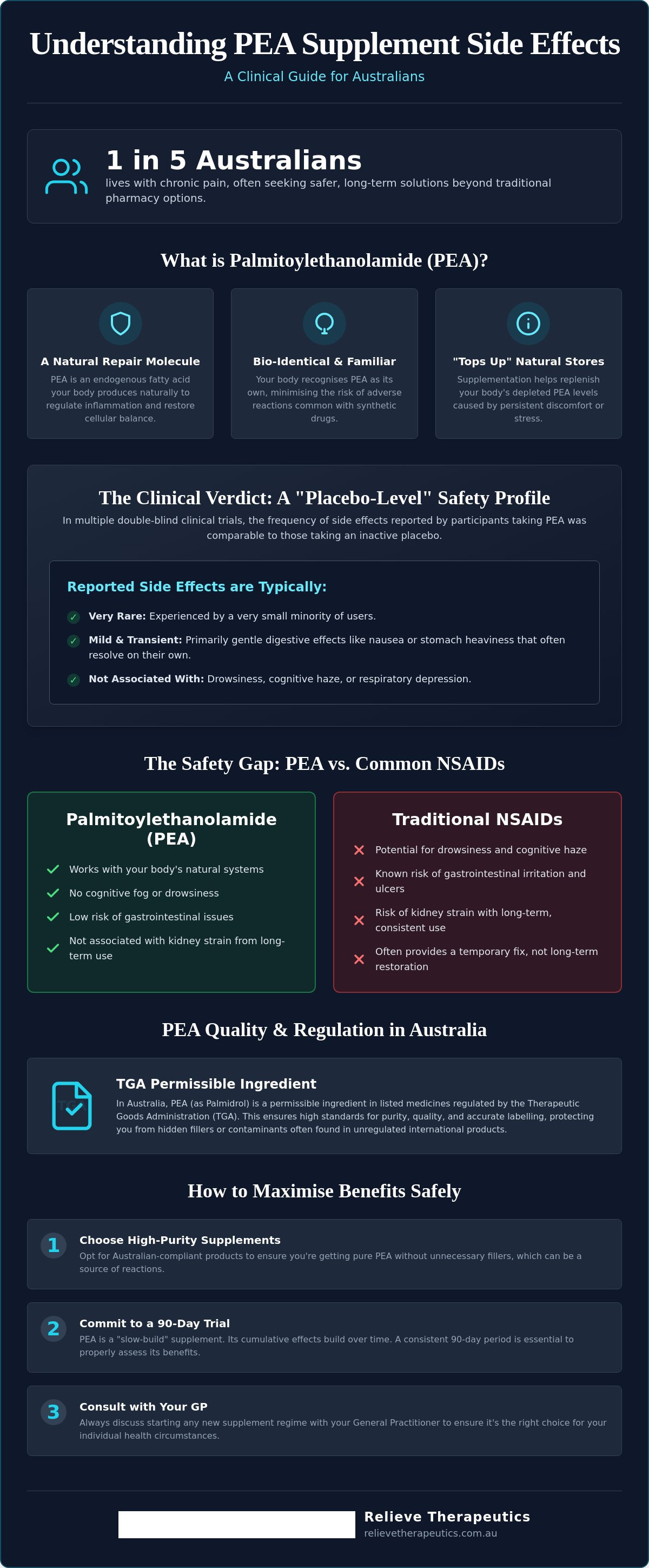
Decades of clinical research have established a robust safety profile for Palmitoylethanolamide. Meta-analyses involving thousands of participants consistently reveal that the frequency of adverse events is remarkably low. When clinicians evaluate PEA supplement side effects Australia, they often highlight a "placebo-level" profile. This means that in many double-blind trials, the group receiving PEA reported no more side effects than those receiving an inactive sugar pill. It's a level of tolerability that's rare in the world of chronic discomfort management.
One of the most significant advantages of PEA is its lack of "drug-likeness" in terms of adverse reactions. Unlike traditional interventions, it doesn't cause sedation, respiratory depression, or cognitive impairment. This high safety margin is inherently linked to how PEA works for pain; it modulates existing biological pathways rather than forcing a heavy-handed chemical change. Ongoing research, such as this Clinical trial on PEA for chronic pain, continues to validate these findings across diverse patient groups, reinforcing its status as a reliable option for long-term use.
Common but Mild: Digestive Considerations
While the vast majority of users experience no adverse reactions, a very small percentage may notice mild digestive shifts. These rare reports typically involve slight nausea or minor stomach upset during the first few days of use. These effects are almost always transient. They tend to resolve quickly as your system adjusts to the lipid intake. In clinical literature, gastric tolerance is defined as the ability of the digestive system to process a substance without significant irritation or functional change. PEA consistently scores exceptionally high in this metric, making it suitable for those with sensitive stomachs.
Long-term Safety: Is it Safe for Years of Use?
Safety shouldn't be a short-term consideration. Clinical data tracking users for 6 to 12 months and beyond shows no evidence of cumulative toxicity. There is no documented strain on the liver or kidneys, which is a primary concern for those moving away from long-term NSAID use. Perhaps most importantly, PEA doesn't lead to pharmacological tolerance or addiction. Your body doesn't "get used to it" in a way that requires ever-increasing doses to maintain efficacy. If you're planning a sustained approach to your wellness, starting with a consistent 3-month supply provides a stable window to observe these cumulative benefits without the fear of long-term dependency.
Side Effect Comparison: PEA vs. Traditional Pain Medications
When evaluating long-term wellness strategies, Australians often encounter a significant "Safety Gap." Standard pharmaceutical interventions are frequently effective for acute episodes, yet their chronic use can introduce a heavy pharmacological burden. This is where the profile of PEA supplement side effects Australia offers a distinct advantage. Unlike many synthetic options, PEA does not disrupt the body's primary physiological systems. A reputable foundation summarizes clinical data on PEA by noting that numerous trials have reported no serious adverse events, contrasting sharply with the known risks of common pharmacy medications.
Choosing the right path requires a clear understanding of these trade-offs. By comparing the biological impact of PEA against traditional options, you can make a choice grounded in both efficacy and safety. This comparison is not about dismissing conventional medicine, but about recognising where a natural lipid may offer a more sustainable profile for your daily function, comfort, and long-term health.
PEA vs. NSAIDs (Ibuprofen, Naproxen)
Non-steroidal anti-inflammatory drugs (NSAIDs) are a staple in many Australian households, yet they carry well-documented risks for the digestive system. Chronic use is linked to gastric lining erosion, stomach ulcers, and potential cardiovascular strain. PEA operates through an entirely different mechanism. It modulates mast cell activation and PPAR-alpha receptors without inhibiting the COX enzymes that protect your stomach.
For individuals with sensitive digestive systems or those concerned about kidney health, PEA provides a welcome alternative. It offers a way to manage discomfort without the risk of gastrointestinal bleeding. It's also worth noting that many users find they can integrate PEA alongside their existing regime if advised by a healthcare professional. Following a structured PEA dosage for pain ensures you are supporting your body's lipid levels without overwhelming your system.
PEA vs. Gabapentinoids and Opioids
The "brain fog" and lethargy associated with nerve pain medications like gabapentin can be just as debilitating as the discomfort itself. These drugs often cause significant sedation, dizziness, and cognitive impairment. In contrast, PEA supports neurological health without crossing the threshold into sedation. It allows you to maintain your mental clarity while addressing the underlying inflammatory triggers.
Furthermore, PEA has a zero-addiction profile. Unlike opioid-based alternatives, it does not engage the brain's reward centres or lead to chemical dependency. There is no risk of withdrawal and no need for escalating doses to bypass tolerance. This safety makes PEA a cornerstone of "multimodal" management in Australian clinics, providing a foundation of stability, safety, and restorative care for those seeking a life less restricted by medication side effects.
How to Minimise Risks and Maximise Benefits
Starting a new wellness programme requires more than just a purchase; it requires a methodical strategy to ensure your body adapts seamlessly. While the profile of PEA supplement side effects Australia is remarkably gentle, your approach to intake can further enhance your experience. A successful regime is built on three pillars: consistency, timing, and purity. By following a structured introduction, you allow your system to integrate this fatty acid without disruption, moving closer to your goals of daily comfort and restored vitality.
For those who identify as highly sensitive, a "titration" approach is often the most supportive path. This involves starting with a single capsule daily for the first week before moving to the standard twice-daily dose. This slow introduction gives your cells ample time to recognise and utilise the increased lipid levels. It's about working with your biology, not against it. Taking this measured approach helps you stay in tune with your body's signals as you begin your journey.
The Importance of Taking PEA with Food
Palmitoylethanolamide is a lipid molecule. Because it's a fatty acid, it's naturally "fat-loving," meaning it requires dietary fats to be transported effectively across the intestinal wall. Taking your capsules during a meal that includes healthy fats like avocado, olive oil, or eggs significantly assists with this transport. This timing also serves a secondary purpose; it provides a protective buffer for your stomach. While rare, those who experience minor nausea often find that switching from an empty stomach to a meal-time dose resolves the issue immediately. Bioavailability refers to the proportion of a supplement that enters the circulation to have an active effect; taking PEA with a healthy fat source is the simplest way to maximise this efficiency.
Drug Interactions: What Should You Disclose to Your Pharmacist?
One of the most reassuring aspects of PEA is its clean interaction profile. To date, there are no known major drug-drug interactions, making it a versatile addition to many existing health plans. Even so, transparency with your Australian GP or pharmacist is essential for responsible health management. If you're currently taking blood thinners or have specific lipid-related allergies, a professional consultation ensures your plan is tailored to your unique biology. This is particularly relevant if you're learning how to take PEA for nerve pain, as your doctor can help you coordinate your supplement with any existing prescriptions.
Most importantly, remember that PEA is a "slow-build" molecule that requires time to accumulate in your tissues. Committing to a consistent 90-day trial with a 180-capsule pack ensures you give your body the necessary window to achieve its cumulative, restorative benefits without the pressure of an immediate, short-term result.
Why Quality Matters for Safety: The Relieve Therapeutics Standard
When Australians investigate PEA supplement side effects Australia, they frequently overlook a critical variable: the presence of hidden excipients. In many budget-friendly options, the active molecule is often overshadowed by binders, artificial colours, and synthetic fillers. These additives are frequently the true culprits behind minor sensitivities or digestive discomfort. By choosing a high-purity PEA endocannabinoid supplement, you eliminate these unnecessary variables. You ensure your body interacts only with the lipid it already recognises, protecting your system from avoidable chemical exposure.
Relieve Therapeutics operates with the quiet confidence of a specialist. By focusing exclusively on pure PEA capsules, we maintain a standard of transparency that prioritises your long-term health over marketing fluff. Our commitment to quality control means every batch meets the rigorous expectations of the Australian health landscape. This focus on substance over style provides you with a reliable foundation for your wellness journey, ensuring that your experience is defined by restoration rather than reaction.
Pure PEA vs. Complex Blends
A single-ingredient supplement offers a significant safety advantage: it allows you to track your body's response with absolute precision. When you use a complex "proprietary blend," identifying the source of a sensitivity becomes nearly impossible. Our range of PEA 60, 120, and 180 capsules allows you to select the volume that matches your specific stage of care. For those beginning their journey, the 60-count pack offers a gentle introduction. However, most Australians find the 180-count variation the most supportive choice for the recommended 90-day cumulative window. This consistency is vital for safety; it prevents the "start-stop" cycle that can disrupt your body's natural lipid regulation.
Supporting Your Journey to Relief
We understand that managing persistent discomfort is as much an emotional challenge as a physical one. Our role is to act as your trustworthy guide, providing the evidence-based education you need to move forward with dignity. We encourage a long-term view of health that rejects the "quick fix" mentality in favour of steady, biological restoration. This patient approach is the hallmark of a safe and effective regime.
Your path to daily comfort should be supported by experts who value purity as much as you do. We invite you to explore our range of PEA capsules and discover the difference that a clinical-grade, Australian-standard supplement can make. Start your journey today with the confidence that you are choosing a partner dedicated to your safety, your vitality, and your long-term success.
Empowering Your Path to Daily Vitality
Choosing a sustainable strategy for your health doesn't have to mean accepting the heavy trade-offs of traditional medications. Your journey toward comfort is supported by the fact that Palmitoylethanolamide is a molecule your body already understands. By focusing on the verified data regarding PEA supplement side effects Australia, you can move forward with the confidence that you're choosing a path of biological harmony. You've learned how purity, timing, and consistency work together to create a restorative environment for your cells.
Success in managing persistent discomfort is rarely about a quick fix; it's about a commitment to quality and patience. Relieve Therapeutics is proud to be an Australian-owned and operated specialist, providing pure Palmitoylethanolamide capsules without unnecessary fillers. Our range is available in 60, 120, and 180-count supplies to ensure you have the right support for your initial trial or long-term regime. View our range of pure PEA capsules for natural support and take control of your wellness today. You deserve a life defined by function and comfort rather than the limitations of side effects.
Frequently Asked Questions
Can PEA cause weight gain or metabolic changes?
PEA does not cause weight gain or adverse metabolic shifts. While it is technically a fatty acid amide, it functions as a signalling molecule rather than a source of dietary calories. It doesn't influence insulin sensitivity or fat storage in a way that would impact your weight. Most users find it has a neutral effect on their metabolic profile, making it a stable choice for those managing their body composition.
Is it safe to drive after taking a PEA supplement?
It is entirely safe to drive or operate machinery after taking PEA. Unlike many traditional nerve pain medications, PEA is non-sedating and does not cause drowsiness or impaired reaction times. It supports your comfort without clouding your cognitive function. You can maintain your daily responsibilities and commute with the confidence that your mental clarity remains intact.
Does PEA interact with common Australian blood pressure medications?
There are no documented major interactions between PEA and standard Australian blood pressure medications. Because PEA functions through biological pathways distinct from those used by ACE inhibitors or beta-blockers, it is generally considered compatible. However, you should always disclose your supplement regime to your GP. This ensures your healthcare provider can monitor your overall wellness holistically.
What should I do if I experience mild nausea after taking my PEA capsule?
If you notice mild nausea, the most effective resolution is to take your capsule with a substantial meal. This simple adjustment often resolves digestive shifts immediately by slowing the lipid's absorption. Choosing a high-purity product also minimises the risk of reacting to synthetic fillers. If discomfort persists, consider a titration approach by reducing your intake for a few days while your system adapts.
Is PEA safe for pregnant or breastfeeding women in Australia?
While PEA is a substance naturally produced by the human body, there is currently insufficient clinical data regarding its use during pregnancy or breastfeeding. As a disciplined, evidence-based provider, we recommend avoiding supplementation during these periods unless specifically advised by your obstetrician. Protecting the health of both mother and child requires a cautious approach to any new substance during these developmental stages.
Can I take PEA if I have a nut allergy?
Yes, you can typically take pure PEA supplements even if you have a peanut allergy. Although PEA is found naturally in peanuts, the supplemental form is a purified molecule and does not contain the proteins responsible for allergic reactions. Choosing a dedicated provider like Relieve Therapeutics ensures you receive a pure product free from cross-contamination. If you have a severe allergy, it's always wise to check the full ingredient list for any secondary excipients.
Will PEA show up on a workplace drug test?
PEA will not appear on a workplace drug test. It is a non-psychoactive lipid that your body already produces naturally. It does not contain any substances screened for in standard Australian drug panels, such as THC or opioids. You can use this supplement to support your vitality without any concern regarding your professional compliance or testing requirements.
How long do I need to take PEA before I know it is safe for me?
Most users will have a clear understanding of their tolerance within the first 3 to 7 days of use. While the restorative benefits build over a 90-day period, any sensitivity regarding PEA supplement side effects Australia usually presents early in the regime. If you feel comfortable during the first week, you can proceed with confidence. Long-term clinical data suggests that if a supplement is well-tolerated initially, it remains safe for sustained use over many months.