

Did you know that approximately 4.0 million Australians are currently living with the persistent burden of back problems? It's a staggering figure that highlights a common frustration; the cycle of temporary relief followed by the inevitable return of discomfort. If you've spent years relying on standard painkillers only to find your sleep disrupted and your mobility restricted, you're not alone. As interest grows in PEA for back pain Australia, many are discovering a sophisticated, evidence-based alternative for those wary of long-term dependency on prescription medications.
This guide explores how Palmitoylethanolamide, or PEA, targets the underlying neuroinflammation that often drives chronic sciatica and spinal distress. We'll examine the clinical science behind this fatty acid amide and how it integrates into the current Australian healthcare environment. You'll discover a pathway toward improved daily function, better rest, and a restored sense of vitality. By shifting the focus from masking symptoms to supporting the body's natural regulatory systems, you can establish a reliable management strategy that prioritises long-term comfort, safety, and physical freedom.
Key Takeaways
- Learn how PEA addresses the biological "wind-up" of chronic discomfort by calming the overactive glial cells and mast cells within the spinal cord.
- Discover why this naturally occurring fatty acid amide serves as a sustainable, non-addictive alternative to traditional NSAIDs and prescription opioids.
- Understand the essential protocols for using PEA for back pain Australia, including the specific loading phase required to achieve optimal tissue saturation.
- Gain a realistic perspective on the therapeutic timeline, noting that maximum restorative benefits often develop over a consistent three-month period.
- Identify the benefits of sourcing high-quality capsules from a specialist Australian retailer to ensure transparency, purity, and supply for long-term management.
Understanding Back Pain and the Role of Palmitoylethanolamide (PEA)
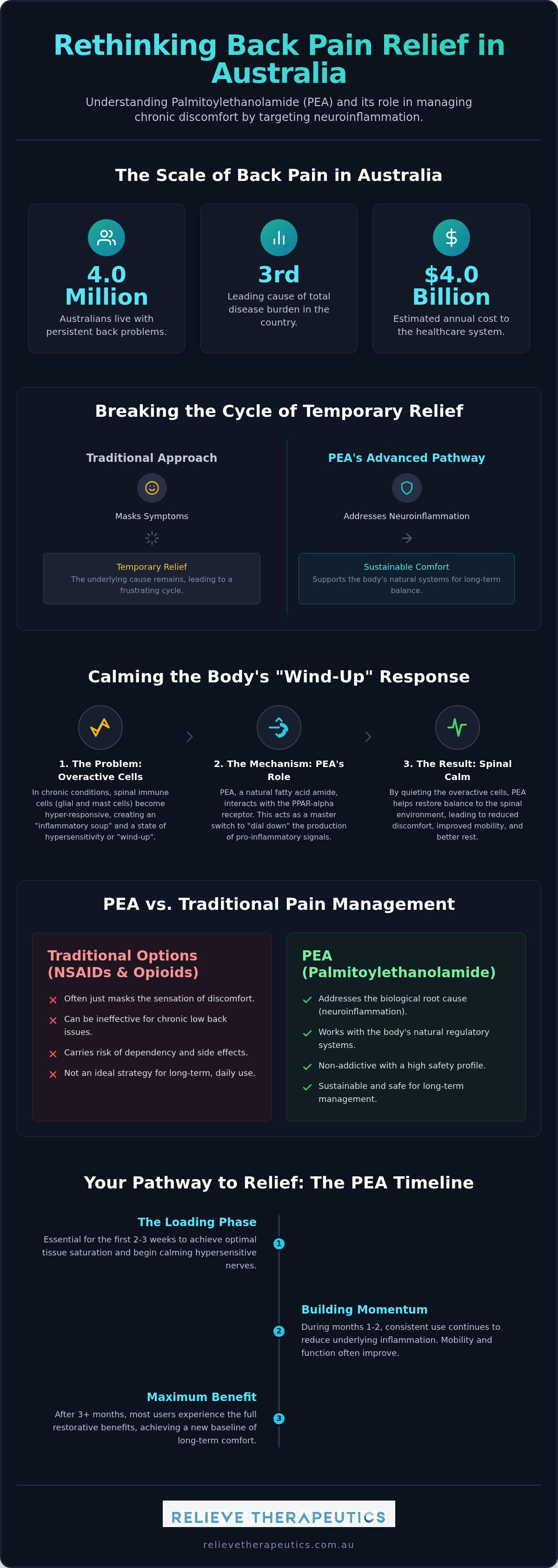
Back problems represent a significant health challenge in Australia, affecting approximately 4.0 million people. This condition is the third leading cause of total disease burden across the country, costing the healthcare system an estimated $4.0 billion annually. For many, the journey involves a repetitive cycle of anti-inflammatory medications and physical therapies that provide only fleeting relief. This often occurs because traditional approaches focus solely on mechanical issues, such as joint alignment or muscle strain, while overlooking the chemical driver of persistent discomfort: neuroinflammation.
When tissue stress or injury occurs, the body naturally produces Palmitoylethanolamide (PEA) to protect cells and restore equilibrium. This molecule is a fatty acid amide that acts as a biomodulator, essentially "dialling down" the volume of overactive pain signals. By addressing the inflammatory environment surrounding spinal nerves, PEA for back pain Australia offers a sophisticated alternative for those who haven't found success with standard pharmacy options. It doesn't just mask the sensation; it helps recalibrate the body's internal response to chronic stress.
The Biological Roots of Back Discomfort
Your body is designed to manufacture PEA on demand to manage inflammation and cellular distress. However, in cases of chronic back pain, the demand often outstrips the body's natural production capacity. This leads to depleted levels of this protective molecule, leaving nerves in a state of constant "wind-up" or hypersensitivity. PEA works in close harmony with the endocannabinoid system (ECS), specifically by enhancing the activity of compounds that regulate mood, sleep, and physical comfort. Restoring these levels is a vital step in breaking the cycle of nocturnal disruption and daily stiffness.
Why PEA is Gaining Popularity in Australia
There is a clear shift within the Australian wellness community toward integrated, non-opioid strategies for long-term health. As evidence suggests that traditional opioids are often ineffective for acute low back pain, many individuals are seeking evidence-based supplements that offer a higher safety profile. Palmitoylethanolamide (PEA) is a fatty acid amide that has been studied for over 50 years. Its status as a TGA-listed ingredient in 2026 ensures that users can access high-quality formulations that meet strict Australian manufacturing standards. This accessibility allows for a self-managed, sustainable approach to improving mobility and regaining a sense of physical freedom.
The Science of Relief: How PEA Targets Back and Sciatic Pain
To understand why chronic back discomfort persists, we must look beyond the bones and muscles to the immune cells within the nervous system. Central to this process are glial cells and mast cells. In a healthy state, these cells maintain spinal health; however, during chronic injury, they become hyper-responsive. This leads to a phenomenon known as "wind-up," where the spinal cord becomes hypersensitive to even minor movements. PEA for back pain Australia offers a targeted way to "shut down" this overactivity. Unlike traditional analgesics that merely block pain signals at the receptor level, PEA addresses the inflammatory cascade at its biological source. It works with the body's natural regulatory systems rather than simply masking symptoms with a temporary chemical veil.
Modulating Glial Cells for Spinal Health
The primary mechanism behind PEA's efficacy is its interaction with the PPAR-alpha receptor. By binding to this nuclear receptor, PEA acts as a master switch that reduces the expression of pro-inflammatory genes. This interaction effectively quietens the glial cells in the spinal cord, stemming the production of the "inflammatory soup" that causes persistent stiffness. For many Australians, this cellular modulation translates into tangible physical benefits. Improved mobility, reduced morning rigidity, and a decrease in the overall intensity of daily discomfort are common outcomes when the spinal environment is no longer in a state of constant alarm. It's a proactive approach to restoring function at a microscopic level.
PEA for Sciatica: Supporting the Sciatic Nerve
Sciatica presents a unique challenge, often involving "burning" or "shooting" sensations that radiate from the lower back through the lower limbs. This occurs when the sciatic nerve is compressed or irritated, leading to damage of the myelin sheath, which is the protective coating around our nerves. PEA provides essential support for nerve regeneration and myelin integrity. By stabilising the mast cells surrounding the nerve root, it prevents the release of chemical triggers that exacerbate nerve irritation. You can explore the how does PEA work for pain guide for a more granular look at these biological pathways. Integrating this supplement into a daily routine provides the building blocks the body requires to repair itself. If you're ready to address the root cause of your discomfort, choosing high-quality PEA capsules is a vital step toward long-term nerve health.
Comparing PEA with Traditional Pain Management Options
When managing persistent spinal issues, many Australians reach for Non-Steroidal Anti-Inflammatory Drugs (NSAIDs) like ibuprofen. While effective for short-term relief, long-term use of these medications is frequently associated with gastrointestinal irritation, kidney stress, and potential cardiovascular risks. In contrast, PEA offers a superior safety profile for chronic management. It acts as a fatty acid amide that the body already recognises, significantly reducing the risk of systemic side effects. This makes PEA for back pain Australia a compelling choice for those requiring a sustainable, multi-month strategy without compromising gut health.
The transition away from prescription opioids is another critical factor in the current Australian healthcare landscape. Unlike traditional narcotics, PEA is non-addictive and does not lead to tolerance buildup. It provides a way to address neuroinflammation without the heavy sedative effects or the risk of dependency. This allows patients to remain alert, engaged, and active in their recovery journey. Consequently, PEA is often utilised as a complementary support alongside physical therapy. By lowering the baseline of inflammatory "noise" in the spine, it enables more effective participation in rehabilitation exercises and manual therapy sessions.
Safety and Side Effects: The Natural Advantage
One of the most reassuring aspects of Palmitoylethanolamide is its high tolerability. It has no known significant drug interactions, which is particularly beneficial for Aussies already managing other health conditions. Unlike many pharmaceutical nerve pain medications, it doesn't cause "brain fog," drowsiness, or cognitive impairment. However, it's always prudent to consult your GP when integrating non-opioid pain relief supplements into your daily regime to ensure a coordinated approach to your wellness. This transparency ensures your management plan remains safe, effective, and tailored to your specific needs.
Bioavailability: Why Micronisation Matters
The effectiveness of a supplement is entirely dependent on how well the body can absorb it. Standard PEA is naturally composed of large particles that are difficult for the digestive system to process, often leading to poor bioavailability. To overcome this, high-quality formulations undergo a process called micronisation. This technical procedure reduces the particle size to a few millionths of a metre, significantly increasing the surface area for absorption. When selecting high quality PEA capsules, Australian consumers should prioritise ultra-micronised options. This ensures the molecule can efficiently reach the overactive glial cells in the spine, providing the robust support needed for complex back and sciatic issues.
Practical Steps for Incorporating PEA into Your Routine
Success with PEA for back pain Australia requires a shift in mindset. Unlike fast-acting synthetic drugs that provide a temporary "numbing" effect, PEA works by gradually modulating cellular responses and restoring biological balance. This process isn't instantaneous. It demands a structured approach to ensure the compound reaches therapeutic levels in your system. To begin, we recommend a methodical tracking of your discomfort levels over a 4 to 8 week period. This data provides a clear picture of your progress as neuroinflammation begins to subside.
The first step is the loading phase. Most clinical protocols suggest an intake of 1200mg per day to saturate the tissues and quieten the overactive glial cells discussed earlier. Because PEA is a lipid-like molecule, taking your capsules with a meal containing healthy fats, such as avocado, eggs, or olive oil, can significantly enhance absorption. This simple adjustment ensures the micronised particles are efficiently transported into your bloodstream, providing the best possible support for your spinal health.
Finding Your Optimal PEA Dosage
Determining the right amount for your specific needs is a personalised process. While the initial loading phase is crucial, many people eventually transition to a lower maintenance dose once their symptoms have stabilised. You can find a detailed breakdown in our PEA dosage for pain guide. Typically, a starting dose of 300mg to 600mg twice daily is effective for most Australians, though individual requirements vary based on the severity of the back discomfort and the duration of the condition.
Managing Expectations and Consistency
Consistency is the "golden rule" for natural endocannabinoid support. It's vital to remember that PEA is not a "rescue medication" for sudden flares. Instead, it's a long-term management tool. Full benefits often take 3 to 6 weeks to manifest, and research indicates it can take up to three months to experience the maximum restorative effect. For a step-by-step routine on how to integrate this into your lifestyle, refer to our guide on how to take PEA for nerve pain. If you're ready to start your journey toward sustainable relief, you can order PEA capsules online from our specialist range today.
Quality Matters: Choosing Australian-Sourced PEA Capsules
Selecting a high-quality supplement is the final, most critical step in your management plan. In the Australian healthcare landscape of 2026, Palmitoylethanolamide is regulated by the TGA as a listed medicine. This ensures that products meet strict safety and quality standards, but not all formulations are equal. When you choose a specialist Australian retailer like Relieve Therapeutics, you're opting for a direct-to-consumer model that prioritises transparency and scientific rigor. Quality is not a luxury; it's a necessity for effective neuroinflammation management. High-purity capsules free from unnecessary fillers or allergens ensure that the micronised particles can do their work without interference. By sourcing your PEA for back pain Australia from a local specialist, you also benefit from reliable shipping and dedicated support tailored to the needs of our community.
Selecting the Right Supply for Your Journey
Every individual's experience with spinal discomfort is unique, and your supply should reflect your specific stage of recovery. We've designed our range to provide flexibility and value as you progress through your management strategy. For those trialling the supplement for the first time, PEA 60 capsules provide an ideal entry point to observe how your body responds over the first few weeks. If you've already established a consistent routine, PEA 120 capsules serve as a strategic mid-range option that balances cost and convenience. For long-term chronic back pain management, our 180-count bottle offers the best value. This larger quantity is particularly beneficial during the initial three-month window when consistent tissue saturation is paramount for achieving maximum restorative results.
The Relieve Therapeutics Commitment
Our focus remains firmly on providing the Australian community with evidence-based support and clear, honest information. We believe in the power of natural pathways to help you reclaim your mobility and improve your quality of life. It's vital to remember that while PEA is a robust tool for managing discomfort, these are dietary supplements designed to support your health journey, not replace professional medical advice. We encourage you to maintain an open dialogue with your healthcare provider as you integrate these capsules into your routine. Reclaiming your physical freedom is a gradual process; however, with the right quality of support, a life defined by comfort and vitality is well within reach. We're proud to be your partner in this journey toward sustainable, long-term relief.
Reclaim Your Physical Freedom with Evidence-Based Support
Managing persistent spinal discomfort requires a shift from masking symptoms to addressing the biological drivers of pain. By targeting overactive glial cells and reducing neuroinflammation, Palmitoylethanolamide offers a sustainable pathway toward improved mobility and better sleep. Choosing high-purity, micronised PEA for back pain Australia ensures your body receives the support it needs with maximum bioavailability. It's about establishing a routine that respects your body's natural regulatory systems while providing the building blocks for long-term comfort.
Relieve Therapeutics is a specialist Australian retailer dedicated to providing direct-to-consumer value without compromising on quality. Our focused product line is designed for those seeking a transparent, science-backed alternative to traditional pharmaceutical options. Whether you're starting with a trial bottle or committing to a bulk supply for long-term management, your journey toward restoration begins with a single, informed choice. Browse our range of high-quality PEA capsules and start your journey to relief today. You don't have to navigate the burden of chronic discomfort alone; a more active, restful future is within your reach.
Frequently Asked Questions
Is PEA effective for lower back pain and sciatica?
Yes, PEA is effective for managing lower back pain and sciatica by targeting the underlying neuroinflammation that standard analgesics often overlook. It works as a biomodulator to stabilise mast cells and quieten overactive glial cells in the spinal cord. This process reduces the "wind-up" effect of chronic nerve signals, which is a common driver of shooting or burning sensations. By addressing these cellular pathways, it helps restore mobility and comfort in the lower limbs.
How long does it take for PEA to start working for back pain?
PEA typically requires a consistent period of use before full benefits manifest, as it isn't designed for immediate, "rescue" relief. Most users begin to notice a reduction in inflammation and discomfort within 3 to 6 weeks of daily use. However, clinical research suggests that it can take up to three months to reach maximum therapeutic efficacy. Patience is essential while the molecule gradually saturates your tissues and recalibrates your body's natural endocannabinoid response.
Can I take PEA alongside my current prescription pain medication?
Yes, you can generally take PEA alongside most prescription medications, as it has no known major drug interactions. Because it is a fatty acid amide naturally produced by the body, it is highly compatible with traditional pharmaceutical regimes. However, we always recommend consulting your GP or specialist before adding new supplements to your plan. This ensures a coordinated approach to your health, particularly if you are managing complex spinal conditions or multiple medications.
Are there any side effects when taking PEA capsules?
PEA is remarkably well-tolerated and lacks the severe side effects often associated with pharmaceutical nerve pain medications. Most users experience no adverse reactions; however, a small number of people report mild gastrointestinal upset. Crucially, it does not cause the "brain fog," drowsiness, or cognitive impairment common with standard prescriptions. This high safety profile makes it an excellent option for Australians seeking a sustainable, long-term strategy for managing persistent back discomfort without lifestyle disruption.
Why should I choose micronised PEA over standard versions?
Choosing micronised PEA is vital because standard versions are composed of large particles that the human digestive system struggles to absorb. Micronisation reduces the particle size to a few millionths of a metre, which significantly increases the surface area for absorption. Using micronised PEA for back pain Australia ensures that the compound actually reaches the bloodstream and spinal nerves. Without this technology, much of the supplement may simply pass through the body without providing relief.
Is PEA legal to buy as a supplement in Australia?
Yes, PEA is entirely legal to purchase as a supplement in Australia and is regulated by the Therapeutic Goods Administration (TGA). As of August 2026, it is included in the Therapeutic Goods (Permissible Ingredients) Determination, which confirms its safety and quality for use in listed medicines. This regulatory oversight provides assurance that the products you purchase from reputable Australian retailers meet strict manufacturing standards for purity, potency, and consumer safety.
What is the recommended daily dosage of PEA for chronic back pain?
The common PEA for back pain Australia protocol begins with a "loading phase" of 1200mg per day, often split into two doses. This higher intake is maintained for the first few weeks to saturate the tissues and address chronic neuroinflammation effectively. Once your symptoms have stabilised, many individuals transition to a maintenance dose of 300mg to 600mg twice daily. Taking your capsules with a fat-containing meal will further assist with the absorption of this lipid-like molecule.
Do I need a prescription to buy PEA capsules in Australia?
No, you do not need a prescription from a doctor to purchase PEA capsules in Australia. While some formulations are marketed for practitioner-only dispensing, PEA is available as a listed medicine that can be bought over-the-counter or through specialist online retailers. This accessibility allows you to self-manage your recovery journey with ease. However, seeking guidance from a healthcare professional is still encouraged to ensure your dosage is perfectly aligned with your specific health needs.