

The most publicised natural remedy in your social circle might actually be the most difficult one to legally access in Australia. While the global conversation often centres on medicinal cannabis, many Australians are surprised to learn that obtaining high-quality CBD oil in 2026 still requires a doctor's consultation and a formal prescription. If you're evaluating the complex landscape of PEA vs CBD for pain, you likely feel frustrated by the lack of clear information regarding what's actually legal, safe, and effective for long-term use.
It's exhausting to manage persistent discomfort while worrying about the side effects of traditional pharmaceuticals or the legal grey areas of imported supplements. You deserve a solution that's grounded in clinical evidence and easy to integrate into your daily routine. This guide provides a definitive comparison of Palmitoylethanolamide (PEA) and Cannabidiol (CBD) to help you make an informed choice for your health. We'll explore the biological mechanisms of these compounds, clarify the current TGA regulations, and explain how PEA functions as a biological mirror to support your body's natural pathways to comfort and vitality.
Key Takeaways
- Distinguish between the plant-derived origins of CBD and the endogenous nature of PEA, which is a fatty acid amide produced naturally within your own body.
- Clarify the 2026 Australian regulatory environment to understand why PEA is an accessible supplement while CBD still requires a formal doctor's prescription.
- Compare the biological mechanisms of PEA vs CBD for pain to determine which compound most effectively supports your body's endocannabinoid system.
- Identify the specific areas, such as nerve-related discomfort or sciatica, where PEA provides a targeted and evidence-based pathway to improved daily function.
- Evaluate the practical advantages of standardised capsules, which offer a reliable and mess-free alternative to the variable dosing of oils or tinctures.
Understanding the Basics: What are PEA and CBD?
Choosing between natural supplements often feels like a search for a needle in a haystack. While Cannabidiol (CBD) has dominated public conversation, another compound has been quietly gaining scientific traction. Both substances aim to modulate how your body perceives inflammation and discomfort, yet they originate from very different sources. Understanding the fundamental chemistry of PEA vs CBD for pain is the first step toward reclaiming your daily function.
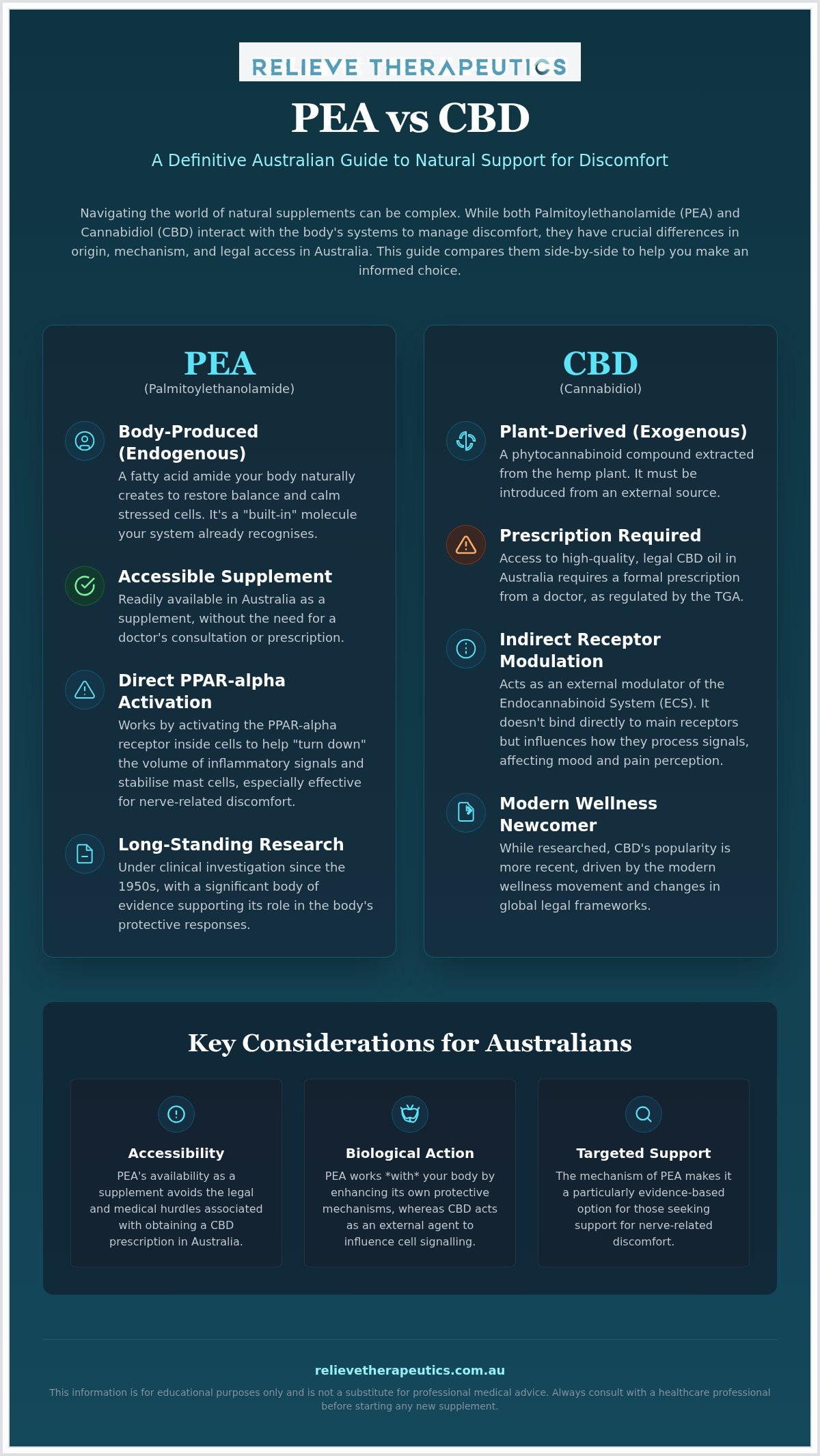
CBD is a phytocannabinoid. This means it's a plant-based compound extracted from hemp. It acts as an external key that interacts with your internal regulatory systems. Conversely, What is Palmitoylethanolamide (PEA)? It is a fatty acid amide that your body already produces. While CBD is the "famous" newcomer, PEA has been the subject of rigorous clinical research since the 1950s. It was first identified for its ability to support the body’s protective responses, long before the modern wellness movement took shape.
The Origins: Plant-Based vs. Body-Born
The primary distinction lies in whether a compound is exogenous or endogenous. CBD is exogenous; it must be introduced from outside the body. PEA is endogenous, meaning your cells synthesise it on demand. When you experience physical stress, injury, or persistent discomfort, your body naturally increases PEA production to restore balance. It's a biological self-defence mechanism. You can also find PEA in everyday foods like egg yolks, peanuts, and soy lecithin. This makes PEA a familiar, "built-in" molecule that your system already knows how to process and utilise effectively.
Why Australians are Turning to Natural Alternatives
Many Australians are moving away from traditional options. The side effects of long-term NSAID use or the heavy fog of opioids can often feel as debilitating as the discomfort itself. There's a growing demand for sustainable, non-drowsy support that doesn't interfere with work or family life. When comparing PEA vs CBD for pain, many find the endogenous nature of PEA reassuring. It represents a shift toward working with the body rather than overriding it. This "Trustworthy Specialist" approach prioritises substance over hype, focusing on high-purity supplements that offer a reliable path to long-term vitality and comfort.
The Science of Relief: How PEA and CBD Interact with Your Body
To truly grasp the debate of PEA vs CBD for pain, we must first look at the Endocannabinoid System (ECS). Think of the ECS as your body's master regulator. It maintains homeostasis by overseeing sleep, mood, and immune responses. While both compounds interact with this system, they do so through entirely different biological doorways. This distinction is crucial for anyone seeking a targeted approach to their physical well-being.
CBD acts as an external modulator. It doesn't bind directly to the primary CB1 and CB2 receptors like THC does; instead, it influences them indirectly. This modulation helps your body maintain a state of balance. When evaluating PEA vs CBD for pain, the mechanism of receptor activation becomes a deciding factor for many users. PEA is an endogenous fatty acid that works through a unique nuclear receptor, offering a biological mirror to your body's own processes.
PEA and the PPAR-alpha Pathway
PEA works primarily by activating the PPAR-alpha receptor. This receptor acts as a metabolic gatekeeper within the cell nucleus. When activated, it helps "turn down" the volume of inflammatory genes. This process is vital for addressing the underlying "fire" of chronic discomfort. Scientists often describe this as the how does PEA work for pain mechanism. It's particularly effective for nerve-related issues because it stabilises mast cells. These are the immune cells responsible for releasing pro-inflammatory chemicals. By calming these cells, PEA provides a steady foundation for recovery.
CBD and Receptor Modulation
CBD takes a different route. It influences how other receptors, such as serotonin and vanilloid receptors, process signals. This explains its reputation for supporting mood and altering pain perception. Crucially, CBD is non-psychoactive. It won't get you "high." It simply alters the way your brain receives signals of discomfort. While effective for some, the requirement for a prescription in Australia can make it a complex path to navigate. Exploring Australian-sourced PEA supplements often provides a more direct and accessible alternative.
There is also a fascinating synergy known as the "entourage effect." PEA inhibits the enzyme FAAH, which is responsible for breaking down anandamide, your body's "bliss molecule." By slowing this breakdown, PEA allows your natural endocannabinoids to circulate longer. This indirect support of the ECS provides a gentle, sustainable way to manage daily challenges without the need for synthetic intervention. It's about empowering your body's existing chemistry to function at its peak.
Key Differences in Legality, Side Effects, and Accessibility in Australia
While the biological mechanisms are fascinating, the practical reality of PEA vs CBD for pain often comes down to how easily you can access these supports. In Australia, the regulatory environment is a significant factor in your decision-making process. You need a solution that is not only effective but also fits seamlessly into your life without legal hurdles or safety concerns. Understanding the current Therapeutic Goods Administration (TGA) framework ensures you choose a path that is both compliant and reliable.
Legality and the TGA Framework
The 2026 landscape for natural support remains complex. Although the TGA created a pathway for low-dose CBD to be sold over-the-counter in pharmacies, the reality is that as of May 2026, no products have met the rigorous safety and efficacy requirements for this category. This means CBD remains a prescription-only medicine. You must consult a doctor, pay for a script, and often wait for specific approval. In contrast, PEA is classified as a supplement and is widely available without a prescription. This makes ordering high quality PEA capsules a frictionless process for many Australians. You can manage your health on your own terms, avoiding the ongoing costs and administrative delays of the medicinal cannabis system.
Roadside drug testing is another critical consideration for Aussie drivers. Many CBD oils, even those labelled as broad-spectrum, can contain trace amounts of THC. This presents a genuine risk of a positive roadside test and subsequent legal consequences. PEA is 100% non-cannabinoid and has no relationship to THC. It offers total peace of mind for those who need to drive for work or family commitments.
Side Effects and Long-Term Safety
Safety is the cornerstone of any long-term health strategy. CBD is generally well-tolerated, but it can cause drowsiness, dry mouth, or changes in appetite. More importantly, CBD is known to interact with certain liver enzymes, which can affect how your body processes other medications like blood thinners or anti-seizure drugs. PEA has a remarkably clean safety profile. Because it is a molecule your body already produces, it's processed with high efficiency and minimal disruption. Clinical trials spanning several decades have documented a lack of significant adverse effects or drug interactions. If you are just beginning your natural support journey, starting with a PEA 60 capsules pack allows you to evaluate your body's response with confidence. It represents a disciplined, evidence-based choice for those prioritising safety alongside relief.
Choosing the Right Path: Which Supplement Suits Your Condition?
Selecting the most effective support requires a nuanced understanding of your body's specific signals. While the debate of PEA vs CBD for pain often treats these compounds as interchangeable, they serve distinct primary roles in your recovery. Your choice should align with the underlying cause of your discomfort, whether it is structural, neurological, or inflammatory in nature. Identifying the right tool for the job is the hallmark of a disciplined health strategy.
When to Favour PEA for Nerve and Inflammatory Pain
PEA demonstrates a specific affinity for mast cells and glia cells. These are the "first responders" within your nervous system. When these cells become overactive, they drive the cycle of chronic nerve pain and neuro-inflammation. This biological focus makes PEA an ideal choice for targeted palmitoylethanolamide sciatica support. By calming these reactive cells, PEA helps break the feedback loop of discomfort. It is also widely used as a staple for chronic pelvic conditions, such as endometriosis, where it acts as a gentle stabiliser for sensitive tissues.
CBD is often preferred when physical discomfort is accompanied by significant psychological components. If your primary challenges involve high levels of anxiety or severe sleep disturbances, the mood-modulating properties of CBD may be beneficial. However, for Australians prioritising physical restoration and nerve health without the administrative burden of a script, PEA remains the specialist's choice for daily function.
Can You Combine PEA and CBD?
Using both compounds can create a powerful "dual-action" approach. They target different biological pathways simultaneously to provide a more comprehensive management strategy. PEA works through the PPAR-alpha receptor to address the inflammatory "fire," while CBD modulates the broader endocannabinoid system. Interestingly, PEA has a "sparing" effect on anandamide, your body's "bliss molecule." By slowing its breakdown, PEA may actually enhance the efficacy of CBD. This synergy allows you to approach recovery from multiple angles. If you choose to use it as a standalone, following a clear PEA dosage for pain guide ensures you achieve the necessary therapeutic levels for long-term comfort.
Always consult your GP before starting any new supplement regime. This is particularly vital if you are already taking prescription medications for other health conditions. A professional consultation ensures your natural support plan is safe, personalised, and tailored to your unique medical history. To start your journey with a high-purity, non-prescription option, you can explore our range of specialist PEA capsules designed for the Australian lifestyle.
Why PEA is the Preferred Natural Support for Many Australians
Australians value simplicity and scientific certainty in their health choices. When weighing up PEA vs CBD for pain, the lack of regulatory red tape often tips the scales in favour of Palmitoylethanolamide. PEA is a listed supplement rather than a prescription-only medicine. It is safe, non-drowsy, and already exists within your cells as a natural fatty acid amide. One technical detail that sets high-quality options apart is micronisation. This process reduces particle size to significantly improve absorption. It ensures your body can utilise the compound effectively to support your internal regulatory pathways.
Choosing a supplement that is endogenous means you are working with your biology rather than introducing a foreign plant extract. This provides a level of reassurance that is often missing from the complex medicinal cannabis conversation. For those seeking a reliable, long-term strategy, PEA offers a clear and evidence-based path to improved daily function and restored vitality.
The Capsule Advantage
Managing chronic discomfort requires absolute consistency. Messy oils or tinctures can be difficult to dose accurately and even harder to transport, often leading to wasted product or skipped doses. Capsules provide a clean, portable, and precise alternative. You can easily organise your intake around your work or travel schedule without any guesswork. We offer specialised counts to suit every stage of your support journey, from initial trials to long-term maintenance. For those moving beyond the first few weeks, choosing PEA 120 capsules provides a strategic, two-month supply for sustained support. This ensures you maintain the steady state required for the best possible outcomes.
Supporting Local: The Relieve Therapeutics Difference
Selecting a supplement partner is a fundamental matter of trust. At Relieve Therapeutics, we don't dilute our expertise with a broad range of unrelated products. We are specialist Australian retailers dedicated exclusively to high-purity PEA. This disciplined focus ensures every bottle meets our rigorous standards for purity and manufacturing excellence. Being Australian-owned and operated means our shipping is fast, reliable, and local. You won't be waiting weeks for international customs clearance or worrying about the quality of overseas manufacturing.
We act as your knowledgeable guide, simplifying complex biological concepts so you can make informed decisions. Our commitment to transparency and quality reflects our role as a partner in your personal health journey. We encourage you to take the first step towards a more comfortable and active lifestyle. By choosing a specialist who values substance over style, you can find the natural support you need with total confidence. Explore our range of 60, 120, and 180-count packs to find the right fit for your daily routine.
Empowering Your Path to Sustainable Comfort
Deciding on the best natural support involves balancing clinical efficacy with practical accessibility. While the debate of PEA vs CBD for pain continues, the biological advantages of Palmitoylethanolamide are clear. It is an endogenous compound that mirrors your body's own protective mechanisms. It offers a direct pathway to comfort without the legal complexities or prescription requirements often associated with medicinal cannabis in Australia.
By choosing high-purity, micronised PEA, you ensure optimal absorption and consistent daily function. You don't have to navigate this journey alone or settle for variable alternatives. As a trusted Australian specialist, Relieve Therapeutics provides the transparency and quality you need to manage your health with absolute confidence. Our commitment to excellence ensures you receive the support you deserve.
Find Your Natural Support: Shop Our Range of PEA Capsules Today. Benefit from discreet and fast local shipping as you take this proactive step toward a more vibrant, active lifestyle. Your well-being is a long-term investment, and we're here to support every stage of your restoration.
Frequently Asked Questions
Is PEA legal in Australia without a prescription?
PEA is entirely legal to purchase in Australia as a listed supplement without a medical script. While low-dose CBD was down-scheduled by the TGA in 2021, no products have yet met the strict safety requirements for over-the-counter sale in 2026. This makes Palmitoylethanolamide a highly accessible choice for those seeking natural support. You can legally order high-purity capsules online and have them delivered directly to your home without a doctor's consultation.
Can I take PEA and CBD together for better results?
You can certainly combine these two compounds to target different biological pathways. Using both creates a dual-action strategy where PEA addresses cellular inflammation while CBD modulates the broader endocannabinoid system. When evaluating PEA vs CBD for pain, some users find that PEA’s ability to slow the breakdown of anandamide actually makes their CBD more effective. We recommend discussing this combined approach with your GP to ensure it aligns with your specific health history.
Will PEA show up on a workplace or roadside drug test?
PEA will not show up on any standard workplace or roadside drug test. It is a naturally occurring fatty acid amide produced by your own cells; it is not a cannabinoid derived from the cannabis plant. Unlike some CBD oils that may contain trace amounts of THC, PEA is 100% THC-free and non-psychoactive. This provides total peace of mind for Australian drivers and professionals who must comply with strict drug-free workplace policies.
How long does it take for PEA to start working compared to CBD?
PEA typically follows a cumulative timeline rather than providing an immediate effect. While some people notice changes within days, most clinical research suggests it takes two to four weeks of consistent dosing to achieve optimal therapeutic levels. This differs from CBD, which often acts more quickly on mood or sleep. Consistency is vital for long-term success. Starting with a 60-count pack allows you to evaluate this gradual but steady restoration of daily function.
Does PEA have any common side effects or drug interactions?
PEA has an exceptional safety profile with very few documented side effects. Because it is an endogenous molecule that your body already knows how to process, it rarely causes the drowsiness or digestive issues sometimes associated with plant extracts. Unlike CBD, which can interact with liver enzymes and affect medications like blood thinners, PEA has no known significant drug interactions. This makes it a reliable and disciplined choice for those managing multiple health conditions simultaneously.
Is PEA better than CBD for nerve pain specifically?
PEA is often preferred for nerve-related issues due to its specific interaction with mast cells and glia cells. These cells play a critical role in neuro-inflammation and the chronic firing of pain signals. While CBD is excellent for mood and general relaxation, PEA’s unique mechanism targets the biological source of nerve discomfort in conditions like sciatica and neuropathy. This focused approach makes it a staple for many Australians seeking targeted natural support for nerve health.
Can I take PEA capsules if I am already taking other pain medications?
You can generally integrate PEA capsules into your routine even if you are using traditional medications. It is well-tolerated and lacks the common drug-interaction risks associated with many other supplements. However, your safety is our priority. We always advise a consultation with your healthcare provider before starting any new regime. This ensures your natural support plan is properly coordinated with your existing prescriptions for the best possible long-term outcomes for your vitality.
Why is PEA sometimes called the "legal alternative" to CBD in Australia?
PEA is considered a legal alternative because it offers similar biological benefits to CBD without the administrative hurdles of a prescription. In the context of PEA vs CBD for pain, PEA is a frictionless option that you can purchase freely as a listed supplement. While CBD remains legally restricted to the medical system in 2026, PEA provides a safe, evidence-based, and non-drowsy pathway to relief that is available to all Australians over-the-counter.