

If you’re asking what not to take with PEA, it’s understandable to want a clear answer before adding a supplement to your routine. For palmitoylethanolamide, often shortened to PEA, there are no definitively documented drug interactions. However, that does not prove every combination is safe. Research is limited, so your medicines, health conditions and other supplements still matter.
This guide explains what current evidence can and cannot establish about combining PEA with medicines and supplements. It also outlines why some situations may warrant extra care, without presenting theoretical concerns as confirmed interactions or advising you to stop prescribed treatment.
To prepare for a medication review, make a complete list of your prescription medicines, over-the-counter products and supplements. Include doses if you know them, along with anything you use only occasionally and any recent changes. A health professional can consider your circumstances and advise whether changes or monitoring are appropriate. Don’t change a prescribed medicine on your own.
Key Takeaways
- There isn’t a definitive, evidence-backed list of what not to take with PEA. Learn how to distinguish established evidence from theoretical concerns.
- Use medicine categories as prompts for a professional review, not as proof that PEA interacts with them.
- Prepare for a useful discussion by listing your medicines, over-the-counter products and supplements, then checking their labels.
- Search results and personal anecdotes can raise questions, but they can’t confirm that PEA caused a particular effect.
- If you’re pregnant, breastfeeding, considering PEA for a child or managing a complex treatment plan, seek individual advice before combining products.
What not to take with PEA: what the evidence can, and cannot, tell you
There isn’t a definitive, evidence-backed list of medicines or supplements that everyone should avoid with PEA. That doesn’t mean every combination is known to be safe. Research into palmitoylethanolamide interactions is limited, so the answer to “what not to take with PEA” depends on your medicines, health conditions and other individual circumstances, rather than a blanket avoid list.
First, check that you mean palmitoylethanolamide, not phenethylamine. Both use the abbreviation PEA, but they are different substances. The Palmitoylethanolamide overview provides background on the compound. It does not show that a particular medicine combination is safe.
Does PEA have known interactions with medicines?
A medicine interaction occurs when one product changes another’s effects or contributes to unwanted effects. Interaction information available as of February 2026 reports no definitively known or documented drug-to-drug interactions for palmitoylethanolamide. This describes what has been documented. It does not prove interactions are impossible or that every combination has been adequately studied.
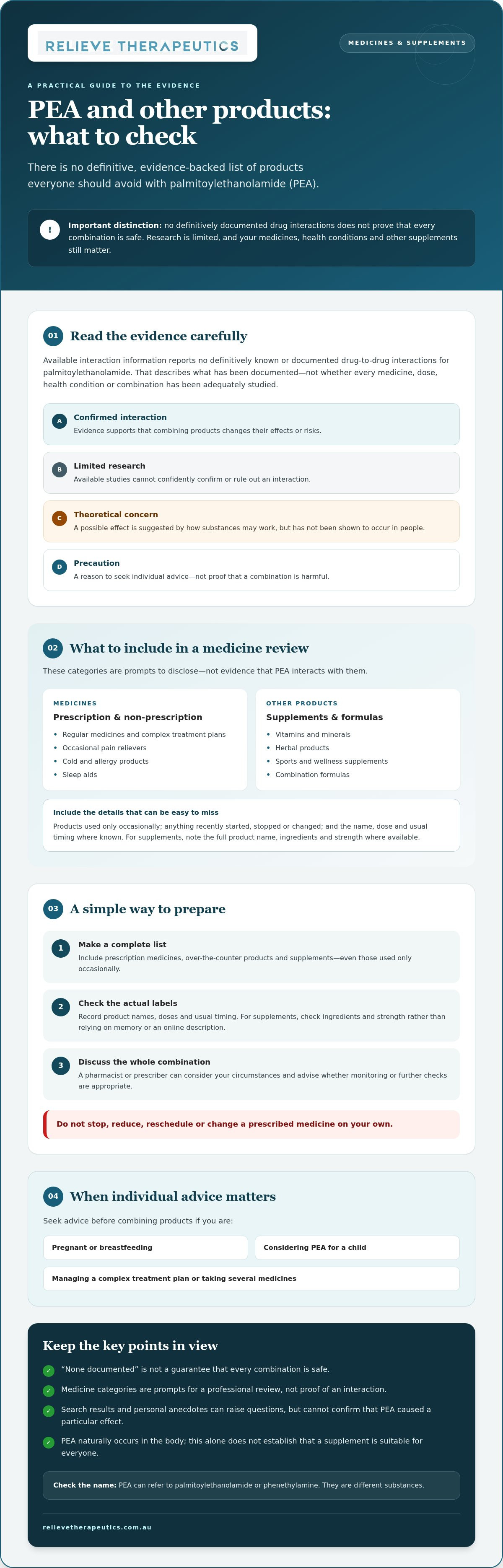
It helps to distinguish four ideas. A confirmed interaction is supported by evidence that combining products changes their effects or risks. Limited research means available studies can’t confidently confirm or rule out an interaction. A theoretical concern suggests a possible effect based on how substances may work, but does not demonstrate that it occurs in people. A precaution is a reason to seek individual advice, not proof that a combination is harmful.
The key limitation is that an absence of documented interactions cannot establish safety for every medicine, dose, health condition or combination. Research into PEA alongside other products is not enough to turn “none reported” into a universal clearance.
Why personal health details still matter
Advice can vary according to your prescribed medicines, non-prescription products, health conditions and other circumstances. A pharmacist or prescriber can review the full combination and decide whether monitoring or further checks are appropriate. Don’t stop or change a prescribed medicine because of a search result or theoretical concern.
PEA is also naturally produced in the body, but that fact alone doesn’t establish that a supplement is suitable for everyone. A supplement’s dose and use are not the same as the body’s natural processes. This guide provides general information, not an individual medication assessment. For advice about your situation, bring your complete product list to a qualified health professional.
Which medicines and supplements should you check before taking PEA?
A useful medicine review starts with a complete list, not just the products you take every day. Tell your pharmacist or prescribing clinician about all prescription medicines, over-the-counter products and supplements you use. Include anything you’ve recently started, stopped or had changed. These details help them assess what not to take with PEA in your circumstances. The categories below are prompts to disclose, not evidence that PEA interacts with them.
Prescription and over-the-counter medicines
Record each product’s name, dose and usual timing. Include medicines you use only occasionally, such as pain relievers, cold and allergy products or sleep aids. These are easy to overlook because they may not appear on a regular prescription list. If you take several medicines or follow a complex regimen, ask for an individual review before adding PEA.
Bring the medicine packaging or a current list if that’s easier. Don’t stop, reduce or reschedule prescribed medicines on your own, even if you’re concerned about a possible interaction. Your prescriber or pharmacist can advise whether any action is appropriate.
Vitamins, herbal products and other supplements
Include vitamins, minerals, herbal products, sports or wellness supplements, and combination formulas. Write down the full product name and, where available, its ingredients and strength. Formulas can vary, so a familiar product name may not tell a health professional everything in the version you use. Check the actual label rather than relying on memory or an online description.
Don’t assume a product is irrelevant because it’s described as natural or because you take it only occasionally. Equally, an ingredient or product category on your list doesn’t automatically mean it’s unsafe to combine with PEA. Sharing the information lets a qualified professional assess the full combination rather than guess.
For a practical appointment checklist, group your information into regular medicines, occasional-use products and supplements. Note recent changes and the questions you want answered. If you’re also checking how to take PEA, see this separate PEA dosage guide. Intake information doesn’t replace a medicine review.
Relieve Therapeutics is an Australian online retailer of PEA capsules, not a source of individual medication assessments. You can review its PEA capsule information, then discuss your product list and personal questions with your pharmacist or prescriber.
How to assess a possible PEA interaction without guessing
A search result can raise a question, but it can’t assess your full medicine list or establish that PEA caused a symptom. Headlines may leave out important details, while personal reports describe one person’s experience without proving cause and effect. A pharmacist or prescribing clinician can help weigh the available evidence against your circumstances.
Use this checklist to prepare:
- Record: list every medicine and supplement, including when you started, stopped or changed each one.
- Check: read the actual labels for active ingredients, strength and directions.
- Ask: take the list and labels to a pharmacist or prescribing clinician for an individual review.
- Follow up: follow their advice and note any new symptoms, when they began and what products you were taking at the time.
Prepare a complete product and medicine list
Include prescription and non-prescription medicines, supplements and anything you use only occasionally. Where known, record each product’s name, active ingredients, dose, frequency and start date. If you notice a new symptom, note when it began and whether you had recently added or changed a product. This timeline can help a health professional assess the situation, but it doesn’t prove that a particular product caused the symptom.
Bring the packaging or clear photos of every label. This is especially useful for combination products, where the full ingredient list may not be obvious from the front of the pack.
Check claims with an Australian health professional
For advice about your medicines, speak with a pharmacist or the clinician who prescribes them. For claims about a product’s Australian regulatory status or listing, check the specific product with the Therapeutic Goods Administration (TGA). A listing check and a personal interaction assessment answer different questions. Neither should be replaced by a search snippet or anecdote.
If you want separate information about taking PEA, read this guide to taking PEA for nerve pain. Keep intake questions separate from interaction advice, and confirm personal concerns with a health professional. For general product information, you can also visit Relieve Therapeutics’ PEA capsule information. An online retailer can’t assess your individual medicine combination.
When should you get advice before combining PEA with another product?
Seek individual advice before adding PEA if you have a complex treatment plan, take several regular medicines or supplements, or have significant health concerns. A pharmacist or prescribing clinician can consider your circumstances alongside your current treatment. They can help answer what not to take with PEA in your situation, rather than relying on a general avoid list.
Get professional guidance before using PEA during pregnancy or breastfeeding, or before giving it to a child. Evidence for these circumstances may be limited, so advice should be tailored to the person. Don’t use PEA or another dietary supplement as a replacement for prescribed treatment, and don’t change prescribed medicines without speaking to the clinician responsible for your care.
Before starting, stopping or changing a combination
Check with a health professional before starting PEA while taking regular medicines or several supplements. This is particularly useful if your treatment has recently changed or involves multiple prescribers. They can review the complete picture rather than one product in isolation. If you’re already using PEA and considering a change, ask a pharmacist or prescriber how to proceed. There’s no universal waiting period that can safely guide everyone.
If you’ve already taken PEA with another product
If you’ve taken the combination and feel well, try not to panic or make abrupt changes to prescribed treatment. Contact a pharmacist or prescriber for advice specific to your medicines and circumstances, including whether to continue using the supplement. Keep the packaging or a photo of the label handy.
If you notice a new or concerning symptom, contact a health professional promptly. Explain what you took, how much, when you took it and when the symptom began. A symptom that appears after taking two products does not, by itself, establish which product caused it. Don’t try to diagnose the cause or rely on a universal waiting period before asking for advice.
Get urgent help for severe, rapidly worsening or alarming symptoms. In Australia, call Triple Zero (000) for an emergency. Routine interaction questions can be discussed with a pharmacist or prescriber, but emergency symptoms need urgent care.
Once you’ve checked with a health professional that PEA is appropriate for your circumstances, you can view PEA capsule information. An online retailer can provide product information, but can’t assess your personal medicine combination or replace clinical advice.
Choose PEA with a clear label and a sensible safety plan
Choosing a supplement involves more than comparing capsule counts. Read the specific product label, share its details with your pharmacist or prescriber, and check any questions about your medicines and health circumstances. That’s a more reliable way to consider what not to take with PEA than relying on a general list or product description alone.
What to look for on a PEA supplement label
Read the packaging for the ingredient list, serving directions and any warnings. Make sure you understand what the label says about the product and its intended use. If anything is unclear, keep the packaging or take a photo so you can ask a pharmacist or prescriber about it.
For Australian regulatory or listing information, verify the exact product rather than assuming its status from the ingredient name, retailer or capsule count. The Therapeutic Goods Administration (TGA) provides information you can use to check product-specific claims. A pack of 60, 120 or 180 capsules describes the supply size only. It doesn’t establish whether a product is suitable for you, its quality or its clinical effectiveness.
A practical plan for discussing PEA with your pharmacist
Take the PEA label and your complete medicine and supplement list to a pharmacist or prescribing clinician. Explain what you’re considering using it for, and ask whether the combination is appropriate given your medicines and health circumstances. If your treatment changes, update them before making your own adjustments. Don’t alter prescribed medicines based on supplement packaging or online information.
- Check the label for ingredients, directions and warnings.
- Disclose all medicines and supplements, including products used occasionally.
- Confirm personal questions with a qualified health professional before acting.
Relieve Therapeutics is an Australian online retailer offering PEA capsules in 60, 120 and 180-count supplies. Its product information can help you review available options, but an online retailer can’t assess personal medicine interactions or replace clinical advice. Address your safety questions with a health professional first, then explore the Australian guide to high-quality PEA capsules for further product-selection information.
Make your next step an informed one
There isn’t a definitive, evidence-backed list of products everyone must avoid with PEA. Limited interaction evidence can’t confirm that every combination is safe, so the practical answer to what not to take with PEA depends on your medicines, supplements and health circumstances.
Before using PEA, check the specific product label and share your complete medicine and supplement list with a pharmacist or prescriber. Include occasional-use products and recent changes, and don’t stop or adjust prescribed treatment without professional advice. A product label or online information can help you prepare questions, but it can’t replace an individual assessment.
Relieve Therapeutics is an Australian online retailer with PEA capsule options in 60, 120 and 180-count supplies. Review its product information alongside advice from your health professional, then explore Relieve Therapeutics’ PEA capsules and product information.
A careful check can help you move forward with greater clarity and confidence.
Frequently Asked Questions
Is it safe to take PEA with prescription medicines?
There isn’t enough interaction research to confirm that every PEA and prescription medicine combination is safe for every person. Current information reports no definitively documented drug-to-drug interactions for palmitoylethanolamide, but that doesn’t rule out possible effects or make an individual review unnecessary. Before combining PEA with prescription medicines, ask your pharmacist or prescriber to consider your full medicine list, health circumstances and the specific product label.
Can I take PEA with other supplements?
Whether PEA is appropriate alongside other supplements depends on the products and your circumstances. There isn’t a definitive, evidence-backed list of combinations to avoid, and limited interaction research can’t establish that every combination is safe. Share the labels for vitamins, herbal products and combination formulas with a pharmacist or prescriber. Include ingredients, strengths and how often you take each product, even if you use it only occasionally.
What medicines should I avoid with PEA?
There’s no definitive, evidence-backed list of medicines everyone should avoid with PEA. The phrase “what not to take with PEA” shouldn’t be treated as proof that particular medicine categories have confirmed interactions. Ask a pharmacist or prescriber to assess your own list, especially if you take several medicines or have recently changed treatment. Don’t stop, reduce or reschedule a prescribed medicine without advice from the clinician responsible for your care.
What should I do if I accidentally took PEA with another medicine?
If you’ve taken PEA with another medicine and feel well, don’t panic or abruptly change your prescribed treatment. Contact a pharmacist or prescriber for advice tailored to the products and amounts involved. Keep the packaging and note when you took each product. If you develop a new or concerning symptom, seek prompt health advice. For severe or emergency symptoms in Australia, call Triple Zero (000).
Should I stop my medication before taking PEA?
No. Don’t stop, reduce or change the timing of a prescribed medicine to make room for PEA unless your prescriber advises you to do so. Stopping treatment without guidance may affect your care. Before starting PEA, show a pharmacist or prescribing clinician the product label and your complete medicine and supplement list. They can consider your treatment plan and advise whether using the combination is appropriate for you.
Can I take PEA while pregnant or breastfeeding?
Ask your doctor, midwife or pharmacist for individual advice before using PEA during pregnancy or breastfeeding. Evidence for these circumstances may be limited, so general information about PEA or other people’s experiences can’t determine whether it’s suitable for you. Share the exact product label and details of any medicines or supplements you use. Don’t start or stop prescribed treatment without discussing it with your health professional.
Can I take PEA before surgery?
Tell your surgeon, anaesthetist and pharmacist that you’re taking or considering PEA, and provide the product label and your full medicine and supplement list. Ask the surgical team whether you should use it before or after your procedure, as advice depends on your circumstances and care plan. Don’t assume a universal stopping period applies, and don’t change prescribed medicines unless your treating team advises you to.