

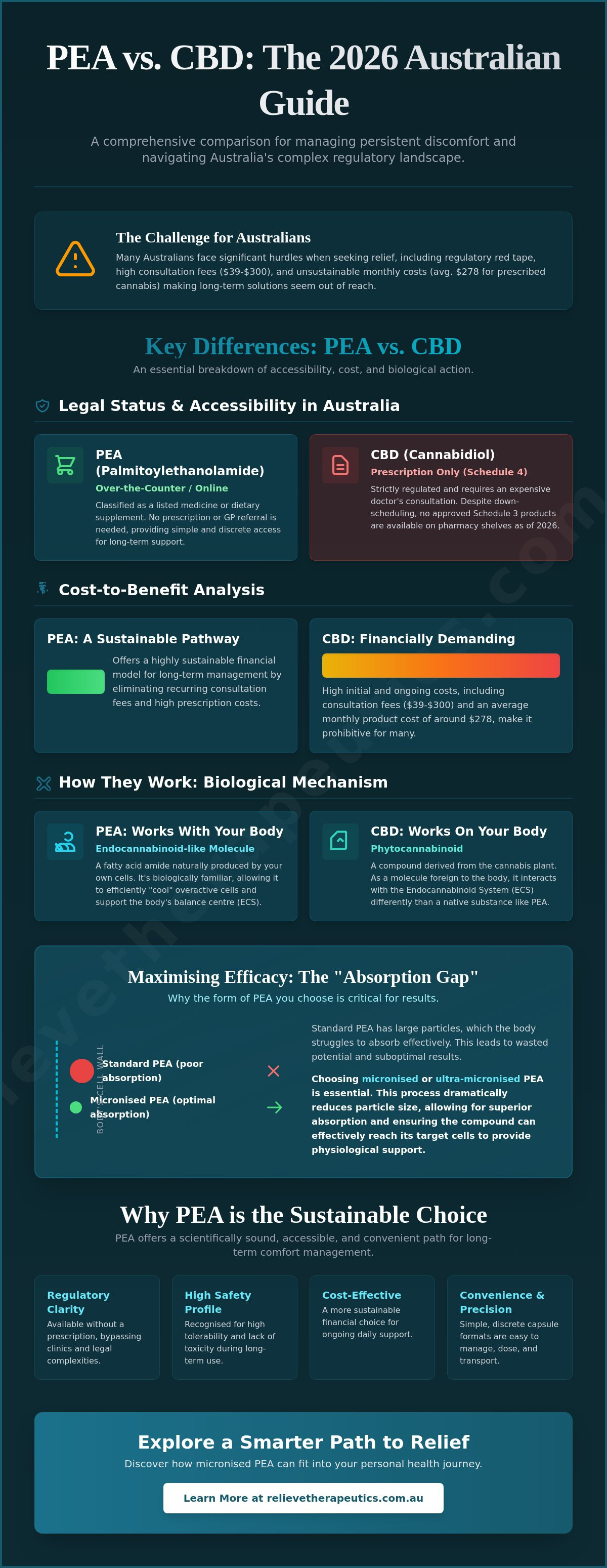
What if the most effective way to manage your persistent discomfort isn't found behind a doctor's prescription pad or a costly medicinal cannabis consultation? Many Australians are now turning to PEA as a CBD alternative Australia-wide, seeking a more accessible path to relief that avoids regulatory red tape and excessive out-of-pocket expenses. You've likely felt the frustration of navigating strict TGA schedules for medicinal cannabis, only to find that high consultation fees and pharmacy hurdles make it a difficult long-term commitment for managing nerve or joint issues.
We understand that living with chronic discomfort takes a significant physical and emotional toll. You deserve a solution that is both scientifically sound and easy to source locally. Palmitoylethanolamide, or PEA, is a fatty acid amide that works within your body's own endocannabinoid system to support comfort, vitality, and daily function. It offers a sophisticated, non-prescription option that provides clinical support without the administrative burden of traditional cannabis products.
This comprehensive 2026 comparison explores the essential differences between these two compounds. We'll examine the current Australian regulations, break down the comparative costs, and explain the biological mechanisms that make PEA a reliable partner in your personal health journey.
Key Takeaways
- Understand the regulatory landscape and why many are now opting for PEA as a CBD alternative Australia wide to bypass prescription hurdles and high consultation fees.
- Discover how PEA functions as a biologically familiar molecule that supports your endocannabinoid system, the body's natural balance centre.
- Learn about the "Absorption Gap" and why choosing micronised or ultra-micronised PEA is essential for achieving optimal physiological results.
- Compare the safety profiles of both compounds to see why PEA is recognised for its high tolerability and lack of toxicity during long-term use.
- Evaluate the cost-to-benefit ratio to determine why this natural fatty acid amide offers a more sustainable pathway for managing persistent nerve and joint discomfort.
Exploring the Shift: Why Australians are Seeking a CBD Alternative
Australians are seeking more autonomy in managing their health. Interest in natural cannabinoids has peaked, yet the legal framework hasn't kept pace with public demand. Finding PEA as a CBD alternative Australia wide has become a priority for those who want results without the bureaucracy. People are tired of the red tape. They want effective relief that fits into their daily lives without constant medical supervision or the stigma sometimes associated with cannabis clinics.
CBD has faced significant hurdles. While the TGA down-scheduled low-dose CBD to Schedule 3 in 2021, by June 2026, there are still no approved products on pharmacy shelves. This leaves patients reliant on Schedule 4 prescriptions. These involve expensive doctor consultations, which can range from $39 to $300, and high monthly costs. For many, the $278 average monthly cost reported for prescribed cannabis in 2022 is simply unsustainable. It's a complex, expensive system that often feels inaccessible to the average person living with persistent discomfort.
Enter Palmitoylethanolamide (PEA). This compound is a naturally occurring fatty acid amide produced within our own cells. Unlike CBD, which is a phytocannabinoid derived from plants, PEA is an endocannabinoid-like molecule. It speaks the body's native language. From a clinical perspective, this biological familiarity is vital. It means the body recognises the molecule and knows exactly how to metabolise it to promote balance and comfort. It's a clean, efficient way to support the system using a substance the body already understands.
The Australian Regulatory Landscape in 2026
The TGA classifies PEA as a listed medicine or dietary supplement. This means it's available for purchase over-the-counter or online without a general practitioner's referral. In contrast, CBD remains strictly regulated as a prescription medicine. By choosing PEA as a CBD alternative Australia's health-conscious public can access a substance that meets rigorous local manufacturing standards while remaining legally available for daily use. It provides a level of regulatory clarity and peace of mind that CBD currently lacks in the local market.
Accessibility and Convenience for Chronic Support
Convenience is a major driver for this shift. Ordering PEA online is a simple, discrete process that avoids the waiting times associated with medicinal cannabis clinics. Many find that non-prescription pain relief Australia options are more sustainable for long-term management. Australians also tend to prefer the precision of discrete capsule formats. These are easier to manage and transport than the messy, inconsistent dosing often found with CBD oils. It's about finding a solution that works with your lifestyle rather than creating new hurdles.
The Science of the Endocannabinoid System: How PEA and CBD Compare
Understanding the biological landscape of the body requires a look at the Endocannabinoid System (ECS). This system acts as a sophisticated balance centre. It maintains homeostasis across various physiological processes, including how we perceive discomfort and manage recovery. While many Australians are familiar with CBD, it's essential to distinguish between phytocannabinoids and endocannabinoid-like molecules. CBD is a foreign compound introduced from plants. In contrast, PEA is a substance your own cells synthesise daily. This native origin is a primary reason why PEA as a CBD alternative Australia is gaining such clinical traction; it works with the body rather than on it.
One of the most compelling aspects of PEA is its ability to "cool" overactive mast cells and glial cells. When these cells become chronically activated, they release pro-inflammatory chemicals that contribute to persistent sensitivity. PEA acts as a biological brake. PEA's mechanism of action involves binding to the PPAR-alpha receptor, which regulates the genetic pathways involved in the inflammatory response. This targeted approach helps quieten the cellular "noise" of a sensitised nervous system, allowing for a more stable state of comfort.
Direct Comparison: Mechanisms of Action
CBD is known for its indirect interaction with CB1 and CB2 receptors. This can influence mood and general wellbeing. However, PEA’s focus on the PPAR-alpha receptor provides a more specialised pathway for addressing tissue sensitivity. Learning how does PEA work for pain highlights its role in protecting neurons and reducing the fire of inflammation. It is produced by your body on-demand. When you experience physical stress or injury, your cells ramp up production to protect themselves. Supplementation simply supports this existing natural defence when your internal resources are depleted.
PEA as an Endocannabinoid Support Tool
The "Entourage Effect" is often discussed in cannabis circles, but it is a concept that applies equally to PEA. PEA enhances the effectiveness of anandamide, often called the bliss molecule. It does this by inhibiting the enzyme that breaks anandamide down. This means your body’s natural comfort signals last longer and work harder. The PEA endocannabinoid supplement connection is about providing your system with the raw materials it needs to maintain this state of balance. If you are looking to bolster your body's innate resilience, you can browse our selection of Australian-tested PEA capsules to find the right fit for your routine.
Safety, Legality, and Side Effects: The Practical Differences
Safety and legality are the cornerstones of any long-term wellness strategy. While the therapeutic benefits of various compounds are often debated, the practical impact on your daily life is what truly matters. When evaluating PEA as a CBD alternative Australia, the standout feature is its exceptional safety profile. Clinical data suggests that PEA is remarkably well-tolerated, even during extended periods of use. Unlike some botanical extracts that may cause lethargy, dry mouth, or digestive upset, PEA is a substance your body already recognises. It is non-toxic, non-addictive, and does not carry the risk of liver enzyme interactions often associated with high-dose CBD.
Navigating workplace drug testing is a common source of anxiety for many Australians. Even some CBD products marketed as isolate can occasionally present risks due to manufacturing inconsistencies or trace cannabinoids. PEA eliminates this concern entirely. Because it is not derived from the cannabis plant, it contains zero THC and will not trigger a positive result on a roadside or workplace drug screen. This makes it a secure choice for professionals in high-stakes industries, including mining, construction, and transport. It provides a level of professional security that prescription alternatives simply cannot match.
Driving and Workplace Safety in Australia
For those holding heavy vehicle licences or operating machinery, legal certainty is non-negotiable. PEA offers total peace of mind in this regard. It is a pure, isolated molecule that does not impair cognitive function, alertness, or motor skills. Unlike hemp-derived oils that may exist in a legal grey area regarding roadside testing, PEA is a straightforward dietary supplement. It allows you to maintain your professional life and legal standing while effectively managing chronic discomfort.
Long-term Tolerance and Efficacy
A significant advantage of PEA is the lack of pharmacological tolerance. You don't need to constantly increase your intake to achieve the same results. In fact, many users find that the benefits accrue over time. We often recommend a loading dose during the first few weeks to saturate the tissues and provide sustained support. For a detailed breakdown of how to structure your intake, our PEA dosage for pain guide provides specific, evidence-based recommendations for the Australian consumer. This methodical approach ensures you receive the maximum benefit from your supplementation routine.
Maximising Efficacy: Micronisation and Absorption Strategies
The biological efficacy of any supplement is determined by how much of the active compound actually reaches your cells. While we have established the regulatory and safety benefits of PEA as a CBD alternative Australia, the physical structure of the molecule presents a unique challenge. In its raw, standard state, PEA is a lipid-like substance with large particles that do not dissolve easily in water. This creates what clinical researchers call the "Absorption Gap." If the particles are too large, they simply pass through the digestive system without being utilised. This is a common frustration for those who have tried low-quality versions and seen little result.
CBD is typically delivered in an oil-based format to overcome its own solubility issues. While effective, oils can be difficult to dose precisely and often have a lower shelf stability. PEA requires a different technological approach. By reducing the size of the PEA particles, we can exponentially increase the surface area available for uptake. This process ensures that the molecule can effectively cross the blood-nerve barrier to reach the overactive cells that require support. It turns a difficult-to-absorb lipid into a highly bioavailable tool for daily wellness.
Why Particle Size is the Key to Relief
Success with this compound depends entirely on the manufacturing process. When searching for high quality PEA capsules, you must look for terms like micronisation or ultra-micronisation. Ultra-micronisation is the reduction of particles to below 10 micrometres for enhanced solubility. This microscopic size allows the body to bypass the usual digestive hurdles. It ensures the compound is absorbed quickly and efficiently, providing the cellular support discussed in previous sections without the waste associated with standard powders.
Choosing the Right Format for Your Lifestyle
Capsules offer a distinct advantage over powders or oils. They provide a fixed, pre-measured dose that ensures consistency in your routine. This is particularly important for managing specific issues where steady levels are required. For example, palmitoylethanolamide sciatica support relies heavily on maintaining high bioavailability to reach deep-seated nerve pathways. Using fixed-count bottles also allows you to track your progress accurately over a 30 or 60-day period. To start your journey with a professionally formulated product, you can shop our range of micronised PEA capsules designed for optimal absorption.
Choosing Your Path: Why PEA is the Sustainable Choice
Selecting a long-term strategy for managing discomfort requires a balance of efficacy, cost, and peace of mind. When we evaluate the cost-to-benefit ratio, the advantages of PEA as a CBD alternative Australia wide are clear. CBD necessitates a recurring cycle of medical consultations and high pharmacy markups. PEA offers a streamlined, over-the-counter path that respects both your time and your budget. It removes the financial stress often associated with medicinal cannabis, allowing you to focus entirely on your recovery and daily function.
There is also a profound psychological benefit to using a molecule your body already produces. You aren't introducing a foreign botanical extract; you are simply replenishing a native compound that your cells use to protect themselves. This biological alignment fosters a sense of safety and professional care. Transitioning from CBD to PEA is a straightforward process. Many Australians choose to start a loading dose of PEA while finishing their current CBD supply, allowing the fatty acid amide levels to build up in their system over several weeks. This methodical overlap ensures a smooth shift toward a more sustainable, self-managed routine.
Finding Your Optimal Supply
Consistency is the foundation of natural support. For those beginning their journey, we suggest evaluating the PEA 120 capsules. This quantity provides a perfect two-month trial period, which is the ideal timeframe to monitor your body's response and observe the cumulative benefits. For individuals managing long-term, persistent issues, our bulk 180-count packs offer the most efficient way to maintain your routine without interruption. We recommend keeping a simple daily log during the first 30 days to track improvements in your comfort levels and overall vitality.
The Relieve Therapeutics Commitment
Relieve Therapeutics is dedicated to providing Australians with a reliable, high-purity source of Palmitoylethanolamide. We understand that when you are in discomfort, you don't want to wait for international customs clearances or deal with the uncertainty of overseas manufacturing. Our stock is held locally, ensuring fast, reliable shipping across the country. We see ourselves as your partner in this journey toward natural comfort. By choosing our professionally formulated capsules, you're opting for a transparent, evidence-based solution that prioritises your long-term outcomes. You can explore our full range of PEA capsules today and take the first step toward a more sustainable path to wellness.
Empowering Your Path to Natural Vitality
The journey toward sustained comfort is often a personal one that requires both patience and the right biological tools. By adopting PEA as a CBD alternative Australia wide, you're choosing a path defined by regulatory clarity, scientific rigour, and biological familiarity. We've explored how this native molecule supports the endocannabinoid system by "cooling" overactive cellular responses, all while avoiding the administrative burdens or workplace drug testing anxieties associated with restricted alternatives. The use of ultra-micronised particles also ensures that you're receiving the highest possible bioavailability for effective nerve and joint support.
Our focus remains on your long-term outcome. Relieve Therapeutics provides pure Palmitoylethanolamide (PEA) capsules that are dispatched daily from Australia, ensuring you have a reliable ally in your wellness routine. We understand the physical and emotional toll of persistent discomfort, and we're committed to offering a transparent, high-quality solution that you can trust. You don't have to navigate these complexities alone.
Browse our range of high-purity PEA capsules and start your journey to relief today.
Take the next step toward a more comfortable and vibrant future with the quiet confidence of a specialist-backed approach.
Frequently Asked Questions
Is PEA legal to buy in Australia without a prescription?
Yes, PEA is legal to purchase over-the-counter in Australia. The Therapeutic Goods Administration (TGA) allows it to be sold as a listed medicine or dietary supplement. This makes PEA as a CBD alternative Australia-wide a highly accessible option. You don't need a GP appointment or a special access scheme approval to start using it for joint or nerve support.
Can I take PEA and CBD together for better results?
Yes, PEA and CBD can be used concurrently because they target different pathways within the endocannabinoid system. PEA focuses on the PPAR-alpha receptor and glial cell activation, while CBD interacts indirectly with CB1 and CB2 receptors. This combination can create a synergistic effect. However, many find PEA alone provides sufficient relief without the added expense of medicinal cannabis.
How long does it take for PEA to start working compared to CBD?
PEA generally requires a cumulative period of two to four weeks to reach optimal physiological levels in the tissues. While CBD might offer more immediate effects on mood or sleep, PEA works by modulating cellular responses over time. Consistency is vital for success. Most clinical studies observe the most significant improvements after 30 to 60 days of daily intake.
Will PEA show up on an Australian roadside drug test?
No, PEA will not show up on an Australian roadside drug test or workplace screen. It is a fatty acid amide that your body naturally produces; it is not a cannabinoid derived from the cannabis plant. It contains no THC or other restricted substances. This provides total security for those in the transport, mining, or construction industries who must maintain a zero-tolerance status.
Is PEA safer for long-term use than traditional anti-inflammatories?
Yes, PEA is recognised for its high tolerability and lacks the common side effects associated with traditional anti-inflammatories. Long-term use of NSAIDs can lead to gastric ulcers, kidney issues, or cardiovascular stress. PEA has no known serious side effects or drug-drug interactions. It acts as a safer partner for managing chronic sensitivity over many months or years without damaging the digestive system.
What is the best dosage of PEA for nerve-related discomfort?
A standard therapeutic dosage often starts at 1,200mg per day, typically split into two 600mg doses. This loading phase is usually maintained for the first three to four weeks before some users transition to a maintenance dose of 600mg daily. When using PEA as a CBD alternative Australia, ensure your capsules are micronised to guarantee these doses are effectively absorbed by the nervous system.
Does PEA have any psychoactive effects like THC?
No, PEA has absolutely no psychoactive effects and will not make you feel "high" or impaired. It does not bind to the CB1 receptors in the brain responsible for the intoxicating effects of THC. You can safely go about your daily routine, drive, and work with full cognitive clarity while the compound supports your internal balance and comfort levels.
Can I use PEA for fibromyalgia or endometriosis support?
Yes, PEA is frequently used to support those living with fibromyalgia and endometriosis due to its effect on mast cell activation. These conditions often involve chronic neuro-inflammation and centralised sensitivity. By "cooling" the inflammatory response at a cellular level, PEA helps reduce the over-sensitisation of the nervous system. It provides a natural, evidence-based layer of support for these complex and painful conditions.