

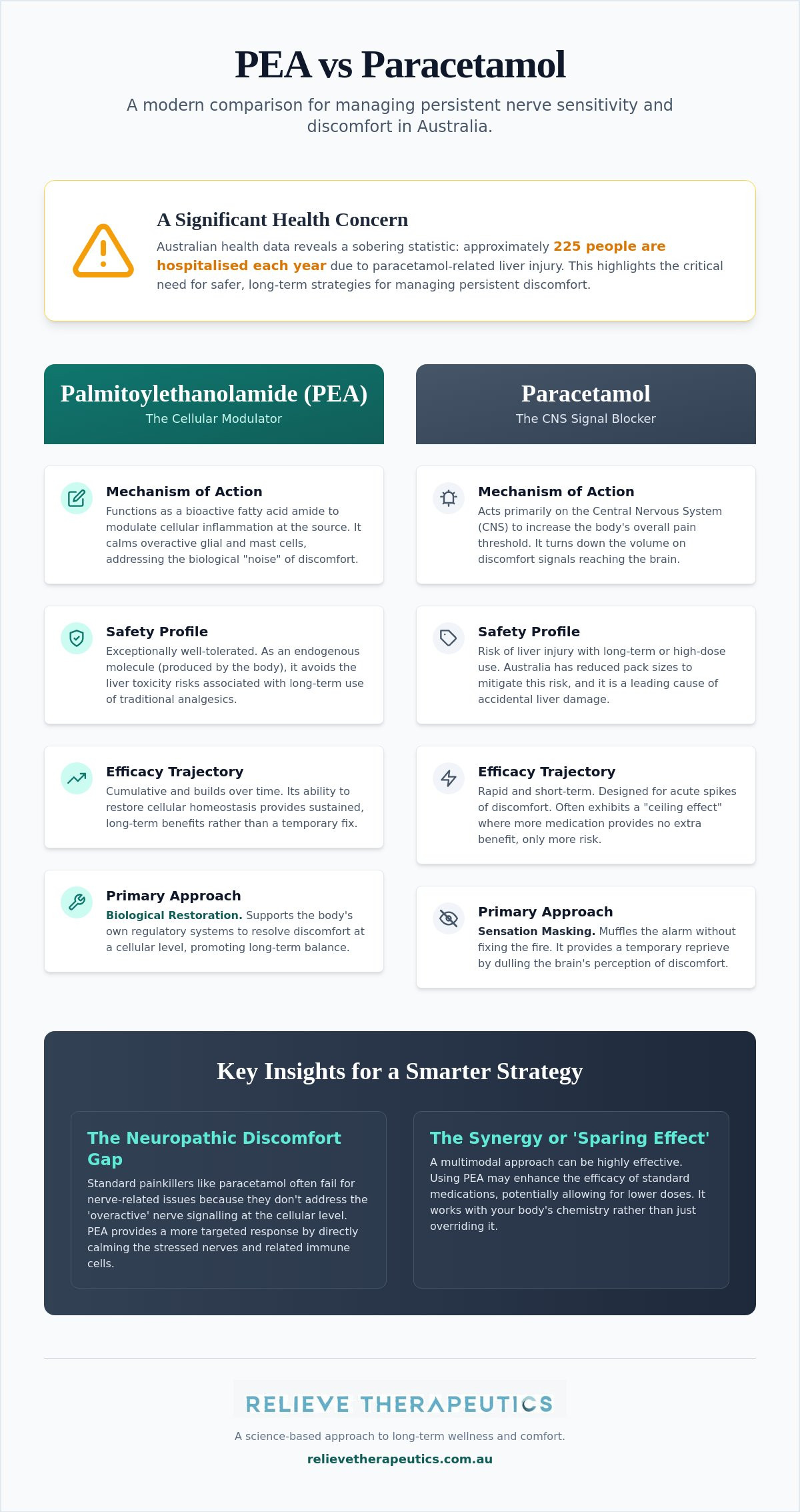
Reaching for a packet of paracetamol is an almost instinctive response to discomfort, yet for persistent nerve sensitivity, this common remedy often acts as little more than a temporary veil. You likely know the frustration of masking a problem without addressing the underlying source, particularly as Australian health data reveals that roughly 225 people are hospitalised annually due to paracetamol-related liver injury. Understanding the nuances of palmitoylethanolamide vs paracetamol is the first step toward reclaiming your daily vitality and finding a solution that works with your body rather than just silencing its signals.
This science-based comparison explores how PEA differs from traditional analgesics in its mechanism, safety, and efficacy for chronic nerve health. You will learn how these two substances interact with your central nervous system and endocannabinoid pathways to manage discomfort through distinct biological channels. We will preview the latest clinical insights regarding ultra-micronised formulations, examine recent Australian regulatory changes for paracetamol, and outline a safer long-term strategy for improved daily function and comfort.
Key Takeaways
- Understand how paracetamol acts on the central nervous system while PEA modulates cellular inflammation and nerve sensitivity at the source.
- Evaluate the safety profiles of palmitoylethanolamide vs paracetamol, focusing on how PEA's endogenous nature avoids the liver toxicity risks of long-term analgesic use.
- Discover why standard painkillers often fail to address 'overactive' nerve signalling and how bioactive fatty acids provide a more targeted response for neuropathic discomfort.
- Learn how a multimodal approach can create a 'sparing effect', potentially enhancing the efficacy of standard medications when used alongside pure PEA.
- Identify the practical advantages of high-count 180-capsule bottles for Australians seeking a consistent and sustainable long-term management strategy.
Palmitoylethanolamide vs Paracetamol: Understanding the Mechanism Gap
Most Australians manage daily discomfort by reaching for a familiar white tablet. However, as the focus shifts toward sustainable long-term wellness, many are evaluating palmitoylethanolamide vs paracetamol to understand which approach aligns better with their specific health goals. While both aim to reduce discomfort, they operate on entirely different biological levels. One acts as a signal blocker in the brain, while the other functions as a cellular modulator within the tissues themselves. This distinction is vital for those who find that standard remedies no longer provide the relief they need for persistent nerve sensitivity.
How Paracetamol Works: The CNS Approach
Paracetamol is primarily classified as a central-acting analgesic. It works by increasing the overall pain threshold within the central nervous system (CNS), essentially turning down the volume on the signals the brain receives. It is thought to inhibit cyclooxygenase (COX) enzymes in the brain, yet it lacks significant anti-inflammatory activity in peripheral tissues like joints or nerves. This makes it effective for acute headaches or fevers, but it does little to address the underlying cellular "noise" that characterises chronic discomfort. It masks the sensation without resolving the local biological stress. It doesn't fix the fire; it just muffles the alarm.
How PEA Works: The Glial Cell Modulator
Palmitoylethanolamide (PEA) is a bioactive fatty acid amide that the body produces naturally in response to tissue stress or injury. Unlike standard analgesics, PEA targets mast cells and glial cells to dampen "neuro-inflammation" at the source. It interacts with the PPAR-alpha receptor to downregulate the expression of pro-inflammatory genes, effectively calming overactive nerve signalling. how does PEA work for pain is best explained by its ability to restore cellular homeostasis and reduce the sensitivity of peripheral nerves through the direct modulation of nuclear receptors. It is a biological response rather than a chemical override.
The fundamental gap between palmitoylethanolamide vs paracetamol lies in the distinction between masking and modulating. Paracetamol provides a temporary reprieve by dulling the brain's perception of discomfort. PEA, conversely, supports the body's internal regulatory mechanisms. For Australians facing persistent discomfort, the shift toward PEA represents a move away from the "quick fix" toward a strategy of biological restoration. This approach is particularly relevant given the 2025 scheduling changes that reduced paracetamol pack sizes to mitigate the risks of long-term reliance. It's about choosing a partner for your health journey that respects your body's natural chemistry and long-term vitality.
Efficacy and Safety: A Head-to-Head Comparison
Deciding between palmitoylethanolamide vs paracetamol requires an understanding of the "time horizon" of your discomfort. Paracetamol is often viewed as the "sprinter" of the medicine cabinet; it is designed for rapid, short-term action against acute spikes like a tension headache or a post-exercise fever. However, for those facing persistent nerve sensitivity, this common analgesic often hits a "ceiling effect." This means that beyond a specific dosage, taking more medication provides no additional relief but significantly increases the metabolic load on your organs. It is a tool for the moment, not a strategy for the season.
PEA offers a different trajectory altogether. As an endogenous molecule, its efficacy is cumulative. A recent PEA for chronic pain meta-analysis indicates that while its onset may be slower than standard OTC drugs, its ability to modulate overactive signalling pathways builds over time. Unlike paracetamol, which can occasionally cause gastric distress or allergic reactions in sensitive individuals, PEA is exceptionally well-tolerated. Because your body recognises the molecule as its own, the risk of rejection or adverse response is remarkably low.
The Safety Advantage of Endogenous Molecules
Safety is the primary driver for many Australians transitioning away from traditional painkillers. Paracetamol remains a leading cause of accidental liver injury in Australia, often resulting from the unintentional "stacking" of different cold and flu medications. PEA carries no such risk of liver or kidney toxicity. It lacks known drug-to-drug interactions with common Australian prescriptions, making it a reliable ally for those managing multiple health conditions. It supports your biological resilience without taxing your digestive system or compromising your long-term organ health.
Comparison Table: PEA vs Paracetamol
| Feature | Paracetamol | Palmitoylethanolamide (PEA) |
|---|---|---|
| Primary Target | Central Nervous System (Brain) | Peripheral Cells (Glia and Mast Cells) |
| Safety Profile | Risk of liver toxicity with high use | High; naturally produced by the body |
| Long-term Use | Discouraged due to organ strain | Ideal; supports cellular homeostasis |
| Best For | Acute fever and simple headaches | Chronic discomfort and nerve support |
Achieving the best results requires understanding the correct PEA dosage for pain, which typically involves an initial loading phase to saturate cellular receptors. For those looking to move beyond the cycle of temporary masking, choosing a pure Australian PEA supplement provides a sustainable path toward daily comfort and improved vitality.
Why Paracetamol Often Fails for Neuropathic Discomfort
The "I've tried everything" sentiment is a common refrain among those living with neuropathic discomfort. It's a valid frustration. If you've relied on standard over-the-counter options for years with little success, it isn't because your body is "broken," but rather that your current tools aren't reaching the right target. Nerve discomfort differs fundamentally from muscle soreness; it isn't just about tissue damage, but about a nervous system that has become hypersensitised. When comparing palmitoylethanolamide vs paracetamol for nerve-related issues, the difference lies in the cellular environment where each intervention acts. Paracetamol attempts to dull the brain's reception of signals, but it does nothing to address the "stuck" transmission lines in the peripheral nerves.
Standard analgesics are designed for nociceptive discomfort, which is the body's response to an external injury like a cut or a bruise. Neuropathic discomfort is different. It is a malfunction of the signalling process itself. The debate of palmitoylethanolamide vs paracetamol is less about which is "stronger" and more about which is appropriate for the specific pathology of nerve health. One masks the symptom, while the other supports the biological structures responsible for the sensation.
The Role of Glial Cells in Nerve Sensitivity
For decades, science viewed glial cells as mere "glue" holding neurons together. We now understand they are the active regulators of our experience. Glial cells act as the 'volume knobs' of the nervous system, determining the intensity of every signal sent to the brain. In chronic conditions, these cells become chronically activated, keeping the volume turned up to the maximum setting. PEA possesses a unique ability to "calm" these overactive cells, effectively turning the volume down. Paracetamol simply cannot interact with this pathway, leaving the source of the hypersensitivity untouched.
PEA for Specific Australian Health Concerns
This cellular approach makes PEA particularly relevant for Australians managing complex conditions like sciatica or diabetic neuropathy. Clinical evidence suggests that by modulating mast cells and glia, PEA provides a foundation for long-term comfort that standard analgesics cannot match. It is why many local practitioners are shifting away from purely symptomatic treatments toward more restorative options. It targets inflammation, calms sensitivity, and restores function.
Whether you are investigating palmitoylethanolamide sciatica support or searching for the most effective supplement for neuropathy Australia has to offer, the goal remains the same: restoring daily function. By addressing the overactive signalling at its origin, you move from merely "getting by" to actively managing your health. This transition is becoming the gold standard in clinics across the country as we move toward non-opioid and non-NSAID management strategies. It is precise, evidence-based, and compassionate.
Synergy or Substitution: Can You Take PEA with Paracetamol?
Modern clinical practice is increasingly moving toward a "multimodal" approach to health management. This strategy involves using multiple substances that target different biological pathways simultaneously to achieve a better outcome with fewer side effects. When considering palmitoylethanolamide vs paracetamol, many users wonder if they must choose one or the other. In reality, these two substances can often work in tandem. While paracetamol provides a rapid, temporary dampening of signals in the brain, PEA works behind the scenes to recalibrate the cellular environment where those signals originate. It's a partnership between immediate relief and long-term restoration.
The 'Analgesic Sparing' Effect
One of the most compelling reasons to use PEA alongside traditional remedies is the "analgesic sparing" effect. Clinical research suggests that PEA may enhance the efficacy of standard painkillers, potentially allowing individuals to achieve the same level of comfort with a lower dose of paracetamol. By reducing your daily intake of over-the-counter medications, you directly lower the chemical burden on your liver and kidneys. This is a vital consideration for those who have relied on daily analgesics for years and worry about cumulative toxicity. Before altering any established medication regime, you should consult with an Australian healthcare professional to ensure a safe and coordinated transition.
Timeline of Results: Patience vs. Immediate Relief
The most significant hurdle when comparing palmitoylethanolamide vs paracetamol is the difference in onset time. Paracetamol usually takes effect within 30 minutes, providing a predictable but short-lived window of relief. PEA doesn't work this way. Because it involves the modulation of nuclear receptors and the calming of glial cells, the effects are cumulative rather than immediate. It doesn't mask a symptom in minutes; it changes a biological response over weeks.
Most clinical trials for PEA focus on outcomes at the 4-week and 8-week marks. During the first 30 days of use, your body is essentially rebuilding its natural stores of this fatty acid amide and resetting overactive inflammatory pathways. Consistency is the key to success. Unlike paracetamol, which you might take only when the discomfort peaks, PEA must be taken daily to maintain the saturation required for cellular change. Managing your expectations during this initial transition phase is crucial for long-term success. If you're prepared to commit to a more sustainable strategy, you can order high-count PEA capsules to support your first 90 days of management.
Choosing Quality PEA in Australia: Relieve Therapeutics
Navigating the supplement market in Australia requires a discerning eye, particularly when moving away from familiar over-the-counter options. While the scientific debate of palmitoylethanolamide vs paracetamol highlights clear biological advantages for long-term comfort, the efficacy of PEA depends entirely on the purity and concentration of the formulation. Not all supplements are created equal. Relieve Therapeutics specialises exclusively in high-quality PEA capsules, ensuring that Australians have access to a clean, concentrated source of this endogenous molecule without the unnecessary fillers often found in generic alternatives.
Choosing a local specialist also removes the logistical hurdles of international shipping. You don't have to wait weeks for a parcel to clear customs while your management routine is interrupted. Local Australian shipping ensures a seamless supply, allowing you to maintain the consistency required for cellular modulation. This reliability is the cornerstone of a successful transition from the temporary masking of paracetamol to a more sustainable, restorative approach. It's about stability, transparency, and professional care.
Tailored Quantities for Your Journey
We recognise that every individual's path to comfort is unique. To support your specific needs, we provide three distinct options designed for different stages of your health journey:
- PEA 60 Capsules: This is the ideal 'Starter' pack. It's perfect for those new to the molecule who wish to observe how their body responds during the initial loading phase.
- PEA 120 Capsules: Often chosen as the 'Maintenance' option, this size supports established routines and ensures you have a steady supply for two months of consistent use.
- PEA 180 Capsules: Our 'Chronic Management' bulk option offers the best value. It's the logical choice for those switching from daily paracetamol who require long-term, uninterrupted cellular support.
The Relieve Therapeutics Difference
Relieve Therapeutics isn't a generalist health shop. We maintain a dedicated focus on PEA because we believe in the power of specialised knowledge. By concentrating on a single, evidence-based molecule, we ensure our manufacturing standards and purity levels remain at the highest possible tier. We act as your trustworthy specialist, simplifying complex biological concepts so you can make informed decisions about your vitality. Our commitment to transparency means you always know exactly what you're putting into your body. There's no marketing fluff; just science-backed support for your daily function.
If you're ready to move beyond the limitations of palmitoylethanolamide vs paracetamol and embrace a strategy that works with your body's natural chemistry, we're here to help. You can order your PEA supplement Australia and begin your natural support journey today. Reclaim your comfort, restore your movement, and rediscover your daily vitality with a partner you can trust.
Empowering Your Path to Sustainable Comfort
Choosing between palmitoylethanolamide vs paracetamol represents a pivotal decision to move away from temporary masks toward a strategy of biological restoration. You've seen that while paracetamol targets the brain's perception of signals, PEA modulates the cellular environment and calms overactive nerve pathways at its origin. This evidence-based approach provides a safer path for those managing persistent nerve sensitivity, avoiding the metabolic strain often associated with long-term analgesic use.
Relieve Therapeutics is an Australian owned and operated specialist dedicated to providing the purity and concentration your body deserves. Our specialised focus ensures that every capsule supports your journey toward improved daily function and vitality. With discrete and fast local shipping, you can maintain the consistency required for long-term cellular health without the frustration of international wait times.
Secure your 180-capsule bulk pack for long-term support and take the first step toward a more functional lifestyle today. You don't have to settle for merely getting by; a more comfortable and active future is well within your reach.
Frequently Asked Questions
Can I take PEA and paracetamol together?
Yes, you can take PEA and paracetamol together as they operate through distinct biological channels. This multimodal approach allows paracetamol to provide immediate, central-acting relief while PEA focuses on modulating peripheral cellular inflammation. Always consult your healthcare professional before combining supplements with existing medications to ensure a coordinated management plan and to avoid any potential overlaps in your specific health regime.
Is PEA better than paracetamol for nerve pain?
PEA is generally considered more effective for the specific pathology of nerve pain because it targets the overactive glial cells responsible for nerve sensitivity. While paracetamol increases the overall pain threshold in the brain, it does little to address the "stuck" transmission lines in the peripheral nerves. Research into palmitoylethanolamide vs paracetamol suggests that PEA's ability to dampen neuro-inflammation makes it a superior choice for long-term nerve health.
Does PEA have the same liver risks as paracetamol?
No, PEA does not share the liver toxicity risks associated with long-term paracetamol use. As an endogenous fatty acid amide already produced by your body, PEA is metabolised without placing a heavy chemical burden on your liver or kidneys. This high safety profile makes it a reliable alternative for individuals concerned about the cumulative effects of standard analgesics on their long-term organ health and vitality.
How long does it take for PEA to start working compared to Panadol?
Panadol typically provides relief within 30 minutes, whereas PEA requires a cumulative build-up period to reach therapeutic levels. While paracetamol offers a quick but temporary mask, most clinical trials for PEA observe meaningful results after 4 to 8 weeks of consistent daily use. You should view paracetamol as a tool for acute spikes and PEA as a sustainable strategy for biological restoration and comfort.
Is PEA available over-the-counter in Australia?
Yes, PEA is available in Australia as a listed medicine and can be purchased without a prescription. Following TGA regulations, it's classified as a substance with a low risk profile, making it accessible for direct-to-consumer purchase. This allows Australians to manage their chronic discomfort independently with high-quality, pure supplements like our 60, 120, or 180-capsule packs, which are delivered via fast local shipping.
Can PEA replace my daily paracetamol for chronic pain?
PEA can often replace daily paracetamol for chronic management, particularly when the discomfort is driven by nerve sensitivity or persistent inflammation. Many users find that once PEA has saturated their cellular receptors, their reliance on standard analgesics naturally decreases. We recommend a gradual transition under the guidance of a specialist to ensure your comfort levels remain stable while your body's natural regulatory systems begin to take over.
Are there any side effects of switching from paracetamol to PEA?
Switching from paracetamol to PEA is generally very well tolerated with no known significant side effects. Because PEA is a molecule your body already recognises, it avoids the gastric distress or allergic reactions sometimes triggered by synthetic medications. The primary difference is simply the time required for the body to recalibrate its natural inflammatory response during the initial loading phase, which requires patience and daily consistency.
Is PEA a drug or a dietary supplement?
In the context of palmitoylethanolamide vs paracetamol, PEA is classified as a dietary supplement or a listed medicine rather than a synthetic pharmaceutical drug. It's a bioactive fatty acid amide that mimics the body's natural response to tissue stress and injury. This classification reflects its natural origins and its role in supporting physiological balance and cellular homeostasis rather than overriding biological signals with harsh chemical compounds.