

What if the secret to managing persistent discomfort wasn't about masking the heat, but recalibrating your body's internal temperature? For the one in five Australians aged 45 and over living with chronic pain, the search for relief often feels like a trade-off between effectiveness and unwanted side effects. You may feel frustrated by the limitations of standard anti-inflammatories or overwhelmed by technical jargon. Finding reliable information on PEA for chronic inflammation Australia is the first step toward a more sustainable and natural approach to recovery.
This guide explores how Palmitoylethanolamide acts as a biological thermostat to help your system regulate its inflammatory response from within. We'll break down the latest 2026 TGA guidelines, simplify the underlying science, and outline how to establish a high-purity supplement routine. By understanding how this fatty acid supports your endocannabinoid system, you can move toward reduced systemic inflammation and improved daily mobility. It's time to move beyond temporary fixes and focus on restoring your long-term vitality through evidence-based support.
Key Takeaways
- Understand how Palmitoylethanolamide functions as a biological 'thermostat' to address natural deficiencies and recalibrate your body's response to persistent discomfort.
- Explore the cellular science behind the 'Master Switch' theory, where PEA modulates inflammatory pathways without the common side effects of standard COX-inhibitors.
- Learn the specific framework for a successful routine, including the critical eight-week loading phase required to restore systemic balance.
- Discover why choosing high-purity PEA for chronic inflammation Australia ensures a reliable, professional-grade foundation for your daily mobility and long-term vitality.
- Gain clarity on how to organise your supplement intake to support gastrointestinal health while achieving consistent, evidence-based results.
Understanding Palmitoylethanolamide for Inflammation: Australia’s Natural Approach
Palmitoylethanolamide, often shortened to PEA, is far from a synthetic laboratory creation. It is a naturally occurring fatty acid amide that your body synthesises on demand to maintain cellular balance and protect against tissue damage. If you are researching What is Palmitoylethanolamide, you'll find it belongs to a class of biological molecules that act as internal first responders. It functions within the endocannabinoid system, serving as a lipid mediator that regulates the intensity of your immune response. For many, the search for high-quality PEA for chronic inflammation Australia begins with a desire to move away from conventional medications that carry a heavy burden of side effects.
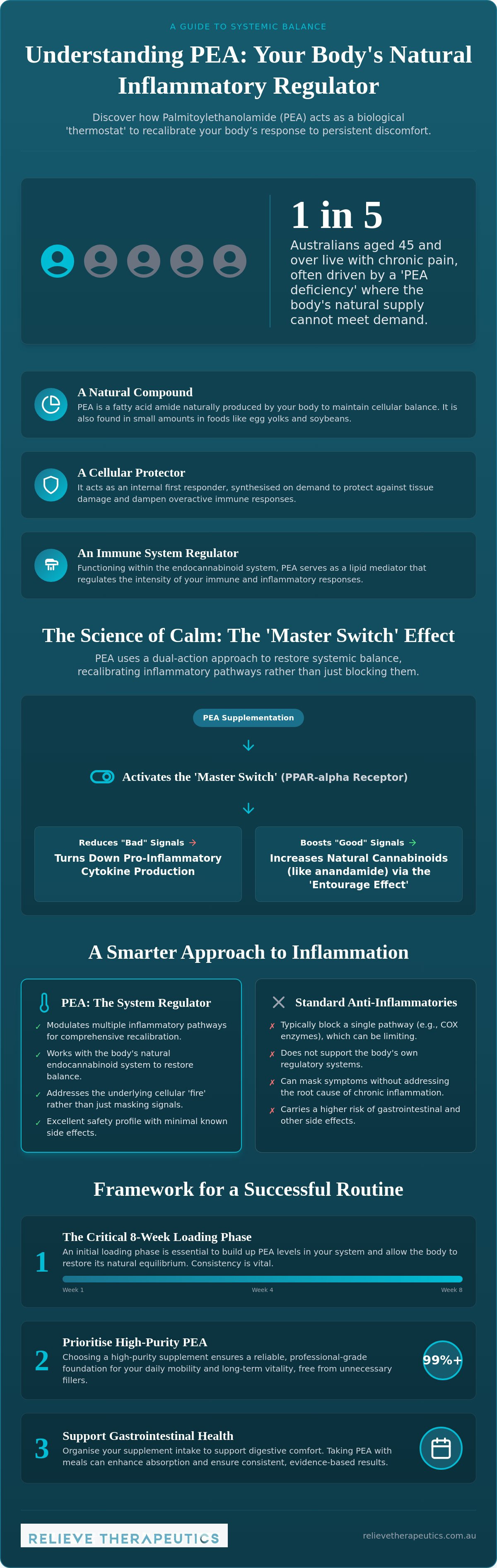
According to the Australian Institute of Health and Welfare, one in five Australians aged 45 and over are living with chronic pain. This persistent discomfort is often driven by a state of "PEA deficiency." During periods of sustained physiological stress or injury, the body's demand for this protective molecule often outstrips its supply. When your internal production cannot keep up with the inflammatory load, the system remains in a state of heightened sensitivity. Supplementing with PEA provides the body with the raw materials needed to restore its natural defences and regain systemic equilibrium.
The Chronic Inflammatory Cycle
Acute inflammation is a vital healing response. It's the heat and swelling you feel after a minor injury, which signals the body to repair tissue. Chronic inflammation, however, is a silent and destructive process. It lingers long after the initial threat has passed, often manifesting as morning stiffness, persistent fatigue, or a general sense of physical heaviness. In the busy Australian lifestyle, these signs of systemic stress are frequently ignored or masked with temporary fixes. Standard interventions often focus on blocking specific pain pathways, yet they may fail to address the underlying cellular "fire" that keeps the cycle moving. This is why a more comprehensive, receptor-based approach is required for long-term management.
PEA: A Molecule of Restoration
Think of PEA as a biological coolant for your cells. As an endogenous modulator, it works to dampen overactive immune responses that have become stuck in a feedback loop. This "cooling" effect helps to quieten the signals that lead to persistent discomfort and tissue irritation. While the body produces its own supply, small amounts of PEA are also present in common foods such as egg yolks, soybeans, and peanuts. However, the concentrations found in a standard diet are rarely sufficient to overcome a deep-seated inflammatory state. By utilising a concentrated supplement, you can provide your system with the targeted support it needs to transition from a state of defence to a state of restoration. This natural alignment with the body's own chemistry makes PEA for chronic inflammation Australia an increasingly popular choice for those seeking sustainable vitality.
The Science of Calm: How PEA Modulates Inflammatory Pathways
To understand how PEA functions, we must look at the cellular level, where it interacts with a specific nuclear receptor called PPAR-alpha. This receptor acts as a biological "Master Switch" for inflammatory gene regulation. When your system is under stress, PEA binds to these receptors to signal a reduction in the production of pro-inflammatory cytokines. Unlike traditional options that simply block a single pathway, PEA provides a more comprehensive recalibration of your body's immune response. This sophisticated mechanism is why many people seeking PEA for chronic inflammation Australia find it offers a different kind of relief than what they've experienced before.
Beyond its direct action on receptors, PEA also facilitates what scientists call the "entourage effect." It helps maintain higher levels of your body's natural cannabinoids, such as anandamide, by inhibiting the enzymes that usually break them down. This dual-action approach-reducing the "bad" inflammatory signals while boosting the "good" protective ones-is currently being explored in several ongoing clinical trials. This research continues to validate the compound's role in restoring systemic balance and promoting long-term vitality.
Targeting the Mast Cells and Glia
In the early stages of an inflammatory response, mast cells act as the body's alarm system, releasing chemicals that trigger sensitivity and swelling. When this alarm stays "on" indefinitely, it leads to chronic discomfort. PEA works by stabilising these mast cells, preventing them from overreacting to minor stimuli. Simultaneously, it addresses glial cells, which are the immune cells of the nervous system. When glia become overactive, they can cause nerves to become hypersensitive, leading to persistent issues. PEA acts as a cellular peacemaker, instructing overactive immune cells to return to a state of rest.
Systemic vs. Localised Support
Choosing oral capsules allows for systemic support, meaning the molecule can travel through the bloodstream to reach every corner of the body. This is particularly beneficial for those experiencing widespread discomfort rather than a single, isolated injury. For Australians, the focus is often on finding a high-purity formulation that ensures maximum bioavailability. If you are curious about the specific mechanics of this process, you can read more about how does PEA work for pain to see how it targets nerve-related issues. By selecting a specialist provider like Relieve Therapeutics, you ensure that your supplement routine is built on a foundation of purity and clinical-grade quality.
PEA vs. Standard Anti-Inflammatories: Analysing the Benefits
Standard anti-inflammatories, such as Non-Steroidal Anti-Inflammatory Drugs (NSAIDs), are designed for speed. They work by blocking specific enzymes to provide rapid relief, yet this often comes at a cost to your body's delicate internal systems. Choosing PEA for chronic inflammation Australia represents a shift from temporary suppression to systemic support. While NSAIDs are effective for acute injuries, their long-term use is frequently limited by concerns over gastrointestinal irritation and renal stress. PEA offers a different path. It is a lipid mediator that your body already recognises, allowing for a receptor-based approach that respects your natural biology.
The safety profile of Palmitoylethanolamide is one of its most significant advantages for those requiring ongoing support. Because it is an endogenous substance, it doesn't carry the same risk of stomach ulcers or kidney strain associated with synthetic COX-inhibitors. When you examine the science of how PEA works, it becomes clear that its mechanism is restorative rather than disruptive. This makes it an ideal suitability for individuals seeking non-opioid alternatives or those who have found standard treatments too harsh for their system. It's a "slow and steady" approach that builds efficacy over weeks rather than minutes, focusing on long-term stability rather than a fleeting mask for discomfort.
Why Particle Size and Purity Matter
Particle size is the invisible factor that determines how well your body can actually use a supplement. Standard PEA often has large, clumpy particles that are difficult for the digestive system to absorb efficiently. Ultra-micronised formulations break these particles down into tiny fractions, significantly increasing the surface area for absorption. For Australians, this distinction is vital. You should always prioritise high quality PEA capsules that have undergone rigorous laboratory testing for purity. Without these standards, you may be investing in a product that your body simply cannot process, leading to sub-optimal results in your recovery journey.
The Synergy of Natural Relief
PEA doesn't just work alone; it often thrives in a supportive environment. Many people find success by using it alongside other natural anti-inflammatories like high-strength turmeric or fish oil. This combination can create a multi-targeted approach to systemic health. PEA is particularly favoured for nerve-related inflammatory issues because it addresses the glial cells that synthetics often miss. Crucially, it provides this support without the "brain fog," lethargy, or sedative effects common in other chronic management options. It allows you to maintain your mental clarity while your body focuses on dampening the internal "heat" of inflammation.
Practical Guidance: How to Organise Your PEA Supplement Routine
Organising a routine for PEA for chronic inflammation Australia requires a methodical approach. It isn't a "rescue" medication to be taken only when discomfort peaks; instead, it relies on reaching a state of receptor saturation. This is achieved through a structured "Loading Phase," typically lasting between four and eight weeks. During this period, your body works to replenish its endogenous levels and recalibrate its inflammatory response. Once this baseline is established, most users transition to a "Maintenance Phase" to sustain their daily vitality. Consistency is the most critical factor in this process.
To ensure you don't miss a dose, take your capsules at the same time each day. A common strategy involves splitting the intake between morning and evening, such as with breakfast and dinner. This helps maintain steady levels in your system and integrates the habit into your existing daily rhythm. While PEA is available over-the-counter, current TGA guidelines suggest consulting a healthcare provider if you intend to use it for more than 21 consecutive days to ensure your chronic condition is being managed correctly.
Finding Your Optimal Daily Intake
In the Australian context, a standard starting intake for the loading phase is usually 1200mg per day. This is often divided into two 600mg servings to improve absorption. This higher initial amount is designed to overcome the physiological deficiency that often accompanies long-term systemic stress. After the first two months, you might find that a lower dose is sufficient to maintain your mobility and comfort. For a detailed breakdown of these requirements, you can consult our guide on PEA dosage for pain. Adjusting your routine based on your body's specific response is key to finding the right balance for your lifestyle.
Managing Expectations and Timelines
Patience is essential because PEA works through a cumulative biological recalibration rather than an instant chemical block. You should view your progress in stages:
- At 2 weeks: You might notice subtle changes in sleep quality or a slight reduction in morning stiffness as the "cooling" effect begins.
- At 4 weeks: Daily mobility often begins to improve, and the background noise of persistent discomfort may start to fade.
- At 8 weeks: This is the critical milestone where receptor saturation is typically reached, allowing for more significant functional gains.
We encourage users to keep a "comfort diary" to track these subtle improvements in mobility and function. Recording your comfort levels on a scale of one to ten often reveals progress that might feel too gradual to notice day-to-day. For those beginning this eight-week journey, the PEA 180 Capsules pack provides the exact supply needed to complete the loading phase without interruption, ensuring your recovery remains on track.
Why Relieve Therapeutics is Australia’s Preferred Choice for PEA
Selecting a partner for your health journey requires more than just finding a product on a shelf. As an Australian-owned and operated specialist, Relieve Therapeutics bridges the gap between clinical research and daily wellness. We focus exclusively on Palmitoylethanolamide, allowing us to maintain a level of expertise that generic pharmacies simply cannot match. When you're looking for PEA for chronic inflammation Australia, you need a source that prioritises transparency, manufacturing purity, and evidence-based guidance. We don't just sell capsules; we provide a reliable foundation for those seeking to move beyond persistent discomfort and reclaim their daily function.
The transition from the loading phase to long-term maintenance is a pivotal moment in your recovery. Our 180-capsule pack is the logical choice for this initial eight-week recalibration. It ensures you have a continuous supply during the period when receptor saturation is most critical. This eliminates the frustration of interrupted routines and provides the peace of mind that comes with a planned, methodical approach. It's about providing the quiet confidence you need to stay committed to your health goals without the pressure of frequent reordering. By focusing on this critical window, we help you establish a routine that is both sustainable and effective.
Tailored Solutions for Your Journey
We offer three distinct variations to meet you wherever you are in your recovery process. Our 60-capsule pack serves as an ideal introduction for those curious about the compound's effects. For users moving into the maintenance phase or those looking for a balanced middle ground, our PEA 120 capsules provide a strategic two-month supply at a standard maintenance dose. Finally, the 180-capsule pack remains the gold standard for starting the journey. Every order is backed by local Australian shipping and a dedicated support team that understands your specific needs and concerns.
Commitment to Purity and Value
Our focus remains steadfast on providing high-purity, laboratory-tested supplements that meet the expectations of discerning Australian consumers. We don't believe in marketing fluff or vague promises. Instead, we prioritise substance, ensuring each capsule contains the precise amount of active ingredient required for efficacy. By offering bulk options, we make the management of PEA for chronic inflammation Australia more sustainable for your budget. This direct-to-consumer model allows us to maintain high standards while providing exceptional value. Reclaiming your vitality is a journey of natural science, and we're here to act as your reliable ally every step of the way.
Reclaiming Your Vitality Through Cellular Support
Managing persistent discomfort is a journey that requires patience, precision, and the right biological tools. By understanding how Palmitoylethanolamide functions as a master switch for your immune response, you can move away from temporary fixes toward a more sustainable, receptor-based approach. The transition from the critical eight-week loading phase to long-term maintenance is essential for restoring your body's internal balance and regaining daily mobility. Consistency is key to achieving these results.
Choosing high-purity PEA for chronic inflammation Australia ensures you are supporting your system with a molecule it already recognises. As a specialist Australian retailer, Relieve Therapeutics provides laboratory-tested formulations that prioritise transparency and quality. Our 180-count bottles offer significant bulk savings, making it easier to complete the initial recalibration period your body requires. Order your PEA 180 capsules today for sustained natural support and start your transition toward a more comfortable, active lifestyle. It's time to stop masking the heat and start cooling the fire from within.
Frequently Asked Questions
Is Palmitoylethanolamide effective for systemic inflammation?
Yes, Palmitoylethanolamide is highly effective for regulating systemic responses by acting as a lipid mediator within your endocannabinoid system. It functions by binding to specific nuclear receptors that control the expression of inflammatory genes. This process helps to quieten overactive immune cells and restore cellular balance throughout the entire body, rather than just masking symptoms in a single area.
How long does it take for PEA capsules to start working?
You should expect a timeline of four to eight weeks for the compound to reach full receptor saturation. While some individuals report subtle improvements in mobility within the first two weeks, the biological recalibration process is cumulative. Consistency is vital during this initial period to ensure your system has the necessary levels to sustain long-term comfort and vitality.
Are there any known side effects of taking PEA supplements?
PEA is remarkably well-tolerated because it is an endogenous substance that your body already produces naturally. Clinical studies have consistently demonstrated a high safety profile, with no significant adverse effects reported for gastrointestinal or renal health. This makes it a reliable choice for individuals who find traditional synthetic anti-inflammatories too harsh for their digestive systems.
Can I take PEA with my current prescription medications?
There are no known drug-to-drug interactions associated with PEA, allowing it to be integrated into most health routines without complication. It does not interfere with the metabolic pathways of common medications. Despite this high level of compatibility, you should always consult your healthcare professional before starting a new supplement to ensure it aligns with your specific medical history.
What is the difference between micronised and standard PEA?
The primary difference lies in the particle size, which directly impacts how well your body can absorb the supplement. Micronised PEA is processed into much smaller particles, creating a larger surface area for more efficient uptake in the digestive tract. Standard PEA often features larger, clumpy particles that are difficult for the body to break down, which can lead to sub-optimal results.
Is PEA a type of CBD or cannabinoid?
No, PEA is not a cannabinoid, although it is often discussed alongside them because it supports the endocannabinoid system. It is a fatty acid amide that is naturally present in both animals and plants. It does not produce any psychoactive effects and is entirely separate from CBD or THC, making it a distinct and legal natural health option in Australia.
How many PEA capsules should I take daily for inflammation?
A standard Australian approach involves a daily intake of 1200mg during the initial eight-week loading phase. This is typically achieved by taking two 600mg capsules, often split between morning and evening meals. Using this specific routine for PEA for chronic inflammation Australia ensures your receptors remain saturated, providing the best foundation for a successful transition to a lower maintenance dose later on.
Where is Relieve Therapeutics PEA sourced and shipped from?
Relieve Therapeutics is a proudly Australian-owned and operated specialist. We maintain a focused e-commerce model where all our high-purity, laboratory-tested formulations are stored and shipped directly from our Australian facilities. This ensures that you receive fast local shipping and access to a domestic support team that understands the unique needs of the Australian health landscape.