

Your body already produces the very compound you are considering as a supplement, making it one of the most biologically compatible options for managing long-term discomfort. If you have spent years managing persistent aches, you have likely encountered the "pharmaceutical fog," gastric upset, or the constant worry about whether a new supplement is PEA safe to take over the long term. It is exhausting to sift through conflicting advice while simply seeking a way to reclaim your daily function. You deserve a solution that supports your system rather than overriding it.
This specialist’s guide provides a comprehensive overview of the safety profile of Palmitoylethanolamide, backed by clinical data from 2025 and 2026. We will provide a transparent look at the rare, mild side effects like temporary bloating and explain how this "body-identical" lipid works in harmony with your natural pathways. By the end of this article, you will understand the evidence behind this fatty acid and know exactly how to select a high-quality Australian product that prioritises purity, potency, and your long-term vitality.
Key Takeaways
- Understand why PEA is classified as a "body-identical" lipid and how its natural production within your own cells contributes to its high safety profile.
- Discover what the latest 2026 clinical data reveals about whether is PEA safe to take for long-term use without the risk of dependency or common pharmaceutical side effects.
- Learn how PEA differs from traditional NSAIDs by providing support for discomfort without the associated risks of gastric ulceration or kidney strain.
- Identify the specific groups, including those on complex medication regimens, who should consult an Australian healthcare professional before beginning supplementation.
- Recognise why prioritising high-purity, micronised formulations is essential for ensuring both optimal absorption and superior digestive tolerability.
What is Palmitoylethanolamide and is it Naturally Safe?
Understanding whether is PEA safe to take begins with a look inside your own biology. Palmitoylethanolamide (PEA) is an endogenous fatty acid amide, a lipid molecule that your cells produce naturally. It acts as a protective mechanism, functioning as a primary regulator of cellular homeostasis. When your system detects stress, injury, or persistent discomfort, it synthesises PEA to help restore balance. Because it is a substance your body already recognises and utilises, it carries a level of biological compatibility that synthetic alternatives simply cannot match.
This "body-identical" nature is the foundation of its high tolerability. Beyond our internal production, PEA exists in various everyday foods. You can find it in small quantities within:
- Egg yolks
- Peanuts and peanut oil
- Soy lecithin
- Alfalfa and corn
The Biological "Body-Identical" Advantage
When you introduce a synthetic compound to your system, your liver and kidneys must work to metabolise and clear the foreign substance. This often leads to the side effects many people fear. PEA operates differently. It is biologically familiar. Your body produces it on demand in response to physiological challenges, meaning the pathways for its use and disposal are already well established. By supplementing with PEA, you aren't overriding your natural functions. You're supporting them. This distinction is critical for those concerned about long-term dependency or systemic strain.
Regulatory Status in Australia
In Australia, PEA is classified as a dietary supplement rather than a prescription medicine. It is widely available through both practitioner-only channels and high-quality retail platforms. The Therapeutic Goods Administration (TGA) oversees the standards for supplements sold locally, ensuring that products meet strict safety and quality benchmarks. When questioning if is PEA safe to take, your focus should remain on sourcing. Choosing a reputable Australian retailer that specialises in pure, laboratory-tested formulations ensures you receive a product free from unnecessary fillers or contaminants. This transparency is vital for maintaining the safety profile that makes PEA such a hopeful option for your wellness journey.
Potential Side Effects and Tolerability: What the Research Shows
Clinical investigations involving thousands of participants provide a definitive answer to whether is PEA safe to take over the long term. A landmark 2025 meta-analysis published in Nutrition Reviews confirmed that PEA is exceptionally well-tolerated, with an adverse event profile that often mirrors that of a placebo. This means that in many large-scale studies, the group taking the supplement reported no more discomfort than those taking a sugar pill. For the vast majority of users, the experience of taking PEA is entirely neutral, with no noticeable side effects whatsoever.
The safety data is robust. Researchers have conducted comprehensive safety and toxicity studies on PEA, which demonstrate that it lacks the toxicological risks associated with many traditional interventions. Unlike many pharmaceutical options that can strain the liver or kidneys, PEA follows natural metabolic pathways that the body manages with ease. This high level of tolerability makes it a reliable choice for those who have previously struggled with the harsh side effects of standard care.
Commonly Reported Mild Reactions
While rare, a small percentage of users may experience minor digestive changes. These typically manifest as a slight sense of heaviness in the stomach, mild nausea, or bloating. These reactions are usually transient and resolve quickly as your system adjusts to the supplement. If you find your digestion is particularly sensitive, taking your capsules with a meal can effectively mitigate these issues. Ensuring you have a consistent routine with your PEA capsules often provides the best balance of comfort and efficacy.
Long-Term Safety and Dependency
One of the most significant concerns for those managing persistent discomfort is the fear of dependency. PEA is not habit-forming. It does not interact with the receptors responsible for addiction, and there is no clinical evidence of a "withdrawal" effect if you choose to stop supplementation. Research has monitored users taking daily doses ranging from 300 mg to 1,200 mg for periods of 3 to 12 months with no loss of efficacy or increase in safety risks. This makes it a sustainable option for those seeking a long-term partner in their wellness journey. It simply supports your body's natural state without creating a new problem to solve.
Comparing the Safety of PEA to Standard Pain Relief
Many Australians find themselves in a difficult position when managing long-term discomfort. Standard Non-Steroidal Anti-Inflammatory Drugs (NSAIDs) like ibuprofen or aspirin are effective for acute issues, yet they often come with a significant "safety tax" when used daily. When considering if is PEA safe to take, the comparison to these common over-the-counter options is where the supplement truly shines. While traditional analgesics work by inhibiting enzymes that can also protect your stomach lining, PEA utilises a completely different biological pathway. It acts as a modulator rather than a blunt-force inhibitor, providing a supportive option for those who cannot tolerate the systemic strain of standard medications.
Gastric and Renal Considerations
The most frequent complication of long-term NSAID use is gastric irritation, which can escalate to ulceration or internal bleeding. PEA does not carry this risk. It is a lipid that is naturally processed by the body without degrading the protective mucosal lining of the gut. This makes it significantly gentler on the stomach and a viable alternative for individuals with sensitive digestive systems or those at risk of renal strain. Additionally, many people who rely on chemist-bought medications suffer from "rebound headaches" or medication-overuse discomfort. PEA does not trigger this cycle. To understand the specific pathways it uses to provide relief without these complications, you can explore how does PEA work for pain in our detailed mechanism guide.
The Non-Opioid Alternative
In modern Australian health, there is a growing movement towards non-opioid pain relief supplements that don't compromise cognitive function. Many prescription options are associated with "brain fog," heavy sedation, or a frightening risk of dependency. PEA is entirely non-habit forming and does not cause grogginess. It allows you to maintain a clear head and remain active in your daily life while it works in the background to support your cellular health. Because it is non-sedating, it can be taken at any time of day without interfering with your work or ability to drive. It offers the quiet confidence of a specialist-grade supplement that respects your need for both comfort and mental clarity.
By choosing a supplement that avoids the common pitfalls of liver and kidney toxicity, you are making a sustainable decision for your future wellness. PEA provides a level of safety and reliability that standard chemist options simply cannot match for long-term use.
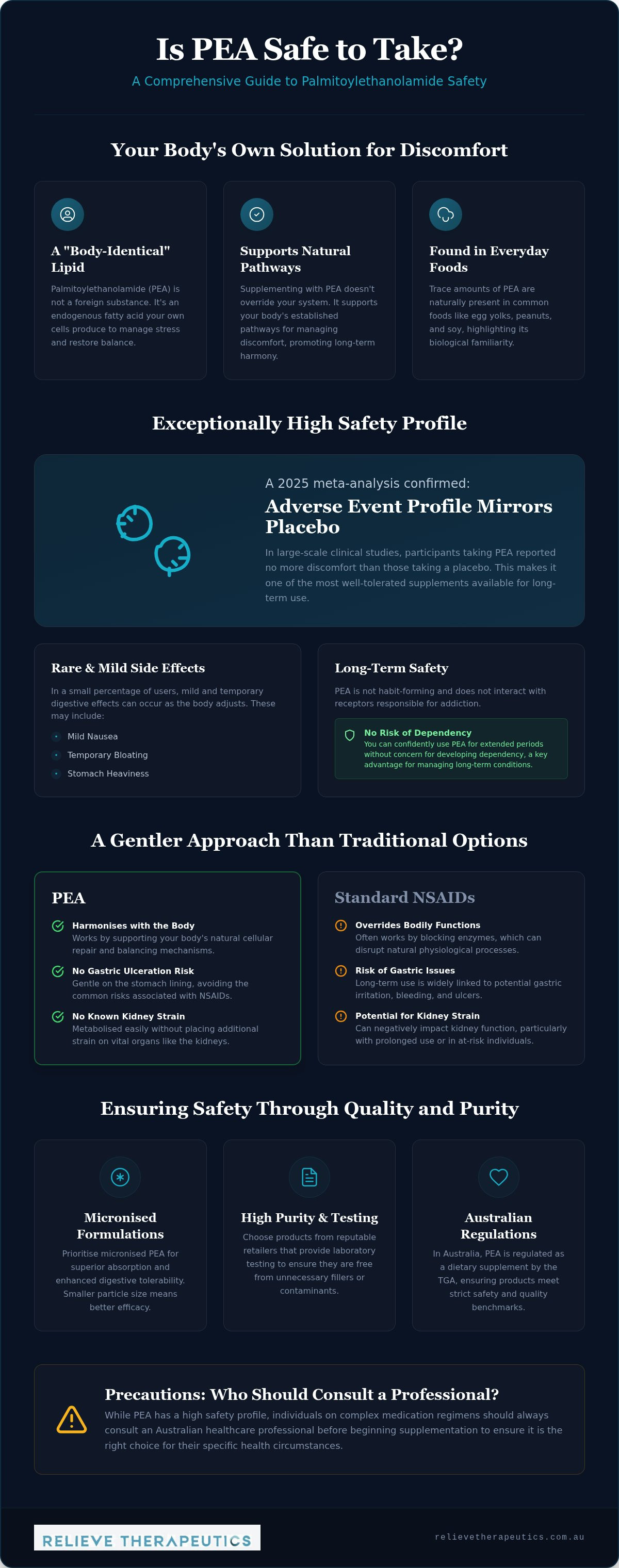
Precautions: Who Should Consult a Professional?
Clinical evidence supports the high tolerability of PEA for the general population. However, determining if is PEA safe to take for your specific health profile requires a tailored assessment from a qualified professional. While the biological compatibility of this lipid is a significant advantage, it should not replace the coordinated care of a GP or specialist. This is particularly true for individuals managing complex, multi-system conditions where various physiological pathways are already under strain. Your wellness journey is most effective when your healthcare team is fully informed of every supplement you introduce.
To make the most of your next consultation, we recommend preparing a brief summary of your current regimen. Bringing clear information allows your doctor to provide precise advice based on your unique biochemistry. Consider including these details in your discussion:
- The specific milligram dosage of your supplement (typically 400mg to 600mg).
- A comprehensive list of all current prescriptions and chemist-bought medications.
- A timeline of your symptoms and what you hope to achieve with supplementation.
Pregnancy and Breastfeeding
There is currently insufficient clinical research to definitively confirm the safety of PEA for pregnant or breastfeeding women. In the supplement industry, a "lack of data" is a standard safety precaution rather than an indication of harm. Because these are periods of significant physiological change, we advise a cautious approach. Always seek professional medical guidance before starting any new supplement during these times. Your specialist can help you weigh the potential benefits against the lack of specific clinical trials for these demographics.
Potential Drug Interactions
To date, clinical literature has not identified any serious drug-drug interactions involving PEA. Its unique mechanism of action means it does not typically interfere with the metabolic pathways used by common pharmaceuticals. In many clinical settings, it is actually used as an "add-on" therapy to enhance the support provided by standard treatments. Following a structured PEA dosage for pain schedule is the most reliable way to ensure you are staying within the levels validated by research. This methodical approach helps maintain steady systemic support without the need for high-risk "rescue" medications.
If you have discussed these precautions with your healthcare provider and are ready to start, you can buy pure PEA capsules directly from our Australian-based store to ensure you receive a specialist-grade product.
Ensuring Safety Through Quality and Purity
While the biological nature of the compound is the foundation of its tolerability, the manufacturing process ultimately determines whether the final product is PEA safe to take for your specific needs. Safety in supplementation is inextricably linked to purity. When a product is manufactured without rigorous quality control, the presence of heavy metals, residual solvents, or unlisted fillers can compromise the very wellness journey you are trying to support. Selecting a specialist-grade supplement ensures that you are introducing only the active lipid into your system, maintaining the integrity of your health regimen.
Relieve Therapeutics operates as a dedicated partner in your care by focusing exclusively on high-purity PEA. By avoiding the clutter of unrelated supplements, we maintain a disciplined focus on quality control and manufacturing transparency. This meticulous approach allows us to provide a product that meets the high standards expected by Australian consumers who prioritises substance, safety, and long-term outcomes.
The Importance of Micronisation
Micronisation is not merely a marketing term; it is a critical safety and comfort feature. Because PEA is a lipid-soluble substance, it can be difficult for the body to absorb in its raw, large-particle state. Large particles require more effort from the digestive system to break down, which can lead to the "gastric heaviness" or bloating some users report with inferior products. Micronisation involves reducing the particle size to between 2 and 10 micrometres. This process significantly improves bioavailability, allowing the compound to be absorbed more rapidly and efficiently. Better absorption means your body can utilise the supplement with less metabolic waste, resulting in a smoother experience for your digestive tract and more consistent systemic support.
Sourcing Pure PEA in Australia
Safety starts with transparency. Many mass-market supplements contain unnecessary flow agents, synthetic dyes, or common allergens that can trigger sensitivities. When evaluating your options, look for formulations that prioritise hypoallergenic fillers and avoid "label clutter." A clean ingredient list is often the best indicator of a manufacturer's commitment to safety. We encourage you to consult our high quality PEA capsules guide to better understand the manufacturing standards that separate specialist products from generic alternatives. By choosing a local Australian supplier that values scientific rigour and laboratory-verified purity, you can move forward with the quiet confidence that your supplement is as safe as it is effective.
Empowering Your Wellness with Informed Choices
The transition from managing discomfort to reclaiming vitality requires a solution that respects your body’s internal chemistry. By understanding that Palmitoylethanolamide is a naturally occurring lipid already produced by your own cells, you can move past the uncertainty of whether is PEA safe to take. The clinical evidence from 2025 and 2026 reinforces its exceptional tolerability, particularly when compared to the systemic strain often associated with traditional analgesics. It offers a clear-headed, non-habit-forming alternative that supports your daily function without the common pharmaceutical side effects.
As a specialised Australian supplier, Relieve Therapeutics is committed to providing the transparency and purity your health journey deserves. Our focused range of quality-assured PEA capsules ensures you receive a micronised formulation designed for optimal absorption and digestive comfort. Whether you are starting with a 60-count bottle or choosing our 120 or 180 capsule options for long-term support, you are partnering with a local expert dedicated to your restoration. Browse our range of high-purity PEA capsules and start your journey safely today.
You have the power to choose a path grounded in science and natural compatibility. Take the next step with confidence, knowing you have a reliable ally in your pursuit of comfort and daily vitality.
Frequently Asked Questions
Is PEA safe to take with my other blood pressure or heart medications?
PEA has no documented serious interactions with blood pressure or heart medications to date. Because it is a lipid processed through different metabolic pathways than most cardiovascular drugs, it is often used as a supportive add-on. You should always notify your GP before starting any new supplement, as they can monitor your overall health profile and ensure your treatment plan remains coordinated and effective.
Can I take PEA every day for a long period of time?
Yes, you can take PEA daily for extended periods. Research has validated its safety for continuous use over 3 to 12 months with no evidence of dependency or "withdrawal" effects. Unlike some chemist medications that lose efficacy over time, PEA maintains its supportive role in cellular homeostasis. Many users find it becomes a sustainable part of their long-term wellness journey.
Does PEA cause drowsiness or affect my ability to drive?
PEA does not cause drowsiness or impair your cognitive function. It is a non-sedating compound that works without affecting the central nervous system in a way that leads to grogginess. This makes it a reliable option for Australians who need to remain clear-headed for work, study, or driving. You can maintain your daily routine with confidence while using this supplement.
Are there any known allergic reactions to Palmitoylethanolamide?
Allergic reactions to pure Palmitoylethanolamide are exceptionally rare because the molecule is already produced within your own cells. When people do experience a sensitivity, it is almost always due to the fillers or "flow agents" used in low-quality capsules. This is why choosing a high-purity product from a specialist Australian supplier is a critical step in determining if is PEA safe to take for your specific needs.
What should I do if I experience a stomach ache after taking PEA?
If you experience mild digestive heaviness, the most effective solution is to take your capsules with a meal. This often slows the absorption slightly and makes it gentler on a sensitive stomach. These symptoms are typically transient and resolve as your system adjusts. If discomfort persists, consult your healthcare professional to ensure the dosage is appropriate for your individual requirements.
Is PEA safe for elderly patients managing chronic discomfort?
PEA is considered highly suitable for elderly patients because it does not place the same strain on the liver or kidneys as traditional analgesics. As we age, our natural production of PEA may decrease, making supplementation a logical way to support cellular balance. Its high tolerability profile makes it a hopeful alternative for those managing multiple health conditions simultaneously.
Can I take PEA if I have a history of stomach ulcers?
Yes, PEA is generally safe for those with a history of stomach ulcers. Unlike Non-Steroidal Anti-Inflammatory Drugs (NSAIDs), PEA does not inhibit the enzymes responsible for protecting the gastric lining. It provides a way to manage discomfort without the risk of irritating or worsening existing digestive issues. It is a gentle, lipid-based approach to long-term support.
Is PEA safe for people with nut allergies if it is found in peanuts?
Pharmaceutical-grade PEA is safe for individuals with nut allergies. Although PEA is found in trace amounts within peanuts, the supplement itself is a purified compound that does not contain the proteins responsible for allergic reactions. When you buy from a transparent supplier like Relieve Therapeutics, you are receiving a laboratory-verified product that focuses on purity and safety for all users.