

Your body possesses a sophisticated internal system designed to regulate discomfort and restore balance. When nerves feel over-sensitised, it is often because these natural biological "brakes" have become depleted or overwhelmed. You are likely asking how does PEA work for pain because you want a solution that aligns with your natural chemistry rather than one that merely masks symptoms with unwanted side effects. It is a common frustration for those seeking to reclaim their vitality and move with ease once again.
This guide provides a clear, evidence-based look at the mechanism of Palmitoylethanolamide (PEA). We will explain how this naturally occurring fatty acid calms overactive immune cells, modulates nerve signals, and restores equilibrium to your system. Recent 2025 meta-analyses have confirmed that PEA helps improve daily function and quality of life, typically showing significant results within four to six weeks. You will discover how this non-opioid support option works at a cellular level to help you manage discomfort with confidence and professional-grade precision.
Key Takeaways
- Discover that PEA is a biomolecule produced by your own cells to act as a natural mediator during times of physical stress or injury.
- Understand how does PEA work for pain through the ALIA mechanism, which calms the "first responder" immune cells that often trigger persistent discomfort.
- Explore the connection between PEA and the PPAR-alpha receptor, a master regulator that helps stabilise your body's internal signalling systems.
- Learn why bioavailability is the most critical factor in choosing a supplement and how to ensure the fatty acid reaches your cells effectively.
- Establish a practical management plan, including why a six to eight-week window is necessary to assess the full restorative benefits of supplementation.
What is PEA? Understanding the Body's Natural Defence Molecule
Every cell in your body contains a sophisticated regulatory system designed to maintain equilibrium and manage irritation. At the heart of this system is a biological mediator known as Palmitoylethanolamide (PEA). This endogenous fatty acid amide acts as a primary responder within your internal repair kit. Unlike synthetic compounds that introduce foreign chemicals to your system, PEA is a substance your body already recognises and produces to protect its own tissues.
To understand how does PEA work for pain, you must first view it as an "on-demand" molecule. Under normal conditions, your cells maintain low levels of PEA. However, when you experience physical stress, injury, or nerve irritation, your body immediately ramps up production to calm overstimulated systems. While small amounts of this molecule are found in common foods such as egg yolks, peanuts, and soybeans, these dietary sources are rarely sufficient to address persistent or systemic discomfort. This is why concentrated supplementation has become a vital area of clinical interest.
The Endogenous Nature of PEA
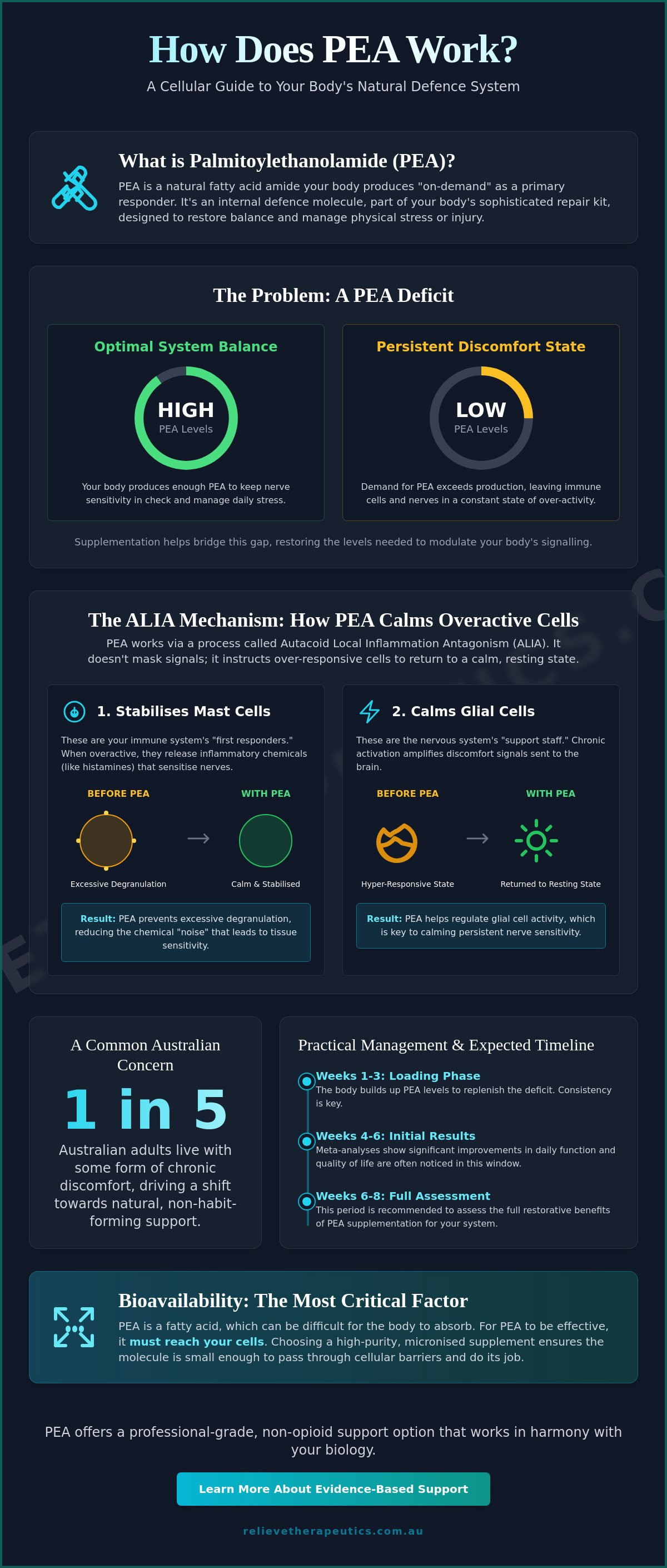
Your body synthesises Palmitoylethanolamide (PEA) directly from cell membrane phospholipids. This process is a precise, elegant response to cellular distress. When your system is functioning optimally, this natural production is enough to keep sensitivity in check. Unfortunately, during periods of persistent discomfort, the demand for PEA often exceeds the body's ability to produce it. This creates a "PEA deficit," leaving your nerves and immune cells in a state of constant over-activity. Shifting from a natural internal molecule to a high-purity dietary supplement allows you to bridge this gap, restoring the levels required to successfully modulate your body's signalling pathways.
Why Australians are Turning to Natural Support
The search for reliable, non-habit-forming support is growing rapidly across the country. Current data indicates that one in five Australian adults live with some form of chronic discomfort, a reality that impacts daily function and emotional wellbeing. Many people find themselves sensitive to the side effects of traditional pharmaceuticals or are simply wary of long-term reliance on synthetic options. There is a clear, documented shift toward non-prescription support goals. Australians are increasingly prioritising solutions that work in harmony with their biology, seeking out evidence-based compounds like PEA that offer a pathway to restoration without the heavy burden of systemic side effects. This movement reflects a broader commitment to long-term health and sustainable vitality.
The Cellular Mechanism: Calming the Glial and Mast Cells
To truly grasp how does PEA work for pain, we must look at a process known as ALIA (Autacoid Local Inflammation Antagonism). This mechanism represents the body's natural method of down-regulating overactive cells. When your system is under stress, certain cells become hyper-responsive, leading to a cycle of persistent discomfort. PEA intervenes by binding to specific receptors that instruct these cells to return to a resting state. It is a targeted, biological approach that addresses the root of cellular irritation rather than merely masking the sensation.
By focusing on the underlying cellular environment, PEA helps restore stability to your tissues. This process is disciplined, evidence-based, and essential for those seeking a non-habit-forming support option. Supporting this cellular balance with high-quality PEA capsules can provide the necessary foundation for long-term comfort and improved daily function.
Mast Cells and the Inflammatory Response
Mast cells are the "first responders" of your immune system. They reside in almost every tissue and are responsible for detecting potential threats. When triggered, they undergo a process called degranulation, where they release a flood of histamines, cytokines, and other inflammatory chemicals. While this response is vital for acute healing, chronic activation causes these chemicals to constantly sensitise nearby nerve endings. PEA acts as a natural stabiliser for these cells. It prevents excessive degranulation, thereby reducing the chemical "noise" that leads to tissue sensitivity and prolonged recovery times. This stabilisation is a key step in breaking the cycle of recurring discomfort.
Glial Cells: The Key to Persistent Nerve Sensitivity
While mast cells handle the immune response, glial cells manage the nervous system's "support staff." In the brain and spinal cord, glia play a critical role in nerve signalling. However, when glia become overactive, they contribute to neuro-inflammation, a state where the "volume" of pain signals is effectively turned up. This phenomenon, often called "wind-up," makes the nervous system hyper-sensitive to even minor stimuli. PEA acts as a biological dimmer switch for these overactive cells, lowering the intensity of glial activity to prevent the nervous system from remaining in a state of high alert. Through this modulation, PEA helps decrease the release of pro-inflammatory markers, allowing your nerves to communicate more calmly and accurately. This restoration of balance is vital for anyone looking to reclaim their vitality and move through the day with greater ease.
PEA and the Endocannabinoid System: The Entourage Effect
While the cellular actions on mast and glial cells provide immediate relief, the broader question of how does PEA work for pain involves its sophisticated interaction with the endocannabinoid system (ECS). PEA is technically classified as an "endocannabinoid-like" molecule. It does not bind directly to the primary receptors typically found in the brain and immune system. Instead, it acts as a synergistic partner that enhances the body's existing regulatory pathways. This collaborative action is often referred to as the "entourage effect," where the presence of one compound amplifies the efficacy and duration of another.
Traditional pharmaceutical approaches often rely on "blocking" pathways, which can lead to a range of systemic side effects. In contrast, understanding how does PEA work for pain reveals a more nuanced strategy. It encourages the body to use its own resources more efficiently. This method is disciplined, evidence-based, and deeply respectful of the body's natural intelligence. It provides a reliable ally for those seeking a long-term path toward vitality that feels both safe and sustainable.
PPAR-Alpha: The Master Controller
Activation of the PPAR-alpha receptor is the primary mechanism through which PEA exerts its influence. By binding to this nuclear receptor, PEA effectively switches off the expression of genes that drive pro-inflammatory responses. This is a master control function that supports long-term metabolic and nerve health. Unlike traditional "blocker" medications that temporarily halt a signal, this approach restores the cellular environment to a state of calm, stability, and balance.
Supporting Your Body's Own Bliss Molecule
The relationship between a PEA endocannabinoid supplement and your body's internal chemistry is built on the "entourage effect." PEA prevents the breakdown of Anandamide, your body's own soothing molecule, keeping its levels elevated for longer. This support is vital for maintaining homeostasis and equilibrium. By working with your biology rather than against it, PEA encourages a natural return to daily comfort, restoration, and physical vitality.
The Science of Absorption: Why Bioavailability Matters
While understanding the biological mechanisms is essential, the practical efficacy of this molecule depends entirely on its ability to enter your bloodstream. Palmitoylethanolamide is a large, fat-soluble molecule. By its very nature, it is difficult for the human digestive tract to absorb. In its standard form, PEA particles are often too large to pass efficiently through the intestinal wall. This physical barrier is the primary reason why many people fail to see results with generic powders. When considering how does PEA work for pain, we must acknowledge that its restorative potential is only realised if the compound reaches the target cells in sufficient concentrations.
To overcome this challenge, high-purity formulations utilise a process called micronisation. This involves reducing the particle size into the micrometre range. Smaller particles create a significantly larger total surface area. This increased area allows the body's digestive enzymes to break down and absorb the fatty acid much more effectively. It is a precise engineering solution to a biological hurdle, ensuring that the active ingredients are actually utilised by your system rather than simply passing through it.
Micronised vs. Standard PEA
Absorbing fatty substances in a water-based digestive environment presents a unique physical challenge. Standard PEA powder often suffers from a "clumping" effect, where large particles stick together and resist dissolution. Micronisation bypasses this issue entirely by ensuring each particle remains distinct and accessible. This is why high quality PEA capsules prioritise specific particle sizes as a benchmark for efficacy. Choosing a micronised version means you aren't just taking a supplement; you're ensuring that the science of restoration is physically capable of working within your body.
Maximising Your Daily Intake
Enhancing your results often involves simple adjustments to your daily routine. Taking your capsule with a meal that contains healthy fats can significantly assist the transport of PEA into your system. Consider these practical steps:
- Consume your supplement alongside avocado, olive oil, or eggs.
- Maintain a consistent daily schedule to keep levels steady.
- Allow for a loading period to assess the full biological impact.
Consistency remains equally important for those investigating how does PEA work for pain over extended periods. Maintaining steady levels in the body allows the PPAR-alpha receptors and glial cells to remain modulated without interruption. Rapid absorption is critical for initiating a response in acute scenarios, whereas consistent bioavailability provides the steady-state support required for managing chronic nerve sensitivity. To begin your journey with a formulation designed for optimal uptake, you can order micronised PEA capsules here.
Implementing PEA into Your Management Programme
Integrating a new supplement into your daily routine requires a shift in perspective. Unlike fast-acting synthetic options that provide a temporary "mask," PEA works by gradually modulating your body's internal signalling systems. This biological restoration takes time. Understanding how does PEA work for pain highlights that the molecule must reach steady-state levels within your tissues to effectively calm overactive glial and mast cells. Most clinical observations suggest a window of six to eight weeks is necessary to fully assess the restorative benefits and improved daily function.
Safety is a cornerstone of this natural approach. PEA possesses a high safety profile and is generally well-tolerated, which allows it to be used alongside other supplements or existing therapies. It does not carry the same risk of dependency or systemic burden as many traditional pharmaceuticals. This makes it an ideal partner for long-term health journeys. By prioritising patience, consistency, and professional guidance, you can create a sustainable path toward comfort and vitality.
Finding Your Optimal Routine
Success with Palmitoylethanolamide is built on a disciplined schedule. Learning how to take PEA for nerve pain effectively involves more than just the dosage; it is about timing and tracking. We recommend keeping a simple daily log during the first two months. Note your comfort levels, your ability to perform daily tasks, and your overall energy. This data provides clarity during your loading period. It is also a valuable resource to share when consulting with your healthcare professional to tailor the programme to your specific biological needs.
Choosing the Right Supply for Your Journey
Selecting the correct supply size is a strategic decision that ensures you don't run out during the critical initial phase. For those just beginning, a PEA 120 capsules pack is often considered the "sweet spot." It provides enough supply to cover the essential eight-week assessment period without interruption. Once you have established your baseline and recognised how does PEA work for pain in your own life, moving to bulk supplies of 180 capsules offers a practical and cost-effective solution for long-term maintenance. You can explore our range of pure, micronised capsules at Relieve Therapeutics to start your journey toward natural, science-backed support today.
Reclaiming Your Vitality Through Biological Support
Understanding how does PEA work for pain reveals a pathway to comfort that respects your body's natural chemistry. By calming overactive immune cells and modulating nerve signalling through the ALIA mechanism, PEA offers a sophisticated alternative to traditional blockers. Success depends on choosing a micronised formulation to ensure the fatty acid is actually absorbed and utilised by your system. Consistency is your greatest ally during the initial loading phase as your body restores its internal balance and equilibrium.
This biological approach is mirrored in wider research; to learn more about how different molecules are examined in cellular studies, you can explore the findings provided by EuroLab Peptides.
As a specialist Australian retailer, we are committed to providing pure PEA formulations that meet the highest standards of quality and transparency. You deserve a partner who values substance over hype in your health journey. We provide fast local shipping across Australia to ensure your supply remains consistent and reliable throughout your programme. Order your high-quality PEA capsules from Relieve Therapeutics today and take the first step toward restored daily function. You don't have to navigate this journey alone; we are here to support your return to a more comfortable and active life.
Frequently Asked Questions
Is PEA a type of cannabinoid like CBD?
PEA is not a cannabinoid, though it is often described as an "endocannabinoid-like" molecule. While CBD interacts with the endocannabinoid system (ECS) through specific receptors, PEA primarily works through the PPAR-alpha receptor. It supports the ECS indirectly by preventing the breakdown of your body's own soothing molecules, creating what scientists call the entourage effect.
How long does it take for PEA to start working for pain?
You should expect a loading period of approximately four to six weeks before noticing significant restorative benefits. Because PEA modulates cellular activity rather than blocking signals instantly, it requires time to reach steady-state levels in your tissues. Most clinicians suggest a full eight-week trial to accurately assess how does PEA work for pain in your specific situation.
Can I take PEA with my current prescription medications?
PEA has a high safety profile and is generally considered safe to take alongside other supplements or prescription medications. Clinical studies haven't identified significant drug-drug interactions, largely because it's a molecule your body already produces naturally. It's always best practice to consult with your GP or specialist before starting any new supplement to ensure it aligns with your specific management programme.
Does PEA have any common side effects?
Clinical trials and real-world studies report that PEA is exceptionally well-tolerated with minimal side effects. Unlike many traditional pharmaceutical options, it doesn't cause drowsiness, gastric irritation, or dependency. In rare cases, some individuals might experience mild digestive discomfort, but this is uncommon and usually resolves quickly as the system adapts.
What is the difference between standard and micronised PEA?
The primary difference lies in the particle size and your body's ability to absorb the compound. Standard PEA consists of large, fat-soluble particles that the gut often finds difficult to process, leading to poor bioavailability. Micronised PEA has been engineered into tiny particles in the micrometre range, which significantly increases the surface area for absorption and ensures the active ingredients reach your cells effectively.
How many PEA capsules should I take each day for best results?
Most clinical research utilises a daily intake ranging from 600mg to 1200mg, typically divided into two doses. Taking one capsule in the morning and another in the evening helps maintain consistent levels in your system. For the best results, we recommend following the specific guidance on your product label or the advice provided by your healthcare professional.
Is Palmitoylethanolamide safe for long-term daily use?
Yes, Palmitoylethanolamide is considered safe for long-term daily use because it's an endogenous substance. Your cells already produce this fatty acid to manage inflammation and protect tissues. Unlike some synthetic options that may lose efficacy over time, PEA remains a reliable ally for sustained support without the risk of habit-forming effects or systemic toxicity.
Can PEA help with specific conditions like sciatica or fibromyalgia?
Research validates the use of PEA for various chronic conditions involving nerve sensitivity, including sciatica and fibromyalgia. By calming overactive glial cells and mast cells, it helps lower the "volume" of persistent signals that characterise these conditions. Understanding how does PEA work for pain allows you to see it as a targeted way to restore balance to a hyper-sensitive nervous system.