

The most expensive supplement you'll ever buy is the one your body cannot actually use. If you've been managing persistent nerve-related discomfort, you've likely felt the frustration of investing in health products that simply don't deliver on their promises. Many Australians are now turning to ultramicronised pea to bridge this gap, yet the technical science behind it often remains shrouded in jargon. You aren't alone in wanting a solution that prioritises results and transparency over complex marketing claims.
The missing link in your recovery journey is often found in particle size. Because Palmitoylethanolamide is a lipid, it's naturally difficult for the human gut to break down and absorb effectively. This article will explain why ultramicronisation is a biological necessity that ensures the support actually reaches your cells. We'll demystify the science of superior absorption and show how the right particle size leads to improved daily comfort, giving you the confidence to choose the right Australian supplement for your needs in 2026.
Key Takeaways
- Grasp the biological necessity of particle reduction and how milling PEA to below 10 micrometres overcomes the body's natural absorption barriers.
- Compare the clinical efficacy of ultramicronised pea against standard versions to understand why a smaller particle size translates to better value and biological availability.
- Learn about the 'saturation point' and why maintaining a consistent daily routine is vital for supporting nerve health and comfort over the long term.
- Navigate the Australian market with confidence by knowing exactly what to look for on a label to ensure you're receiving a high-purity, practitioner-grade product.
What is Ultramicronised PEA? Defining the Gold Standard
To understand the efficacy of ultramicronised pea, we must first look at its biological foundation. Palmitoylethanolamide (PEA) is an endogenous lipid, meaning it's a fatty acid molecule your body produces naturally to manage discomfort and protect nerve tissues. While the body creates its own supply, chronic conditions often deplete these levels, leaving the nervous system without its primary regulatory support. Supplementation provides a way to replenish this vital molecule, but the physical form of the supplement determines whether it actually reaches your bloodstream.
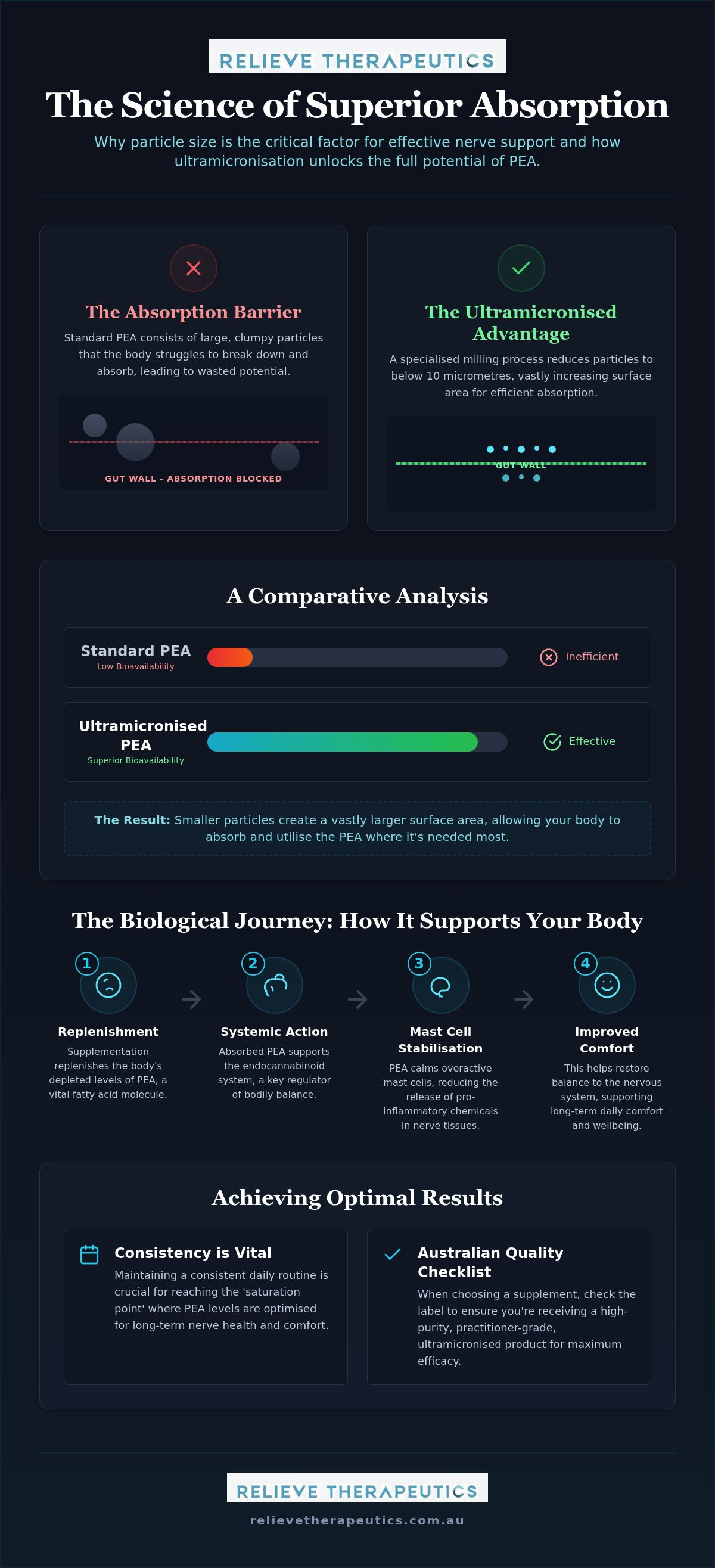
The primary challenge with standard PEA is its physical structure. In its raw, non-processed state, the particles are large and tend to clump together. This causes standard PEA to behave like clumpy sand in the digestive system, where the body struggles to break it down before it passes through the gut unabsorbed. Ultramicronisation is a specialised milling process that reduces these particle sizes to below 10 micrometres. Ultramicronisation is the process of increasing surface area for optimal lipid absorption. By transforming the physical state of the molecule, we ensure that the body can utilise the support it's being given.
The Role of PEA in the Endocannabinoid System
Within your body, PEA acts as a sophisticated support molecule for the endocannabinoid system. It doesn't function like a foreign drug that forces a change; instead, it works with your natural regulatory systems to restore balance. One of its most critical roles involves mast cell stabilisation in nerve tissues. When mast cells become overactive, they release pro-inflammatory chemicals that can lead to persistent discomfort. PEA helps to quieten these cells, acting as a natural fatty acid that signals the body to reduce its own inflammatory response. It's a biological partner in your recovery, providing the stability your nervous system needs to function correctly.
Standard vs Ultramicronised: The Surface Area Secret
The difference between standard and ultramicronised pea comes down to basic physics. Larger particles have significantly less surface area relative to their volume, which creates a massive bioavailability hurdle. Because PEA is fat-soluble, it needs to dissolve in the fatty environment of the gut to be absorbed. Smaller particles allow for much faster dissolution, ensuring the molecule is ready for uptake before it leaves the digestive tract. Without this reduced particle size, most of the supplement is simply wasted. Choosing an ultramicronised version ensures that you aren't just buying a product, but actually providing your body with a format it can recognise, process, and use for long-term comfort.
The Science of Absorption: Why Particle Size Matters
Pharmacokinetics is the study of how your body moves a molecule from the stomach into the bloodstream. It's a complex journey. For a compound to be effective, it must first cross the intestinal barrier. This is where the 'Lipinski Rule of Five' presents a challenge. This rule helps scientists predict how well a substance will be absorbed based on its physical properties. Because PEA is fat-soluble, it naturally resists dissolving in the gut's watery environment. Clinical research demonstrates that ultramicronised pea achieves significantly higher blood plasma levels than standard versions, providing the concentration required to support nerve tissues effectively.
The size of the particle directly influences the ALIA (Autacoid Local Inflammation Antagonism) mechanism. This is the biological process where the body regulates its own inflammatory signals. If the particles are too large, they're simply excreted before they can trigger this response. High-quality absorption ensures the molecule is available when and where it's needed most. It's the difference between a supplement that works and one that's wasted.
Breaking Down the ALIAmide Mechanism
PEA acts as a multifunctional molecule for neuroprotection by calming overactive mast cells. These cells are often the culprits behind persistent nerve discomfort. When they're overstimulated, they release chemicals that keep the nervous system in a state of high alert. Rapid absorption allows the PEA to reach these cells efficiently. Scientific data shows a clear dose-response relationship, where smaller particles lead to a more predictable and effective biological response.
From Lab to Capsule: The Milling Process
To reach these microscopic dimensions, manufacturers use jet-milling technology. This process uses high-pressure air to crash particles into each other until they reach the desired size. It's a cold process, which is vital because it prevents heat damage to the delicate fatty acid. While 'micronised' PEA typically ranges from 2 to 10 microns, ultramicronised pea is refined even further to between 0.8 and 2 microns. This precision ensures maximum surface area for dissolution. Choosing a reliable Australian option, such as PEA 180 Capsules, ensures you're getting a product designed for long-term consistency and optimal uptake.
Ultramicronised vs Standard PEA: A Comparative Analysis
Comparing standard and ultramicronised versions reveals why many users fail to see results with generic options. Standard PEA particles are often significantly larger than the microscopic threshold required for efficient uptake. This isn't just a manufacturing detail; it's a barrier to recovery. When you choose ultramicronised pea, you're investing in a format that bypasses the physical limitations of the digestive tract. It's the difference between a molecule that stays in the gut and one that reaches the nerve tissues where it's needed most.
Cost-efficiency is often misunderstood in the supplement industry. A more expensive, well-absorbed supplement is actually cheaper per effective dose because none of the active ingredient is wasted. Standard PEA might look better on the shelf, but if only a fraction reaches your bloodstream, the cost per milligram of absorbed support is drastically higher. True value lies in efficacy, transparency, and results. Choosing a high-quality Australian supplement ensures you aren't just spending money, but actually supporting your body's natural regulatory systems.
Why Standard PEA Often Leads to Disappointment
Large lipid particles naturally attract each other, creating a clumping effect in the intestinal tract. This physical clustering prevents the molecule from interacting with the gut lining, which is why people often switch to ultramicronised after seeing no results with standard. Understanding how does PEA work for pain helps clarify why these physical properties are so critical. Without the specialised milling process, the body simply cannot break down these clusters fast enough to be useful. This leads to a cycle of frustration for those managing persistent discomfort.
The Clinical Evidence for Ultramicronisation
Clinical trials involving thousands of patients have consistently shown superior results for nerve support with reduced particle sizes. A meta-analysis of clinical trials included 786 patients who received PEA for various discomforts, highlighting its effectiveness when delivered in a bioavailable format. This research is particularly relevant for those seeking palmitoylethanolamide sciatica support, where targeted nerve health is the priority. Identifying 'filler' PEA requires a discerning eye; always look for labels that explicitly state the micronisation process to ensure you're getting practitioner-grade quality. This level of scientific rigour is what separates professional support from standard retail options.
How to Use Ultramicronised PEA for Optimal Results
Achieving the best outcomes with ultramicronised pea requires a strategic approach rather than sporadic use. Unlike some synthetic options that provide a temporary masking effect, PEA works by replenishing your body's natural lipid levels. This process involves reaching a 'saturation point' where the concentration of Palmitoylethanolamide in your tissues is high enough to effectively stabilise mast cells and support nerve health. Most users find that it takes time to build up in the system, meaning patience and persistence are your greatest allies in the early stages of supplementation.
Consistency is the foundation of success. Taking your capsules at the same time each day helps maintain steady blood plasma levels, ensuring your nervous system receives uninterrupted support. To further enhance the efficiency of your ultramicronised pea, we recommend taking it with a meal that contains healthy fats, such as avocado, eggs, or olive oil. Because PEA is lipophilic, these fats act as a natural carrier, helping the microscopic particles move even more effectively through the intestinal wall and into your circulation.
Dosage Guidelines for Nerve Support
A structured protocol is often the most effective way to establish a baseline of support. For the first 4 to 8 weeks, many clinical practitioners suggest a 'loading phase' of 1200mg per day. This higher concentration helps the body reach the saturation point more rapidly. Once you've established a comfortable baseline, you can typically transition to a maintenance dose of 600mg per day to sustain long-term nerve health. For a more detailed breakdown of these protocols, you can refer to our PEA dosage for pain guide.
Safety, Contraindications, and TGA Context
In Australia, PEA is regulated by the Therapeutic Goods Administration (TGA) as a complementary medicine, ensuring high standards of quality and safety for consumers. One of the primary reasons Australians choose this natural fatty acid is its high tolerability. Unlike many standard nerve support options, PEA doesn't typically cause the 'brain fog', drowsiness, or cognitive heaviness that can interfere with daily life. It's considered safe for long-term use and doesn't generally interact with common medications, though we always recommend consulting your GP before starting any new supplement regime. To begin your journey with a high-purity, Australian-owned option, you can shop our range of ultramicronised PEA capsules today.
Sourcing Quality Ultramicronised PEA in Australia
Buying locally within Australia isn't just about convenience; it's about accountability and safety. When you source your ultramicronised pea from an Australian owned and operated specialist, you benefit from stringent quality control measures that international marketplaces often lack. Shipping times are significantly reduced, ensuring your routine isn't interrupted by long transit delays or customs holdups. More importantly, Australian suppliers operate within a regulated environment that prioritises consumer safety, providing peace of mind that what's on the label is exactly what's inside the capsule.
A common mistake many people make is assuming that 'Pure PEA' is the same as 'Ultramicronised PEA'. While purity is a baseline requirement, the particle size is what dictates whether the supplement is actually bioavailable. If a label doesn't explicitly state the micronisation process, the product likely contains the larger, clumpy particles that the human gut struggles to absorb. For those managing persistent discomfort, these technical details are the difference between a wasted investment and genuine biological support. Precision milling is a mark of a practitioner-grade product.
Relieve Therapeutics: Precision and Purity
We believe in transparency and professional care. Our commitment to quality means providing high-quality PEA without unnecessary additives, allergens, or fillers. We understand that every individual's journey is unique, which is why we offer flexible options to suit your specific stage of support. Our range includes 60, 120, and 180-capsule counts, allowing you to choose the volume that best fits your management plan. For those looking to maintain their progress after the initial loading phase, our PEA 120 capsules provide a balanced approach to sustained natural support.
Your Next Steps Toward Natural Support
Starting a new health routine should be a clear and confident process. For those new to Palmitoylethanolamide, a 60-capsule starter pack is an ideal way to begin and assess your body's response. However, because nerve support is a long-term commitment that relies on reaching a saturation point, savvy Australian buyers often choose our 180-capsule pack. This bulk option ensures you have a consistent, uninterrupted supply through the critical early weeks and into the maintenance phase. We're here to act as your reliable ally, providing the evidence-based tools you need for improved daily comfort and mobility. Order your ultramicronised PEA from Relieve Therapeutics today and experience the difference that precision science makes to your wellness journey.
Empowering Your Path to Natural Nerve Support
Understanding the science behind particle size transforms how you approach your recovery. You've seen why ultramicronised pea is a biological necessity; it overcomes the absorption hurdles that lead standard supplements to fail. By prioritising a format that your body can actually use, you're moving away from the frustration of wasted investments and toward a future of improved daily comfort. Remember that consistency is your greatest ally. Reaching your saturation point takes time, but the reward is a stabilised nervous system and restored mobility.
Choosing a dedicated Australian partner ensures you receive the transparency and quality your health deserves. Relieve Therapeutics provides a high-quality ultramicronised formula backed by our commitment to being 100% Australian owned. With fast local shipping across the country, your journey toward natural support is never interrupted by long delays. You now have the knowledge to make an informed choice; it's time to take the next step toward reclaiming your vitality. Shop Premium Ultramicronised PEA Capsules at Relieve Therapeutics and experience the difference that precision science makes to your daily life. Better comfort is within your reach.
Frequently Asked Questions
Is ultramicronised PEA better than standard PEA?
Yes, ultramicronised pea is superior because it overcomes the body's natural absorption barriers. Standard PEA consists of large, clumpy particles that the human gut cannot easily break down. By reducing the particle size to below 10 micrometres, the surface area increases significantly, allowing for faster dissolution and higher blood plasma levels. This ensures the molecule actually reaches the nerve tissues instead of passing through the system unutilised.
How long does it take for ultramicronised PEA to start working?
PEA is not a fast-acting medication; it requires a cumulative period to reach a biological saturation point. While some individuals notice subtle shifts within the first two weeks, clinical protocols typically suggest allowing 4 to 8 weeks of consistent daily use to experience the full benefits. This timeframe allows the lipid levels to build up in your system and effectively stabilise overactive mast cells.
Can I take ultramicronised PEA with my other medications?
PEA is an endogenous fatty acid that generally shows a very low risk of interaction with common medications. It doesn't typically interfere with the metabolic pathways used by most pharmaceutical options. However, your safety is paramount. We always recommend consulting your GP or healthcare specialist before adding any new supplement to your regime, especially if you are managing complex health conditions.
Does ultramicronised PEA have any side effects?
Ultramicronised PEA is considered highly tolerable and is not associated with the common side effects of standard nerve support options. It doesn't cause drowsiness, cognitive fog, or physical dependence. In very rare cases, some users may experience mild gastrointestinal discomfort. Because it's a molecule your body already produces naturally, it's widely regarded as a safe and gentle option for long-term use.
Why is ultramicronised PEA more expensive than regular versions?
The higher cost reflects the specialised manufacturing process required to achieve microscopic particle sizes. Jet-milling technology is a sophisticated, cold-process technique that ensures the fatty acid's integrity is preserved while reducing it to sub-10-micron dimensions. While the initial price is higher, it represents better value because you aren't wasting money on large particles that your body cannot absorb.
Do I need a prescription to buy ultramicronised PEA in Australia?
No, you don't need a prescription to purchase PEA in Australia. It's available over-the-counter and is regulated as a complementary medicine by the Therapeutic Goods Administration (TGA). This regulatory oversight ensures that Australian consumers have access to high-quality, practitioner-grade supplements without the need for a clinical appointment, making it a convenient option for natural support.
Can I take PEA long-term for chronic nerve support?
Yes, long-term use is both common and appropriate for managing chronic nerve-related discomfort. Since PEA is a natural component of your body's regulatory system, it doesn't lose efficacy over time or lead to tolerance issues. Maintaining a steady daily intake helps sustain the protective environment your nerves need to function comfortably, making it a reliable ally for ongoing wellness.
What is the best time of day to take PEA capsules?
Consistency is more important than the specific hour, though we recommend taking your capsules with a meal containing healthy fats. Since ultramicronised pea is fat-soluble, consuming it alongside avocado, eggs, or olive oil can further assist the absorption process. Choosing a regular time, such as with breakfast or dinner, helps you maintain a steady routine and ensures your body receives a constant supply of support.