

If your supplement is too large to enter your bloodstream, you aren't actually supporting your body; you're simply passing an expensive ingredient through your system. You've likely spent time and money trying to manage persistent nerve or joint discomfort, only to feel let down by products that don't seem to make a difference. It's a common frustration, and often, the fault isn't with the ingredient itself but with its delivery. When comparing ultra-micronised vs standard PEA, the primary difference isn't just a marketing label. It's a fundamental biological requirement for absorption.
We understand that navigating technical jargon can be exhausting when you just want to feel better. You deserve transparency and evidence-based information to make the right choice for your wellbeing. In this article, you'll discover the critical scientific distinction between these two forms and why ultra-micronisation is essential for maximum efficacy. We'll break down the science of bioavailability, discuss the current 2025 TGA landscape for Australian supplements, and provide a clear framework for choosing a reliable source that delivers real results.
Key Takeaways
- Discover why the lipid nature of PEA causes natural clumping and how this physical barrier often prevents standard supplements from reaching your bloodstream.
- Understand the critical distinction between ultra-micronised vs standard PEA, focusing on how particle sizes under 10 micrometres significantly enhance bioavailability.
- Review the clinical evidence demonstrating that reduced particle size leads to superior pharmacokinetics and a faster onset of action for those seeking relief.
- Learn to identify genuine technical specifications on supplement labels, helping you look past marketing fluff to find truly effective Australian-made options.
- Acquire the knowledge needed to choose a reliable supplement that ensures your investment in health translates into measurable daily comfort.
The Bioavailability Challenge: Why Standard PEA Often Falls Short
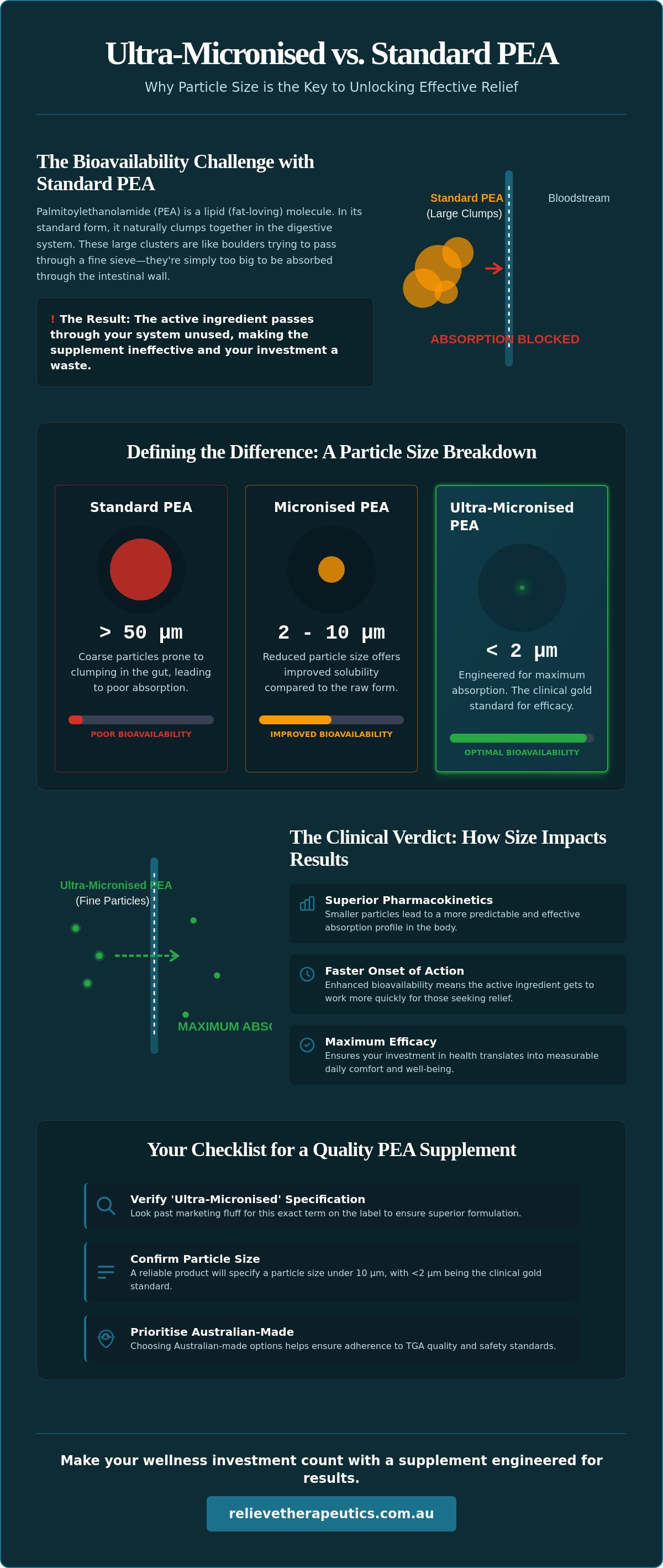
To understand why some supplements provide life-changing relief while others feel like a waste of money, we have to look at the underlying chemistry. Palmitoylethanolamide (PEA) is a fatty acid amide, which classifies it as a lipid. In practical terms, this means it's a "fat-loving" molecule that doesn't dissolve in water. While this lipid structure is exactly what allows it to interact with our cell membranes, it creates a significant hurdle for digestion. When you swallow a standard PEA capsule, these fat-soluble molecules naturally gravitate toward one another, forming large, irregular clumps that are difficult for the body to break down.
The human intestinal tract acts as a sophisticated gatekeeper. To enter the bloodstream, a substance must be broken down into a size that can be transported across the delicate intestinal barrier. Large clusters of standard PEA often fail this "size test." When evaluating ultra-micronised vs standard PEA, the core issue is that what you swallow isn't always what you absorb. If the particles remain too large, they simply cannot bypass the gut wall, leaving the active ingredient stuck in the digestive system rather than reaching the nerves or joints where it's needed most.
The 'Large Particle' Problem in Modern Supplements
Visualise standard PEA particles as large "boulders." If you try to pass a bucket of boulders through a fine kitchen sieve, the result is predictable; they sit on top, unable to move through the mesh. This is a precise analogy for how unmicronised supplements behave in the gut. Because the body cannot efficiently emulsify these dense lipid clusters during their relatively short transit time, the unabsorbed PEA simply passes through the digestive tract unused. This is often the hidden reason behind "non-responders." These individuals aren't resistant to the benefits of PEA; they're simply using a format that their biology cannot process. It's a frustrating experience that often leads people to abandon a potentially helpful solution simply because the delivery method was flawed.
Why Your Body Needs a Helping Hand with Lipids
Our bodies are remarkably familiar with this compound. We produce PEA naturally in response to tissue stress or discomfort, but our internal production is highly localised and occurs in tiny, precise amounts exactly where it's needed. Supplementation, however, requires the molecule to travel from the stomach to the rest of the body. This is why how does PEA work for pain is a question that cannot be answered without discussing particle size. To make external supplementation effective, we must reduce the particle size to a level that mimics the body's own specialised delivery. Without this technical intervention, the difference between ultra-micronised vs standard PEA becomes the difference between a supplement that works and one that is simply excreted. High purity is only half the battle; without absorption, even the purest ingredient remains silent within the body.
Defining the Difference: Micronised vs Ultra-Micronised PEA
Micronisation is the technical process of reducing the average diameter of a solid material's particles through controlled mechanical force. When we evaluate the spectrum of ultra-micronised vs standard PEA, we are looking at three distinct categories of particle size that dictate how your body responds to the supplement. These tiers are not merely marketing labels; they represent significant differences in engineering and biological compatibility.
- Standard PEA: Particles are typically larger than 50 micrometres (μm). These are coarse and, as established, are highly prone to clumping in the gut.
- Micronised PEA: Particles are reduced to a range between 2 and 10 micrometres (μm), which improves solubility compared to the raw form.
- Ultra-Micronised PEA: This is widely considered the gold standard in clinical supplementation, featuring particles engineered to be smaller than 2 micrometres (μm).
The difference between 50 μm and 2 μm is more than just a number. It represents a fundamental shift in how the lipid behaves when it encounters your digestive enzymes. Because researchers want to objectively test the effectiveness of this compound in rigorous settings, they almost exclusively utilise these smaller formats to ensure consistent, measurable results across study participants.
The Physics of Surface Area
The physics of surface area explains why these tiers matter so much for your comfort. Imagine a single large sugar cube. It has a limited surface area exposed to liquid, meaning it dissolves slowly from the outside in. If you crush that same volume into fine icing sugar, the total surface area increases exponentially, allowing for near-instant dissolution. Ultra-micronisation is the mechanical reduction of particles to enhance dissolution, ensuring the lipid can interact with the aqueous environment of your digestive tract rather than sitting as an inert mass. Smaller particles provide more "entry points" for the body to process the nutrient.
Ultra-Micronisation: The Technological Edge
Achieving "ultra" status is not a simple feat of grinding. It requires specialised jet-milling equipment that uses high-pressure air to collide particles at high speeds until they reach the desired sub-2-micron size. This process is complex, time-consuming, and significantly more expensive than simple grinding, which justifies the premium price point of high-quality formulations. These ultra-fine particles can bypass the digestive hurdles that stop standard particles, moving through the intestinal wall with far greater efficiency. If you are looking for a supplement that respects your biology, choosing a professionally micronised PEA is the most reliable way to ensure you are receiving the gold standard in absorption technology.
The Clinical Verdict: How Particle Size Impacts Your Results
Clinical data provides a clear window into how your body processes different supplement formats. When we examine the data surrounding ultra-micronised vs standard PEA, the most striking difference is found in pharmacokinetics; the study of how a substance moves through the body. Standard PEA often yields erratic results because its absorption is inconsistent. One day you might absorb a small amount, and the next, almost nothing at all. Ultra-micronised versions, however, offer a predictable "onset of action." This means the time between taking a capsule and feeling its support is shorter and more reliable.
This reliability is vital for long-term management. Because the absorption is so much more efficient, calculating the correct PEA dosage for pain becomes a straightforward task rather than a guessing game. You can trust that the amount listed on the label is actually reaching your system. Over time, this creates a "cumulative effect" where consistent blood levels provide steady support, rather than the "peaks and troughs" associated with poorly absorbed formats.
Bioavailability: The Only Metric That Matters
Bioavailability refers to the proportion of a supplement that successfully enters your circulation. In clinical trials, ultra-micronised PEA consistently demonstrates significantly higher plasma concentration levels than its standard counterparts. This isn't just a lab finding. It has direct implications for your wellbeing. Higher bioavailability ensures that the PEA can effectively interact with your endocannabinoid system, supporting the body's natural pathways for dampening discomfort and soothing overactive nerves. If the molecule cannot reach these receptors, it cannot perform its biological function.
Efficacy in Chronic Conditions
For those searching for an effective supplement for neuropathy Australia, particle size is a non-negotiable factor. Nerve-related conditions, such as sciatica or fibromyalgia, involve complex signalling pathways that require a steady, reliable supply of PEA to help regulate mast cell activity. Standard PEA often fails in these complex cases because the "on-off" nature of its absorption doesn't provide the constant support the nervous system requires. Smaller particle sizes ensure that the compound is available around the clock, offering a level of stability that coarse powders simply cannot match. This clinical precision is what transforms a supplement from a hopeful trial into a dependable part of your daily routine.
Choosing Your Supplement: What Australians Should Look for on the Label
Selecting a supplement shouldn't feel like a gamble, yet the shelves are often crowded with vague promises and confusing terminology. In Australia, we are fortunate to have some of the most rigorous therapeutic standards in the world. However, even within a regulated market, the difference between ultra-micronised vs standard PEA can be obscured by clever branding. To ensure your investment translates into physical comfort, you must look beyond the front of the bottle and scrutinise the technical specifications.
A primary indicator of quality is the mention of Good Manufacturing Practice (GMP). This certification ensures that the product is made in a clean, controlled environment and that the contents match the label exactly. When you buy from a local Australian specialist rather than a generic international marketplace, you gain a level of quality control that is often missing in cross-border transactions. Local specialists are accountable to Australian standards, providing a layer of safety and transparency that protects your health and your wallet.
Reading the Fine Print
Transparency is the hallmark of a professional supplement. When reading a label, look for specific mentions of the milling process or the resulting particle size. If a product hides behind a "proprietary blend" without stating the specific PEA type, it's often a sign that standard, unmicronised powder is being used to cut costs. You should also check for unnecessary fillers or additives. A clean formulation ensures that nothing interferes with the absorption process we've discussed in previous sections, keeping the focus entirely on your restoration.
The Value Proposition: Price vs. Performance
It's tempting to choose the largest bottle with the lowest price tag, but this is often a false economy. A cheaper 180-pack of standard PEA might actually be more expensive when you calculate the "cost per absorbed milligram." If your body only absorbs a fraction of a coarse powder, you're essentially paying for a product that your system cannot use. We encourage you to think in terms of "cost per result" rather than "cost per capsule." For those new to this journey, starting with a PEA 60 capsules pack is a sensible way to test efficacy without a long-term commitment. By choosing a high-absorption format from the outset, you give your body the best possible chance at finding the relief it deserves.
If you're ready to experience the difference that clinical-grade particle size makes, you can browse our range of ultra-micronised PEA designed specifically for those who value science-backed quality.
Elevating Your Wellness Journey with High-Quality PEA
We've explored the biological hurdles that often render standard supplements ineffective. Particle size isn't just a minor detail; it's the "secret ingredient" that determines whether a lipid compound like PEA remains an inert mass in the gut or becomes a functional tool for your nervous system. By prioritising absorption, you ensure that your body receives the support it needs to maintain daily comfort and vitality. This transition from coarse powders to precision-engineered particles marks the difference between a supplement that merely exists and one that truly performs.
The decision between ultra-micronised vs standard PEA is ultimately a choice between hope and evidence. We understand the physical and emotional toll that persistent discomfort takes on your life. Seeking out natural, non-opioid support is a proactive and dignified step toward reclaiming your quality of life. It reflects a commitment to long-term wellness that avoids the heavy-handed approach of more aggressive interventions, favouring instead the body's own regulatory pathways for restoration and balance.
Why Relieve Therapeutics Favour Precise Standards
Our commitment to your health is grounded in transparency and scientific rigour. We don't simply stock products; we meticulously select formulations that meet the highest technical specifications. Each batch of PEA capsules we offer undergoes a specialised milling process to ensure the sub-2-micron particle size discussed throughout this article. This discipline ensures you receive the "Trustworthy Specialist" guidance you deserve, with every capsule backed by clinical logic. We believe the quality of your supplement directly influences the quality of your daily function, which is why we never compromise on these precise manufacturing standards.
Taking the Next Step Toward Comfort
Consistency is just as vital as quality in the world of natural health. While some individuals notice a difference relatively quickly, the most profound benefits of high-absorption PEA often emerge through sustained, daily use. For those ready to commit to a comprehensive trial, we suggest the PEA 120 capsules pack. This provides a strategic two-month supply, allowing your system ample time to stabilise and respond to the compound's supportive effects.
Your journey toward comfort is personal, but you don't have to navigate it without expert support. By choosing a format that respects your biology, you are making an informed investment in your future wellbeing. Explore our range of high-quality PEA capsules today and take a definitive step toward the reliable, science-based relief you've been searching for.
Prioritising Efficacy for Long-Term Wellbeing
Understanding the science of absorption is the first step toward finding relief that actually lasts. The distinction between ultra-micronised vs standard PEA is the most critical factor in determining whether your supplement reaches your bloodstream or simply passes through your system unused. By choosing a particle size under 2 micrometres, you are giving your body the technical support it needs to process this lipid effectively and support your nervous system's natural pathways.
You deserve a partner in health that values substance and transparency over marketing hype. We provide pure, ultra-micronised PEA designed for maximum absorption, ensuring you don't waste time or money on ineffective formats. As an Australian owned and operated business, we dispatch every order from our local warehouse for fast, reliable delivery across the country. Your comfort is our priority, and we are here to help you navigate your path to restoration with the quiet confidence of an expert ally.
Shop our range of high-quality Australian PEA capsules today and experience the difference that clinical-grade engineering can make to your daily life. We look forward to supporting you on your journey toward better health and sustained vitality.
Frequently Asked Questions
Is ultra-micronised PEA safe to take with other medications?
Clinical research indicates that PEA is exceptionally well-tolerated and does not have any known significant drug-drug interactions. Because it is a fatty acid amide naturally produced by the human body, it generally integrates safely with other treatment plans. We always advise consulting with your healthcare professional before starting a new supplement to ensure it is appropriate for your specific medical history and current prescriptions.
How long does it take for ultra-micronised PEA to start working?
Initial support is often noticed within the first one to three weeks of consistent daily use. However, for chronic conditions, the full cumulative effect typically develops over two to three months as the compound helps regulate cellular activity. Choosing ultra-micronised vs standard PEA ensures a more predictable onset of action, as the smaller particles reach the bloodstream more efficiently than coarse, unmicronised alternatives.
Can I just take more standard PEA to get the same effect as ultra-micronised?
Simply increasing the dose of standard PEA does not overcome the biological bottleneck of poor absorption. The large, "boulder-like" particles in standard formats naturally clump together, making them difficult for the intestinal wall to transport. Taking more of an unabsorbable substance often results in more waste passing through your system rather than providing the targeted support your nerves and joints require.
What is the difference between micronised and ultra-micronised?
The distinction is defined by the precise micrometre (μm) size of the particles. Micronised PEA usually features particles between two and ten micrometres, which offers a significant improvement over raw, unprocessed powder. Ultra-micronised PEA is the superior clinical standard, with particles engineered to be smaller than two micrometres. This ultra-fine size provides the maximum possible surface area for dissolution and absorption in the body.
Are there any side effects specific to ultra-micronised PEA?
There are no side effects unique to the ultra-micronised format, and it is considered very safe for long-term use. In some cases, the superior absorption of ultra-fine particles may actually reduce the risk of minor gastrointestinal upset sometimes caused by large, unabsorbed lipid clusters sitting in the gut. While rare, a very small number of users might experience mild symptoms such as nausea or bloating during the initial days.
Why is ultra-micronised PEA more expensive than standard versions?
The premium price reflects the sophisticated jet-milling technology and rigorous quality control required to reach a sub-2-micron particle size. This specialised mechanical process is far more complex and time-consuming than basic grinding. When you invest in ultra-micronised capsules, you are paying for the pharmaceutical-grade engineering that ensures the active ingredient is actually bioavailable rather than simply passing through your digestive tract unused.
Do I need a prescription to buy ultra-micronised PEA in Australia?
You do not require a prescription to purchase PEA in Australia. It is classified as a "listed medicine" by the Therapeutic Goods Administration (TGA), which allows it to be sold over-the-counter as a therapeutic supplement. This regulatory status confirms its established safety profile, making it accessible to Australians seeking evidence-based natural support for persistent discomfort without the need for a formal doctor's script.
Can I open the capsules and mix the powder with food?
You can certainly open the capsules and mix the powder with food if you prefer not to swallow them whole. Since PEA is a lipid, or "fat-loving" molecule, it is best combined with foods containing healthy fats, such as yogurt, avocado, or a small amount of olive oil. Avoid mixing the powder with plain water or juice, as it is hydrophobic and will not dissolve effectively in water-based liquids.