

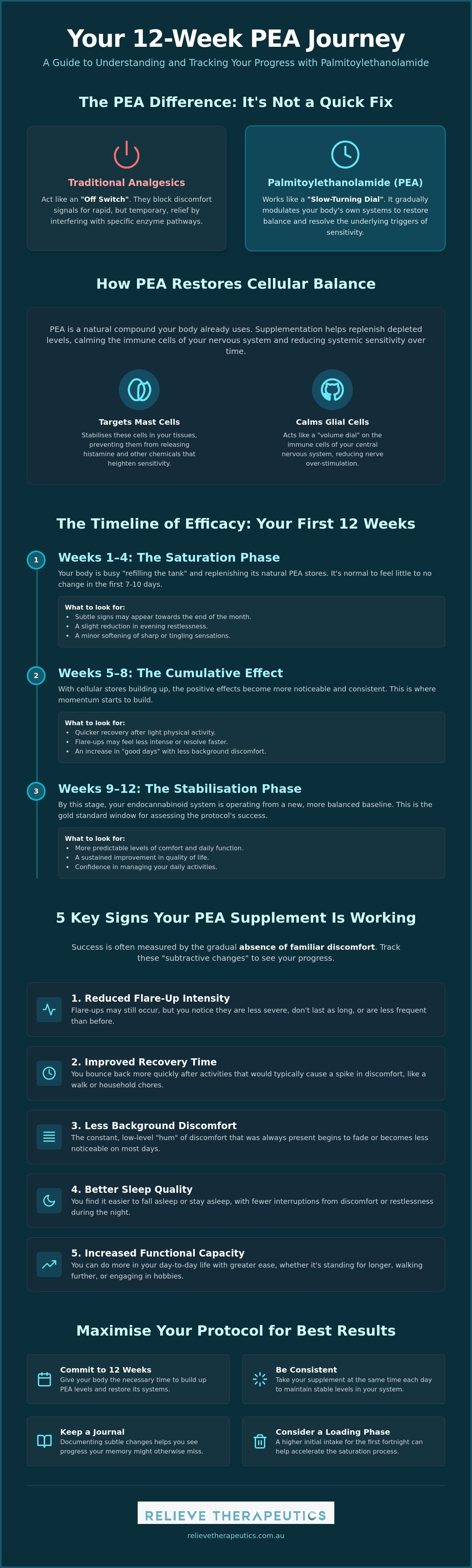
Unlike a traditional tablet that offers a sudden "off" switch, Palmitoylethanolamide (PEA) works more like a slow-turning dial. It's natural to feel frustrated when you don't see immediate results, especially when you're managing persistent discomfort. Identifying the specific signs PEA supplement is working for you requires a shift in perspective; you aren't looking for a single moment of relief, but a cumulative cellular change. Because PEA modulates your body's natural response to inflammation, the early indicators are often subtle and easy to miss if you aren't sure what to track.
We recognise the difficulty in distinguishing between a random good day and true supplement efficacy. You want validation that your investment is actually supporting your vitality, comfort, and daily function. This guide provides a clear framework to help you measure your progress with clinical precision. We'll explore the physiological markers, lifestyle improvements, and functional shifts that indicate your system is responding to the protocol. You'll gain the confidence to maintain your journey for the full 12 weeks, ensuring you give this fatty acid amide the necessary time to build up and restore your quality of life.
Key Takeaways
- Understand why PEA requires a disciplined 12-week approach to modulate your system, moving beyond the expectation of an overnight fix.
- Identify the subtle signs PEA supplement is working for you by monitoring "subtractive" changes, where the gradual absence of familiar discomfort becomes your primary marker of success.
- Learn to document functional wins using a daily journal to help you see through natural fluctuations and validate your physiological progress.
- Utilise a methodical troubleshooting checklist to distinguish between a biological non-response and a simple need for protocol adjustment.
- Organise your supplement routine around a three-month window to provide your endocannabinoid system with the stability it needs for restoration.
Understanding the PEA Mechanism: Why It Doesn’t Work Overnight
Palmitoylethanolamide (PEA) is a naturally occurring fatty acid amide produced by your own body in response to tissue damage, stress, or cellular threat. It isn't a foreign chemical compound; it's a biological tool your system already recognises and utilises to maintain internal balance. Unlike traditional pharmaceutical "quick fixes" such as Ibuprofen or Paracetamol, which act as blunt blockers to specific enzyme pathways, PEA functions as a sophisticated modulator within the endocannabinoid system (ECS). It doesn't simply cut the power to your discomfort signals. Instead, it tunes the system back toward a state of calm.
This subtle approach is precisely why you won't feel a dramatic shift within thirty minutes of your first dose. Traditional analgesics provide temporary relief by interfering with the production of prostaglandins. PEA works at a deeper, cellular level to resolve the underlying triggers of sensitivity. To see the signs PEA supplement is working for you, you must first allow for "biological saturation." This is the process where your body replenishes its internal stores, moving from a state of deficiency back to a functional baseline where it can effectively manage inflammation on its own.
The Role of Glial Cells and Mast Cells
PEA is particularly effective because it targets two key players in chronic discomfort: glial cells and mast cells. Glial cells are the immune cells of your central nervous system. When they become overactive, they release pro-inflammatory substances that keep your nerves in a state of high alert. PEA acts as a "volume dial," calming these cells and reducing their output. Simultaneously, it stabilises mast cells in your peripheral tissues, preventing them from releasing histamine and other chemicals that contribute to systemic sensitivity. Neuroinflammation is the primary target of PEA supplementation. By "cooling" these cellular fires, PEA creates an environment where your nerves can finally settle.
Why Initial Levels Matter
If you've been dealing with long-term discomfort, your tissues are likely in a state of "PEA deficiency." Your body has been burning through its natural supply faster than it can produce it, leaving your cellular defences depleted. The first few weeks of a new protocol are often spent "refilling the tank" rather than noticing overt changes in sensation. This biological catch-up phase varies from person to person. Those with lower baseline inflammation may notice subtle shifts sooner, while others require more time for the compound to reach the necessary concentration in the tissues. Recognising the signs PEA supplement is working for you starts with understanding that your body is prioritising internal restoration before it can signal a reduction in outward discomfort.
The Timeline of Efficacy: Your First 12 Weeks with PEA
In Australia, health practitioners generally view 12 weeks as the gold standard for assessing the success of a PEA protocol. It's a physiological marathon rather than a sprint. Achieving results requires maintaining a consistent PEA dosage for pain to ensure your cellular stores remain topped up. Many specialists recommend a "loading phase" during the initial fortnight, where a higher daily intake helps accelerate the saturation process. Tracking these changes in a daily journal is essential; it provides the objective data needed to see progress that your memory might otherwise miss.
Weeks 1–4: The Saturation Phase
During the first 7 to 10 days, most users feel absolutely nothing. This is completely normal and expected. Your body is busy "refilling the tank" at a cellular level, addressing the long-term depletion discussed in previous sections. However, toward the end of the first month, you might notice the first signs PEA supplement is working for you. These are often small: a slight reduction in evening restlessness or a minor softening of that sharp "pins and needles" sensation. Don't be discouraged by the lack of a "eureka" moment. Stick to your routine, as the biological foundation is still being laid.
Weeks 5–8: The Cumulative Effect
This is where the cumulative effect becomes more visible. You might find that you recover more quickly after a trip to the shops or a light walk. Flare-ups, while they may still occur, often feel less intense or resolve faster than they did previously. According to a comprehensive scientific review on PEA, this window is when the body begins re-organising its signalling pathways. You're moving from a state of high-frequency discomfort to a more manageable baseline. Your journal will likely show more "good days" clustered together.
Weeks 9–12: Consistent Modulation
By the third month, your baseline comfort should feel more stable. This is the "new normal" where mobility feels less like a chore and more like a natural part of your day. It's often at this stage that users choose to transition to a PEA 180 capsules supply to ensure they don't run out during the maintenance phase. If you haven't already, you might consider how a pure formulation can protect these hard-won gains. Identifying these long-term signs PEA supplement is working for you is the ultimate goal of the 12-week journey.
5 Key Signs Your PEA Supplement is Working for You
Measuring progress with PEA requires a shift in how you define success. Instead of looking for a sudden "on" switch, you should look for "Functional Wins"—the small, practical improvements in your daily life that indicate your system is stabilising. These markers are frequently "subtractive," meaning you notice the absence of a negative sensation rather than the presence of a new one. To accurately identify the signs PEA supplement is working for you, try to evaluate your week as a whole. Natural daily fluctuations can mask the steady, upward trend of recovery that a pure palmitoylethanolamide supplement provides.
Sign 1: Improved Sleep Quality and Duration
One of the earliest signs PEA supplement is working for you is a change in your sleep architecture. When your nervous system is overstimulated, evening nerve firing can make falling asleep feel like an uphill battle. Users often report a reduction in the "night-time throb," which is that persistent, rhythmic discomfort that interrupts deep rest. As your evening sensitivity decreases, you may find you fall asleep faster and stay asleep longer. Better sleep creates a vital positive feedback loop; well-rested tissues are generally more resilient and less prone to inflammatory spikes the following day.
Sign 2: Increased "Activity Threshold"
Your "activity threshold" is the invisible line representing how much physical effort you can exert before you "pay for it" with a flare-up. You might find you can walk to the local shopping centre or spend an extra half-hour in the garden without the usual repercussions. This gradual return of hobbies is a primary indicator of efficacy. A systematic review of PEA for chronic pain highlights how these functional improvements often precede a significant drop in overall pain scores. If you are doing more with less fear of the aftermath, your protocol is likely hitting its mark.
Sign 3: Reduced Intensity of "Zaps" and "Flares"
For those dealing with neuropathy, the dampening of "zaps"—those sharp, electric-shock sensations—is a major milestone. PEA works to stabilise the nerve membranes, making them less likely to fire spontaneously or overreact to minor stimuli. This biological calming effect is central to how does PEA work for pain. You may notice that when flares do occur, they are shorter in duration and far less debilitating than they were before you started your journey. Consistency is the key to maintaining this dampened state of nerve sensitivity.
Troubleshooting: What if You Don’t See Any Signs?
It is disheartening to reach the mid-point of a trial and feel as though the needle hasn’t moved. We understand this frustration, especially when you are seeking relief from long-term discomfort. However, before concluding that you are a "non-responder," it is essential to audit your protocol. Most cases of perceived failure are actually due to issues with absorption or consistency rather than a biological incompatibility. If you haven't seen the clear signs PEA supplement is working for you by the 12-week mark, a methodical check of these variables is the necessary next step.
The Bioavailability Factor
PEA is a lipid-like substance, which means it does not dissolve easily in water. Standard PEA often consists of large, jagged particles that the human gut struggles to process. Large PEA particles are difficult for the human gut to absorb effectively. This is why ultra-micronised formulations are the industry benchmark; by reducing the particle size, the surface area increases, allowing for significantly better uptake into the bloodstream. If your current supplement is not micronised, you may simply be passing the compound through your system without it ever reaching your tissues to modulate those overactive glial cells.
Dosage and Consistency Checks
Consistency is the foundation of the saturation phase we discussed earlier. Skipping even a few days can cause your cellular levels to dip, effectively resetting your progress. To maintain a steady concentration in the blood, many practitioners suggest a "split-dose" technique. Taking half your dose in the morning and the other half at night prevents the "peaks and troughs" associated with once-daily intake. Additionally, because PEA is fat-soluble, taking your capsules alongside a source of healthy fats, such as avocado, olive oil, or eggs, can aid the transport of the compound across the intestinal wall.
Finally, ensure you are using an Australian-sourced product that prioritises purity and avoids unnecessary fillers that can interfere with absorption. If you have followed a strict protocol for a full 12 weeks with no change, it is time to consult your GP to rule out other underlying factors or to discuss a dosage adjustment. To ensure you are starting with the highest quality foundation for your journey, you can order pure PEA capsules from a specialist who understands the Australian market. Identifying the signs PEA supplement is working for you is much easier when you are confident in the integrity of your supplement.
Maximising Your Journey with Relieve Therapeutics
Relieve Therapeutics stands as a dedicated partner in your long-term wellness journey. We specialise in high-purity Palmitoylethanolamide formulations, ensuring every capsule you take is free from the unnecessary fillers or binders that can often hinder absorption. By focusing on the Australian market, we provide a level of transparency and reliability that overseas suppliers often struggle to match. Our commitment to local standards means you can trust the integrity of your supplement as you work toward restoring your daily function and vitality.
Why the 180-Count Bottle is the Strategic Choice
The 12-week gold standard for assessing efficacy is a biological reality based on how the endocannabinoid system responds to modulation. Choosing our PEA 180 capsules pack is the most strategic choice for anyone serious about this commitment. This specific bottle size is designed to carry you through the entire saturation and modulation phases without the stress of re-ordering. It provides a cost-effective solution for the critical build-up window, ensuring your cellular "tank" remains full during the weeks when the most significant changes occur.
Consistency is the single most important variable when determining if the signs PEA supplement is working for you will manifest. Running out of capsules during week six or seven, just as the cumulative effect is beginning to peak, can be a major setback for your nervous system. With our efficient Australian shipping, we ensure that your supply remains uninterrupted. Maintaining a steady blood level of PEA is what allows your glial cells to remain in a calmed state, eventually leading to the subtractive relief we've described in earlier sections.
Your Partner in Natural Support
We believe that natural support should be grounded in clinical rigor and empathetic care. Our role is to act as a knowledgeable guide, simplifying the science of neuroinflammation so you feel empowered in your choices. Persistence is often the difference between a failed trial and a life-changing result. As you monitor your sleep, activity thresholds, and flare-up intensity, remember that your body is working on a cellular timeline that requires steady support. We are here to provide that support through every stage of your 90-day protocol.
Final results with PEA are a product of patience, purity, and persistence. If you have questions about our range or how to best track your progress, we encourage you to reach out. Identifying the signs PEA supplement is working for you is a gradual process, but it is one that leads toward a more comfortable and active future. Browse our range of high-purity PEA capsules and start your 12-week journey today.
Empowering Your Path to Restoration
Restoring your body's natural balance is a journey of persistence rather than a sudden event. By shifting your focus toward functional wins like improved sleep quality and a higher activity threshold, you can accurately identify the signs PEA supplement is working for you. Success with this protocol is rarely found in a single moment of relief; it is built through the steady, cumulative modulation of your nervous system over a full 12-week window. Consistency remains your most powerful tool in this process.
Relieve Therapeutics provides the pure Palmitoylethanolamide formulation you need to support this cellular shift. Our capsules are dispatched directly from Australia for fast local delivery and are available in 60, 120, and 180-count value packs to suit your specific protocol. We act as your reliable partner, providing the substance and transparency required for long-term nerve health support. Order your 12-week supply of PEA capsules from Relieve Therapeutics today.
Stay the course and trust the biological process. Your commitment to quality and patience is the foundation of your future comfort.
Frequently Asked Questions
How long does it take for PEA to start working for nerve pain?
It typically takes between 4 and 12 weeks of consistent use to notice significant shifts in your comfort levels. While some individuals report subtle changes within the first month, clinical research indicates that a full three-month window is necessary for the compound to reach biological saturation in your tissues. Consistency is the primary factor in achieving this cellular build-up.
Can I take PEA with my other prescribed medications?
PEA has no known major drug interactions and is generally considered safe to use alongside other protocols. It is a fatty acid amide that your body already produces naturally, which contributes to its high safety profile. You must always consult your GP or specialist before introducing a new supplement to ensure it aligns with your specific medical history and current treatments.
What does it feel like when PEA starts working?
Success with PEA is often a "subtractive" experience where you notice the absence of negative sensations rather than a new, dramatic feeling. Common signs PEA supplement is working for you include a softening of sharp, electric-shock sensations, a reduction in evening restlessness, and an ability to perform daily tasks at the shopping centre or garden with less recovery time.
Is there a specific time of day I should take my PEA capsules?
A split-dose approach is the most effective way to maintain steady concentrations in your system. Taking one capsule in the morning and one in the evening prevents the fluctuations associated with a single daily dose. This methodical timing provides more consistent support for your endocannabinoid system throughout the day and night.
Should I take PEA on an empty stomach or with food?
You should take your PEA capsules with a meal that contains healthy fats to maximise uptake. Because PEA is a lipid-like substance, fats such as those found in eggs, avocado, or olive oil act as a transport mechanism. This significantly improves the absorption rate across the intestinal wall compared to taking it on an empty stomach.
What happens if I stop taking PEA after I start feeling better?
Discomfort may gradually return if you stop the protocol, as your body's internal stores of the compound begin to deplete. PEA works by modulating overactive signals rather than providing a permanent "cure." Many users transition to a long-term maintenance dose after the initial 12-week build-up to sustain their functional gains and protect their quality of life.
Are there any side effects I should look out for during the first few weeks?
PEA is exceptionally well-tolerated and is not associated with the common side effects of traditional analgesics, such as drowsiness or gastric ulcers. In very rare instances, some individuals might experience mild gastrointestinal upset during the first few days. These symptoms are typically transient and resolve quickly as your system adjusts to the supplement.
Why is micronised PEA considered better than standard PEA?
Micronised PEA is superior because it solves the inherent absorption challenges of the compound. Standard PEA particles are often too large for the human gut to process efficiently. By reducing the particle size, the surface area increases, which allows for much higher bioavailability and ensures the signs PEA supplement is working for you are not hindered by poor digestive uptake.