

Imagine waking up to a crisp coastal sunrise, only to find your knees feel as though they're filled with grit and rust. For the one in five Australians over 45 living with persistent pain, this "stiff start" isn't just a morning nuisance; it's a physical barrier to the active life you've worked hard to build. If you've been researching PEA for arthritis Australia, you're likely seeking a way to reclaim your mobility without the long-term side effects often linked to traditional anti-inflammatories.
It's frustrating when your body feels like an uninvited guest in your own life, especially when simple joys like gardening or walking the dog become sources of physical dread. This guide will show you how Palmitoylethanolamide (PEA) supports joint health by acting as a biological dimmer switch for systemic inflammation. We'll examine the latest 2026 clinical data, explain the TGA-approved role of this fatty acid, and provide a clear framework for how to integrate PEA into your daily wellness routine for lasting comfort and vitality.
Key Takeaways
- Understand how Palmitoylethanolamide functions as a vital lipid molecule that replenishes the body's natural reserves during chronic inflammatory states.
- Explore the unique biological mechanism where PEA targets mast cells to dampen the chemical triggers of joint discomfort and swelling.
- Compare the safety profile of PEA against traditional anti-inflammatories to protect your long-term stomach and kidney health.
- Master the specific loading and maintenance dose strategies required when using PEA for arthritis Australia to achieve improved mobility.
- Learn why sourcing high-purity capsules from a reputable Australian provider is critical for ensuring consistent, filler-free joint support.
Understanding PEA for Arthritis in the Australian Context
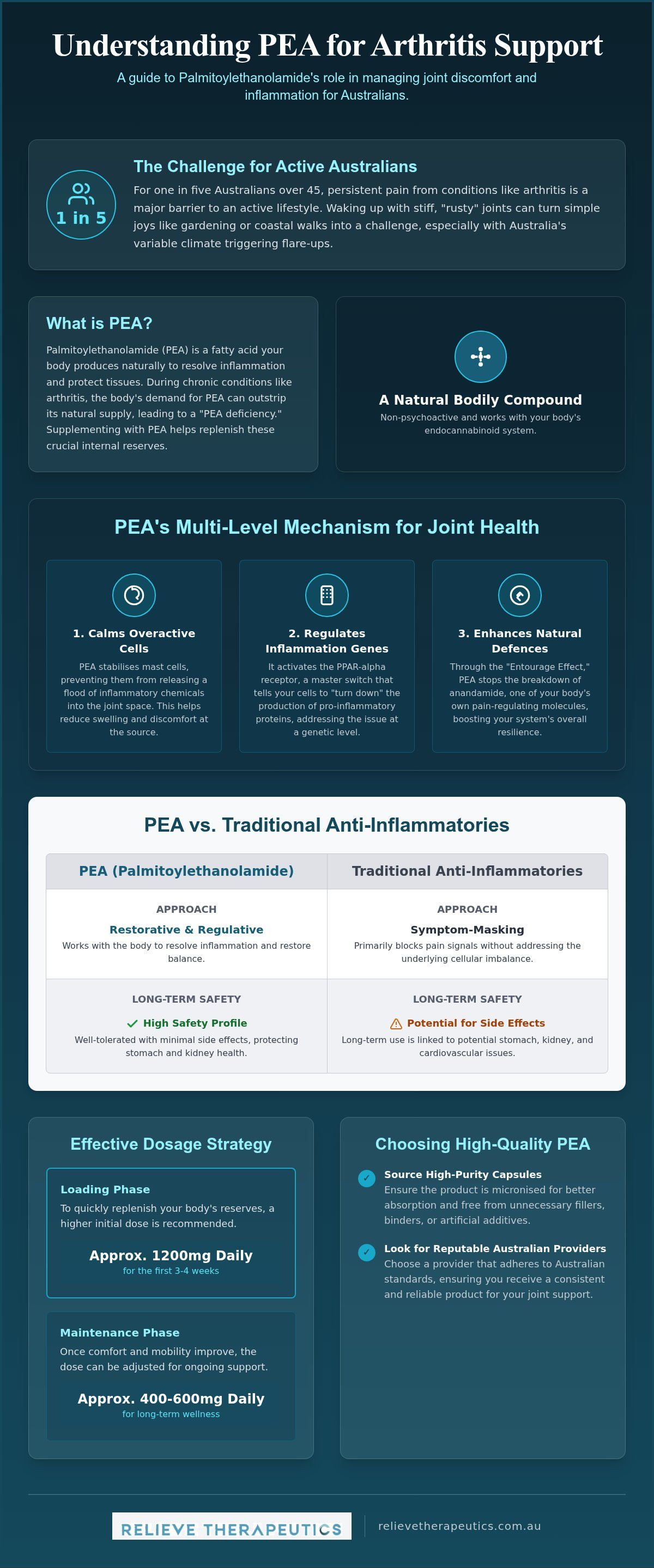
Palmitoylethanolamide, commonly known as PEA, is a lipid signalling molecule that your body produces naturally to resolve inflammation and protect tissues. When you explore What is Palmitoylethanolamide (PEA), you discover a substance that acts as a biological guardian. In a healthy state, the body synthesises sufficient PEA to manage minor physiological stress. However, clinical theories suggest a "PEA deficiency" occurs during chronic inflammatory states. In these instances, the demand for this protective molecule far outstrips the body's ability to produce it. This depletion is a primary reason why many people are now investigating PEA for arthritis Australia as a way to replenish their internal defences and support long-term joint health.
The Australian integrative health community has shown a significant surge in interest regarding PEA. Practitioners are increasingly looking for non-opioid options that align with the body's natural chemistry. By providing a clean, targeted way to manage discomfort, PEA offers a sophisticated alternative for those who want to avoid the systemic burden of traditional heavy medications. It represents a shift towards restorative care, focusing on how the body can be supported to heal and regulate itself from within.
The Prevalence of Arthritis in Australia
Arthritis is a significant health challenge in our community, affecting approximately one in seven Australians. This condition isn't just about occasional aches; it's a persistent barrier to the active lifestyle many of us value. Australia's diverse climate plays a role too. The damp winters in the southern states or the sudden cold snaps in regional areas can trigger significant flare-ups, leaving joints feeling "rusty" and immobile. Many locals integrate PEA for arthritis Australia into their daily routine to stay mobile despite these environmental shifts. It works as a supportive element within a broader holistic lifestyle, helping to maintain comfort during gardening, coastal walks, or daily errands.
Is PEA a Natural Endocannabinoid?
PEA is frequently described as "cannabimimetic," meaning it mimics the actions of cannabinoids by interacting with the endocannabinoid system (ECS). While it's closely related to this system, it operates through different biological pathways than substances like CBD. Crucially, PEA is completely non-psychoactive and is a legal dietary supplement in Australia. It doesn't bind directly to the receptors that cause a "high," making it a safe, professional choice for those seeking ECS benefits without any cognitive side effects. By targeting mast cells and specific receptors like PPAR-alpha, PEA helps dampen the inflammatory response at its source, providing a unique level of cellular support that differs from traditional building blocks like glucosamine.
The Biological Mechanism: How PEA Supports Joint Health
Palmitoylethanolamide is far more than a simple supplement; it’s a sophisticated lipid that communicates directly with your cellular receptors. While many traditional options merely mask symptoms, PEA addresses the underlying biological environment. It operates primarily through the PPAR-alpha receptor, a protein that acts as a master regulator of inflammatory genes. By activating this receptor, PEA effectively "switches off" the production of various pro-inflammatory proteins at the source. This genetic regulation is a key reason why many Australians are turning to PEA for arthritis Australia for long-term management.
Another critical aspect of its function is the "Entourage Effect." PEA doesn't work in isolation; it prevents the breakdown of anandamide, which is a naturally occurring fatty acid in your body that helps regulate pain and mood. By increasing the levels of your body's own protective lipids, PEA enhances the overall resilience of your nervous and immune systems. This multi-layered approach ensures that the body isn't just fighting a symptom, but is being supported to maintain its own internal balance.
Dampening the Inflammatory Cascade
Acute inflammation is the body’s necessary response to injury, yet the chronic, "smouldering" inflammation found in arthritis is a different beast entirely. It’s a persistent, low-grade fire that slowly damages joint tissue over time. PEA regulates mast cells through a process known as the ALIAmides mechanism, which prevents these immune cells from releasing a flood of inflammatory chemicals into the joint space. This stabilisation helps "reset" the sensitivity of overactive pain receptors, providing a calmer internal environment and reducing the sensation of constant discomfort.
Supporting Cartilage and Mobility
Beyond just managing discomfort, PEA plays a protective role for the joint’s microenvironment. It helps shield the delicate synovial lining and cartilage from oxidative stress, which is often heightened in arthritic joints. When inflammation is kept in check, the quality of synovial fluid improves, ensuring your joints stay lubricated and functional. For those exploring PEA for arthritis Australia, this biological support translates directly into better function during daily activities like morning walks or gardening. If you’re ready to experience this level of cellular support, you can explore high-purity PEA options designed for consistent, local delivery.
PEA vs Conventional Joint Support: A Comparative View
Choosing the right support for joint health often feels like a trade-off between efficacy and safety. Traditional non-steroidal anti-inflammatories (NSAIDs) are effective for short-term relief, yet their long-term use is frequently limited by concerns over stomach irritation and kidney stress. For many searching for PEA for arthritis Australia, the primary goal is to find a sustainable alternative that doesn't compromise digestive or renal health. PEA provides this balance by working through the body's natural lipid pathways rather than inhibiting the protective enzymes that maintain the stomach lining.
It’s also helpful to distinguish PEA from common building blocks like glucosamine and chondroitin. While those substances provide the structural raw materials for cartilage repair, they don't necessarily address the underlying inflammatory "fire" that causes discomfort. PEA acts as a modulator, quietening the overactive immune cells that drive the sensation of stiffness. Using these building blocks alongside a modulator like PEA can create a comprehensive support system, addressing both the structure and the chemical environment of the joint simultaneously.
Safety Profile and Side Effects
One of the most reassuring aspects of PEA is its high level of tolerability. Clinical literature consistently highlights a lack of significant drug-to-drug interactions, which is particularly important for elderly Australians who may already be managing multiple medications for blood pressure or heart health. Because PEA is a substance your body already produces, it's processed efficiently without placing an undue burden on your system. It is non-addictive, does not cause drowsiness, and has no reported "rebound" effect, making it a reliable ally for consistent, daily management of joint comfort.
The Advantage of Natural Fatty Acids
Bio-identical molecules are typically better tolerated by the digestive system because the body recognises their chemical structure. While some conventional options focus on "masking" the sensation of pain, PEA focuses on "modulating" the inflammatory response. This distinction is vital; instead of just turning off a warning signal, you're supporting the body’s ability to regulate its own internal environment. This approach leads to more stable, long-term outcomes rather than the "peaks and troughs" associated with fast-acting, short-lived alternatives.
This biological compatibility is a cornerstone of why this fatty acid is becoming a staple in integrative health. Understanding the science behind the molecule helps clarify why it works so harmoniously with your existing physiology. When combined with other natural remedies like high-quality fish oils or turmeric, PEA provides the cellular stabilisation necessary to enhance the effectiveness of your entire wellness routine, allowing for improved daily mobility and a more active Australian lifestyle.
Practical Implementation: Dosage and Expectations for Arthritis
Implementing a successful regimen of PEA for arthritis Australia requires a shift in mindset from "immediate relief" to "cumulative restoration." Because Palmitoylethanolamide is a fatty acid, it doesn't flood the system like a synthetic chemical. Instead, it must be absorbed into your cellular membranes and saturated within your tissues over several weeks. This biological "buildup" is essential for switching off the chronic inflammatory signals we discussed earlier. To ensure this process is efficient, the particle size of your supplement is paramount. Micronised PEA has been processed into smaller particles, significantly increasing its surface area for better absorption in the digestive tract. Without this step, the body struggles to break down the dense lipid structure, leading to poor bioavailability and inconsistent results.
Consistency is the most vital factor in maintaining steady lipid levels. Taking your capsules at the same time each day helps to create a stable biological environment; this prevents the "smouldering" inflammation from flaring up when levels dip. For many Australians, pairing the morning dose with a source of healthy fats, such as avocado or olive oil, can further support the absorption of this lipid-based molecule. This simple habit ensures you get the most out of every capsule.
Finding Your Optimal PEA Dosage
Most clinical protocols suggest starting with a "loading dose" to rapidly address the existing PEA deficiency in arthritic joints. A common starting point is 1200mg daily, often split into two 600mg doses, for the first four to eight weeks. Once you observe a consistent improvement in comfort and mobility, you can begin to titrate down to a maintenance dose, typically between 300mg and 600mg daily. This allows you to find the lowest effective amount for your specific needs. For a detailed breakdown of these protocols, you can consult our PEA dosage for pain guide.
The Arthritis Management Timeline
Managing expectations is key to long-term success. While some individuals notice a difference quickly, most follow a predictable recovery curve as the body adapts:
- Weeks 1 to 2: You might notice subtle changes, such as reduced morning stiffness or improved sleep quality as the systemic "volume" of inflammation begins to lower.
- Weeks 4 to 6: This is typically when noticeable improvements in daily mobility and joint comfort occur. Tasks like unscrewing a jar or walking up the stairs become less daunting.
- Month 3 and Beyond: The full biological effect is often reached by the ninety-day mark. At this stage, your tissue levels are stabilised, providing a foundation for long-term joint support and vitality.
To start your journey toward better mobility and consistent joint support, you can order high-purity PEA capsules directly from our Australian-owned facility.
Choosing High-Quality PEA Capsules in Australia
Selecting the right supplement is a critical decision for anyone managing long-term joint discomfort. When you're searching for PEA for arthritis Australia, the marketplace can often feel crowded with products of varying standards. Sourcing from a reputable, local provider ensures that you're receiving a product manufactured under strict quality controls. High-purity Palmitoylethanolamide is essential; unnecessary fillers or flow agents can interfere with absorption or trigger sensitivities in reactive systems. By prioritising purity, you ensure that your body receives the exact lipid signalling molecule it needs without any biological clutter.
The journey toward improved mobility often requires different levels of support at different stages. We've designed our range to reflect this reality, offering pack sizes of 60, 120, and 180 capsules. A smaller pack might suit someone trialling the supplement for the first time, while the larger counts provide the continuity needed for the "buildup" phase we discussed earlier. Consistent supply is the backbone of successful arthritis management. Relying on local Australian shipping means you won't face the long delays or customs uncertainties associated with international orders, keeping your wellness routine on track.
Why Relieve Therapeutics is the Trusted Choice
We position ourselves as more than just a supplier; we're a partner in your health journey. Our commitment to transparency means we provide clear, evidence-based information to help you make informed choices. As an Australian-owned and operated organisation, we understand the specific lifestyle needs of our community, from the coastal walker to the avid gardener. For those committed to a long-term management plan, our PEA 180 capsules offer the best strategic value. This larger quantity ensures you have an uninterrupted supply during the critical months of biological stabilisation.
Final Checklist for Australian Buyers
Before you finalise your purchase, it's wise to run through a quick quality assessment. Ensuring your supplement meets professional standards protects both your health and your investment. Use this checklist to verify your choice:
- Purity Verification: Confirm the only active ingredient is pure Palmitoylethanolamide without hidden additives.
- Local Presence: Opt for providers with Australian-based support and fast local dispatch to ensure reliability.
- Quality Standards: Check that the product aligns with the benchmarks detailed in our high quality PEA capsules guide.
By following these steps, you can feel confident that you're supporting your joints with the highest calibre of natural care available in Australia.
Reclaiming Your Active Australian Lifestyle
Living with arthritis doesn't have to mean accepting a gradual decline in your daily mobility. By understanding how Palmitoylethanolamide functions as a biological regulator, you can move beyond simply masking discomfort and start supporting your body's internal inflammatory balance. The transition from stiff, "rusty" mornings to fluid movement is a gradual process that relies on consistency and high-purity supplementation. Whether you're navigating seasonal flares or managing persistent joint stress, PEA for arthritis Australia offers a scientifically grounded, natural pathway to improved comfort.
As a trusted Australian specialist, we're committed to providing the transparency and reliability you need for long-term health. We offer fast shipping across Australia and provide our premium capsules in 60, 120, and 180-count packs to suit every stage of your journey. Order your high-purity PEA capsules from Relieve Therapeutics today and take a proactive step toward restoring your vitality. You deserve to walk, garden, and explore with confidence again.
Frequently Asked Questions
Is PEA effective for both osteoarthritis and rheumatoid arthritis?
PEA provides biological support for both conditions by targeting the underlying inflammatory pathways. While osteoarthritis is primarily a degenerative condition and rheumatoid arthritis is autoimmune, both involve overactive mast cells and chemical triggers that drive joint discomfort. By stabilising these cells, PEA helps manage the "smouldering" inflammation common to both types. It acts as a versatile modulator, supporting the joint microenvironment regardless of the initial cause of the inflammation.
Can I take PEA along with my prescription arthritis medication?
Clinical studies have shown that PEA for arthritis Australia has an exceptionally low risk of drug-to-drug interactions. It doesn't interfere with the metabolic pathways used by most conventional treatments. However, it's essential to discuss any new supplement with your GP or specialist, particularly if you're on complex medication regimens. Many Australians find that PEA works harmoniously with their existing care plan to provide a more comprehensive level of daily support.
How long does it take for PEA to start working for joint pain?
You should expect to follow a consistent routine for at least four to eight weeks before evaluating the full results. This timeframe allows the fatty acid to saturate your cellular membranes and reach the therapeutic levels necessary to influence inflammatory genes. Some individuals report subtle improvements in sleep or stiffness within the first fortnight, but the most significant gains in mobility typically occur after the initial month of steady, daily supplementation.
Are there any long-term side effects of taking PEA capsules?
PEA is remarkably well-tolerated because it's a substance your body already produces naturally. Unlike some traditional options, it doesn't place stress on the kidneys or cause the digestive irritation often associated with long-term anti-inflammatory use. Current research, including meta-analyses of multiple clinical trials, confirms a strong safety profile with no serious adverse effects reported. It remains a reliable choice for those seeking a sustainable, long-term approach to managing persistent joint discomfort.
Do I need a prescription to buy PEA in Australia?
No, you don't require a prescription to purchase PEA in Australia. The Therapeutic Goods Administration (TGA) permits Palmitoylethanolamide as an active ingredient in listed medicines and dietary supplements. This status allows Australians to access high-quality joint support directly from reputable local providers. It offers a convenient and professional way to manage your wellness journey without the need for a clinical consultation every time you need to replenish your supply.
What is the best time of day to take my PEA supplement?
Consistency is more important than the specific hour, but taking your capsules with a meal containing healthy fats is highly recommended. Since PEA is a lipid-based molecule, dietary fats like those found in eggs or avocado help facilitate its absorption. Many people find that splitting their daily intake into a morning and evening dose provides more stable support throughout the day and night, helping to maintain consistent levels within the tissues.
Can PEA help with the morning stiffness associated with arthritis?
Yes, PEA is particularly effective at addressing the "rusty" feeling many Australians experience upon waking. Morning stiffness is often caused by the accumulation of inflammatory chemicals in the joint space during the night. By dampening the activity of mast cells while you sleep, PEA for arthritis Australia helps to limit this chemical buildup. This proactive regulation leads to a more comfortable start to the day and improved mobility during your early morning activities.
Is micronised PEA better than standard PEA for joint absorption?
Micronisation is a critical factor in the efficacy of any lipid-based supplement. This process reduces the particle size of the PEA, which significantly increases its surface area and allows for much better absorption in the small intestine. Standard PEA can be difficult for the body to break down and utilise effectively. Choosing a micronised version ensures that a higher percentage of the active molecule reaches your joints, providing more reliable and consistent support.