

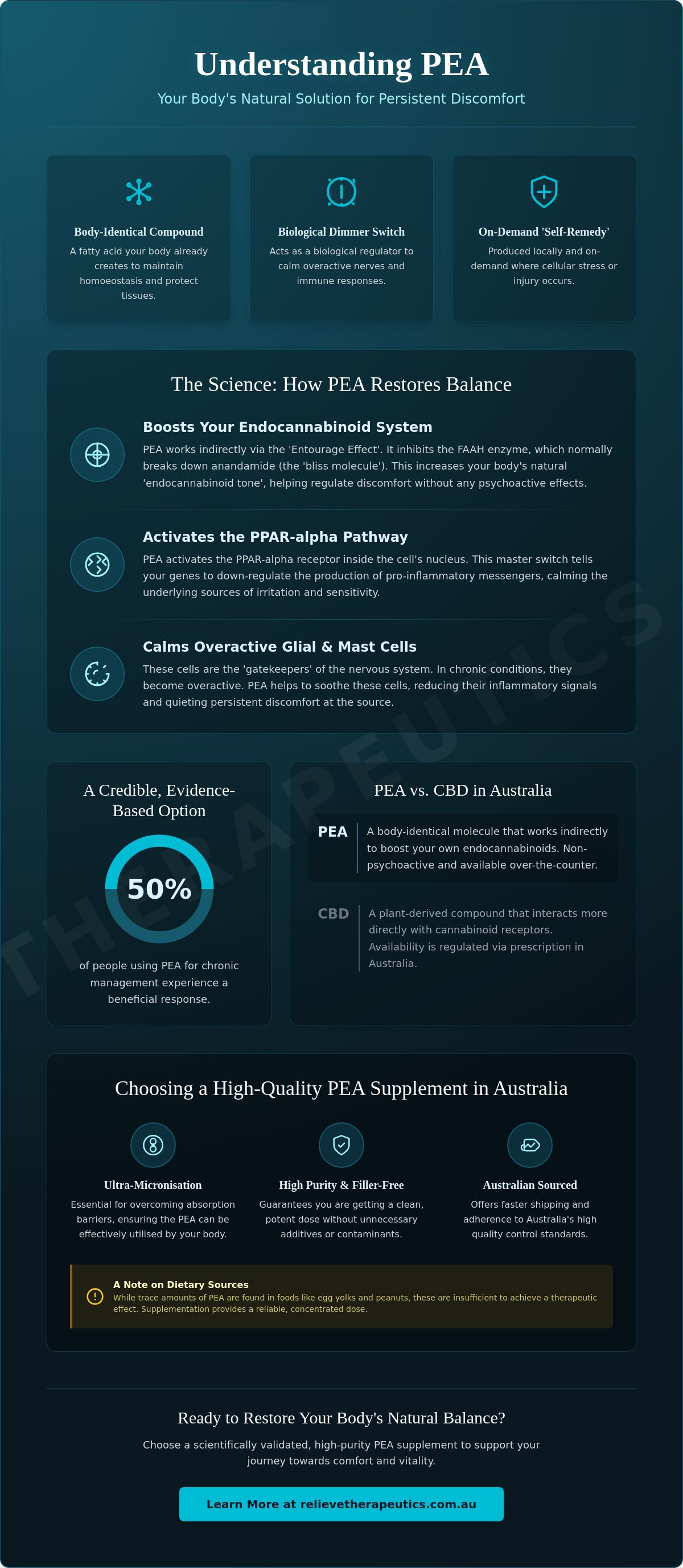
What if the most effective way to manage persistent discomfort isn't by adding something foreign to your system, but by replenishing a molecule your body already creates? This is the core premise of a PEA endocannabinoid supplement, a body-identical fatty acid that acts as a biological dimmer switch for overactive nerves. Research indicates that approximately 50% of people using PEA for chronic management experience a beneficial response; this reflects its growing role as a credible, evidence-based alternative for those seeking long-term relief.
It's common to feel frustrated by the side effects of traditional medications or confused by how PEA differs from options like CBD. You deserve a solution that is transparent, scientifically validated, and locally available. This guide provides a comprehensive look at how Palmitoylethanolamide restores endocannabinoid tone to quieten pain signals at their source. You will gain a clear understanding of the biological mechanisms, confidence in navigating 2026 Australian regulations, and the knowledge required to choose the correct dosage for your needs. We'll examine the latest clinical science and provide practical steps to help you regain your daily comfort, mobility, and vitality.
Key Takeaways
- Understand how Palmitoylethanolamide acts as a body-identical fatty acid to restore tissue balance and calm overactive immune responses in the nervous system.
- Compare the legal and biological differences between CBD and a PEA endocannabinoid supplement to determine which approach best suits your personal health journey.
- Discover the "Glia Cell Theory" and how targeting PPAR-alpha receptors can quieten persistent discomfort without the side effects of traditional medication.
- Learn why ultra-micronisation is essential for overcoming absorption barriers and how to identify high-purity, filler-free supplements available within Australia.
- Gain practical insights into dosage protocols and the benefits of choosing locally sourced capsules for faster shipping and reliable quality control.
Understanding PEA: The Body’s Own Endocannabinoid Modulator
PEA is a fatty acid amide that lives in the space between laboratory science and natural biology. It's technically known as an "autacoid," a term derived from the Greek words for "self-remedy." Unlike hormones that travel through the bloodstream to distant organs, autacoids like Palmitoylethanolamide (PEA) are produced locally to act on nearby tissues. Their primary role is to maintain homeostasis, which is the delicate internal balance required for optimal health. When our system encounters cellular stress, injury, or persistent inflammation, it produces PEA as a protective response. For many Australians, a PEA endocannabinoid supplement is a tool to restore this natural chemical messenger when the body's internal supply is exhausted by chronic demand.
The Biological Origin of PEA
Synthesis occurs within the lipid bilayer of our cell membranes. The body uses precursors like N-acyl-phosphatidylethanolamine to create PEA exactly where it's needed. This "on-demand" production is efficient but fragile. During episodes of prolonged discomfort, these lipid stores can become depleted, leading to a state of deficiency that worsens sensitivity. While you can find trace amounts in peanuts, egg yolks, and certain legumes, these dietary sources are generally insufficient for therapeutic purposes. High-quality supplementation offers a way to bypass these dietary limitations, providing a reliable concentration that the body can readily utilise to support its own recovery processes.
PEA and the Endocannabinoid System (ECS)
The ECS is our master regulatory network, responsible for modulating pain, immune response, and sleep cycles. PEA is often categorised as an "endocannabinoid-like" compound because it supports this system without directly binding to CB1 or CB2 receptors. Instead, it works through the "Entourage Effect," a synergistic process that boosts the efficacy of our own internal cannabinoids. It accomplishes this by inhibiting the FAAH enzyme, which is responsible for breaking down anandamide, often called the "bliss molecule."
By slowing this breakdown, PEA increases "endocannabinoid tone," allowing anandamide to stay active in the system for longer. This mechanism is particularly valuable because it provides the benefits of ECS support without any psychoactive effects. It's a sophisticated, indirect path to restoration. Integrating a PEA endocannabinoid supplement into a daily routine helps maintain these elevated levels of internal signalling, offering a calm, steady approach to managing the physical toll of long-term discomfort.
The Science of Support: How PEA Targets Chronic Discomfort
The effectiveness of a PEA endocannabinoid supplement lies in its multi-layered approach to biological regulation. While many traditional options focus solely on blocking pain signals, PEA works to resolve the underlying inflammatory environment. It achieves this by engaging with specific receptors and cellular "gatekeepers" that govern our sensitivity to discomfort. This is a sophisticated process of restoration rather than a temporary mask.
The PPAR-alpha Pathway Explained
The primary mechanism of Palmitoylethanolamide involves the activation of the Peroxisome Proliferator-Activated Receptor alpha (PPAR-alpha). This receptor acts as a master switch within the cell nucleus. Once activated, it influences the expression of genes responsible for the inflammatory response. By binding to this receptor, PEA effectively instructs the cell to down-regulate the production of pro-inflammatory cytokines, which are the chemical messengers that drive systemic redness and swelling.
The unique PEA chemical properties allow it to traverse cell membranes and reach these nuclear receptors directly. This is a critical distinction from many other supplements that only interact with surface-level receptors. PPAR-alpha is a nuclear receptor that regulates pain-related gene expression. This deep-seated action helps to recalibrate the body's baseline, moving it away from a state of constant high alert and toward a state of restorative calm.
Mast Cells and Glial Cells: The Gatekeepers of Pain
Chronic discomfort is rarely just about the nerves themselves. It often involves the "support staff" of the nervous system: glial cells and mast cells. Glial cells surround our neurons, providing protection and nutrition. However, when they become overactive, they release substances that irritate the nerves they are meant to support. This leads to a cycle of heightened sensitivity. Mast cells play a similar role in the periphery. They are responsible for the "fire" of inflammation, releasing histamines and other chemicals during the degranulation process. This often creates an "itch-pain" cycle that is difficult to break.
PEA provides a solution by quietening these cells without suppressing the entire immune system. It acts as a stabilising agent that prevents the excessive release of inflammatory mediators. To achieve the best results, many people choose to buy PEA capsules online from trusted Australian providers to ensure they are getting a pure, standardised dose. This targeted action provides a way to manage discomfort with precision and balance.
Consistent use of a PEA endocannabinoid supplement allows these biological changes to take hold. It isn't an overnight fix. Instead, it's a gradual process of down-regulation. By calming the "gatekeepers" of pain, you are essentially lowering the volume on the signals that have become too loud. This methodical approach is why many Australians find PEA to be a reliable partner in their long-term wellness strategy. The cumulative effect is a steady reduction in the sensitivity of pain pathways, leading to improved daily function and comfort.
PEA vs. CBD: Deciphering the Endocannabinoid Landscape in Australia
Many Australians seeking natural relief find themselves at a crossroads between CBD and Palmitoylethanolamide. While both interact with the body's regulatory systems, their biological paths are distinct. A PEA endocannabinoid supplement offers a body-identical approach, utilising a fatty acid your system already recognises and produces. This provides a level of biological familiarity that exogenous plant compounds cannot match. Understanding these differences is the first step toward making an informed choice for your long-term wellness.
The primary contrast lies in how these compounds engage with your internal chemistry. CBD typically works by interacting with various receptors and indirectly influencing the endocannabinoid system. In contrast, The Science of Palmitoylethanolamide (PEA) demonstrates that PEA functions as a metabolic modulator. It enhances "endocannabinoid tone" by preserving the body’s own molecules from premature breakdown. It is the difference between introducing a foreign substance to a system and ensuring the system's own components have the support they need to function correctly.
Regulatory Status in Australia
The Australian regulatory environment creates a clear distinction regarding accessibility. PEA is approved by the TGA as an active ingredient in listed medicines and is classified as a dietary supplement. This allows it to be sold over-the-counter and online without the need for a medical appointment. CBD, however, remains largely a Schedule 4 substance in Australia; this means most therapeutic doses require a formal prescription from a doctor. This ease of access makes PEA a practical and immediate option for those managing chronic discomfort. As with any change to your health regime, you should consult your GP to ensure these supplements align with your broader management plan.
Synergy and Combination Therapy
Adopting a "multi-target" approach often yields more comprehensive results than relying on a single pathway. PEA is highly versatile and can be integrated with other non-opioid pain relief supplements to address discomfort from multiple angles. Because it is body-identical, PEA possesses an exceptional safety profile. It rarely interferes with conventional chemist-bought medications, making it a reliable partner for those already on a structured treatment path.
Using a PEA endocannabinoid supplement alongside other natural modulators can help create a synergistic effect. This helps to quieten overactive nerves while simultaneously supporting tissue health and immune balance. This steady, non-psychoactive foundation is designed to restore daily function and vitality without the legal hurdles or side effects often associated with other options. It represents a disciplined, evidence-based choice for the modern Australian consumer.
Maximising Efficacy: Dosage, Bioavailability, and Dietary Sources
Achieving the best results from a PEA endocannabinoid supplement requires an understanding of its physical properties. PEA is naturally lipophilic, meaning it's a "fat-loving" molecule. This characteristic presents a specific challenge for absorption in the water-based environment of the human digestive tract. Without proper processing, the body often struggles to break down the compound, which can lead to it passing through the system without providing the intended support. Maximising efficacy is about ensuring the molecule reaches the cells where it can do its work.
Why Particle Size Matters
In its raw form, PEA exists as large, jagged crystals that tend to clump together. This clumping significantly reduces the surface area available for the body to process. To solve this, high-quality manufacturers use a process called micronisation or ultra-micronisation. This mechanical technique reduces the particle size to between 0.8 and 6 micrometres, which is several times smaller than a human hair.
Smaller particles bypass the body's natural tendency to group fatty substances, allowing for much higher intestinal uptake. When you choose high quality PEA capsules, you're ensuring the supplement is in a form that is bioavailable and ready for immediate use. This structural precision is what separates professional-grade supplements from standard powders.
Optimal Dosage Strategies
Clinical study averages suggest a standard daily intake of 1200mg for most adults managing chronic conditions. This is typically split into two 600mg doses, taken morning and night, to maintain steady levels in the system. Many practitioners recommend a "Loading Phase" for the first 2 to 4 weeks, where a higher dose is used to saturate the tissues and restore endocannabinoid tone. Once a beneficial response is achieved, a lower "Maintenance Phase" dose may be sufficient for long-term management.
Consistency is the most critical factor in this process. Because PEA works by modulating gene expression and calming overactive cells, its effects build gradually over time rather than providing an instant, temporary mask. For those starting their journey, PEA 60 capsules provide an ideal introductory supply to assess how your body responds to the protocol. It's also important to follow local guidelines; the TGA advises that PEA should not be used for more than 21 consecutive days without consulting a healthcare provider. This ensures your progress is monitored and your management plan remains safe and effective.
If you're ready to begin a structured approach to your wellness, you can order PEA capsules in Australia directly through our secure online store. Taking this proactive step allows you to take control of your comfort using a body-identical molecule that works in harmony with your natural biology.
Choosing a High-Quality PEA Supplement in Australia
Selecting the right PEA endocannabinoid supplement is a decision that requires both clinical scrutiny and a focus on purity. In a market saturated with generic wellness products, Australians should prioritise locally based retailers. Choosing an Australian provider ensures faster shipping times and access to local support that understands the specific regulatory landscape of the TGA. Relieve Therapeutics operates as a specialist in this field, focusing on the integrity of a single, powerful molecule rather than a broad catalogue of unrelated items. This disciplined approach ensures that every capsule meets the high standards required for chronic management.
Purity is the most significant factor when assessing a supplement's value. You should avoid products containing unnecessary fillers, artificial colours, or synthetic additives that add no therapeutic benefit. We offer tiered quantity options to support you at every stage of your health journey. Our PEA 60 Capsules are ideal for those beginning a trial, while our PEA 120 and PEA 180 Capsules provide a convenient, cost-effective solution for long-term maintenance protocols.
Transparency and Labelling
A reliable supplement label should provide a clear, unambiguous breakdown of its contents. Look for products that list "Palmitoylethanolamide" as the sole active ingredient and specify the use of ultra-micronised powder. You won't find hidden stimulants or complex proprietary blends in a high-quality formulation. Specialist providers value substance over style; they avoid hyperbolic marketing and focus on providing a clean, effective product. This transparency creates an atmosphere of safety and professional care, allowing you to focus on your recovery with total confidence.
Getting Started with Your Protocol
Starting your journey involves a few deliberate steps. First, consult with a healthcare professional to ensure PEA aligns with your current health status. Second, select an ultra-micronised formulation to ensure maximum bioavailability. Finally, maintain a consistent daily routine to allow the compound to build within your system over several weeks. For those specifically managing sensory discomfort, understanding how to take PEA for nerve pain can provide more targeted insights.
View PEA as a partner in your long-term wellness strategy rather than a temporary fix. It's a tool for restoration, designed to work in harmony with your body’s natural chemistry. By choosing a specialist provider, you're ensuring that your path to comfort is supported by scientific rigour and a commitment to quality. Explore our range of pure PEA capsules at Relieve Therapeutics to find the right support for your personal health goals.
Restoring Balance Through Biological Precision
Managing the complexities of long-term discomfort requires more than just temporary relief; it demands a strategy that supports your body's natural regulatory systems. A high-quality PEA endocannabinoid supplement provides this foundation by replenishing the fatty acids your system uses to quieten overactive pain signals. By understanding the importance of ultra-micronisation and the unique role of the PPAR-alpha receptor, you can move away from the frustration of side effects and toward a state of restorative calm.
You don't have to manage this health journey alone. We provide a reliable path to wellness through transparency and clinical rigour. Our capsules contain pure Palmitoylethanolamide with no artificial fillers, ensuring you receive only the active support you need. As an Australian-owned and operated business, we offer local shipping to ensure your routine remains uninterrupted. Whether you're starting with a trial or maintaining a long-term protocol, our 60, 120, and 180-count value packs are designed to suit your specific needs. Browse our range of high-purity PEA capsules today and take a disciplined step toward reclaiming your daily vitality. You deserve a solution that is as meticulous and dedicated as you are.
Frequently Asked Questions
Is PEA a cannabinoid like THC or CBD?
PEA is not a phytocannabinoid derived from plants; it is a body-identical fatty acid amide produced naturally within your own cell membranes. While it interacts with the endocannabinoid system, it is technically classified as an "endocannabinoid-like" compound. This allows it to support internal balance and tissue homeostasis without the external plant-based origins found in hemp-derived products. It acts as a biological modulator that helps regulate your system from the inside out.
How long does it take for a PEA endocannabinoid supplement to work?
You should expect the effects of a PEA endocannabinoid supplement to build gradually over two to four weeks. Unlike medications that provide a temporary mask, PEA works by recalibrating cellular responses and down-regulating inflammatory genes. Consistency is vital during this initial saturation phase. Many Australians find that their daily function and comfort levels improve steadily as their internal levels reach a therapeutic threshold over time.
Can I take PEA if I am already on prescription pain medication?
PEA has an exceptional safety profile and is frequently used alongside conventional treatments without known drug interactions. It doesn't compete for the same metabolic pathways as most prescription medications, which makes it a versatile partner for integrated management plans. However, you should always consult your healthcare provider before adding new supplements. This ensures they complement your specific medical history and any current prescriptions you're taking.
Are there any known side effects of Palmitoylethanolamide?
Side effects are remarkably rare because Palmitoylethanolamide is a substance your body already produces. Some individuals report very mild gastrointestinal discomfort when starting a higher loading dose, though this typically resolves quickly. It is generally considered non-toxic and well-tolerated even for long-term use. Its biological familiarity is one of its primary advantages for those who are often sensitive to synthetic or foreign alternatives.
What is the difference between micronised and standard PEA?
The difference lies in particle size and the resulting rate of absorption. Standard PEA consists of large crystals that the body struggles to break down, whereas micronised and ultra-micronised versions are mechanically reduced to just a few micrometres. This increased surface area prevents clumping in the digestive tract. Choosing an ultra-micronised PEA endocannabinoid supplement ensures the molecule is small enough to be effectively absorbed into your bloodstream for optimal efficacy.
Can I get enough PEA from my diet alone?
You cannot realistically obtain therapeutic levels of PEA through diet alone. While trace amounts exist in common foods like peanuts, soy lecithin, and egg yolks, you'd need to consume unmanageable quantities to match a standard 1200mg daily supplement dose. Supplementation provides a concentrated, standardised, and reliable way to restore your body's levels. This is particularly important when your natural stores have been depleted by chronic stress or prolonged physical discomfort.
Is PEA legal to buy over-the-counter in Australia?
PEA is entirely legal to purchase over-the-counter and online in Australia. It is approved by the TGA as an active ingredient in listed medicines, meaning it has been assessed for safety and quality. No prescription is required to access these capsules. You can easily find high-purity options from specialist Australian providers that comply with local manufacturing standards. This makes it a highly accessible option for those seeking natural support.
Does PEA cause a "high" or any psychoactive effects?
PEA is completely non-psychoactive and cannot cause a "high" or any form of intoxication. It does not bind directly to the CB1 receptors in the brain that are responsible for the mind-altering effects of some cannabinoids. Instead, it works through different pathways like the PPAR-alpha receptor. This allows you to support your body's regulatory systems while maintaining full mental clarity and focus throughout your daily activities and work.