

Your body already produces the very molecule you're considering taking for chronic pain relief. For many Australians, the transition from traditional medications to natural supplements is often clouded by the fear of trading one discomfort for another. It's completely valid to feel cautious when researching palmitoylethanolamide side effects, especially when you're trying to distinguish between genuine clinical evidence and aggressive marketing hype.
We understand that you want a solution that supports your vitality without the burden of nausea or brain fog. This guide offers a comprehensive look at the 2026 safety profile for PEA, known officially as palmidrol by the TGA. You'll gain a clear understanding of common versus rare reactions, how it integrates with prescription nerve pain meds, and the essential steps to starting your regime with total confidence. We'll also clarify the latest Australian guidelines on usage duration so you know exactly when to consult your GP for a professional review.
Key Takeaways
- Understand why PEA is exceptionally well-tolerated because it's a fatty acid amide your body already produces and naturally metabolises.
- Identify the rare instances of palmitoylethanolamide side effects, such as mild nausea, and how they differ from the gastrointestinal risks of traditional pain relief.
- Gain clarity on why there are currently no documented major drug interactions, making it a viable consideration for those on complex medication regimes.
- Recognise the vital link between product purity and safety to ensure your choice is free from the low-quality fillers often found in unverified imports.
- Learn the practical steps for starting a PEA regime safely, including when to seek professional guidance from your GP according to 2026 TGA standards.
Is Palmitoylethanolamide Safe? Understanding the PEA Safety Profile
Safety is the primary concern for anyone managing long-term discomfort. When you explore the profile of Palmitoylethanolamide (PEA), you'll find a compound that is fundamentally different from synthetic alternatives. PEA is an endogenous fatty acid amide. This clinical term means the molecule is already present in your tissues, organs, and even your brain. It's a natural part of your biology.
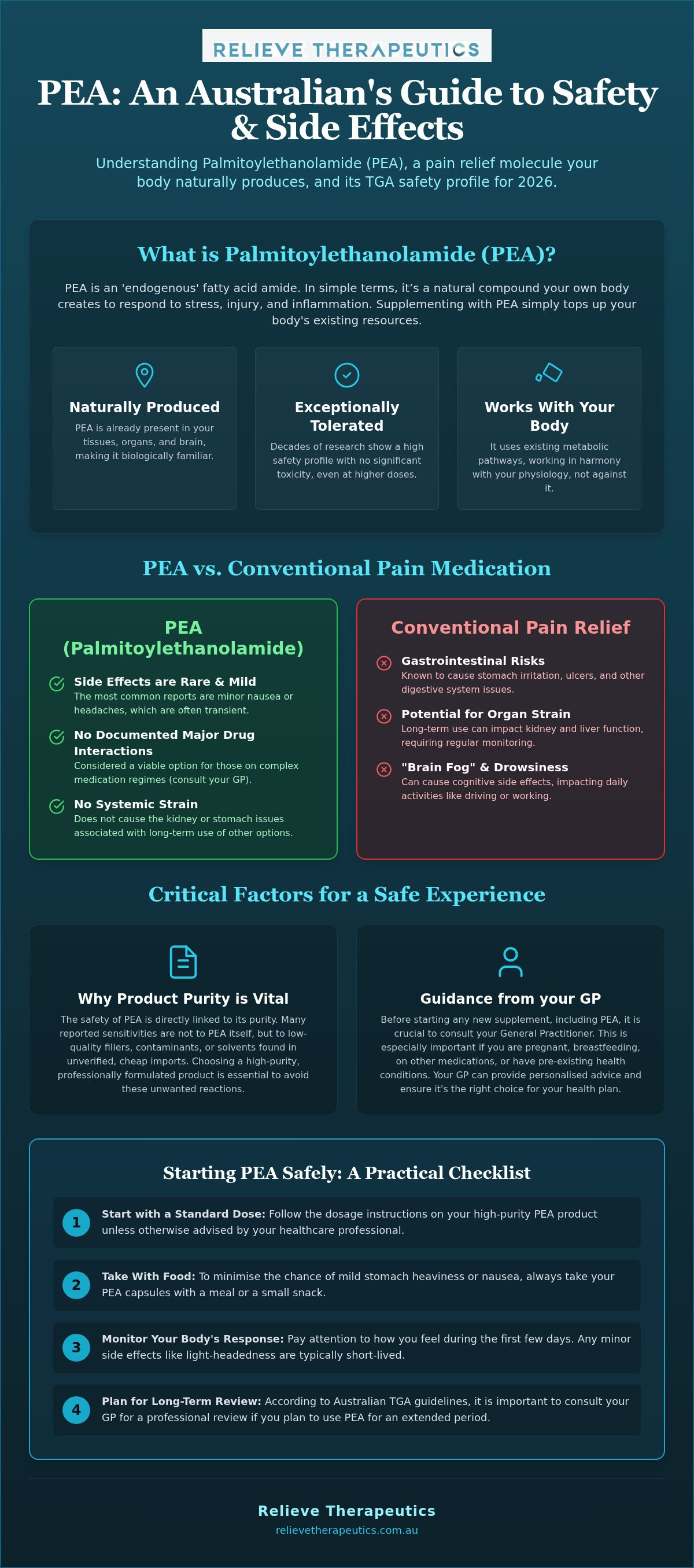
Because PEA is naturally occurring, your body isn't encountering a foreign substance. It already possesses the specific metabolic pathways required to process and utilise the compound efficiently. This biological familiarity is why palmitoylethanolamide side effects are remarkably rare. Unlike many synthetic options, there is no evidence of significant toxicity, even at higher doses. You won't experience the "hangover" effects or systemic strain often found with traditional pharmaceutical choices.
What Does 'Endogenous' Mean for Your Safety?
Your body is a sophisticated, self-regulating system. It produces PEA as a direct response to cellular stress, injury, or inflammation. Think of it as an internal repair signal. When you take a supplement, you're simply "topping up" the levels of a molecule your body is already trying to use for restoration. This natural alignment is the cornerstone of its safety. It works in harmony with your physiology, which is why major adverse reactions are so infrequent compared to other supplements.
Clinical Evidence and Long-term Use
The history of PEA research is extensive, stretching back to the 1950s. Over the last seven decades, trials involving thousands of patients have consistently shown that it's exceptionally well-tolerated. A 2025 meta-analysis involving 1,196 patients confirmed that PEA significantly reduced pain scores with no major side effects reported. This track record provides a level of reassurance that few other natural ingredients can match.
When you investigate how does PEA work for pain, you'll see it targets specific pathways without disrupting your general health. It doesn't cause the kidney strain or stomach issues often associated with long-term use of other options. For Australians seeking a sustainable regime, this clinical consensus is vital. It confirms that you can focus on your recovery without the constant worry of palmitoylethanolamide side effects interfering with your daily life.
Potential Side Effects of PEA: What the Research Shows
Transparency is essential when discussing any supplement regime. While the clinical consensus highlights a high safety profile, no active ingredient is entirely exempt from potential minor reactions. It's vital to distinguish between the inherent properties of the molecule and the external factors that can influence your experience. In a detailed review of the Therapeutic utility of palmitoylethanolamide, researchers noted a distinct lack of serious adverse events across various clinical settings. Most reported issues are mild, transient, and often resolve as your system adjusts to the supplement.
Research categorises the few reported palmitoylethanolamide side effects into "common" (though still statistically infrequent) and "extremely rare" reactions. Identifying these early allows you to manage your intake effectively and maintain a comfortable routine. It is also important to recognise that many reported sensitivities are actually reactions to low-quality fillers or contaminants found in cheap imports rather than the PEA molecule itself.
Commonly Reported Minor Issues
The most frequent feedback involves mild gastrointestinal symptoms, such as nausea or a "heavy" feeling in the stomach. These sensations often occur when the supplement is taken on an empty stomach. If you experience this, adjusting your PEA dosage for pain or taking your capsules with a meal can often mitigate the issue. A very small number of users report minor headaches or light-headedness during the first few days. These are typically short-lived as the body's endocannabinoid-related systems recalibrate. Investing in high-quality PEA capsules ensures you are receiving a clean formulation designed for optimal tolerance.
Why Some Users Experience No Effects at All
It's common for new users to worry if they don't feel an immediate change or any side effects. PEA is not a "quick fix" like a traditional analgesic; it requires a loading period. Some individuals may need to take the supplement consistently for several weeks or even three months to observe a meaningful shift in their comfort levels. Bioavailability also plays a major role. Standard PEA has larger particles that are more difficult for the human gut to absorb. This is why micronised or ultra-micronised versions are preferred in Australian clinical settings, as they provide better absorption and more predictable outcomes for the user.
Comparing PEA Side Effects with Conventional Pain Medications
Transitioning from traditional chemist-shelf analgesics to natural support is a common journey for many Australians. When managing long-term discomfort, the trade-off between relief and adverse reactions is often a source of significant stress. Traditional options, while effective for acute issues, frequently introduce a new set of complications when used for extended periods. In contrast, palmitoylethanolamide side effects are notably absent from the systemic risks associated with conventional pharmaceuticals, such as gastrointestinal bleeding, kidney strain, or liver toxicity.
The safety profile of PEA is particularly impressive when compared to prescription nerve pain medications or opioid-based alternatives. Many Australians find that while prescription gabapentinoids or opioids may dampen pain signals, they often come with a heavy cost to daily function. These can include dependency risks, a growing tolerance that requires higher doses, and a pervasive sense of fatigue. PEA offers a different path, providing a sustainable way to support your body's natural comfort mechanisms without these complex burdens.
PEA vs. NSAIDs: Protecting Your Gut Health
Many Australians rely on Non-Steroidal Anti-Inflammatory Drugs (NSAIDs) like ibuprofen or naproxen for daily management. However, these medications work by inhibiting enzymes that are also responsible for maintaining the protective lining of your stomach. Prolonged use can lead to gastric ulcers, indigestion, and in severe cases, internal bleeding. PEA operates through an entirely different biological mechanism. By modulating mast cells and glial cells rather than inhibiting the COX enzymes that safeguard the stomach lining, PEA supports a healthy inflammatory response without compromising gastric integrity.
This distinction is vital for those with sensitive digestive systems or those already taking multiple medications. Because it doesn't place undue stress on the kidneys or liver, it remains a gentle yet effective option for long-term use. If you're looking to reduce your reliance on these harsh synthetics, exploring a non-opioid pain relief supplement can be a transformative step in your wellness journey.
The Absence of Cognitive and Sedative Effects
One of the most significant advantages of PEA is its lack of sedative properties. Prescription nerve pain medications are notorious for causing "brain fog," dizziness, and a general lack of mental clarity. For Australians who need to drive, work, or care for family, these cognitive palmitoylethanolamide side effects are non-existent. PEA does not cross the blood-brain barrier in a way that interferes with your alertness or motor skills. You can maintain your daily routine with the confidence that your supplement is supporting your comfort while keeping your mind sharp and clear-headed.
Managing Risks: Interactions and Contraindications for Australians
One of the most reassuring aspects of the clinical data surrounding palmitoylethanolamide side effects is the distinct lack of documented drug-drug interactions. For many Australians managing complex health conditions, adding a new supplement often brings the worry of how it will react with existing prescriptions. Current research suggests that PEA is highly compatible with a wide range of therapies. Because it's a molecule your body already recognises and produces, it doesn't trigger the same metabolic conflicts as many synthetic compounds.
Using PEA Alongside Prescription Medication
PEA is frequently used as a complementary support alongside traditional treatments. In many cases, it can create a 'synergy' where it supports the efficacy of other therapies without increasing the risk of adverse reactions. This makes it a valuable option for those who haven't found sufficient relief through conventional means alone. Crucially, PEA does not interfere with the cytochrome P450 enzyme system, which is the primary metabolic pathway used by the majority of prescription medications. This lack of interference is a significant reason why major interactions are so rare.
While PEA is well-tolerated, maintaining a consistent routine is essential for monitoring your progress. If you're considering adding this to your wellness plan, you can view our high-quality PEA capsules to find a quantity that suits your long-term management goals.
When to Exercise Caution
Despite its safety profile, certain groups should follow the 'precautionary principle'. There is currently insufficient clinical data regarding the use of PEA in pregnant women, breastfeeding mothers, or children. For these groups, avoidance is generally recommended unless specifically advised by a specialist. Additionally, individuals with severe liver or kidney disease should consult their healthcare provider first. While PEA isn't known to strain these organs, professional oversight ensures your regime is tailored to your specific physiological needs.
Allergies are another factor to consider. While high-quality PEA is typically synthetic or derived from lecithin, some lower-grade versions may be sourced from peanuts or egg yolks. Always check the source of your capsules if you have known food sensitivities. It's also wise to monitor for any rare allergic reactions to the capsule shells or excipients used in the manufacturing process.
Your GP Discussion Checklist
Before starting any new regime, a consultation with your GP is the best way to ensure total confidence. Here is a brief checklist of points to discuss:
- Current Medication Review: Share your full list of prescriptions, especially any nerve pain medications.
- Pre-existing Conditions: Discuss any history of liver or kidney issues.
- TGA Guidelines: Mention the 2026 TGA advice regarding the 21-day usage limit before a professional review.
- Allergy History: Confirm that the capsule components align with your dietary requirements.
By following these steps, you ensure that your journey toward better comfort is both safe and evidence-based.
Why Quality Matters: Pure PEA for a Better Experience
In the Australian supplement market, the distinction between a pharmaceutical-grade product and a low-quality import is often found in the fine print of the ingredient list. The purity of the final formulation is a critical factor in your overall experience. Many users who report unexpected palmitoylethanolamide side effects are often not reacting to the PEA molecule itself, but rather to the "mystery" fillers, binders, or contaminants found in unverified products. Choosing a supplement that adheres to rigorous manufacturing standards ensures that your body receives exactly what it needs without the burden of unnecessary additives.
Relieve Therapeutics focuses on providing a clean, transparent product range designed for the specific needs of Australians. By sourcing your supply from a specialist local retailer, you benefit from consistent quality control and predictable storage conditions. We encourage new users to start with a smaller supply to gauge their personal response. This methodical approach allows you to monitor how your system interacts with the compound before transitioning to a more comprehensive, long-term regime.
The Role of Micronisation in Tolerability
The physical structure of PEA plays a vital role in how well your body tolerates it. In its standard form, PEA consists of large, crystalline particles that are inherently difficult for the human gut to absorb. When these large particles remain unprocessed in the digestive tract, they can lead to the mild gastrointestinal heaviness or nausea that some users report. Micronisation is the technical process of reducing these particles to a microscopic size, which significantly enhances their bioavailability.
Smaller particles are processed more efficiently, leading to a smoother experience and more predictable results. If you're beginning your journey, our PEA 60 capsules serve as a perfect entry point. This initial quantity provides enough supply to test your personal tolerability while your body begins the essential loading phase. It's a disciplined way to start, ensuring you feel comfortable and confident in the supplement's role in your wellness plan.
Sourcing Your PEA in Australia
Local sourcing is more than a matter of convenience; it's a marker of reliability. When you choose an Australian-based specialist, you're opting for a product that meets local expectations for safety and efficacy. Relieve Therapeutics specialises in high-count options, including 120 and 180-capsule bottles, specifically for those who have confirmed they tolerate the supplement well and require a sustainable, long-term supply. This focus on simplicity and quality ensures that your focus remains on your daily function and vitality.
The path forward is clear. By prioritising education, consulting with your GP, and insisting on high-quality sourcing, you can manage palmitoylethanolamide side effects effectively. A commitment to purity is the most reliable way to ensure that your journey toward natural support is both safe and restorative.
Starting Your Journey with Confidence
PEA represents a sophisticated bridge between laboratory science and natural wellness. Because it is an endogenous molecule, your body already possesses the metabolic pathways to process it efficiently. This biological alignment is the primary reason why palmitoylethanolamide side effects remain remarkably rare in clinical settings. Most reports are limited to mild, temporary gastrointestinal shifts that often resolve as your system recalibrates. It offers a steady, hopeful path for those seeking to avoid the cognitive fog or gastric strain associated with traditional options.
The transition to natural support should be grounded in quality, transparency, and professional care. Choosing micronised particles ensures optimal absorption while reducing the likelihood of stomach discomfort. Relieve Therapeutics acts as your trustworthy specialist, offering pure PEA formulations backed by disciplined manufacturing standards. We provide the convenience of discreet and fast local shipping across Australia to ensure your regime remains uninterrupted. Secure your supply of high-quality Australian PEA capsules today and take a definitive step toward sustainable comfort. Your health journey deserves a partner committed to substance, integrity, and long-term results.
Frequently Asked Questions
Is Palmitoylethanolamide safe to take every day for long periods?
PEA is safe for daily use; however, the TGA advises a GP review after 21 consecutive days. This regulation ensures that your chronic pain is being managed appropriately by a healthcare professional. Because PEA is an endogenous molecule, your body possesses natural pathways to metabolise it without the risk of cumulative toxicity seen in many synthetic alternatives.
Can I take PEA if I am already on blood pressure medication?
There are currently no documented major drug interactions between PEA and blood pressure medications. PEA doesn't utilise the cytochrome P450 enzyme system, which is the pathway most prescription drugs use for metabolism. While this reduces the risk of conflict, you should still discuss your supplement regime with your GP to ensure it aligns with your overall cardiovascular treatment plan.
Does PEA cause drowsiness or affect my ability to drive?
PEA does not cause drowsiness or affect your ability to drive or operate machinery. Unlike many prescription nerve pain medications that act as sedatives, PEA is a non-psychoactive fatty acid that doesn't impair your cognitive function or alertness. This makes it a preferred choice for active Australians who need to remain clear-headed while managing their daily physical comfort.
What should I do if I experience a mild stomach ache after taking PEA?
If you experience mild nausea or a stomach ache, the most effective solution is to take your capsules with a meal. While palmitoylethanolamide side effects are statistically rare, some individuals have sensitive digestive linings that respond better when the supplement is taken with food. Adjusting the timing of your intake usually resolves these transient issues without needing to stop the regime.
Are there any people who should absolutely avoid taking PEA supplements?
Pregnant women, breastfeeding mothers, and children should avoid PEA as there is currently insufficient clinical data to guarantee safety for these groups. Additionally, individuals with severe liver or kidney disease should consult a specialist before use. It's also wise to check for sensitivities to capsule excipients to prevent any rare allergic reactions that could be mistaken for palmitoylethanolamide side effects.
Is PEA addictive or will I develop a tolerance to it over time?
PEA is entirely non-addictive and you won't develop a tolerance to it over time. Because it works by supporting your body's existing endocannabinoid-related pathways rather than overriding them, there is no risk of dependency or "rebound" effects. You can maintain a consistent daily intake without the need to constantly increase the dose to achieve the same level of natural support.
Can PEA be taken on an empty stomach or should I take it with food?
You can take PEA on an empty stomach, but taking it with a meal containing some healthy fats is generally recommended for better absorption. As a fatty acid amide, PEA is lipid-soluble, meaning it integrates more effectively with your system when taken with food. This practice also serves as a simple way to prevent any potential minor gastrointestinal sensitivity.
Does PEA interact with alcohol or common Australian over-the-counter painkillers?
PEA doesn't interact with alcohol or common Australian over-the-counter painkillers like paracetamol or ibuprofen. It can be safely integrated into a broader management plan that includes these options. Its unique mechanism targets glial cell modulation rather than the enzymes affected by traditional NSAIDs, allowing it to provide support without increasing the risk of stomach irritation or kidney strain.