

What if the reason your supplement isn't delivering results isn't the quality of the ingredient, but a misunderstanding of the saturation period? If you've felt frustrated by conflicting labels or wondered why your progress feels stalled, you're certainly not alone. Many Australians find the transition from chemist-bought medications to natural fatty acids confusing, especially when it comes to avoiding potential interactions and managing daily expectations. Finding the correct palmitoylethanolamide dosage is less about a quick fix and more about a deliberate, evidence-based strategy for long-term comfort.
This guide provides the clarity you need to master your protocol, ensuring you move past the guesswork and into a sustainable health routine. We'll explore the essential 1200mg loading phase, the science of cellular saturation, and how to transition into a maintenance schedule that fits your unique lifestyle. By understanding the three-month trial framework, you can build a foundation of confidence in your long-term supplement strategy; one that prioritises precision, safety, and restored function.
Key Takeaways
- Understand the biological necessity of "saturation" and why consistent daily intake is required to replenish your body's natural fatty acid amide levels.
- Master the structured three-phase palmitoylethanolamide dosage framework, beginning with a 1200mg daily loading protocol to establish a solid foundation.
- Optimise your results by pairing capsules with healthy fats such as eggs or avocado to ensure maximum lipid bioavailability and absorption.
- Tailor your approach for nerve-related discomfort by learning how specific conditions may require adjustments within the dosage spectrum.
- Commit to the "3-Month Rule" and use a dedicated Comfort Journal to accurately monitor your transition toward improved daily function.
Understanding PEA Saturation: Why Dosage Consistency is Critical
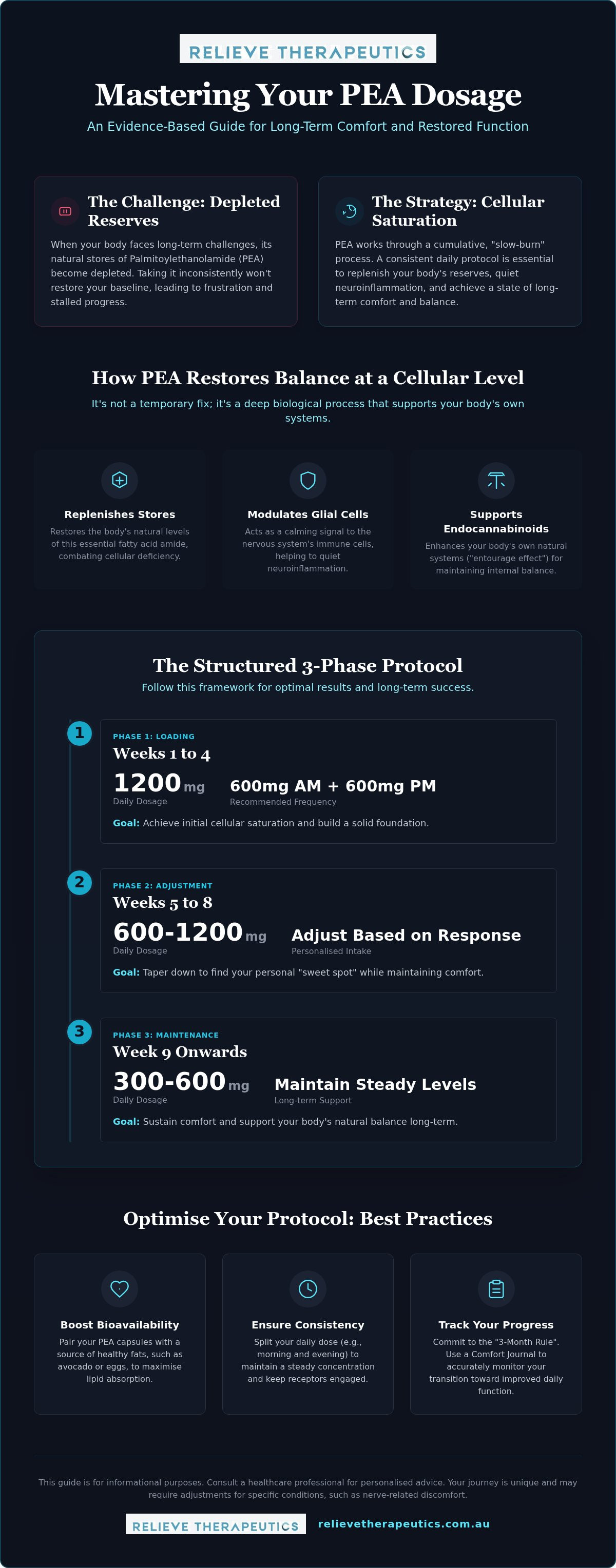
Palmitoylethanolamide (PEA) is a fatty acid amide produced naturally within your own body. It serves as a biological responder to stress, tissue damage, and persistent discomfort. When your system faces long-term challenges, its internal stores of PEA often become depleted, leading to a state of cellular deficiency. This is why the concept of "saturation" is so vital. Unlike traditional rescue medications that provide immediate, short-term relief, PEA works through a cumulative process. It's a "slow-burn" supplement that requires time to replenish these stores and restore a healthy baseline. Taking it only when you feel discomfort won't yield the same results as a steady, daily protocol.
One of the primary roles of PEA is to modulate glial cells. These cells act as the immune system of your nervous system, but they can become overactive and drive neuroinflammation. A consistent palmitoylethanolamide dosage acts as a calming signal to these cells, effectively "quieting" the inflammatory response over time. Because this modulation happens at a deep cellular level, missing doses can disrupt the stabilisation process. Consistency isn't just a suggestion; it's the foundation of the entire therapeutic strategy.
The Science of the Endocannabinoid System
PEA functions as a crucial "entourage" molecule within your body. It doesn't bind directly to the primary cannabinoid receptors; instead, it enhances the activity of your body's own naturally occurring endocannabinoids. By activating the PPAR-alpha receptor, PEA helps regulate the expression of genes involved in the inflammatory response. This receptor activation is highly sensitive to dosage frequency. Regular intake ensures the receptor remains engaged, allowing your body to maintain a state of balance and restoration. For a more detailed exploration of this biological interplay, you can read our PEA endocannabinoid supplement reference guide.
Why One Size Does Not Fit All
Finding the optimal palmitoylethanolamide dosage is an individualised process. Your metabolic rate, body weight, and the specific level of discomfort you're experiencing all influence how much your body requires. Australian clinical observations often distinguish between two distinct phases of use:
- Therapeutic Levels: Higher doses, typically around 1200mg daily, are used to achieve initial saturation.
- Maintenance Levels: Lower doses, often between 300mg and 600mg, are used to sustain comfort once saturation is reached.
While many Australian trials focus on the 600mg to 1200mg range, the specific requirement depends on how severely your natural levels have been depleted. It's about finding the "sweet spot" where your body feels supported without excess.
The Standard PEA Dosage Framework: Loading vs Maintenance
Adopting a structured approach to your palmitoylethanolamide dosage is the most effective way to ensure long-term success. Because this compound relies on cellular accumulation, a "one-off" dose is rarely sufficient to address persistent discomfort. Instead, clinical observations support a three-phase protocol designed to first saturate the tissues and then maintain those levels with a lower daily intake. This method prevents the frustration of slow-acting results by front-loading the support your body requires.
Dividing your daily intake into two separate doses is highly recommended. By taking 600mg in the morning and 600mg in the evening, you create a steady-state concentration in your bloodstream. This prevents the "peaks and troughs" associated with single large doses, keeping your internal receptors consistently engaged throughout a 24-hour cycle. To manage this initial 90-day protocol effectively, many people find that securing a 180-capsule bottle provides the most seamless experience without the risk of running out during the critical transition phase.
| Phase | Duration | Daily Dosage | Frequency |
|---|---|---|---|
| Loading | Weeks 1 to 4 | 1200mg | 600mg twice daily |
| Transition | Weeks 5 to 8 | 800mg to 1200mg | 400mg to 600mg twice daily |
| Maintenance | Week 9 onwards | 400mg to 600mg | Once or twice daily |
Phase 1: The Loading Phase (1200mg Daily)
The 1200mg daily protocol is considered the "gold standard" for initiating a biological response. During these first four weeks, your primary goal is to overcome the existing deficiency in your fatty acid amide levels. The loading phase is designed to flood the system and reset the inflammatory response. Most users find that splitting this into two 600mg doses or three 400mg doses provides the best digestive comfort and consistent support. It's during this window that your glial cells begin to receive the sustained calming signals they need to lower neuroinflammation.
Phase 2: Transition and Maintenance
Once you reach the second month, you may begin to notice subtle shifts in your daily function. Improved mobility or a reduction in the frequency of "flares" are common signs that saturation has been achieved. At this point, you can experiment with a slightly lower palmitoylethanolamide dosage, such as 800mg or 400mg daily. If your discomfort levels remain stable, this lower dose becomes your long-term maintenance strategy. For specific advice on adjusting your intake based on different types of physical challenges, our PEA dosage for pain guide offers further clinical insights.
Personalising Your Intake: Dosage for Specific Conditions
While the 1200mg loading phase serves as a universal starting point, the duration and intensity of your protocol often depend on the specific physiological challenge you're addressing. Nerve-related discomfort, for instance, typically involves more complex signalling pathways than general joint stiffness. Consequently, your palmitoylethanolamide dosage may need to remain at the higher end of the spectrum for a longer period to achieve meaningful restoration. It's about matching the biological support to the level of demand your body is facing. This tailored approach ensures you aren't just taking a supplement, but following a strategic plan for your recovery.
Nerve Support and Sciatica Protocols
For those managing neuropathic pathways, patience is a vital component of the process. In cases of severe nerve-related concerns, clinicians often observe that the initial 1200mg loading phase needs to extend beyond the standard four weeks. This is particularly true for those following a specific palmitoylethanolamide sciatica protocol. Because the sciatic nerve is the largest in the body, replenishing the local PEA levels required to quiet overactive signals can take several months of consistent intake. Nerve tissue heals slowly. If progress feels gradual, remember that staying the course is essential for long-term outcomes. Consistency creates the environment for repair.
Joint Health and General Wellness
Conversely, if your goal is general anti-inflammatory support or maintaining joint mobility, a more moderate palmitoylethanolamide dosage is often sufficient. Once the initial saturation is achieved, many Australians find that a maintenance dose of 400mg to 800mg daily keeps them in a state of comfort. PEA also works effectively alongside other natural foundations. You might consider combining it with:
- High-quality Fish Oil for omega-3 support.
- Curcumin or Turmeric for systemic anti-inflammatory benefits.
- Magnesium to assist with muscle relaxation and sleep.
Maintaining a baseline "wellness" dose helps prevent future flares and supports overall vitality. It acts as a preventative measure, ensuring your body's natural defences remain primed. However, safety remains the priority. If you're currently taking prescriptions from your local chemist, always consult your GP before adjusting your supplement routine. While PEA is a naturally occurring fatty acid with a high safety profile, your healthcare professional can help you organise a schedule that is safe, effective, and tailored to your needs.
Maximising Bioavailability: Best Practices for Taking PEA
Palmitoylethanolamide is a lipid-soluble compound. This means it dissolves in fats rather than water. To ensure your palmitoylethanolamide dosage is utilised effectively by your body, you must take it alongside a meal containing healthy fats. Without this dietary trigger, the compound often struggles to bypass the digestive process, leading to poor absorption. By pairing your capsules with foods like avocado, olive oil, or eggs, you encourage the release of bile and activate the lipid digestion pathways necessary for transport into the bloodstream.
Bioavailability is the cornerstone of any successful supplement strategy. If the body cannot absorb the ingredient, the dosage becomes irrelevant. This is particularly true for PEA, which has a naturally large molecular structure that can be difficult for the gut wall to navigate. Understanding the interaction between fat solubility and digestive timing allows you to get the most value from every capsule.
The Role of Micronisation
Micronisation is a specialised manufacturing process that reduces the particle size of the compound. For the layperson, this simply means making the particles small enough to travel through the gut wall with ease. High quality PEA capsules focus on this technical detail because standard PEA particles are often too large for efficient absorption. Micronisation significantly increases the surface area of each particle, which directly enhances its solubility and overall dosage efficiency. It's the difference between a supplement that sits in the gut and one that reaches the cells where it's needed most.
Dosage Timing and Routine
When it comes to timing, many people wonder if taking their supplement in the morning or at night makes a difference. The truth is that consistency is more important than the clock. Maintaining a steady level of PEA in your system is the primary goal, so choosing a time that fits your daily routine is best. If you happen to miss a dose, don't double up; just resume your normal schedule with your next meal. For those managing specific pathways, following a guide on how to take PEA for nerve pain can help you organise a practical daily plan that aligns with your lifestyle.
To ensure your administration is as effective as possible, follow this daily checklist:
- Pair with Fats: Always take your capsule with a meal containing healthy lipids.
- Split the Dose: Divide your daily amount into morning and evening servings.
- Stay Consistent: Take your doses at roughly the same time each day to support saturation.
- Check the Label: Confirm your supplement is micronised for optimal gut transport.
To begin your journey with high-purity, micronised capsules designed for the Australian lifestyle, you can purchase your 180-capsule supply here.
Long-Term Management: Monitoring Progress and Adjusting
Achieving a stable state of comfort is a journey, not a sprint. To truly evaluate the impact of your palmitoylethanolamide dosage, we recommend adhering to the "3-Month Rule." Because PEA works by modulating cellular responses and replenishing natural stores, judging the results before the 90-day mark often leads to premature discontinuation. Consistency over this period allows your body to fully transition from a state of deficiency to one of saturation. To support this extended trial without interruption, many users opt for the 180-capsule bulk pack; it provides exactly enough supply to cover the loading and transition phases seamlessly.
To gain an objective view of your progress, keeping a "Comfort Journal" is a highly effective practice. Instead of relying on memory, record your daily function, sleep quality, and discomfort levels on a simple scale. You might notice that while the intensity of discomfort hasn't vanished, your ability to walk to the shops or garden for longer has increased. These subtle improvements in daily function are the primary indicators that the protocol is working. It's about validating the small wins that lead to long-term restoration.
When to Increase or Decrease Your Dose
Once you've successfully completed the initial three months, you can begin to listen to your body's signals to find a lower maintenance dose. If you've reached a plateau of comfort, try reducing your intake from 1200mg to 800mg or 400mg daily. Monitor your journal closely during this time. If you experience "breakthrough" discomfort or a return of old symptoms, it's a clear sign that your body still requires a higher level of support. In these instances, you can temporarily return to the loading dose until stability is restored. This flexible, responsive approach ensures you're always providing your system with the precise level of fatty acid amides it needs.
Safety, Side Effects, and Interactions
PEA is exceptionally well-tolerated by the majority of Australians. Because it's a substance your body already produces, it has no known toxicity at standard doses, even when used over many months. Side effects are rare; however, it's always professional practice to keep your GP in the loop regarding your supplement routine. Transparency with your healthcare provider ensures your personal health strategy remains cohesive and safe. At Relieve Therapeutics, we focus on high-purity, simple formulations to minimise the risk of reactions and maximise the reliability of your results. By choosing a clean, evidence-based product, you can focus on what matters most: your return to a more active and comfortable life.
Embarking on Your Journey Toward Lasting Comfort
Restoring your body's natural balance requires a commitment to both science and patience. By following a structured 1200mg loading phase and allowing for a full 90-day saturation period, you move beyond temporary fixes toward genuine, long-term support. Your palmitoylethanolamide dosage is most effective when paired with healthy fats and high-purity, micronised formulations that ensure optimal absorption. Consistency is the final piece of the puzzle; it's the bridge between where you are now and the vitality you wish to reclaim.
To ensure you have the necessary supply for the critical first three months, you can secure your 3-month supply with our PEA 180 Capsules. We provide free Australian shipping on bulk orders, delivering pure, laboratory-tested PEA directly to your door. Trusted by Australians seeking a natural path to wellness, our focused range is designed to simplify your health journey and provide reliable results. You don't have to navigate this transition alone. With the right protocol and a high-quality foundation, you can reclaim your daily function and look forward to a more comfortable future.
Frequently Asked Questions
What is the recommended daily dosage of palmitoylethanolamide?
The standard palmitoylethanolamide dosage for adults typically begins with a 1200mg loading phase per day. This amount is usually maintained for the first four to eight weeks to ensure cellular saturation. Once you achieve a stable level of comfort, you can transition to a maintenance dose of 300mg to 600mg daily. Always check the concentration of your specific capsules to ensure you're meeting these clinical benchmarks for optimal results.
Can I take 1200mg of PEA all at once?
While taking 1200mg in a single serving isn't harmful, it's more effective to divide the amount into two separate doses. Splitting your intake into 600mg in the morning and 600mg in the evening helps maintain a steady-state level of PEA in your system. This approach prevents blood level fluctuations and ensures your receptors are consistently supported throughout the day and night, leading to better long-term outcomes.
How long does it take for PEA to start working?
Most Australians notice initial changes within two to eight weeks of consistent daily use. However, the maximum benefits of PEA are often achieved after a full three-month trial. Because it's a fatty acid that works through biological accumulation rather than immediate chemical suppression, your body needs time to replenish its natural stores. Patience is essential during this period as your system gradually recalibrates its inflammatory response.
Is it safe to take PEA long-term for chronic issues?
Yes, PEA is considered highly safe for long-term use as it's a compound your body produces naturally. Clinical studies have shown no significant toxicity or habit-forming potential even with extended administration. Many people maintain a daily wellness dose for years to support ongoing comfort and mobility. If you're managing chronic conditions, staying on a maintenance dose helps prevent the depletion of your internal stores and reduces future flares.
Should I take PEA capsules on an empty stomach?
You should avoid taking PEA capsules on an empty stomach to ensure maximum absorption. As a lipid-soluble compound, it requires the presence of dietary fats to be transported effectively through the digestive system. Taking your dose with a meal containing healthy fats, such as olive oil, eggs, or avocado, triggers the necessary biological pathways. This simple adjustment can significantly increase the bioavailability of the supplement compared to taking it with water alone.
What is the maximum safe dose of PEA per day?
While clinical trials have safely utilised doses up to 2400mg per day in specific settings, the standard maximum recommended palmitoylethanolamide dosage for general use is 1200mg daily. Consuming more than this amount rarely provides additional benefits once saturation has been achieved. If you feel you require a higher dose to manage significant discomfort, it's important to discuss this strategy with your GP to ensure it aligns with your overall health plan.
Can I take PEA alongside my other medications?
PEA is known for having a high safety profile with no documented drug-to-drug interactions in clinical literature. It can generally be taken alongside traditional medications bought at the chemist without interference. However, we always recommend informing your healthcare professional before adding any new supplement to your routine. This transparency allows your doctor to monitor your progress holistically and ensure that your combination of therapies is perfectly balanced for your specific needs.
Does the dosage change if I am using PEA for nerve pain specifically?
When addressing nerve-related concerns, it's common to remain on the higher 1200mg loading dose for an extended period. Neuropathic pathways are complex and often require more time to reach the saturation point compared to general joint issues. Some individuals maintain the loading dose for up to three months before attempting to transition to a lower maintenance level. This ensures the glial cells receive a sustained signal to quiet overactive discomfort pathways.