

What if the most effective way to manage your body's inflammatory response isn't by blocking it with harsh chemicals, but by speaking its own biological language? For the 5.4 million Australians currently living with chronic pain, the search for palmitoylethanolamide for inflammation often begins when traditional NSAIDs lose their appeal. You might be all too familiar with the gastric upset and "brain fog" caused by standard medications, or perhaps you've felt overwhelmed by the technical jargon surrounding modern supplements. You deserve a clear path to comfort that doesn't compromise your long-term health.
This guide simplifies the science behind this body-identical compound, explaining how it modulates immune cells to "calm" overactive signals. We'll explore the unique ALIA mechanism that sets it apart from standard painkillers and provide practical advice on choosing the right dosage for your needs. By the end of this article, you'll have the confidence to select high-purity, Australian-sourced PEA capsules that support your journey toward restored vitality and daily function. It's time to move beyond temporary fixes and embrace a more sophisticated, evidence-based approach to wellness.
Key Takeaways
- Learn how PEA acts as a biological modulator that "cools" cellular discomfort by calming overactive mast cells and immune signals.
- Understand the safety advantages of using palmitoylethanolamide for inflammation compared to traditional NSAIDs; this approach supports long-term wellness without common gastric side effects.
- Discover why ultra-micronisation is critical for absorption, ensuring your body can effectively utilise this naturally fat-loving compound for maximum efficacy.
- Identify the ideal supplement volume for your personal health goals, ranging from 60-count starter options to the 180-capsule pack for sustained support.
- Gain confidence in your health journey by following current Australian guidelines for dosage, duration, and professional consultation.
Understanding Palmitoylethanolamide (PEA) and the Inflammatory Response
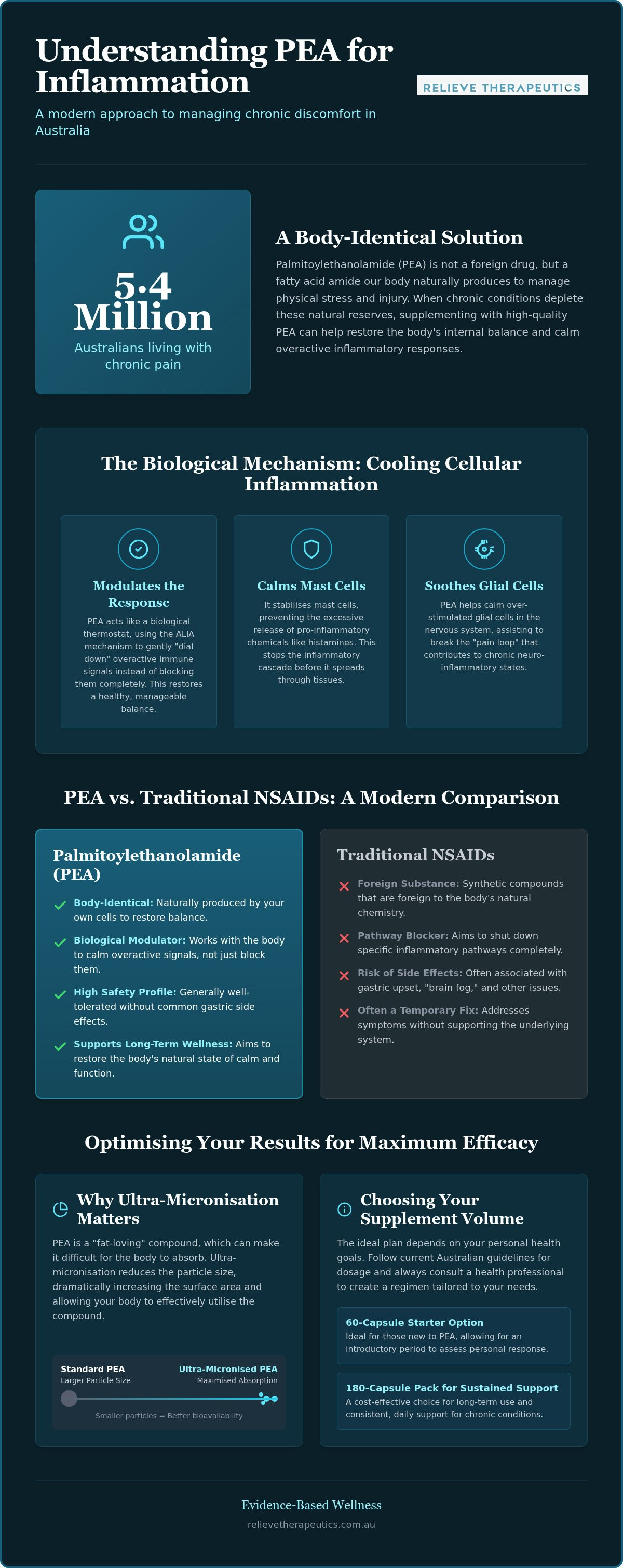
Palmitoylethanolamide (PEA) is a fatty acid amide that functions as a crucial part of our internal repair system. It's not a foreign substance; our cells synthesise it "on-demand" to restore balance when we face physical stress or injury. You can think of it as a biological first responder. When tissues are damaged or under threat, your body ramps up production to manage the fallout. However, during periods of prolonged stress, these natural reserves can become depleted, leaving the body in a state of persistent discomfort. This is why many Australians are now exploring palmitoylethanolamide for inflammation as a way to replenish what's been lost.
The Endocannabinoid System Connection
PEA is often described as an endocannabinoid-like molecule. While it shares a similar structural family with compounds found in hemp, it's entirely non-psychoactive and functions through different pathways. Its primary target is the PPAR-alpha receptor, a protein that acts like a master switch for gene expression related to pain and inflammatory responses. Unlike CBD, which requires a prescription in Australia as a Schedule 4 substance, PEA is a naturally occurring compound found in common foods like egg yolks, peanuts, and soy lecithin. It supports the endocannabinoid system indirectly by preventing the breakdown of other beneficial lipids, helping your body maintain its own internal harmony without the need for synthetic interference.
Inflammation: The Body’s Silent Alarm
Inflammation is often misunderstood. In its acute form, it's a vital, healthy response that helps your body heal from a graze or a common cold. It's the "alarm" that tells your immune system to get to work. The problem arises when this alarm gets stuck in the "on" position. Chronic inflammation is a silent, persistent state where the body continues to attack perceived threats long after the initial danger has passed. This leads to tissue stress, reduced mobility, and the emotional exhaustion of daily discomfort. Using palmitoylethanolamide for inflammation offers a way to "reset" this alarm. Instead of simply blocking a single pathway, PEA acts as a biological modulator that helps the body return to its natural baseline of calm and vitality.
The Biological Mechanism: How PEA "Cools" Cellular Inflammation
Think of your body's inflammatory response as a thermostat. When injury or stress occurs, the heat turns up to facilitate healing. However, in chronic states, this thermostat gets stuck on "high," leading to persistent tissue stress and discomfort. Palmitoylethanolamide for inflammation acts as a biological dial, gently turning down that heat at a cellular level. It doesn't force the system to shut off entirely; it modulates the response to ensure it remains within a healthy, manageable range. This restorative process is driven by the ALIA mechanism, which stands for Autacoid Local Inflammation Antagonism. Essentially, it's the body’s natural way of curbing overactive immune responses before they cause lasting damage.
Mast Cell Modulation: Stopping the Cascade
Mast cells are the first responders of your immune system. They store and release potent chemicals, such as histamines and cytokines, through a process called degranulation. While this is helpful for immediate threats, chronic inflammation causes these cells to become hyper-reactive. PEA steps in to stabilise the mast cell membrane, preventing the excessive release of these pro-inflammatory substances. By down-regulating this activity, it stops the inflammatory cascade before it spreads through the surrounding tissue. This stabilising influence is one of the primary documented anti-inflammatory effects that researchers have observed in clinical settings. Managing palmitoylethanolamide for inflammation at this early stage helps prevent the "runaway" effect that often characterises long-term health challenges.
Glial Cells and the Neuro-Inflammatory Link
Inflammation isn't confined to your joints or muscles. It often moves into the nervous system, where glial cells act as the primary caretakers and protectors of your neurons. When these cells become over-stimulated, they maintain a "pain loop" that can be difficult to break with traditional methods. PEA supports the health of these specialised cells, helping them return to a protective rather than a provocative state. This is a critical component in understanding how does PEA work for pain, as it addresses the neuro-inflammatory component of long-term discomfort. By calming these caretaker cells, you're effectively addressing the root cause of the signal rather than just masking the symptom.
By targeting both the local immune response and the nervous system, PEA provides a comprehensive approach to recovery. It offers a sophisticated alternative for those who want to support their body's innate healing capacity. If you're looking for high-purity options to begin this process, you can explore the specialised range at Relieve Therapeutics.
PEA vs. Traditional Anti-Inflammatories: A Modern Comparison
Choosing between pharmaceutical interventions and natural modulators is a pivotal decision for anyone managing long-term discomfort. Most Australians are familiar with non-steroidal anti-inflammatory drugs (NSAIDs), such as ibuprofen or aspirin, which work by inhibiting specific enzymes to stop the production of inflammatory chemicals. While effective for short-term relief, this "blocking" mechanism is often a blunt instrument. In contrast, using palmitoylethanolamide for inflammation offers a more refined approach. Instead of shutting down a pathway entirely, PEA modulates the body's existing response, encouraging a return to homeostasis without disrupting essential biological functions.
The Limitations of Standard NSAIDs
Standard NSAIDs can be hard on the body when used over extended periods. Because they block prostaglandins, which also protect the stomach lining and support kidney function, long-term use frequently leads to gastrointestinal erosions or ulcers. This systemic impact is why many people are now searching for non-opioid pain relief supplements that offer a gentler profile. Blocking a biological pathway can sometimes cause secondary issues, as the body may struggle to maintain its natural protective barriers. For the 60% of Australians living with at least one chronic condition, finding an alternative that respects the body's delicate internal balance is essential for sustainable health.
The PEA Advantage: A Sustainable Approach
PEA is considered a "biomimetic" supplement because it mimics a compound your body already produces. This familiarity means the body recognises and utilises it efficiently without the "rebound" effects or dependency risks associated with some traditional medications. Research into PEA's anti-inflammatory mechanisms shows that it works synergistically with your cells rather than overriding them. This makes it a reliable partner for long-term wellness. Because it is naturally occurring, it doesn't carry the same risk of gastric upset, making it a viable option for those with sensitive digestive systems.
Another significant advantage is its compatibility. Unlike many drugs that have complex interactions, palmitoylethanolamide for inflammation can often be integrated into a broader wellness plan alongside other supports. It doesn't mask symptoms; it addresses the underlying cellular "heat" we discussed earlier. This evidence-based approach provides a sense of security for those who value scientific rigour and natural origins in their health journey. By choosing a modulator over an inhibitor, you're supporting your body's innate ability to repair and recover.
Optimising Your Results: Dosage and Bioavailability for Inflammation
Understanding the physical properties of a supplement is just as vital as knowing its biological function. Palmitoylethanolamide for inflammation is naturally lipophilic, meaning it's a "fat-loving" compound. Because our digestive systems are primarily aqueous, or water-based, standard PEA particles often resist dissolving. This physical mismatch can result in the compound passing through your system underutilised, which is a common frustration for those seeking natural relief. To overcome this hurdle, the supplement must be engineered to bridge the gap between its fatty nature and your body's absorption pathways.
Micronised vs. Standard PEA
The most effective solution to the absorption challenge is a process called micronisation. This technique involves breaking down large PEA crystals into ultra-fine particles, significantly increasing the total surface area available for uptake. It's a simple principle of physics; smaller particles move across the intestinal wall more efficiently than larger ones. When you prioritise high quality PEA capsules, you're ensuring the formulation has been optimised for maximum bioavailability. Without this specialised processing, standard PEA may lack the cellular "reach" required to effectively modulate your inflammatory response.
Finding Your Personal Protocol
Consistency is the final piece of the puzzle. Unlike some traditional interventions that provide a temporary "spike" in relief, PEA works by building up within your tissues over time. Many users find success by starting with a "loading phase" to saturate their system, followed by a lower maintenance dose once balance is restored. For a detailed breakdown of these amounts, you can refer to our guide on PEA dosage for pain and inflammation. To further enhance uptake, it's recommended to take your capsules with a meal containing healthy fats, such as avocado or olive oil, which assists the lipophilic molecules in entering the bloodstream.
Safety and professional guidance remain paramount. While palmitoylethanolamide for inflammation is available over-the-counter in Australia, the Therapeutic Goods Administration (TGA) advises that it shouldn't be used for more than 21 consecutive days without consulting a healthcare provider. This ensures your management plan is tailored to your specific health profile and long-term goals. If you're ready to start with a premium, Australian-sourced option, explore our range of micronised PEA capsules to support your daily wellness journey.
Why Relieve Therapeutics is Australia’s Choice for High-Quality PEA
When managing long-term health, the source of your supplements is as critical as the science behind them. Relieve Therapeutics has established itself as the Australian specialist, focusing exclusively on providing high-purity palmitoylethanolamide for inflammation. While international marketplaces often offer a confusing array of generic products, we provide a transparent range designed for real-world needs. Our selection includes 60, 120, and 180-count options, allowing you to choose the volume that aligns with your specific recovery phase. For those managing persistent inflammatory states, the 180-capsule pack offers the best value for sustained support, ensuring you have a consistent supply without the stress of frequent reordering.
Australian Owned and Operated
Being Australian-owned and operated means we adhere to local quality standards and understand the specific needs of our community. When you are ordering PEA supplements in Australia, you shouldn't have to worry about international customs delays or the freshness of stock sitting in overseas warehouses. Our direct-to-consumer model ensures that every bottle is dispatched quickly from our local centre. This local presence allows us to maintain strict oversight of our supply chain, providing you with the peace of mind that comes from knowing exactly where your health products originate.
The Relieve Therapeutics Difference
We aren't a generalist health store; we are a dedicated specialist. This focus allows us to provide deep expertise in palmitoylethanolamide for inflammation rather than diluting our knowledge across thousands of unrelated products. For users who are transitioning from the initial loading phase to a steady routine, our PEA 120 capsules serve as a balanced, strategic choice for sustained support. We see ourselves as your partner in this journey, offering the clinical authority you expect alongside the empathetic care you deserve.
Our commitment is to substance over style. We provide the technical transparency you need to make informed decisions about your wellness. By specialising solely in PEA, we ensure that our stock is always fresh and our manufacturing standards are meticulously managed. This disciplined approach projects the image of a brand that values long-term outcomes over short-term hype, positioning us as a reliable ally in your personal health journey. Whether you are just beginning to explore natural modulators or looking for a more reliable local supplier, we are here to support your move toward restored vitality and daily function.
Restoring Your Body’s Natural Balance
Empowering your health journey requires moving beyond temporary fixes and embracing the body's own restorative mechanisms. We've explored how palmitoylethanolamide for inflammation acts as a sophisticated biological modulator, calming overactive immune signals without the harsh side effects of traditional inhibitors. By prioritising ultra-micronised formulations, you ensure that this naturally occurring lipid is effectively absorbed and utilised where it's needed most. Consistency is the foundation of success; allowing the compound to build in your system creates a sustainable path toward daily comfort.
As a specialised Australian retailer, Relieve Therapeutics is committed to providing pure PEA formulations that are free from unnecessary fillers. Our range is available in 60, 120, and 180-count supplies to suit every stage of your protocol, from initial loading to long-term maintenance. You don't have to navigate chronic discomfort alone. Browse our range of high-quality PEA capsules at Relieve Therapeutics today to find a reliable partner in your personal wellness journey. We're here to help you move toward a life of greater comfort and restored vitality.
Frequently Asked Questions
Is palmitoylethanolamide safe to take with other anti-inflammatory medications?
PEA is generally safe to use alongside other anti-inflammatory medications because it operates through distinct biological pathways. It doesn't typically interact with standard NSAIDs, making it a versatile addition to a management plan. However, you should always consult with your healthcare professional to confirm suitability for your specific health profile. Its role as a cellular modulator helps support the body's natural response without the conflict often found between different pharmaceutical compounds.
How long does it take for PEA to start working for inflammation?
Most users begin to experience results within two to four weeks of daily use. Unlike short-term painkillers that offer immediate spikes in relief, palmitoylethanolamide for inflammation works by gradually building up in your system. This cumulative effect is why consistency is the most important factor in your protocol. It's a methodical process of cooling cellular signals, requiring a steady approach to achieve the restored vitality and comfort you're looking for.
Are there any known side effects of PEA supplements?
PEA is remarkably well-tolerated because it's a compound your body already synthesises. It doesn't carry the gastrointestinal risks or kidney stress often associated with traditional medications. Most people experience no adverse effects, though very mild digestive changes are occasionally reported during the first few days. Because it's non-addictive and non-psychoactive, it doesn't lead to dependency or the cognitive fog that can sometimes accompany stronger, prescription-only pain management options.
Is PEA a natural substance or is it synthetic?
PEA is a naturally occurring fatty acid amide found in your own cells and in common foods like egg yolks and soy. The capsules we provide are high-purity, body-identical versions of this molecule. This means your system recognises the compound as a familiar biological signal rather than a foreign chemical. It's a sophisticated, evidence-based way to support your body's innate repair system using substances that align with your natural cellular processes.
Can I take PEA long-term for chronic inflammatory conditions?
PEA is designed for sustained support, making it suitable for long-term use in chronic cases. Australian guidelines from the TGA recommend consulting a healthcare provider if you intend to use it for more than 21 consecutive days. This professional oversight ensures your dosage remains optimal as your health goals evolve. Its high safety profile and lack of cumulative toxicity make it a dependable ally for those seeking a gentle, long-term wellness strategy.
What is the difference between micronised and ultra-micronised PEA?
The difference relates to particle size and how well your body can absorb the supplement. Because PEA is naturally fat-loving, larger crystals often pass through the digestive system unutilised. Micronisation breaks these down, while ultra-micronisation creates the smallest possible particles for maximum surface area. This enhanced bioavailability is critical when using palmitoylethanolamide for inflammation, as it ensures the active compound actually enters your bloodstream to modulate the immune response effectively.
Is a prescription required to buy PEA capsules in Australia?
You don't need a prescription to buy PEA capsules in Australia. It's available over-the-counter as a listed complementary medicine regulated by the TGA. This allows you to order high-quality supplies directly from specialised retailers like Relieve Therapeutics without a clinical appointment. While the supplement is easily accessible, we always recommend speaking with your doctor to ensure it's integrated safely into your existing health routine and broader pain management plan.