

Most traditional painkillers are designed to silence your brain's alarm system rather than addressing the source of the fire. While these medications offer temporary relief, they often leave you feeling lethargic, cognitively foggy, and concerned about the risks of dependency. Finding an effective non-opioid pain relief supplement is now a vital step for the 2.2% of Australians who have sought alternatives to traditional pharmaceutical paths. You deserve a strategy that prioritises long-term health, restores daily function, and respects your body's natural equilibrium.
It is frustrating to feel that your medication is simply masking symptoms while your quality of life remains on hold. You likely want to regain your mobility, improve your clarity, and reduce your reliance on heavy prescriptions. This guide explores how natural alternatives like Palmitoylethanolamide (PEA) provide a science-backed pathway to managing chronic discomfort. We will break down how PEA calms overactive nerve cells, review the 2026 TGA regulatory landscape, and provide a clear framework for integrating these supplements into your wellness routine to achieve lasting comfort.
Key Takeaways
- Understand the fundamental shift in Australian pain management from merely masking symptoms to supporting the body's natural cellular response for long-term comfort.
- Explore the biological role of Palmitoylethanolamide (PEA), a naturally occurring fatty acid amide that acts as a potent non-opioid pain relief supplement by regulating inflammation.
- Learn the critical differences between traditional painkillers and natural alternatives, including why supplements require a consistent approach to build sustainable efficacy.
- Discover the importance of micronisation in overcoming absorption challenges, ensuring that active molecules are efficiently utilised by your system for maximum benefit.
- Identify why choosing a specialist Australian provider ensures purity and reliability through high-quality, single-ingredient formulations delivered with domestic efficiency.
The Shift Toward Non-Opioid Pain Relief in Australia
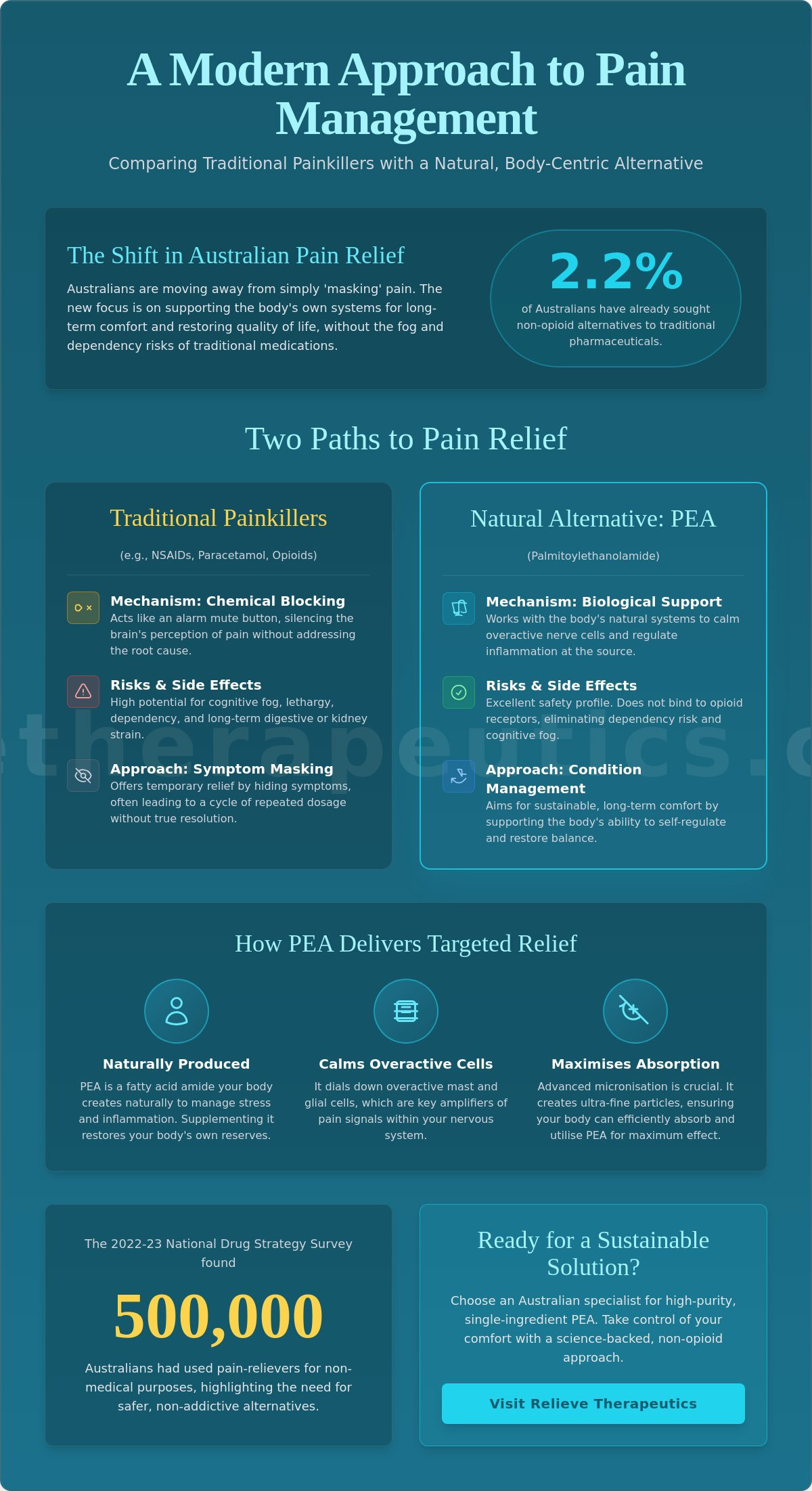
Australia's relationship with chronic pain management is undergoing a fundamental transformation. For decades, the default response to persistent discomfort was a heavy prescription, yet the 2022-2023 National Drug Strategy Household Survey revealed that 500,000 Australians had used pain-relievers for non-medical purposes. This statistic highlights a growing caution regarding dependency and the systemic side effects of traditional medication. Many people now recognise that "masking" a symptom is not the same as managing a condition. They're looking for a non-opioid pain relief supplement that aligns with their body's chemistry rather than overriding it.
The goal is no longer just to silence the pain signal at any cost. Instead, Australians are prioritising long-term sustainability, cognitive clarity, and physical restoration. A supplement is not a "magic pill" but a supportive tool designed to work alongside lifestyle changes like physiotherapy, anti-inflammatory diets, and improved sleep hygiene. When you choose to integrate a non-opioid pain relief supplement into your routine, you're choosing a path of biological support. However, it's vital to consult your Australian GP before transitioning from prescription meds to ensure your plan is safe and tailored to your specific needs.
The Limitations of Traditional Pharmaceutical Options
Standard options like NSAIDs and paracetamol are often effective for acute, short-term injuries. However, long-term reliance can lead to digestive complications, kidney strain, or a "ceiling effect" where the medication no longer provides relief. This shift from "chemical blocking," where signals are simply interrupted, to "biological support" is where natural alternatives excel. By integrating a Palmitoylethanolamide (PEA) protocol, individuals can support the fatty acid amides their bodies already produce to regulate inflammation. This approach addresses the underlying cellular environment rather than just the brain's perception of the pain.
Why 2026 is the Year of Personalised Natural Support
The Australian market in 2026 demands transparency and purity. "Clean label" products that avoid unnecessary fillers are now the standard, backed by rigorous TGA compliance priorities that focus on listed medicine advertising and ingredient integrity. Holistic pain management plans now frequently combine lifestyle adjustments with high-quality, standardised supplements. This personalised approach ensures that support is tailored to individual health histories, lifestyle demands, and specific pain patterns. It represents a move away from one-size-fits-all prescriptions toward a more nuanced, evidence-based wellness journey.
What is PEA? The Premier Non-Opioid Pain Relief Supplement
Palmitoylethanolamide, commonly known as PEA, represents a sophisticated shift in how we approach persistent discomfort. Unlike synthetic compounds that introduce foreign chemicals to the body, PEA is a fatty acid amide produced naturally within our own cells in response to tissue stress. It functions as a vital component of the endocannabinoid system, acting as a lipid mediator that helps regulate inflammation and pain signalling pathways. Many Australians seeking alternatives to traditional painkillers find reassurance in its biological familiarity. PEA is a biomarker-balancing molecule that supports nerve health by maintaining cellular equilibrium. Crucially, it doesn't bind to opioid receptors, which eliminates the risks of dependency, respiratory depression, or the cognitive fog often associated with heavy medication.
How PEA Works Within Your Body’s Natural Systems
Our bodies produce PEA on-demand to protect tissues and dampen inflammatory responses. However, during periods of chronic discomfort, our natural reserves can become depleted, leaving the body unable to self-regulate effectively. PEA works by down-regulating overactive mast cells and glial cells, which are often responsible for amplifying pain signals in the nervous system. You can think of it as a biological thermostat for inflammation. When the heat of inflammation rises too high, PEA helps dial it back to a manageable level. This restorative process makes it a foundational non-opioid pain relief supplement for those who prefer a proactive rather than reactive approach to their health.
The Evidence for Nerve and Joint Support
Clinical interest in PEA has expanded significantly, particularly concerning its efficacy for neuropathic and musculoskeletal issues. Research suggests that by stabilising the cells that surround our nerves, PEA can help reduce the intensity of pins and needles or burning sensations. This versatility is why it's frequently recommended for joint wear and tear as well as complex nerve-related conditions. For a deeper dive into specific applications, you might find our guide on Choosing the Best Supplement for Neuropathy in Australia particularly helpful. By addressing the cellular environment rather than just the symptom, PEA offers a sustainable path toward improved daily mobility and comfort.
Achieving these results requires a commitment to quality and consistency. Because PEA works cumulatively, selecting a high-purity formulation is essential for ensuring your body receives the support it needs. If you're ready to explore a cleaner path to comfort, you can view our range of pure PEA capsules designed specifically for the Australian market.
Comparing Natural Supplements vs. Traditional Painkillers
Choosing between traditional pharmaceuticals and a non-opioid pain relief supplement often involves balancing immediate relief against long-term health. Traditional opioids and NSAIDs are engineered for rapid onset, typically acting within thirty to sixty minutes. While this speed is beneficial for acute trauma, it often comes at a cost to systemic health. In contrast, natural alternatives like PEA focus on long-term sustainability. They don't offer a "quick fix" but instead work to gradually alter the cellular environment, providing a foundation for lasting comfort without the volatile highs and lows of chemical intervention.
A significant advantage of PEA is its gentle profile regarding digestive health. Many Australians find that long-term use of NSAIDs leads to gastric irritation or even ulcers. Because PEA is a lipid naturally occurring in the body, it is remarkably gut-friendly. Additionally, traditional painkillers are frequently associated with "rebound pain," a phenomenon where the body becomes more sensitive to discomfort as the medication wears off. A high-quality non-opioid pain relief supplement avoids this cycle by supporting the body's own regulatory systems rather than temporarily suppressing them.
Safety Profiles and Long-Term Use
Australian clinical reviews consistently highlight the favourable safety profile of PEA. It lacks the significant side effects common to standard anti-inflammatories, such as cardiovascular strain or renal issues. This makes it a viable option for individuals who have been advised to avoid NSAIDs due to pre-existing conditions. While PEA is often compatible with other therapies, the TGA advises that users shouldn't exceed 21 consecutive days of use without a professional check-in. This guideline ensures you remain under the guidance of your GP to monitor your progress and adjust your holistic care plan as needed.
Efficacy: Managing Expectations for Natural Support
Transparency is essential when discussing natural pathways. Unlike the near-instant effect of an opioid, PEA requires a "loading period" to reach therapeutic levels within your tissues. Most users report noticeable changes after two to four weeks of consistent use. Consistency is the most critical factor here; skipping doses can disrupt the cumulative effect required for nerve and joint support. To ensure you are starting with a product that meets rigorous standards, consult our High Quality PEA Capsules buyer's guide. Prioritising purity and correct dosage is the first step toward reducing your reliance on heavy medication.
Maximising Results: Absorption, Micronisation, and Dosage
Palmitoylethanolamide is a large, fat-soluble molecule. This physical structure makes it inherently difficult for the human digestive system to process in its raw, crystalline state. Most standard versions of this non-opioid pain relief supplement struggle with low bioavailability because the particles are simply too large to cross the intestinal wall effectively. To overcome this biological hurdle, the pharmaceutical industry uses a process called micronisation. By reducing the particle size to just a few micrometres, the surface area increases significantly, which allows for much better dissolution and uptake into the bloodstream.
Particle size is the primary differentiator between budget-grade supplements and those that deliver genuine therapeutic results. While raw PEA is cheaper to manufacture, it often passes through the system without being absorbed, leading to disappointing outcomes. Ultra-micronisation takes this a step further, breaking the particles down even smaller to ensure maximum cellular interaction. For those managing chronic conditions over several months, the efficiency of each dose is vital. This is why 180-capsule packs are a popular choice for long-term management. They provide a consistent supply of high-bioavailability support while offering better value for a sustained wellness programme.
Why Particle Size Matters for Your Comfort
Smaller particles cross the intestinal barrier with much greater ease than their larger counterparts. Standard PEA often contains inconsistent particle sizes, which leads to unpredictable and inefficient absorption. In contrast, ultra-micronised formulations provide a uniform, fine powder that your body can readily utilise. When you see "ultra-micronised" on a label, you're looking at a product designed for superior efficacy. It ensures that the active compound actually reaches the overactive mast cells and glial cells that require regulation, rather than being wasted during the digestive process.
Dosage Best Practices for New Users
Most individuals new to this non-opioid pain relief supplement begin with a loading phase to saturate their tissues. This typically involves a higher daily intake for the first few weeks before transitioning to a maintenance level. Splitting your daily intake into two separate doses, one in the morning and one in the evening, is a strategic way to maintain steady blood levels throughout the day and night. For a detailed breakdown of timing and frequency, please refer to our practical guide on How to Take PEA for Nerve Pain. Consistency is the foundation of success when using natural alternatives to manage persistent discomfort.
If you're ready to start your journey with a high-purity, ultra-micronised formula, you can order our premium PEA capsules here for fast delivery across Australia.
Why Relieve Therapeutics is Australia’s Trusted PEA Specialist
Relieve Therapeutics operates with a singular focus on quality, integrity, and transparency. Unlike many brands that offer complex "proprietary blends" containing a dozen different ingredients in trace amounts, we specialise exclusively in high-purity Palmitoylethanolamide. This focused approach ensures that you receive a therapeutic dose of the active compound without unnecessary fillers or synthetic additives. By prioritising a single, high-quality ingredient, we provide a reliable non-opioid pain relief supplement that meets the rigorous expectations of the Australian market in 2026. Our commitment to clinical-grade purity means you can trust the substance inside every capsule to support your body's natural restorative processes.
We understand that the journey toward managing chronic discomfort is personal and often requires different levels of support over time. To accommodate these varying needs, we provide our ultra-micronised PEA in three distinct sizes: 60, 120, and 180 capsules. These options are designed to match your specific stage of care, whether you are in the initial loading phase or transitioning into long-term maintenance. This flexibility ensures you always have access to the exact volume of support required to maintain your daily mobility and comfort.
The Benefit of a Focused Australian Provider
Choosing a local specialist offers practical advantages that international retailers simply cannot match. Relieve Therapeutics is an Australian business, meaning all orders are dispatched directly from our domestic facility. This ensures fast, reliable shipping, which is essential for maintaining the consistency required for chronic care. You don't have to worry about international customs delays or the uncertainty of overseas quality standards. We act as a "Trustworthy Specialist" in your health journey, offering a streamlined online ordering process that removes the need for a pharmacy visit. This direct-to-consumer model allows us to maintain a high standard of professional care while ensuring our products remain accessible to those who need them most.
Starting Your Journey with the 60-Capsule Pack
For those who are new to the world of natural alternatives, the 60-capsule bottle serves as the ideal entry point. It allows you to trial the efficacy of PEA and observe how your body responds to this biological support during the initial weeks. If you are just beginning, we recommend reading our dedicated guide on PEA 60 Capsules, which provides a comprehensive framework for beginners. Taking that first step toward a non-opioid pain relief supplement is an investment in your future vitality and long-term well-being. When you are ready to move away from traditional blockers and toward natural restoration, our team is here to provide the high-purity tools you need to succeed.
Experience the difference that specialist care and ultra-micronised purity can make in your daily life. Explore our full range of PEA capsules today and begin your path toward sustainable, science-backed comfort.
Embracing a Sustainable Path to Daily Comfort
The transition toward non-opioid care represents a significant shift in how we understand chronic discomfort. By moving away from temporary chemical blockers and toward biological support, you're choosing to work with your body's natural systems. We've explored how ultra-micronisation overcomes absorption barriers and why a consistent routine is the most critical factor for success. Selecting a high-quality non-opioid pain relief supplement isn't just about managing symptoms; it's about reclaiming your mobility and cognitive clarity without the burden of dependency.
Relieve Therapeutics remains committed to providing the clinical-grade purity your journey requires. Our capsules contain pure Palmitoylethanolamide with no unnecessary fillers, ensuring you receive only the active support your cells need. With fast, reliable shipping across Australia and flexible quantities of 60, 120, or 180 capsules, we provide the long-term value and consistency essential for your wellbeing. Explore our range of Ultra-Micronised PEA Capsules and start your natural support journey today.
You don't have to navigate this path alone. With the right evidence-based tools and professional guidance, a more comfortable and active future is well within your reach.
Frequently Asked Questions
Is a non-opioid pain relief supplement as strong as prescription medication?
Strength is measured differently when comparing these two paths. Prescription opioids provide rapid, intense suppression of pain signals at the brain level, while a non-opioid pain relief supplement like PEA works cumulatively to support cellular health and regulate inflammation. It isn't a direct "strength" comparison; instead, it's a choice between immediate chemical blocking and sustainable, long-term biological support that avoids the risks of dependency.
How long does it take for PEA supplements to start working?
PEA supplements generally require a consistent loading period of two to four weeks to reach therapeutic levels within your tissues. Unlike fast-acting pharmaceuticals that offer a temporary fix, the effects of PEA are gradual as the compound works to stabilise overactive mast cells and glial cells. Most users report subtle improvements in daily mobility and a reduction in discomfort intensity after the first month of regular use.
Can I take PEA if I am already on other pain medications?
Palmitoylethanolamide is often taken alongside other therapies because it doesn't typically interact with common pharmaceuticals. It's an endogenous lipid that your body already recognises and produces. However, you should always consult your Australian GP before adding a new supplement to your routine, especially if you're transitioning away from prescription medication to ensure your care plan remains balanced and safe.
Are there any known side effects of Palmitoylethanolamide?
There are no significant side effects reported for PEA in Australian clinical reviews. Because it's a fatty acid amide naturally produced by your own cells, the body processes it efficiently. It's remarkably gut-friendly and lacks the gastrointestinal or cardiovascular risks associated with long-term NSAID use. This high safety profile makes it a viable option for those who are sensitive to traditional anti-inflammatories.
Do I need a prescription to buy PEA capsules in Australia?
You don't need a prescription to purchase supplement-grade PEA capsules in Australia. While therapeutic-grade compounded PEA requires a script from a doctor, high-quality listed supplements are readily available for over-the-counter purchase. It's important to note that the TGA recommends a healthcare check-in if using the supplement for more than 21 consecutive days to ensure you have ongoing professional oversight of your progress.
What is the difference between micronised and standard PEA?
The primary difference lies in bioavailability and absorption efficiency. Standard PEA consists of large particles that the human digestive system finds difficult to process, whereas micronised and ultra-micronised PEA have significantly reduced particle sizes. This smaller size allows the non-opioid pain relief supplement to cross the intestinal barrier more effectively, ensuring the active compound reaches the cells that require regulation.
Can PEA help with both nerve pain and joint inflammation?
PEA is a versatile compound that supports both neuropathic and musculoskeletal health. By regulating the cells that surround nerve endings and dampening inflammatory responses in joint tissues, it addresses the underlying cellular stress common to both conditions. This dual action makes it an effective tool for those experiencing complex discomfort that involves both nerve sensitivity and physical joint wear and tear.
Why is PEA often called the "body’s own painkiller"?
PEA is frequently called the "body's own painkiller" because it's an endogenous lipid produced on-demand by your cells in response to tissue stress or injury. It acts as a natural mediator that helps the nervous system return to a state of balance. Supplementing with PEA simply boosts your body's existing capacity to manage inflammation and restore comfort when your natural reserves have been depleted by chronic conditions.