

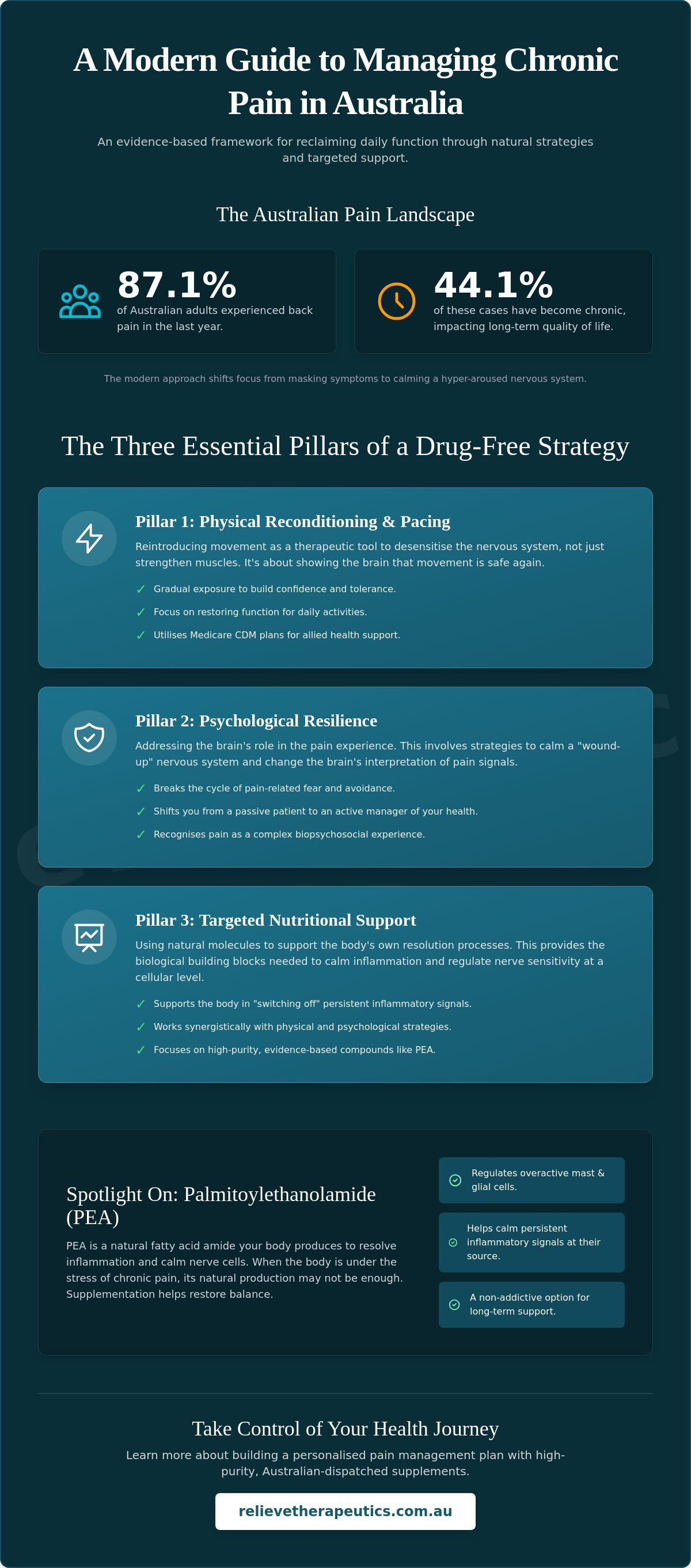
As of May 2026, a staggering 87.1% of Australian adults have experienced back pain within the last twelve months, with the proportion of chronic cases rising to 44.1%. If you're currently managing chronic pain without medication Australia, you likely understand the frustration of "invisible" symptoms that standard diagnostic tests cannot always explain. It's common to feel overwhelmed by the rising costs of allied health or the potential for dependency on pharmaceutical interventions. You deserve a management plan that prioritises your long-term vitality, comfort, and safety.
This guide offers a comprehensive, evidence-based framework designed to help you reclaim your daily function using natural strategies and targeted support. We will examine the essential pillars of recovery: physical movement, psychological resilience, and the clinical role of supplements like Palmitoylethanolamide (PEA). By the end of this article, you'll have a clear roadmap to reduce discomfort, understand how high-quality supplements fit into a broader plan, and ultimately improve your quality of life.
Key Takeaways
- Understand why chronic pain is often a maladaptive nervous system response rather than a simple injury. Learn how shifting away from long-term pharmaceutical dependency can protect your vitality and long-term health.
- Discover the synergy of the three essential pillars for managing chronic pain without medication Australia. This framework integrates physical movement, psychological resilience, and targeted nutritional support for a complete recovery strategy.
- Explore the biological role of Palmitoylethanolamide (PEA) in regulating overactive mast cells and glial cells. This natural fatty acid amide helps the body "switch off" persistent inflammatory signals at their source.
- Follow a structured five-step roadmap to transition from a passive patient to an active manager of your health. This personalised process provides the clarity and confidence needed to navigate complex recovery journeys.
- Identify why high-purity, laboratory-tested supplements are vital for consistent outcomes. Learn how local Australian dispatch and rigorous manufacturing standards ensure you receive reliable support for your daily function.
The Shift Toward Non-Medication Pain Management in Australia
In the Australian medical community, the definition of chronic pain has undergone a significant evolution. We no longer view persistent discomfort simply as a lingering injury that refuses to heal. Instead, specialists now recognise it as a maladaptive response where the nervous system remains in a state of hyper-arousal. For a comprehensive overview of chronic pain and its various classifications, understanding this neurological shift is essential. This "stuck" signal means the brain continues to produce pain even after the initial tissue damage has resolved.
Many Australians are actively seeking alternatives to long-term NSAID or opioid use. This shift is driven by a growing awareness of side-effect profiles, including gastric distress, kidney strain, and the risk of dependency. Rather than merely "blocking" a pain signal at the site of injury, modern strategies focus on "calming" the entire system. This biopsychosocial approach, now standard at leading Australian pain centres, addresses the biological, psychological, and social factors that contribute to the experience of discomfort. It focuses on restoration, function, and long-term stability.
Why the Traditional "Pill for Every Ill" Model is Changing
The reliance on pharmacological interventions for non-cancer chronic pain is decreasing as we acknowledge their limitations. One primary concern is the "wind-up" phenomenon. This occurs when repeated pain signals cause the spinal cord to become hypersensitive, making even minor stimuli feel intense. It's a cycle of increasing sensitivity that pills often fail to break. To ensure safety and efficacy, the Therapeutic Goods Administration (TGA) maintains strict oversight of natural alternatives. For instance, Palmitoylethanolamide (PEA) remains available in Australia as an active ingredient in listed medicines, provided it meets specific purity and therapeutic standards. This regulatory framework provides a layer of professional safety for those moving away from traditional scripts.
The Role of Your GP and Medicare in Natural Management
Effectively managing chronic pain without medication Australia wide requires a coordinated effort. Your GP is the gatekeeper to the Chronic Disease Management (CDM) plan. This initiative provides Medicare rebates for up to five allied health consultations per calendar year. It allows you to build a team of specialists, such as physiotherapists or exercise physiologists, without bearing the full financial burden alone. This is particularly important given that 44% of back pain sufferers currently avoid professional treatment due to rising costs.
A collaborative approach is vital. By working with your GP to establish a formal Care Plan, you move from being a passive recipient of treatment to an active manager of your health. This structured support ensures your strategy is evidence-based, sustainable, and tailored to your specific lifestyle goals. It builds a foundation of transparency, reliability, and clinical safety.
The Three Essential Pillars of a Drug-Free Pain Strategy
Successful recovery is rarely the result of a single intervention. When managing chronic pain without medication Australia wide, clinical success depends on the synergy between three core pillars: physical reconditioning, psychological resilience, and nutritional support. A sensitised nervous system is a complex biological puzzle. Addressing only one aspect often leads to plateaued progress or recurring flare-ups. By integrating these pillars, you create a robust framework that supports the body’s natural capacity for restoration and stability.
In modern clinical practice, "natural" is not a synonym for "unscientific." On the contrary, the most effective drug-free strategies are grounded in rigorous data. Leading Australian pain clinics now focus on desensitising the nervous system through gradual exposure and targeted support. This transition from a passive treatment model to an active self-management plan is the most reliable way to achieve long-term comfort and daily function.
Pillar 1: Physical Reconditioning and Pacing
Movement is a vital form of medicine for the musculoskeletal system. For many, low-impact options like hydrotherapy or clinical Pilates provide a safe entry point into activity. The goal is to move away from the "boom-bust" cycle, where a person overexerts on a good day only to be bedridden the next. Australian specialists advocate for the "Pace, Plan, Prioritise" method. This involves breaking tasks into smaller segments and resting before the pain spikes. It's also essential to distinguish between "hurt" and "harm." Feeling discomfort during movement does not always indicate new tissue damage; often, it's simply a hypersensitive system reacting to safe stimuli. Overcoming this kinesiophobia is a critical step in regaining mobility.
Pillar 2: Psychological Resilience and Retraining the Brain
Psychological strategies are not about suggesting the pain is "all in your head." Instead, they recognise that the brain is the ultimate architect of the pain experience. Cognitive Behavioural Therapy (CBT) helps patients identify and change the thought patterns that amplify distress. Mindfulness and desensitisation techniques work to lower the body’s overall "threat" level. Research continues to evolve in this space, such as the new chronic pain therapy developed at UNSW Sydney which focuses on retraining how the brain processes emotional and sensory data. For those in regional areas, online programs like "This Way Up" provide accessible, evidence-based tools to build this resilience from home.
The third pillar involves nutritional support to manage the underlying biological triggers. Integrating high-purity supplements can provide the necessary foundation for these physical and psychological efforts to take hold. You might consider how a targeted nutritional approach can help stabilise your system as you implement these lifestyle changes.
Exploring Natural Molecules: The Role of PEA in Chronic Support
A critical component of a drug-free strategy involves addressing the biological environment of the nervous system. Palmitoylethanolamide (PEA) is a fatty acid amide produced naturally by your body in response to tissue stress or inflammation. Unlike synthetic compounds that attempt to override biological processes, PEA works within your existing physiology to restore balance. For many Australians, it serves as a cornerstone non-opioid pain relief supplement that supports long-term nerve health and stability.
The efficacy of PEA is not a new discovery. PEA is a bioactive lipid that was first identified in 1957 for its anti-inflammatory properties. Its primary role involves "switching off" overactive mast cells and glial cells. These cells act as the sentinels of the immune and nervous systems. When they remain in a state of hyper-arousal, they perpetuate the cycle of persistent discomfort. By regulating these cells, PEA helps quiet the "noise" of a sensitised system, making it an essential tool for managing chronic pain without medication Australia wide.
How PEA Targets the Source of Persistent Discomfort
PEA functions through what researchers call the "entourage effect." It doesn't work in isolation; it supports and enhances the body’s own endocannabinoid system. This interaction helps maintain cellular homeostasis and reduces the intensity of persistent signals. Because the body’s natural production of PEA can be depleted during long-term discomfort, supplementation becomes a logical step. Utilising high quality PEA capsules ensures that you are receiving a pure, bioavailable form of the molecule that the body can readily recognise and use.
Why PEA is Different from Standard Pharmacy Meds
The clinical profile of PEA offers several distinct advantages over traditional pharmaceuticals. First, it lacks the common drug-to-drug interactions that can complicate complex health regimes. This makes it a safe adjunct for those already navigating multiple health priorities. Second, PEA provides gradual, cumulative support. While standard meds often aim for an "instant hit" that wears off quickly, PEA works over time to stabilise the system. Finally, it does not cause the gastrointestinal issues or kidney strain frequently associated with long-term NSAID use. It is a disciplined, evidence-based choice for those prioritising safety and long-term vitality.
How to Design Your Personalised Australian Pain Management Plan
Designing a recovery roadmap requires a fundamental shift in perspective. You are no longer a passive recipient of treatment; you are the active manager of your health journey. By following a structured, evidence-based process, you can navigate the complexities of managing chronic pain without medication Australia with confidence and clarity. This methodical approach ensures that every intervention—whether physical, psychological, or nutritional—serves a specific purpose in your long-term restoration. It's about building a sustainable lifestyle that prioritises function over temporary fixes.
Self-efficacy is the cornerstone of this plan. When you take charge of your recovery, you lower the body’s "threat" level and begin the process of desensitising the nervous system. This transition requires discipline, transparency, and a commitment to quality. By tracking your progress and adjusting your strategy based on real-world outcomes, you create a reliable path toward improved daily function and a higher quality of life.
Step 1-3: Assessment, Assembly, and Activity
Step 1: Consult your GP. Your first priority is to rule out "red flags" and establish a clinical baseline. A thorough assessment ensures your roadmap is safe and tailored to your specific physiological needs. Step 2: Assemble your "Care Team." Use your Medicare-subsidised Chronic Disease Management plan to engage a physiotherapist, psychologist, and nutritionist. This multidisciplinary support is vital, especially considering that only 18% of Australians currently receive referrals for integrated care. Step 3: Begin gentle reconditioning. Start with graded motor imagery or a simple walking program. Focus on consistency rather than intensity to avoid the boom-bust cycle mentioned earlier. These small, predictable movements help retrain the brain to perceive activity as safe rather than threatening.
Step 4-5: Nutritional Support and Review
Step 4: Integrate supportive supplements. Establishing a biological foundation is essential for nerve health and cellular stability. Understanding the PEA capsules benefits can help you decide how to best support your system naturally. It is equally important to learn how to take PEA for nerve pain correctly to ensure optimal absorption and cumulative efficacy over time. Step 5: Review and refine. Every 4–6 weeks, evaluate your progress against functional goals. Can you walk to the local shops? Can you garden for twenty minutes? These milestones are more meaningful indicators of success than a fluctuating pain score on a scale of one to ten.
Maintain a daily pain diary to identify specific triggers and celebrate small wins. This data-driven habit provides the transparency needed to adjust your strategy effectively. If you're ready to start this journey, you can explore high-purity PEA options to support your personalised managing chronic pain without medication Australia strategy today.
Why Quality-Sourced PEA is a Logical Choice for Your Toolkit
Integrating a nutritional foundation into your recovery roadmap requires a commitment to substance over marketing hype. When managing chronic pain without medication Australia wide, the quality of your supplements is just as critical as the consistency of your physical therapy. Low-quality alternatives often contain fillers that can interfere with absorption or trigger sensitivities in a system that is already hyper-aroused. By prioritising high-purity Palmitoylethanolamide (PEA), you ensure your body receives a clean, bioavailable molecule that directly supports the cellular calming process. This is the final piece of the biological puzzle.
Relieve Therapeutics operates with the disciplined focus of a specialist. We focus exclusively on high-purity PEA to ensure every capsule delivers clinical reliability and professional safety. Our formulations intentionally avoid unnecessary fillers, artificial colours, and synthetic binders. This meticulous approach to manufacturing guarantees batch consistency, which is vital for the long-term management of chronic conditions. Because we are an Australian-owned and operated centre, every order is dispatched locally. This ensures a predictable supply chain and provides the reassurance that your support journey won't be interrupted by international shipping delays or inconsistent quality standards.
The Relieve Therapeutics Commitment to Purity
Our commitment to transparency means providing a product that bridges the gap between laboratory science and daily wellness. We understand that trust is built on reliability, safety, and results. By removing the "fluff" often found in supermarket supplements, we provide a concentrated tool for your toolkit. This science-first approach respects the complexity of your nervous system and supports your efforts to reclaim daily function. It's a sophisticated solution for those who value integrity in their health choices.
Choosing the Right Quantity for Your Needs
Selecting the appropriate supply is a practical step in your self-management plan. We offer our high-purity PEA in three distinct quantities to suit your specific stage of recovery:
- PEA 60 Capsules: An ideal "starter pack" for those new to natural supplementation or those following the 21-day TGA consultation guideline.
- PEA 120 Capsules: A mid-range option for those who've established their baseline and are moving into the physical reconditioning phase.
- PEA 180 Capsules: Our comprehensive supply for individuals with an established long-term plan who value consistency, stability, and convenience.
Your transition to a drug-free 2026 begins with a single, evidence-based decision. By choosing a science-first approach to nutritional support, you provide your nervous system with the foundation it needs to thrive. You can start your journey today by selecting the supply that best aligns with your current functional goals. This is more than just a supplement; it's a reliable ally in your pursuit of vitality, comfort, and a higher quality of life. Take the first step toward a more resilient future by exploring our range of high-purity PEA options.
Empowering Your Path to Long-Term Vitality
Establishing a resilient future begins with moving beyond the search for a singular miracle cure. By addressing the maladaptive signals of the nervous system through the three essential pillars of recovery, you can reclaim your daily function. This guide has outlined how a structured Care Plan, combined with psychological resilience and high-purity nutritional support, provides a reliable alternative to traditional pharmaceuticals. It's a methodical transition from passive treatment to active self-management.
Successfully managing chronic pain without medication Australia wide is achievable when you prioritise quality and clinical transparency. Our pure PEA is free from artificial fillers and synthetic colours; this ensures your body receives only the essential support it needs. As an Australian owned and operated specialist, we provide free shipping on bulk orders to support your long-term consistency and daily comfort. We remain committed to providing the scientific rigor required for your recovery journey.
You now have the tools to transition from a passive patient to an active manager of your health. Explore our range of high-purity PEA capsules and start your natural journey today. Your commitment to a science-first, drug-free 2026 is a powerful investment in your future vitality and quality of life.
Frequently Asked Questions
Is it really possible to manage chronic pain without any medication?
Yes, many Australians successfully achieve long-term relief by adopting a biopsychosocial approach. This strategy focuses on desensitising an overactive nervous system through physical reconditioning, psychological resilience, and targeted nutritional support. By addressing the underlying triggers rather than masking symptoms, managing chronic pain without medication Australia wide becomes a sustainable clinical reality.
How long does it take for natural supplements like PEA to start working?
PEA functions through a cumulative biological process rather than an immediate pharmaceutical "hit." While some individuals notice subtle changes within the first week, clinical evidence suggests that consistent use for two to four weeks is typically required to see significant functional improvements. This timeframe allows the molecule to effectively regulate overactive mast cells and glial cells.
Can I take PEA alongside my current prescription pain relievers?
Yes, PEA is widely recognised for its lack of drug-to-drug interactions, making it a safe adjunct to most existing regimes. It is often used to provide a biological foundation while a person gradually works with their GP to reduce reliance on other substances. You should always consult your healthcare professional before combining supplements with prescribed medication to ensure your plan is personalised and safe.
Does Medicare cover the cost of natural supplements in Australia?
No, the purchase price of over-the-counter supplements like PEA is not currently covered by Medicare or the Pharmaceutical Benefits Scheme (PBS). However, Medicare can subsidise the professional consultations required to build your management plan. Through a Chronic Disease Management (CDM) plan, you may be eligible for rebates on visits to physiotherapists, exercise physiologists, or psychologists.
What is the best type of exercise for someone with chronic nerve pain?
Low-impact, "graded" activities are generally the most effective for sensitive nervous systems. Hydrotherapy, clinical Pilates, and gentle walking programs allow for movement without triggering a high-threat response in the brain. The objective is to maintain consistency and gradually increase your "activity ceiling" without causing a flare-up or entering a boom-bust cycle.
Are there any side effects to taking PEA capsules daily?
PEA is a fatty acid amide produced naturally by the human body, which contributes to its exceptional safety profile. Clinical trials have shown it is very well-tolerated, even with long-term use. It does not cause the gastric distress, kidney strain, or cognitive "fog" frequently associated with traditional non-steroidal anti-inflammatory drugs or stronger scripts.
How do I explain my new drug-free plan to my Australian GP?
Frame the conversation around your desire to improve "daily function" and your interest in a multidisciplinary approach. When discussing managing chronic pain without medication Australia with your doctor, request a Chronic Disease Management (CDM) plan. This opens a collaborative dialogue about integrating allied health services and evidence-based supplements into your restorative journey.
Why is PEA often recommended for conditions like sciatica or fibromyalgia?
These conditions are characterised by neuro-inflammation and a sensitised nervous system. PEA is recommended because it specifically targets the overactive glial cells and mast cells that perpetuate these persistent signals. By helping to quiet this biological "noise," PEA provides a foundation of stability for individuals dealing with complex, nerve-related discomfort.