

Could one extra PEA capsule put you at risk? If you’re asking, “can you take too much PEA?”, the honest answer is that there’s no established universal upper limit that determines what’s safe for everyone. Palmitoylethanolamide (PEA) has been studied at a range of doses, but an amount used in research isn’t proof of a safe ceiling for you.
It’s understandable to feel uncertain after taking more than intended, especially if you have questions about product directions, medicines or your health. This guide explains what human research can and can’t tell us about PEA intake, what to do after accidentally taking an extra dose, and when to seek professional or urgent help in Australia. It also covers why the label matters and why a higher amount shouldn’t be assumed to be safer or more effective.
Key Takeaways
- If you’re wondering “can you take too much PEA?”, the amount, frequency and duration of use all matter.
- A one-off extra capsule is different from regularly taking more than the product label directs.
- After an accidental extra dose, note how much you took and when.
- For poisoning advice in Australia, call the Poisons Information Centre on 13 11 26. Call 000 for an emergency.
- Capsule quantities describe pack size, not your daily dose or personal suitability.
Can you take too much PEA? What the evidence can, and cannot, tell you
Taking more PEA than directed is a reasonable concern, but current evidence doesn’t establish a universal dose at which excess intake becomes harmful. PEA, short for palmitoylethanolamide, is a compound made naturally in the body and also sold as a supplement. The evidence supports caution, not a precise cutoff that applies to everyone.
In brief: A dose used in a study isn’t the same as a proven maximum safe intake. Follow the product label, and don’t use research doses as a personal dosing guide.
Is there a known maximum safe PEA dose?
Available information does not establish a tolerable upper intake level for PEA. Human research has examined different amounts and periods of use, but those study conditions don’t guarantee that the same intake is suitable for everyone. A commonly reported dose doesn’t become a safety limit simply because it has been studied.
Key distinction: Studied PEA intake describes what researchers examined. An established safety ceiling would require evidence defining an upper limit, and that limit has not been established.
Why does PEA safety evidence have limits?
Research can show how PEA was used and what effects were reported among the people studied. Reviews of clinical research bring findings together, but the results still need to be understood in context. Study participants, duration of use and the formulation tested may differ from your circumstances or the product you have.
A finding that participants generally tolerated PEA under particular study conditions can’t guarantee safety for every individual or predict what might happen after a larger or repeated intake. The Palmitoylethanolamide (PEA) overview provides background on the compound and summarises safety-related research, but it shouldn’t replace advice tailored to your situation.
Treat research as informative, not as permission to increase your dose. The product label gives directions for that specific supplement. A health professional can help you consider those directions alongside your health, medicines and pattern of use. It’s also important to distinguish a one-off extra amount from repeatedly exceeding the label directions.
How dose, duration and personal circumstances change the question
PEA intake isn’t just a matter of counting capsules. The amount taken at one time, how often it’s taken and how long someone uses it are separate details that can affect how a situation should be assessed. An extra capsule taken once is different from regularly exceeding the product directions.
Neither situation can be assessed reliably from capsule count alone. The product’s directions and the amount of PEA per capsule matter too. If you’ve taken more than directed, keep the packaging handy and note what you took and when. For broader context on research and general use, see this PEA dosage guide. It isn’t a personal dosing recommendation.
Does taking more PEA mean better or faster results?
No. Taking a larger amount doesn’t establish that PEA will work better or sooner. A lack of an immediate effect isn’t a reason to increase your intake. Research conditions don’t set a dose for an individual, so follow your product’s directions and speak with a health professional before making a change. This is particularly useful if you’re unsure how to interpret the label or how long to use the supplement.
Who should seek personalised advice before using PEA?
Individual guidance is particularly important if you take medicines, have a health condition, are pregnant or breastfeeding. This is a precaution, not a claim that a specific interaction or harm has been established. Evidence may not answer every question about how PEA fits your circumstances, so share the product label and your intended use with a qualified health professional.
If you’re considering PEA for a particular use, a guide to taking PEA for nerve pain may provide general context. It can’t replace clinical advice or determine whether PEA is suitable for you.
Capsule quantity describes how many capsules are in a pack, not how much to take each day or how long to use it. When reviewing PEA capsules, use the label directions as your reference rather than treating pack size as a dosing guide.
Review PEA capsule options and use the label directions to guide your next steps.
Possible side effects: what to notice and when to get help
If you feel unwell after taking PEA, don’t assume the supplement is definitely the cause, but don’t dismiss the change either. Note what you took, when you took it and what symptoms you noticed. Stop taking further doses for now and seek advice from a health professional, particularly if symptoms persist or concern you.
Which reactions have been reported with PEA?
Human research summaries describe digestive complaints, including nausea or an upset stomach, among possible adverse effects. However, the evidence has limitations. Available information doesn’t provide a reliable estimate of how often these reactions occur or establish that PEA caused a particular person’s symptoms. A symptom that starts after taking a supplement may have another explanation, so timing alone isn’t proof.
Keep track of any changes and share them with a doctor or pharmacist. Seek urgent assessment if symptoms are severe or rapidly worsening. Call 000 for an emergency in Australia. Don’t try to diagnose the cause yourself or take another dose to see whether the reaction happens again.
Could PEA affect medicines or other supplements?
Evidence about interactions between PEA and medicines or other supplements is limited. The absence of a well-established interaction doesn’t prove that every combination is suitable for every person. A pharmacist or doctor can review your full list, including prescription and non-prescription medicines, vitamins and other supplements, alongside the PEA product label.
This review is particularly useful if you take several products, have a health condition or have noticed a new symptom after changing your routine. Bring the packaging or a clear photo of the label so the health professional can see the ingredients and directions. Don’t stop prescribed medicine or adjust its dose without professional advice.
Possible side effects and interactions are reasons to pay attention, not proof that every reaction is caused by PEA. If you’re feeling unwell, pause further PEA use and get advice suited to your circumstances. If you took more than the label directs, keep the amount and timing details handy. The next section explains what to do after an accidental extra dose.
What to do if you accidentally take more PEA than directed
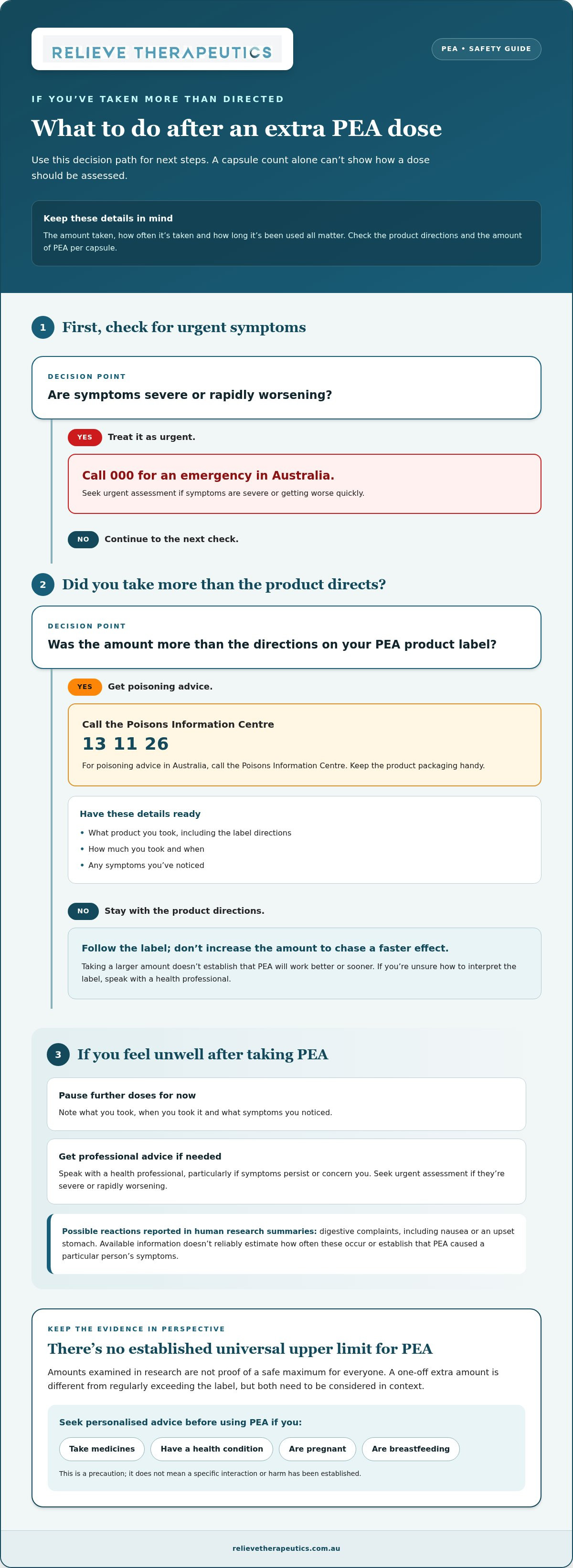
Realising you’ve taken more PEA than the label directs can be unsettling. The amount alone can’t tell you what to expect, so focus on the details and get advice rather than trying to judge the risk yourself. If you’ve taken more than intended, these steps can help you respond calmly:
- Check the label. Confirm the serving directions and the amount of PEA in each capsule. Keep the packaging nearby.
- Note what happened. Record how many capsules you took and when. Include any symptoms and whether you’ve taken other medicines or supplements.
- Seek advice. In Australia, call the Poisons Information Centre on 13 11 26 for poisoning advice. Explain that the product contains PEA and follow the guidance you’re given.
Don’t delay urgent care while trying to work out a dose or calculate whether the amount is concerning. If you’re unsure what to do, call for advice.
What details should you have ready when seeking advice?
Have the product container or a clear photo of its label available. Be ready to share the capsule strength, how many you took, when you took them, and whether you took them all at once or across the day. Also mention any symptoms, medicines, other supplements and relevant health conditions. If you don’t know an exact detail, say so rather than delaying the call to calculate it.
When is urgent help more appropriate than monitoring?
If symptoms are severe or rapidly worsening, or there’s immediate danger, call 000 for emergency assistance. Don’t wait to see whether things improve or attempt a home treatment for a suspected overdose. The Poisons Information Centre can advise on poisoning concerns. Emergency services are the appropriate response to an immediate emergency.
Once you’ve addressed the immediate concern, keep the label directions in view when deciding whether to use the supplement again. You can review PEA capsule options and label information as part of a careful, label-led approach. Product information can help clarify directions, but it can’t replace advice about your individual circumstances.
A cautious, label-led approach to PEA from here
The clearest next step is consistency: follow the directions on the specific product you’re using, avoid increasing your intake on your own, and discuss questions with a health professional. There isn’t a universal cutoff that determines what’s right for every person, so don’t assume a higher amount is better or suitable.
Keep pack size separate from dose. Relieve Therapeutics’ PEA capsules are available in 60, 120 and 180 capsule quantities. Those numbers describe how many capsules are in each pack, not how many to take daily, how long to use them or whether PEA is suitable for you. Check the label for serving directions rather than using pack quantity to guide intake.
How can you keep PEA use clear and consistent?
A simple record can help you follow directions and explain your routine if you seek advice. Note the product, the amount taken and the time, and refer to the label whenever you’re unsure. If you use other supplements containing the same ingredient, consider your total intake and discuss the combination with a pharmacist or doctor before making changes.
For general context on product characteristics and what to look for, read this guide to high-quality PEA capsules. It can support your understanding of product information, but it doesn’t replace individual health advice or the directions on your chosen product.
What should you consider when reviewing PEA products?
Before use, read the label carefully. Check the serving directions and ingredient information, and make sure you understand how the instructions apply to the product in your hands. If anything is unclear or your circumstances have changed, ask a qualified health professional rather than guessing or adjusting the amount yourself.
If you’re still asking “can you take too much PEA?”, keep the practical principle in mind: follow the label and seek tailored advice when needed. A larger pack is a quantity choice, not a recommendation about daily dose or expected outcome.
Once you’ve reviewed the safety guidance and know to follow the label, you can explore the PEA capsule range and compare the available pack quantities.
Use PEA with care and clear guidance
If you’re asking “can you take too much PEA?”, the evidence doesn’t provide a universal safety cutoff for every person. A dose studied in research isn’t a proven maximum, so follow your product’s label and don’t increase your intake without individual advice.
If you’ve taken more than directed, note the amount and timing, then call the Poisons Information Centre on 13 11 26 for advice in Australia. For severe or rapidly worsening symptoms, or immediate danger, call 000.
Relieve Therapeutics is an Australian retailer specialising in PEA dietary supplements, with packs containing 60, 120 or 180 capsules. Pack quantity describes how many capsules are supplied, not a daily dose or a measure of suitability. Once you’ve considered the safety guidance, explore Relieve Therapeutics PEA capsules and review the label directions carefully.
Frequently Asked Questions
Can you take too much PEA in one day?
It’s possible to take more than the product directions recommend, but evidence doesn’t establish a universal daily cutoff that predicts harm for everyone. The amount per capsule, how many you took, when you took them and your personal circumstances all matter. If you’ve exceeded the label directions, don’t take extra doses to compensate or guess what’s safe. Contact the Poisons Information Centre for advice if you’re concerned.
What should I do if I accidentally take an extra PEA capsule?
Check the product label, note how many capsules you took and when, then seek advice if you’re concerned. In Australia, call the Poisons Information Centre on 13 11 26 and have the packaging nearby. Mention any symptoms, medicines or other supplements you use. Don’t delay urgent care to calculate the dose yourself. If symptoms are severe or rapidly worsening, or there’s immediate danger, call 000.
Is there a maximum safe dose of PEA?
There isn’t an established universal maximum safe dose of PEA that applies to everyone. Amounts used in research describe the conditions studied, not a proven upper safety limit or a personal recommendation. Follow the directions on your product label, and speak with a health professional before changing your intake. They can consider your health circumstances and other products or medicines you use.
Can taking more PEA cause side effects?
Taking more than directed may raise reasonable safety concerns, but available evidence can’t predict an individual’s response or establish that a particular symptom was caused by PEA. Human research summaries have reported digestive complaints such as nausea or an upset stomach, but the evidence doesn’t reliably show how often they occur. If you feel unwell after taking PEA, stop further doses for now and seek professional advice.
Can PEA interact with prescription medicines or other supplements?
Evidence about PEA interactions with medicines and other supplements is limited, so it’s not possible to assume every combination is suitable. Before using PEA alongside prescription or non-prescription medicines, vitamins or other supplements, ask a pharmacist or doctor to review your full list. Include the PEA product label and directions. Don’t stop a prescribed medicine or change its dose without advice from the professional who manages your care.
Should I take more PEA if I do not notice an effect?
No, don’t increase your intake simply because you haven’t noticed an effect. A higher amount doesn’t establish a faster or greater benefit, and research doses aren’t personal dosing instructions. Follow your product’s label and discuss questions about use or lack of effect with a health professional. They can help you consider your circumstances and other medicines or supplements before you make any changes.
Who can I call in Australia after taking too much PEA?
For advice after taking more PEA than directed, call the Australian Poisons Information Centre on 13 11 26. Keep the packaging handy and explain the amount taken, the time, any symptoms and other medicines or supplements involved. If symptoms are severe or rapidly worsening, or there’s immediate danger, call 000 for emergency assistance. Don’t wait to work out the dose if urgent help may be needed.