

What if the traditional herbal remedy you've relied on for years is simply missing the mark because it's targeting the wrong biological pathway? Many Australians find themselves stuck in a cycle of increasing their turmeric dosage while seeing little change in persistent nerve or joint discomfort. It's exhausting to manage daily physical limitations, and understanding the nuances of PEA vs turmeric for inflammation is the first step toward reclaiming your daily function.
You deserve a clear, evidence-based path to relief that doesn't involve guessing at dosages or wasting money on low-bioavailability powders. This guide explores the scientific reality of Palmitoylethanolamide (PEA) as a precision neuromodulator compared to the broad-brush systemic effects of turmeric. We'll break down how these molecules interact with your body, the importance of the 90-day therapeutic window, and why Australian-sourced purity matters for your long-term success. You'll gain the confidence to choose the right supplement for your specific health journey, ensuring your investment in wellness finally yields the results you expect.
Key Takeaways
- Learn the fundamental difference between systemic antioxidants and targeted neuro-modulators to better manage your recovery.
- Determine if your discomfort is nerve-driven or tissue-based to settle the PEA vs turmeric for inflammation choice for your personal health goals.
- Discover how to maximise the efficacy of fat-soluble supplements by pairing them with healthy Australian fats like avocado or macadamia oil.
- Understand how to read Australian labels to ensure you are receiving high-purity, micronised PEA without unnecessary fillers or digestive irritants.
- Establish a structured 90-day therapeutic window to accurately assess how these natural compounds support your long-term comfort and vitality.
Natural Anti-Inflammatories: The Rise of PEA and Turmeric
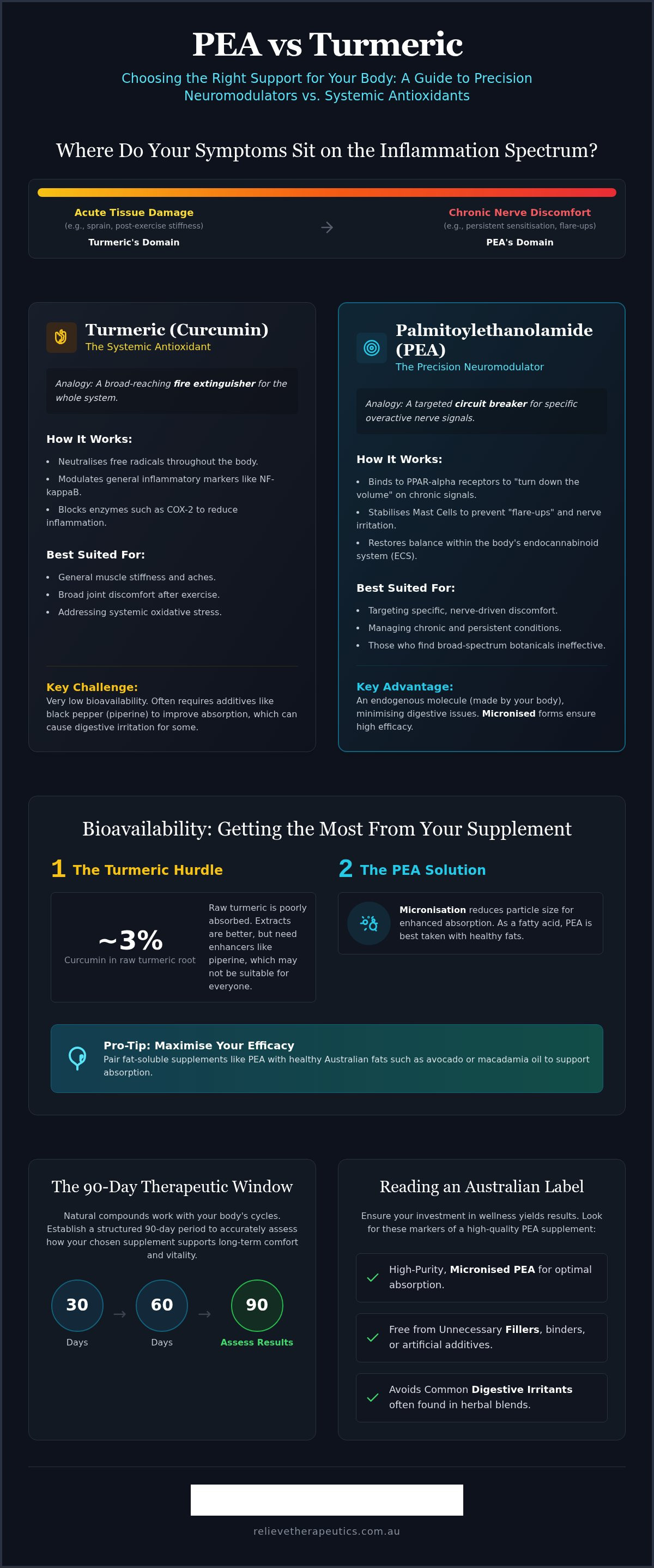
Australians are increasingly looking beyond the chemist's shelf for sustainable, long-term comfort. This shift is driven by a growing awareness that traditional management often masks symptoms rather than supporting the body's innate recovery processes. We now recognise an "Inflammation Spectrum" that defines our physical experience. At one end sits acute tissue damage, such as a sprain or bruise. At the other lies the complex world of chronic nerve discomfort. Deciding on PEA vs turmeric for inflammation depends largely on where your specific symptoms sit on this scale.
Turmeric: The Ancient Golden Botanical
Turmeric, derived from the Curcuma longa plant, is perhaps the most well-known natural anti-inflammatory in Australia. Its reputation is built on curcumin, a bioactive compound that modulates systemic inflammatory markers like NF-kappaB. This botanical acts as a broad-brush antioxidant, helping to neutralise the oxidative stress that damages healthy cells. While its history in traditional wellness is vast, modern users often face a hurdle with bioavailability. Raw turmeric root contains approximately 3% curcumin by weight. To achieve a therapeutic effect, one would need to consume unrealistic quantities of the spice, which is why standardised extracts have become the industry standard for joint support.
PEA: The Body’s Own Protective Molecule
Palmitoylethanolamide (PEA) represents a different category of support. It is not a foreign botanical but an endogenous fatty acid amide produced by your own cells. When tissues are under pressure, the body synthesises PEA to restore balance. It acts as a key player in the endocannabinoid system (ECS), where it serves as a "balancing" agent to prevent nerve signals from becoming over-sensitised. PEA is a signalling lipid that helps regulate the body’s inflammatory response. Because it is a molecule your biology already produces and metabolises, it avoids many of the digestive complications associated with high-dose herbal blends.
The rise of these two options reflects a more sophisticated approach to wellness. Instead of a one-size-fits-all solution, Australians are choosing supplements based on biological pathways. While turmeric addresses the "fire" in the tissues, PEA addresses the "wiring" of the nervous system. This distinction is crucial for those who have found little success with standard herbal remedies and are seeking a more targeted, scientific alternative for their specific health journey. By focusing on pure, micronised PEA rather than complex herbal mixtures, you can avoid the fillers and irritants that sometimes complicate the use of traditional botanicals.
How They Work: Systemic Curcumin vs Neuro-Modulating PEA
To understand the optimal choice of PEA vs turmeric for inflammation, you must look at the biological architecture they influence. Turmeric operates as a systemic antioxidant, addressing the oxidative stress that circulates through your entire body. In contrast, PEA acts as a precision modulator. It works directly within your cells to stabilise overactive signals that have become stuck in a cycle of discomfort. While turmeric is like a wide-reaching fire extinguisher for the whole house, PEA is more like a circuit breaker for specific electrical faults.
The Mechanism of Curcuminoids
The primary strength of turmeric lies in its ability to neutralise free radicals across the whole system. Research into turmeric's anti-inflammatory properties shows that curcumin blocks specific enzymes, such as COX-2, which are responsible for creating inflammatory prostaglandins. This systemic action is why many Australians find it beneficial for general muscle stiffness or broad joint discomfort after exercise. However, curcumin is notoriously difficult for the body to absorb. Most formulations require the addition of piperine, a compound found in black pepper, to slow down the liver's metabolism of the curcumin and allow it to enter the bloodstream effectively.
PEA and the PPAR-alpha Receptor
PEA functions through a sophisticated "lock and key" mechanism involving the PPAR-alpha receptor. When PEA binds to this receptor, it essentially "turns down the volume" on chronic inflammatory signals at a nuclear level. This interaction is particularly vital for neuropathic support. Unlike turmeric, PEA also addresses the "Mast Cell" factor. Mast cells are the first responders of the immune system; when they become overactive, they release a flood of pro-inflammatory chemicals that irritate nearby nerves. PEA helps stabilise these cells, preventing the "flare-ups" common in chronic conditions. For a deeper scientific dive into these pathways, you can explore our detailed article on How Does PEA Work for Pain?.
This neuro-modulating capability is why PEA is often favoured for nerve-specific pathways where traditional botanicals might fall short. It doesn't just mask the sensation; it works to calm the cellular environment that creates the discomfort in the first place. Those looking to support these specific pathways often find that a high-purity PEA supplement provides the targeted relief that broad-brush herbal blends lack. By choosing a molecule that mirrors your body's own protective lipids, you're working with your biology rather than against it.
PEA vs Turmeric: Which is Better for Your Specific Needs?
Choosing between PEA vs turmeric for inflammation requires an honest assessment of your physical sensations. Are you experiencing a dull, throbbing ache in a specific joint, or a sharp, radiating sensation that travels down a limb? Distinguishing between systemic tissue inflammation and neuro-inflammation is the key to selecting the supplement that will actually move the needle on your comfort levels. While many commercial blends combine these ingredients, understanding their individual strengths allows you to tailor your approach to your body's specific requirements.
Targeting Nerve Discomfort
PEA is the preferred specialist tool for neuropathic pathways. While turmeric struggles to reach the deep-seated "wiring" of the nervous system, PEA is highly effective at modulating the glial cells and mast cells that surround nerves. Clinical evidence suggests that PEA provides essential support for nerve sheath protection, making it particularly relevant for those dealing with persistent, electricity-like discomfort. For those seeking specific advice on lower back and leg issues, our guide on Palmitoylethanolamide for Sciatica offers a targeted Australian perspective on managing these complex pathways.
Support for Joint and Muscle Stiffness
Turmeric’s strength lies in managing mechanical joint wear and tear. It is an excellent choice for systemic "cooling" after intense physical activity or for managing the day-to-day stiffness associated with mild arthritis. If your discomfort is primarily located in the "meat" of the muscle or the connective tissue of the joint, turmeric’s ability to inhibit systemic enzymes is highly valuable. However, its limitation becomes apparent in chronic, deep-seated nerve pathways where the issue isn't just tissue swelling but overactive pain signalling. In these instances, the broad-brush approach of a botanical may not provide the precision required for lasting relief.
When comparing side-effect profiles, PEA offers a distinct advantage in tolerability. Many high-dose turmeric supplements require black pepper extracts (piperine) to function, which can lead to digestive sensitivity or "turmeric reflux" in some individuals. PEA, as a fatty acid already present in your body, is generally very well-tolerated and lacks these common gastrointestinal triggers. Regardless of your choice, it's vital to manage expectations regarding the onset of action. Neither compound is an "instant" fix. Both require consistent daily use over several weeks to build therapeutic levels in the system. Most clinical trials observe the most significant shifts at the 8 to 12-week mark, which is why we recommend the 180-capsule pack for those serious about testing these molecules against each other.
Bioavailability: Maximising the Efficacy of Your Supplement
When evaluating PEA vs turmeric for inflammation, the conversation often ignores the most critical factor: how much of the compound actually reaches your cells. Both curcumin and Palmitoylethanolamide are lipophilic, meaning they are "fat-loving" molecules. They do not dissolve easily in water. If you take these supplements on an empty stomach with only a glass of water, your body will struggle to absorb the active ingredients. To ensure you aren't wasting your investment, you must pair your dose with a source of healthy fats. For many Australians, this means taking your capsules alongside a meal containing avocado, macadamia nuts, or cold-pressed olive oil to trigger the necessary digestive processes.
The Problem with Standard Absorption
Raw turmeric powder is notoriously difficult for the human body to process. Because the curcumin content is low and the molecular structure is large, most of it passes through the digestive tract without entering the bloodstream. PEA faces a similar challenge known as the "brick effect". In its standard form, PEA exists as large crystals that are hard for the small intestine to break down. This is why particle size reduction, or micronisation, is so vital. By reducing the lipid particles to just a few microns, we increase the surface area available for bile salts to emulsify the compound. This specialised process transforms PEA from a difficult-to-absorb lipid into a highly bioavailable signalling molecule.
Establishing a Sustainable Routine
This is a common frustration for those comparing PEA vs turmeric for inflammation; they expect immediate results and stop too early. Natural compounds work by gradually building plasma levels in your system. This "build-up" phase is critical for long-term chronic management, particularly when addressing overactive nerve signals. We recommend a consistent 90-day therapeutic window to accurately assess the impact on your vitality. Organising your doses around your typical Australian meal times, such as breakfast and dinner, helps maintain these steady levels throughout the day and night. For more specific timing strategies, you can refer to our guide on PEA Dosage for Pain.
Consistency is the foundation of recovery. Because the body naturally produces and metabolises PEA, maintaining a regular intake ensures your cells have a constant supply of this protective lipid. For those committed to a full 90-day trial, our high-purity PEA 180-capsule packs provide the most reliable way to maintain your routine without the risk of running out mid-cycle. By choosing a micronised, pure source, you bypass the digestive irritants often found in complex herbal blends and focus purely on cellular restoration.
Strategic Support: Why Specialised PEA Matters
Australians often find themselves overwhelmed by complex herbal "cocktails" that promise a broad range of benefits but deliver diluted results. When deciding between PEA vs turmeric for inflammation, the purity of the source becomes the deciding factor in your success. A specialised approach allows you to strip away the noise of multi-ingredient supplements and focus on the specific biological pathway that needs support. By choosing a high-purity, single-molecule supplement, you can accurately track your body's response without wondering which ingredient is doing the heavy lifting.
Avoiding Unnecessary Additives
Pure PEA is often significantly gentler on the stomach than traditional turmeric-black pepper combinations. While piperine is necessary for curcumin absorption, it can irritate the delicate lining of the gut, leading to the discomfort many users report with high-dose herbal regimens. In contrast, high-quality PEA is a bio-identical lipid that your system recognises and processes with ease. When you examine an Australian label, look for transparency regarding purity and micronisation. Reliable products are manufactured in TGA-standard environments, ensuring that the dose listed on the bottle is exactly what you receive in every capsule. This level of precision is essential for those managing chronic conditions where consistency is paramount.
The Relieve Therapeutics Difference
We believe that effective management requires a partner, not just a provider. Relieve Therapeutics focuses exclusively on providing a concentrated source of Palmitoylethanolamide, avoiding the broad herbal range that often lacks clinical focus. This specialist approach ensures that our supply chain is robust and our knowledge of the molecule is deep. Because clinical results for chronic discomfort typically manifest over a 90-day window, our 180-capsule bulk packs are the most logical choice for those serious about their recovery. This quantity supports the necessary therapeutic timeframe without the stress of supply gaps or reordering mid-cycle.
We encourage a holistic approach to your wellness journey. While natural supplementation is a powerful tool, it works best alongside professional guidance and a healthy lifestyle. Our commitment to fast local shipping across Australia means you can begin your trial with confidence, knowing you have a reliable source for your long-term needs. This consistency prevents the interruptions that can reset your progress during the critical build-up phase.
Ready to experience targeted support? View our range of pure PEA capsules.
Choosing Your Path to Targeted Recovery
Navigating the choice between PEA vs turmeric for inflammation requires an understanding of whether your discomfort is rooted in systemic tissue stress or overactive nerve signalling. While turmeric serves as a valuable botanical antioxidant, PEA acts as a precision neuro-modulator that works with your body's own lipid pathways. Achieving lasting results depends on consistency and the quality of your source. A dedicated 90-day therapeutic window ensures your system has the time it needs to stabilise and restore balance at a cellular level.
Relieve Therapeutics is a specialist Australian retailer committed to providing pure, micronised formulations without the digestive irritants common in herbal blends. Our bulk 180-capsule packs offer the most reliable way to maintain your three-month management plan without supply gaps. It's time to stop guessing and start supporting your recovery with scientific rigour. Order your specialised PEA capsules from Relieve Therapeutics today. We're proud to be your partner in reclaiming a life defined by comfort and vitality.
Frequently Asked Questions
Can I take PEA and Turmeric together for inflammation?
Yes, you can take them together. They target different biological pathways. While turmeric addresses systemic tissue markers, PEA modulates nerve signalling and mast cell activity. This dual approach provides comprehensive support across the entire inflammation spectrum. Since they don't share the same mechanism of action, combining them can be a strategic way to manage both joint stiffness and persistent nerve-related discomfort simultaneously.
Which is better for nerve pain, PEA or Turmeric?
PEA is the preferred choice for nerve-related discomfort. While turmeric is effective for mechanical joint wear and systemic tissue issues, it lacks the precision to reach deep-seated neuropathic pathways. PEA specifically targets the glial cells and PPAR-alpha receptors that regulate pain signalling. If you're experiencing radiating sensations or sharp nerve twinges, the neuro-modulating properties of PEA offer more targeted support than traditional botanicals.
How long does it take for PEA to start working compared to Turmeric?
Both compounds require a consistent build-up phase. You might notice subtle shifts with turmeric after four to six weeks. However, clinical research shows that PEA vs turmeric for inflammation often requires an eight to twelve-week therapeutic window to reach optimal plasma levels. This is why we recommend a 90-day trial. Consistency is the most important factor in determining how these molecules will support your long-term comfort and vitality.
Does Turmeric have more side effects than PEA?
Turmeric is more frequently associated with digestive sensitivity. High-dose turmeric often requires piperine to be effective, which can lead to stomach irritation or reflux in some individuals. PEA is a bio-identical fatty acid that your body already produces and metabolises. It has a very high tolerability profile and lacks the common gastrointestinal triggers found in many herbal extracts, making it a gentler option for those with sensitive systems.
Why is micronised PEA considered superior for absorption?
Micronisation is essential for overcoming the "brick effect." Standard PEA crystals are quite large, making them difficult for the small intestine to absorb. By reducing these particles to a few microns in size, we significantly increase the surface area available for digestion. This allows your bile salts to emulsify the lipid more efficiently, ensuring that a higher concentration of the active molecule actually reaches your bloodstream and target cells.
What foods should I eat with PEA to make it work better?
You should pair your dose with healthy fats. Because PEA is lipophilic, it does not dissolve in water and requires dietary lipids for transport. Pairing your capsules with Australian whole foods like avocado, macadamia nuts, or cold-pressed olive oil will trigger the necessary digestive enzymes. Taking your supplement during a substantial meal is the most effective way to maximise absorption and ensure the compound is utilised correctly by your body.
Is PEA safe to take long-term for chronic inflammation?
PEA is considered safe for long-term use as it is an endogenous molecule. Your body naturally synthesises it in response to physical stress. As of August 2026, there are no documented major drug interactions with PEA. However, the TGA recommends a review with your GP if you intend to use it for more than 21 consecutive days. This ensures that any chronic underlying issues are being monitored by a professional.
Do I need a prescription for PEA or Turmeric in Australia?
You do not need a prescription for either supplement. In Australia, turmeric and PEA (referred to by the TGA as palmidrol) are permissible ingredients for listed medicines. This means they are available over-the-counter and are subject to strict quality and safety regulations. When researching PEA vs turmeric for inflammation, ensure you choose TGA-listed products to guarantee that the purity and dosage levels match what is stated on the Australian label.