

What if the standard bottle of fish oil in your pantry is providing the right building blocks, but missing the "off switch" your body needs to resolve persistent discomfort? Many Australians find themselves in a cycle of daily supplement use, yet they still struggle with morning stiffness, limited mobility, and the frustration of slow-acting results. You likely understand that managing inflammation is a long-term commitment; however, it is exhausting when your current routine does not deliver the relief you expected. This guide provides a detailed scientific comparison of PEA vs fish oil for inflammation Australia to help you determine which natural approach best supports your physiological needs.
You will discover how Palmitoylethanolamide (PEA) differs from traditional Omega-3s by acting as a specialised regulator of the body's internal braking system. We examine the unique mechanisms of action, the latest clinical insights into bioavailability, and the practical steps for choosing a high-quality Australian source. Whether you decide to switch your protocol or combine these supplements for a synergistic effect, this information ensures your choice is grounded in evidence, clinical clarity, and professional care.
Key Takeaways
- Understand the biological mechanisms that distinguish PEA vs fish oil for inflammation Australia, allowing you to choose the most effective path for your recovery.
- Learn why fish oil primarily focuses on joint tissue while PEA targets the nervous system and glial cells to address deeper, persistent discomfort.
- Compare the tolerability profiles of both supplements to avoid common issues like digestive upset and the unpleasant aftertastes often associated with marine oils.
- Discover how a "Synergy Strategy" can safely combine both natural options to support your inflammatory health from multiple physiological angles.
- Identify high-quality, Australian-sourced PEA options designed specifically for long-term management and the restoration of daily vitality.
Understanding Inflammation: The Australian Health Landscape
Inflammation is often misunderstood as a purely negative state. In reality, it is your body's essential biological response to injury, irritation, or infection. This process signals the immune system to begin repair and protection. However, a critical distinction exists between acute inflammation, which facilitates healing, and chronic inflammation, which persists long after the initial threat has passed. In Australia, chronic inflammation has become a significant health burden. Statistics from 2022 indicate that 61% of Australians live with at least one long-term health condition; many of these are driven by underlying inflammatory processes that don't resolve on their own.
Common triggers in the Australian lifestyle include repetitive strain from manual work or sport, the physiological changes associated with ageing, and modern dietary habits. When evaluating PEA vs fish oil for inflammation Australia, it's important to recognise how these two substances interact with your biology. Fish oil provides essential lipids that support systemic health, while Palmitoylethanolamide (PEA) is a fatty acid amide that functions as a targeted regulator of the body's internal inflammatory "braking system".
The Role of Fatty Acids in Modern Wellness
Many Australians now turn to lipid-based supplements to bridge the gap in their nutritional intake. The modern Aussie diet often lacks sufficient Omega-3 fatty acids, which are crucial for producing the molecules that signal the end of an inflammatory response. Instead of merely suppressing symptoms, these supplements aim to "resolve" inflammation. This proactive approach focuses on restoring the body to a state of balance, or homeostasis. It's a shift from traditional management toward supporting the body's natural ability to heal itself. With an estimated 3.7 million Australians living with arthritis, the demand for high-quality, lipid-based support has never been higher.
Why One Size Doesn’t Fit All
Not all discomfort is created equal. Different types of physiological stress require different biological pathways for resolution. While fish oil is widely used for systemic support and joint health, it may not address the specific pathways involved in nerve-related or localised inflammation. This is where the debate of PEA vs fish oil for inflammation Australia becomes vital. Australians increasingly prefer natural, non-opioid support that respects the body's complex chemistry. Chronic issues like back problems, which affected 2.1 million Australian men in 2022, often require a more specialised intervention. By understanding that different biological pathways require different tools, you can move beyond a generic approach and find a protocol that truly supports your long-term vitality.
Mechanisms of Action: How They Work in the Body
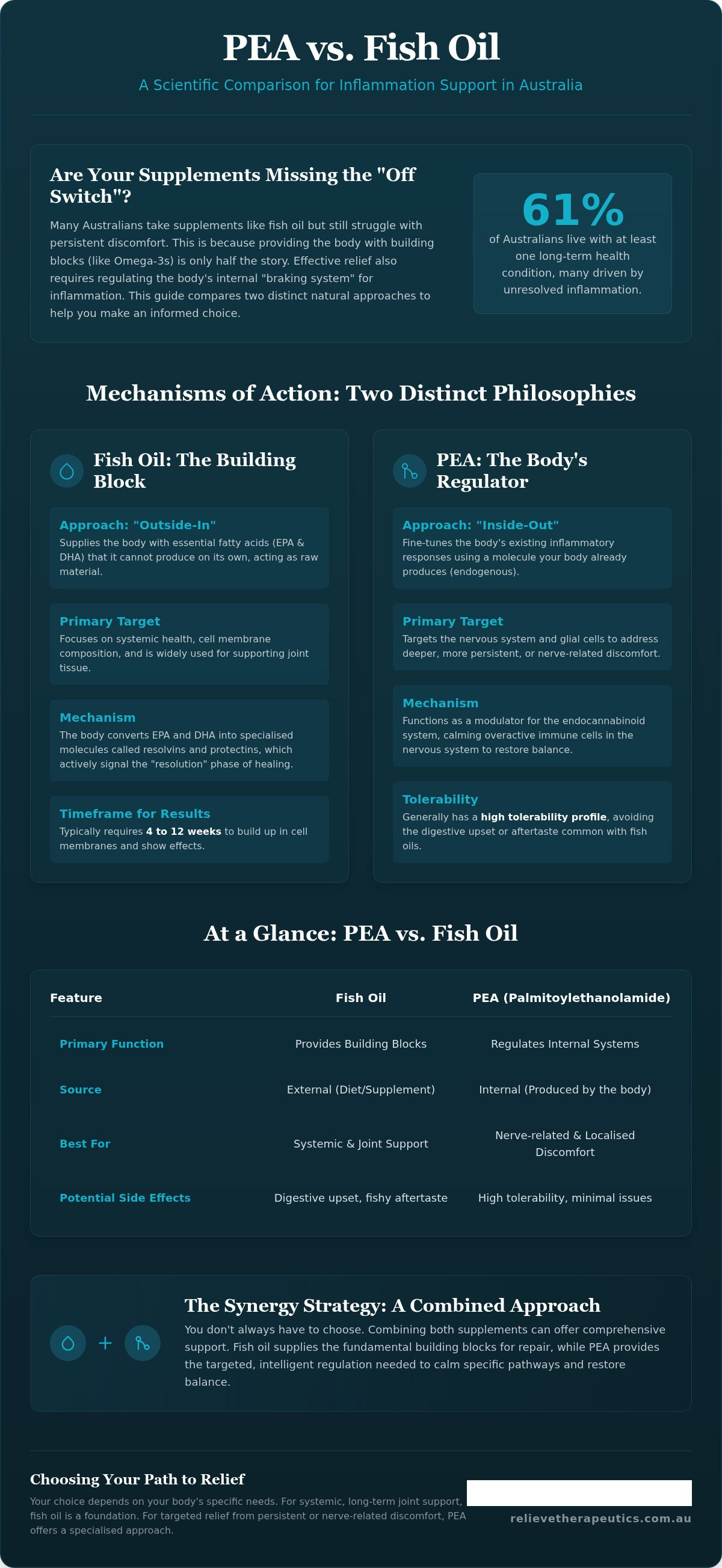
The biological interaction between these two substances represents two distinct therapeutic philosophies. Fish oil adopts an "outside-in" approach by supplying the body with essential fatty acids it cannot produce on its own. In contrast, PEA offers "inside-out" regulation by fine-tuning the body's existing inflammatory responses. Understanding the nuance of PEA vs fish oil for inflammation Australia requires looking at how these molecules engage with cellular receptors and signalling pathways to restore physiological balance.
Fish Oil: The Foundational Omega-3
Fish oil is rich in Eicosapentaenoic acid (EPA) and Docosahexaenoic acid (DHA). These long-chain fatty acids serve as the primary building blocks for eicosanoids, which are signalling molecules that regulate the intensity of an inflammatory response. Research from Tufts University indicates that EPA and DHA work differently against chronic inflammation, with each lipid targeting specific inflammatory markers. Once ingested, the body converts these lipids into resolvins and protectins. These molecules are responsible for the active "resolution" phase of healing. For Australians, it is vital to select high-quality, mercury-tested oils to ensure purity. Because fish oil works by slowly changing the composition of cell membranes, results typically emerge over a timeframe of 4 to 12 weeks.
PEA: The Endocannabinoid Modulator
Palmitoylethanolamide (PEA) is an endogenous fatty acid amide, meaning it is a molecule your body already produces in response to cellular stress or injury. It primarily functions by binding to the PPAR-alpha receptor, a nuclear receptor that acts as a master switch for genes involved in the inflammatory process. You can explore the technical details of how PEA works for pain through its unique ability to stabilise mast cells and regulate glial cell activity.
While fish oil focuses on systemic lipids, PEA provides targeted neuro-protection. It effectively "switches" overactive glial cells from a pro-inflammatory state back to a resting, protective state. PEA also contributes to the "Entourage Effect" within the endocannabinoid system. It does this by inhibiting the breakdown of anandamide, your body's natural "bliss molecule," thereby enhancing its soothing effects. If your current routine feels incomplete, incorporating specialised PEA capsules may provide the targeted regulation your nervous system requires to find lasting comfort.
Direct Comparison: PEA vs Fish Oil
Choosing between these two natural options often depends on where your discomfort originates. When evaluating PEA vs fish oil for inflammation Australia, it's helpful to look at the primary biological targets. Fish oil acts as a systemic lubricant. It focuses on joint tissue and cardiovascular health. PEA, however, targets the nervous system. It regulates mast cells and glial cells to calm overactive pain signals. This distinction is crucial for the millions of Australians living with chronic conditions who may experience both mechanical wear and nerve sensitivity.
The side effect profiles also differ significantly. High-dose fish oil can lead to digestive upset or a lingering aftertaste. To achieve a therapeutic anti-inflammatory effect, research suggests a dose of 2.7g or more of Omega-3s daily. This often requires taking multiple large capsules, which can be difficult for some to tolerate. PEA offers a different experience. Because it is an endogenous molecule, it boasts high tolerability. It provides targeted uptake without the gastrointestinal burden or the "fishy burp" associated with marine oils.
Suitability for Joint vs. Nerve Health
For foundational support, fish oil remains a reliable staple. It aids joint lubrication and supports systemic heart health by providing essential lipids. Yet, for those facing chronic sensitivity or radiating discomfort, PEA is a more specialised choice. It is particularly effective for nerve-related support. This makes it a preferred option for Australians managing conditions like sciatica or fibromyalgia. While fish oil treats the structural side of inflammation, PEA addresses the neurological component, providing a more comprehensive approach to long-term comfort.
Bioavailability and Purity
Absorption is a common hurdle for lipid-based supplements. Lower-grade fish oils often trigger oxidation, leading to poor stability and unpleasant reflux. PEA faces its own challenges regarding solubility. Standard PEA is often difficult for the body to process due to its large particle size. To overcome this, micronised PEA has become the gold standard for absorption. Reducing the particle size ensures the molecule can be absorbed efficiently by the gut. Always prioritise lab-tested Australian supplements. This ensures you receive a product free from contaminants and accurately dosed for your specific health journey.
Practical Guidance: Choosing Your Path to Relief
Determining whether to prioritise PEA vs fish oil for inflammation Australia begins with a clear assessment of your physical sensations. If your discomfort is primarily structural, such as joint clicking or general stiffness after exercise, fish oil provides the necessary lipids for systemic support. However, if you experience burning, tingling, or localised sensitivity that radiates, your nervous system likely requires the targeted regulation of PEA. Identifying the right biological pathway is the first step toward lasting vitality and the restoration of daily function.
To help you decide, consider this simple checklist for identifying your primary type of discomfort:
- Structural: Joint clicking, morning stiffness, or dull aches after physical activity.
- Neurological: Burning sensations, sharp shooting pains, or heightened sensitivity to touch.
- Systemic: Generalised fatigue, brain fog, or persistent inflammatory markers.
The Synergy Strategy
The "Synergy Strategy" involves using both supplements to cover multiple biological pathways. Because PEA is an endogenous molecule with no known drug interactions, it integrates seamlessly into existing routines. A typical routine might involve taking high-quality fish oil with breakfast to support joint lubrication, followed by a consistent PEA dosage split across the day. This dual approach addresses both the structural and neurological components of discomfort, providing a more comprehensive shield against chronic inflammatory states.
Natural lipid-based support requires patience and a disciplined approach. Most professionals recommend a "loading phase," where a higher dose is taken for the first 4 weeks to saturate cellular membranes. Consistency is the foundation of success. Skipping doses often resets the progress made during the initial weeks, delaying the restoration of comfort. By maintaining a steady intake, you allow these molecules to properly integrate into your cellular biology and provide the long-term support your body requires.
What to Look for in an Australian Supplier
When sourcing supplements, Australian consumers should look for transparent labelling, pure ingredients, and ethical manufacturing. Buying from a local, specialised provider ensures faster shipping and more responsive customer support. For those managing long-term conditions, opting for bulk supplies like PEA 180 capsules is a practical way to ensure uninterrupted support. If you are ready to refine your approach, you can order high-quality PEA capsules directly from an Australian-owned specialist.
Relieve Therapeutics: Your Partner in Natural Support
Relieve Therapeutics is a specialised Australian retailer dedicated to providing high-quality Palmitoylethanolamide (PEA) capsules. We understand that the choice between PEA vs fish oil for inflammation Australia often follows a long search for effective, natural support. Our focus remains on substance over style. We provide Australian consumers with a reliable source of PEA that bridges the gap between laboratory science and daily wellness. By choosing a local specialist, you benefit from direct-to-consumer e-commerce. This ensures your supplements arrive quickly and are handled with professional care by an Australian-owned and operated business.
Our product range is designed for simplicity and efficiency. We offer three distinct sizes to suit your specific health journey: 60 capsules, 120 capsules, and 180 capsules. This structure allows you to choose a supply that matches your dosage requirements and management goals perfectly. For those navigating long-term discomfort, our high-count value packs provide a sustainable way to maintain consistency without the stress of frequent reordering. We believe that managing persistent inflammation shouldn't be complicated; it should be supported by a partner who values your long-term outcomes.
When comparing PEA vs fish oil for inflammation Australia, it's clear that quality and local support make a significant difference in your overall experience. We prioritise transparency in everything we do, from our manufacturing standards to our customer service. This ensures you have a reliable ally as you work to restore your vitality and comfort.
Quality You Can Trust
Transparency is the cornerstone of our operations. Every batch of PEA we provide adheres to rigorous quality standards, ensuring you receive a product that is pure and free from unnecessary fillers. We believe that professional-grade support should be accessible and straightforward. Our commitment to quality means we only sell what we believe in. If you are new to this molecule, the PEA 60 capsule starter pack is an excellent way to begin your natural support journey. It allows you to experience the regulatory benefits of PEA firsthand before committing to a larger supply for chronic management. This entry-level option provides the clinical clarity you need to make informed decisions about your health.
Supporting Your Long-Term Journey
We view ourselves as your partner in health. Achieving lasting comfort requires a holistic approach that respects your body's complex biological pathways. While fish oil remains a valuable tool for many, our mission is to provide a sophisticated alternative that targets the nervous system and resolves inflammation from the inside out. We are here to support you at every stage, from your first dose to your long-term maintenance protocol. We invite you to take the next step in your wellness journey by exploring our evidence-based range. Browse the Relieve Therapeutics PEA range and start your journey today.
Refining Your Approach to Inflammatory Health
Moving toward a life of greater mobility requires a shift from generic solutions to targeted, evidence-based support. You now understand that while fish oil provides essential lipids for systemic joint health, PEA offers a sophisticated mechanism for regulating nerve-related sensitivity and overactive glial cells. By identifying whether your discomfort is structural, neurological, or a combination of both, you can make an informed decision on whether to switch protocols or embrace a synergistic strategy. This precision ensures you aren't just suppressing symptoms but actively supporting your body's natural resolution pathways.
Determining the best path between PEA vs fish oil for inflammation Australia depends on your unique biological needs and long-term wellness goals. Consistency remains the foundation of success; choosing a high-quality, locally sourced supplement ensures your body receives the pure ingredients it requires for effective restoration. As an Australian-owned and operated specialist, we're committed to providing the clinical clarity and reliable support you deserve throughout your health journey. Our focus on transparency and purity ensures you can move forward with confidence and safety.
Order high-quality PEA capsules from Relieve Therapeutics Australia and benefit from our specialised expertise and free shipping on eligible Australian orders. We're here to act as your trusted partner in restoring daily comfort and vitality. You don't have to manage this journey alone; let us help you find the relief you've been looking for.
Frequently Asked Questions
Is PEA better than fish oil for inflammation?
It depends on the specific nature of your discomfort. Fish oil provides the essential lipids required for systemic anti-inflammatory responses and joint lubrication. PEA functions as a targeted modulator that stabilises mast cells and regulates the nervous system. When comparing PEA vs fish oil for inflammation Australia, many find that PEA is more effective for persistent, nerve-related issues that standard Omega-3 supplements fail to resolve in the long term.
Can I take PEA and fish oil at the same time?
Yes, you can combine both supplements to address inflammation from multiple biological angles. Fish oil supports the structural integrity of joints, while PEA fine-tunes the body's internal inflammatory braking system. There are no known drug interactions associated with PEA, making it a safe addition to your existing routine. This approach allows for a more comprehensive strategy for managing long-term discomfort and restoring daily vitality through two distinct but complementary pathways.
Does PEA have the same side effects as fish oil?
PEA generally lacks the common side effects associated with fish oil. While high doses of marine oils can cause digestive upset, nausea, or an unpleasant fishy aftertaste, PEA is an endogenous molecule that your body already produces. This results in a high level of tolerability for most users. It provides a clean, targeted intervention without the gastrointestinal burden often reported by those taking the high doses of fish oil required for therapeutic effects.
How long does it take for PEA to start working compared to fish oil?
Both supplements require consistent use before you notice significant results. Fish oil typically takes between 4 to 12 weeks to change the lipid composition of your cell membranes. PEA may begin to show benefits within 2 to 4 weeks, although its effects are cumulative. Because it regulates overactive glial cells, maintaining a steady daily intake is essential. For chronic management, we recommend starting with a 60-capsule supply to assess your initial response.
Is PEA a natural supplement available in Australia?
PEA is a natural fatty acid amide that is permitted as an active ingredient in listed medicines within Australia. It is regulated by the Therapeutic Goods Administration (TGA), ensuring it meets safety and quality standards. Unlike synthetic options, PEA is a molecule found naturally in foods like egg yolks and peanuts. It is also produced within your own cells during times of physiological stress, making it a highly bio-compatible choice for natural support.
Which supplement is better for nerve-related discomfort?
PEA is the preferred choice for nerve-related discomfort due to its unique ability to regulate neuro-inflammation. While fish oil is excellent for structural joint support, it doesn't target the mast cells or glial cells involved in chronic nerve sensitivity. When evaluating PEA vs fish oil for inflammation Australia, clinical evidence suggests PEA is particularly effective for conditions like sciatica. It provides the targeted neuro-protection that systemic Omega-3 supplements often cannot reach.
Are there any people who should avoid taking PEA or fish oil?
Individuals with seafood allergies or those on blood-thinning medications should exercise caution with fish oil and consult a healthcare professional. For PEA, while it is generally well-tolerated, its use is not recommended for pregnant or breastfeeding women due to a lack of long-term clinical data. It is always a disciplined choice to discuss new supplements with your GP, especially if you are managing complex health conditions or taking other prescription medications for chronic issues.
How many PEA capsules should I take daily for inflammation?
Most clinical studies suggest a daily intake of 600mg to 1200mg for effective inflammatory support. This usually equates to taking one or two capsules twice daily, depending on the concentration of your product. Starting with a consistent routine is vital for achieving the best long-term outcomes. For those managing chronic issues, our 180-capsule value pack ensures you have a continuous supply for the initial loading phase and the subsequent maintenance period that follows.