

For Australians considering a PEA supplement for chronic pain, the key point is that palmitoylethanolamide (PEA) is a naturally occurring compound studied as a possible addition to pain care, not a replacement for established treatment. Research findings vary across conditions, so weigh the evidence alongside practical factors such as the formulation and your medicines.
Living with persistent pain can make new options feel important, while uncertainty about benefits and safety can make decisions harder. This guide explains what PEA is and how it may relate to chronic pain, including why micronized and ultra-micronized forms attract attention. It also covers possible effects and side effects, medicine interactions, how long a trial may take, and what to consider when comparing capsules with other forms. Use it as a balanced starting point for a conversation with a healthcare professional.
Key Takeaways
- PEA is being studied for chronic and neuropathic pain, but results vary across conditions and studies.
- Mild digestive discomfort, such as an upset stomach, may occur; evidence about medicine interactions remains incomplete.
- Possible benefits may take weeks to emerge, so timing is an important part of understanding a trial.
- Learn why micronized and ultra-micronized forms are discussed when comparing PEA supplements.
- Compare capsule options and consider how PEA may fit alongside your existing approach to pain management.
Are there any side effects?
PEA is generally described as well tolerated, although mild digestive discomfort has been reported. Understanding possible side effects and interactions can help you weigh it alongside your existing therapies.
Reported tolerability and side effects
Tolerability describes how people manage a supplement and any unwanted effects they experience. Reviews of included studies reported no adverse events, although one study table recorded mild, temporary gastrointestinal symptoms in both the PEA and placebo groups.
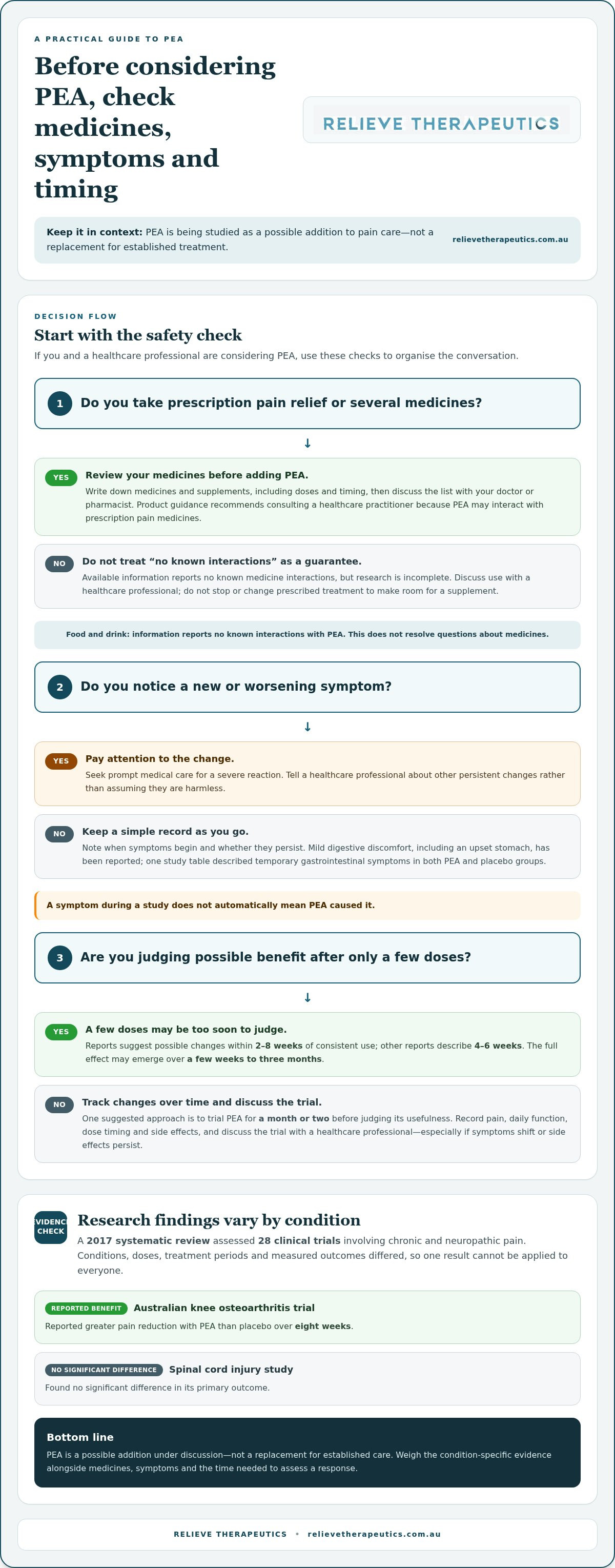
That distinction matters: a symptom reported during a study does not automatically mean PEA caused it. Some people may experience digestive discomfort when starting PEA. Note when symptoms begin and whether they persist, so you can report changes accurately.
Common and serious reactions
An upset stomach is among the side effects reported with PEA. Mild gastrointestinal discomfort may occur when someone starts taking it, while one study table described symptoms as temporary in both the treatment and placebo groups.
The reviewed studies did not report adverse events, but that does not establish that serious reactions are impossible. Pay attention to any new or worsening symptom rather than assuming it is harmless. Seek prompt medical care for a severe reaction, and tell a healthcare professional about other persistent changes.
Possible medication interactions
Available information reports no known interactions between PEA and medicines, but research on interactions is incomplete. Product guidance also advises consulting a healthcare practitioner before use because PEA may interact with prescription pain medicines.
This matters if you use prescription pain relief or several medicines for ongoing conditions. Before adding PEA, prepare a current list of your medicines and supplements, including doses and timing, and discuss it with your doctor or pharmacist. Don’t stop or change prescribed treatment to make room for a supplement.
Information also reports no known interactions between PEA and foods or drinks. This does not resolve questions about medicines, particularly prescription pain relief. A healthcare professional can review your medication list and treatment plan together.
When effects may become noticeable
Potential effects may take time. Reports suggest some people notice changes within 2 to 8 weeks of consistent use; others may take 4 to 6 weeks. The full effect may emerge over a few weeks to three months.
These ranges show why a change after a few doses may not reflect your longer-term response. If you’re assessing PEA, keep a simple record of pain, daily function, dose timing and side effects. For example, note whether walking, sleep or routine tasks change over several weeks.
One suggested approach is to trial PEA for a month or two before judging its usefulness. Discuss the trial and any medicine changes with a healthcare professional, especially if symptoms shift or side effects persist.
PEA: A Natural Pain Killer?
Palmitoylethanolamide, or PEA, is a naturally occurring compound studied for persistent pain. Calling it a “natural pain killer” can overstate what research shows: findings differ between conditions and trials.
Research on chronic pain
Research on chronic pain examines whether PEA may help alongside established care. A 2017 systematic review assessed 28 clinical trials involving chronic and neuropathic pain. Its findings support interest in PEA, but the studies covered different conditions, doses and treatment periods. Those differences make a single result difficult to apply to every person experiencing ongoing pain.
Some trials reported greater pain reduction with PEA than with a placebo, while others found no significant difference in their primary outcome. For example, an Australian knee osteoarthritis trial reported greater pain reduction with PEA than with placebo over eight weeks. By contrast, a spinal cord injury study found no significant difference in its primary outcome.
PEA occurs naturally in the body and has been studied for its relationship with inflammation. It binds to a peroxisome receptor in a cell’s nucleus. This offers a biological reason to investigate its effects, but a proposed mechanism alone cannot show whether a supplement will ease a particular person’s pain.
Neuropathic pain conditions discussed
Neuropathic pain arises from nerve-related problems, and PEA studies have examined several distinct conditions, including diabetic neuropathic pain, burning mouth syndrome, carpal tunnel syndrome and pain associated with multiple sclerosis. These conditions affect different nerves and functions, so findings from one study cannot automatically be applied to another.
Results vary across these examples. A burning mouth syndrome study reported better pain reduction with sublingual PEA than placebo after 60 days. A carpal tunnel syndrome study found no significant difference after oral PEA for 60 days. In a multiple sclerosis study, daily PEA over 12 months produced better pain reduction than placebo.
This variation matters when weighing PEA for an individual diagnosis. A study’s route of use, dose, duration and measured outcome all shape what its results mean. PEA has also been studied for chronic pelvic pain and vestibulodynia, including in research combining it with transpolydatin. Those results do not establish an effect across every chronic pain condition.
PEA for diabetic neuropathic pain
Diabetic neuropathic pain is nerve pain associated with diabetes. An Australian placebo-controlled trial examined oral PEA for diabetic neuropathic pain. The study reported significant improvement on a neuropathic pain scale, offering a specific example of research in this condition.
A separate Australian placebo-controlled trial also reported improvement in diabetic neuropathic pain with the same dose and duration. This finding is relevant to people considering PEA for nerve pain, but a trial describes the participants studied, not everyone with diabetes or neuropathy.
For context, one in five Australians aged 45 and over live with persistent, ongoing pain. That figure describes persistent pain generally, not diabetic neuropathy or response to PEA. A useful way to assess research is to compare the diagnosis, formulation, dose, duration and outcome measured with the question that matters to you. PEA research is promising in some settings, but mixed results mean it should not be described as a proven natural pain killer.
Does PEA interact with medicines (drug interactions)?
For Australians considering a PEA supplement for chronic pain, medicine and supplement details matter when reviewing potential interactions. PEA is a fatty acid amide associated with endocannabinoid signalling, but research on interactions is incomplete.
In Australia, PEA is available without a prescription as capsules or powder, and as a topical cream. Capsules are generally available in 300 mg or 400 mg strengths. For PEA supplements for chronic pain in Australia, compare the amount per serving and full ingredient list, not just the product name.
Check the label for the active ingredient, serving amount, additional ingredients, directions and warnings. Australian dietary supplements are not formally tested to guarantee their contents. Research guidance suggests considering a compounding pharmacy when choosing a product. For PEA supplements for chronic pain in Australia, a clear label helps you understand what each serving contains.
Product information advises pregnant people to avoid PEA because research has not established its safety. If breastfeeding, speak with a healthcare professional before use. These considerations matter when deciding whether a supplement suits your circumstances.
Potential medicine and food interactions
Interaction information describes whether PEA could affect a medicine, food or drink used at the same time. No known interactions with foods or drinks are reported, but research on medicine interactions remains incomplete, so these are separate questions.
Before starting PEA, write down the prescription medicines, over-the-counter pain relief and supplements you use. Include each dose and timing, then discuss the list with your doctor or pharmacist. This helps them consider your full regimen rather than assessing PEA in isolation.
Don’t double a dose after missing one or change a medicine schedule to fit a supplement. Keep prescribed treatment unchanged unless the clinician overseeing it advises otherwise.
Combining PEA with pain medicines
Combining PEA with pain medicines means using it alongside existing treatment, rather than replacing prescribed care without advice. Some information says PEA can be combined with NSAIDs, CBD and prescription pain relievers. However, product guidance advises consulting a healthcare practitioner because interactions with prescription pain medicines are possible.
This is especially relevant if you take prescription pain relief or several medicines. Ask a doctor or pharmacist to review the specific products and doses together. Don’t stop, reduce or replace prescribed medication on the assumption that PEA will have the same effect.
Long-term safety also needs careful interpretation. One multiple sclerosis study used PEA for 12 months, but a single trial duration can’t establish safety for everyone. Reviews reported no adverse events in included studies, while one study table recorded mild, temporary digestive symptoms in both groups. Record new symptoms and share them during medicine reviews.
Time to experience possible benefits
PEA’s potential effects are usually assessed over weeks, not after a single dose. Reported timelines range from 2 to 8 weeks, with a longer period sometimes needed to judge treatment.
Time to assess treatment benefit
Assessing treatment benefit means tracking symptoms and daily function over a consistent trial. Reports suggest allowing at least a month or two before deciding whether PEA is helping. This gives you more than a snapshot of one difficult day or an unusually comfortable morning.
Before starting, choose practical measures to record, such as pain intensity, walking, sleep or completing routine tasks. Note them regularly, alongside dose timing and any side effects. For example, compare whether getting dressed or preparing a meal becomes easier over several weeks, rather than focusing only on brief changes in pain.
Keep other treatment changes visible in your record. Starting a new therapy, changing activity levels or altering prescribed medicines during the same period can make it harder to interpret what has changed. A concise symptom diary gives you and your healthcare professional clearer information to discuss.
Some guidance suggests stopping a trial if there’s no significant benefit after 1-2 months at an increased dose. This is a point for reviewing the trial, not a reason to increase a dose without professional advice. The dose, consistency of use and the outcome you’re tracking all shape how useful the assessment is.
Time to possible pain benefit
Reported onset varies: some people may notice improvement within 2 to 8 weeks of consistent use, while other reports place the timeframe at 4 to 6 weeks. The full effect may take from a few weeks to three months to emerge. These ranges describe different reported timelines, rather than a precise schedule for every person.
Research has also examined oral PEA over 2-3 months. That longer study window helps explain why an early lack of change and a later response aren’t the same observation. PEA is a fatty acid amide, not a fast-acting cannabinoid pain medicine; timing should be understood through the course of use, rather than one dose.
For a useful review, keep the formulation and routine consistent, and record changes in pain and function. If you’re increasing a dose under professional guidance, mark when that change occurs. The suggested review period after an increase is 1-2 months before deciding whether significant benefit has emerged.
Use the same measures throughout. For instance, note how long you can walk, whether sleep is interrupted and how often pain limits a daily task. This makes pain reduction only one part of the picture. Function, tolerability and consistency together provide a more informative view of a PEA trial.
Micronized and ultra-micronized PEA
Micronized and ultra-micronized describe how palmitoylethanolamide powder has been processed, not a different active ingredient. The distinction may matter when comparing formulations, but particle-size terminology alone does not show which product will work best for nerve pain.
What the terms describe
Micronization reduces the size of particles in a powder. Ultra-micronization describes further size reduction, producing finer particles than a micronized form. Both terms refer to physical processing of PEA, a compound that occurs naturally in the body.
Smaller particles can behave differently when mixed or dissolved, which is why particle size is discussed in supplement formulation. But this manufacturing feature is not the same as evidence of better pain relief. A finer powder does not, by itself, establish how much PEA reaches the body or whether patients experience greater benefit.
What studies can and can’t tell you
PEA studies have used different doses, routes and formulations across chronic pain conditions. That variation matters: a result from one formulation cannot automatically establish that micronized or ultra-micronized PEA is more effective than another form.
To interpret a study, look at the formulation used, the condition studied and the outcome measured. For example, a trial measuring pain intensity may not answer whether a formulation improves walking or sleep. A study involving one patient group also cannot settle the comparison for everyone with nerve pain.
Claims about finer particles should be read as formulation information, not proof of superior clinical effects. A meaningful comparison requires research that directly evaluates formulations under comparable conditions. Without that direct comparison, particle-size labels alone cannot rank products by pain benefit.
What to compare on a label
Start with the amount of PEA per capsule or serving, then read the complete ingredient list and directions. Check whether the label identifies micronized or ultra-micronized processing, but weigh that alongside the dose and the formulation used in relevant studies.
For instance, two capsules may both contain PEA while differing in stated processing and serving instructions. Those details explain what you’re taking, but they don’t predict your individual response. Keep the distinction clear: particle size describes the powder, while clinical outcomes describe what studies observed in patients.
If you’re comparing formulations, note the PEA amount, other ingredients and processing description together. This provides a more useful basis for discussing options with a healthcare professional than relying on “ultra” as a stand-alone claim of quality or effectiveness.
To compare available formats, explore PEA capsule options and review the product details alongside your formulation questions.
Relieve Therapeutics: PEA 60 Capsules
Relieve Therapeutics offers PEA capsules for people considering a PEA supplement as part of their chronic pain discussions. The range includes PEA 60 Capsules, PEA 120 Capsules and PEA 180 Capsules, giving you different capsule quantities to consider.
If you’ve discussed PEA with a healthcare professional and are comparing capsule options, review the product details alongside your intended routine and any medicine guidance. The capsule count describes the pack size, not a recommended dose or treatment duration.
For information about the available PEA capsule options, visit relievetherapeutics.com.au.
Make your next step a considered one
If you’re considering a PEA supplement for chronic pain in Australia, make your next step a clear conversation about what matters in your daily life. Think about the changes you hope to notice, such as completing routine tasks more comfortably or having pain interrupt your plans less often. Defining those priorities can make later decisions more practical and personal.
Bring your questions about PEA, your current medicines and your goals to a healthcare professional. Whether PEA suits you depends on your health circumstances and treatment, so discuss it before starting. A thoughtful plan can help you consider a supplement alongside the care you already receive, rather than as a stand-alone solution.
If you’re ready to explore the available PEA options, contact Relieve Therapeutics. Take the time you need to make an informed choice, and keep your comfort and daily wellbeing at the centre of the decision.
Frequently Asked Questions
What is Palmitoylethanolamide (PEA)?
Palmitoylethanolamide (PEA) is a fatty acid amide that occurs naturally in the human body. It is also found in foods such as egg yolk and soybeans. PEA is sold as a dietary supplement, commonly in capsule or powder form. Its presence in the body does not mean a supplement will have the same effect for everyone. Check the product’s active ingredient and serving information to understand the form you’re considering.
How does it work?
PEA is thought to influence biological pathways involved in pain and inflammation. One proposed mechanism involves activating PPAR-α, a receptor that helps regulate inflammatory processes. This differs from simply numbing a painful area. Researchers also study PEA’s relationship with the body’s endocannabinoid system, but PEA is not the same as cannabis or CBD. A proposed mechanism helps explain scientific interest, but does not by itself establish a clinical benefit.
Does PEA interact with foods or drinks?
No known interactions between PEA and foods or drinks are reported. This is separate from medicine interactions, where research remains incomplete. If you take PEA with meals, keep your routine consistent so you can notice digestive changes more clearly. For example, record whether discomfort follows a particular meal or taking the supplement. Discuss persistent symptoms with a healthcare professional, especially if you also take medicines or other supplements.
How does PEA help with nerve pain?
PEA is studied for nerve pain because researchers are investigating its effects on pain signalling and inflammatory processes. Nerve pain can feel like burning, tingling or sharp, shooting discomfort, and its causes vary. PEA is not an established cure for nerve damage. If you’re considering a supplement, note your diagnosis and the symptoms you want to address, such as discomfort that interferes with walking or handling objects.
How long does it take to see an effect after starting PEA?
There is no single timeline that applies to everyone taking PEA. Some reports describe changes after several weeks, while a full response may take longer to assess. Distinguish a short-lived change from consistent improvement by tracking the same daily activities over time. For example, record whether pain affects cooking, walking or sleep. Note when you started and any changes to your routine or other treatments.
How do you take PEA?
Follow the directions for the specific product you’re using, because PEA supplements can differ in formulation and serving instructions. For the Relieve Therapeutics PEA product, the recommended dose is two capsules daily, providing 600 mg of PEA total; they can be taken with or without food. Don’t assume another brand has the same dose. If you take medicines or have questions about your routine, discuss PEA with a healthcare professional.
What is palmitoylethanolamide (PEA), and how might it help chronic pain?
PEA is a naturally occurring fatty acid amide being studied as a possible adjunct for chronic pain. Researchers are examining whether its influence on inflammatory and pain-signalling pathways could support symptom management. “Adjunct” means an additional option, not a substitute for prescribed care. If you’re weighing PEA, consider what daily change would matter to you, such as completing a routine task more comfortably, and discuss that goal with your healthcare professional.
What does clinical research say about PEA effectiveness for chronic pain, and which conditions have been studied?
Clinical research reports mixed findings, with results varying by condition and study design. PEA has been studied for irritable bowel syndrome, dysmenorrhoea, temporomandibular joint pain, rheumatoid arthritis and neuropathic pain associated with cancer. Some studies examined PEA alongside another ingredient or standard pain medicine, so their findings may not apply to PEA alone. Compare the condition, formulation and measured outcome before relating a study to your own pain.