

What if the key to settling your carpal tunnel symptoms isn't found in a surgeon's clinic, but within your body's own natural chemistry? For many Australians, the day begins long before the alarm goes off, usually with the frustrating sensation of pins and needles or the inability to grip a morning coffee cup with confidence. It's exhausting to rely on temporary fixes while fearing that surgery might be the only permanent solution left. Integrating a PEA supplement for carpal tunnel syndrome into your routine offers a scientifically backed, natural approach to nerve support that targets the underlying inflammation keeping the median nerve under siege.
This article provides a clear path forward for those seeking to reduce nocturnal tingling and restore hand grip strength without invasive procedures. We'll explore how Palmitoylethanolamide calms the overactive glial cells responsible for chronic discomfort, detail the clinical dosage required for efficacy, and guide you toward a reliable Australian source for pure capsules designed for long-term wellness. By understanding the biological mechanism of this fatty acid amide, you can transition from merely managing symptoms to actively supporting your nerve health with professional precision.
Key Takeaways
- Understand how median nerve compression leads to persistent tingling and why repetitive tasks in Australian offices or worksites are common triggers.
- Discover how Palmitoylethanolamide acts as a natural biological responder to help your body manage cellular stress and nerve discomfort.
- Examine clinical research where a PEA supplement for carpal tunnel syndrome demonstrated significant improvements in patient symptom severity scales.
- Learn the "Gold Standard" daily dosage and why micronised formulations are necessary for effective absorption and nerve support.
- Find out how to access high-purity PEA capsules from a reliable Australian source to ensure fast delivery and consistent product quality.
Understanding Carpal Tunnel Syndrome: Why the Median Nerve Needs Support
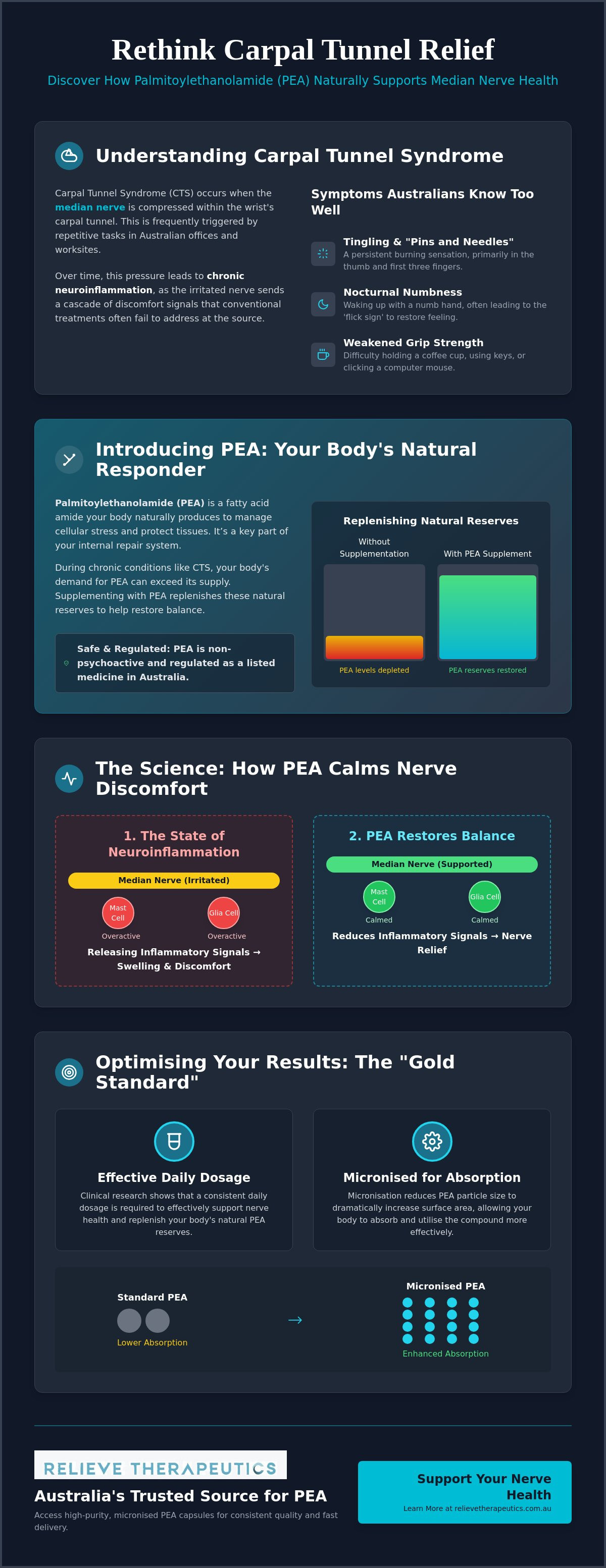
Carpal Tunnel Syndrome (CTS) occurs when the median nerve, which runs from your forearm into the palm of your hand, becomes compressed at the wrist. This narrow passageway, known as the carpal tunnel, can easily become crowded due to swelling or structural changes. In Australia, this condition is frequently triggered by the repetitive nature of modern work. Whether it's the heavy keyboard use found in CBD offices or the repetitive manual labour on residential worksites, the result is the same: the median nerve is under siege. It is the most common compression neuropathy, yet it is often misunderstood as a simple muscle strain.
To address these workplace-related health concerns, Persona Health provides expert medical assessments and injury management services tailored to the needs of Australian employees and employers.
In addition to health assessments, those looking to start or advance their careers in these industries can explore Apprenticeships and Traineeships with Apeiro Institute to gain the vocational skills necessary for long-term success.
For experienced workers seeking to formalise their expertise, Right Pathway offers specialised support to help facilitate the Recognition of Prior Learning (RPL) for Australian qualifications.
Over time, what begins as occasional tingling evolves into a state of chronic neuroinflammation. This is not just a mechanical issue of nerve entrapment that can be ignored. When the nerve is persistently squeezed, it triggers a cascade of inflammatory signals that eventually alter how the nerve functions. Many individuals find that standard anti-inflammatories fail to provide lasting relief because they don't address the specific biological pathways involved in nerve-related discomfort. This is why many are now exploring a PEA supplement for carpal tunnel syndrome as a way to support the nerve from the inside out.
The Symptoms Australians Know Too Well
The experience of CTS is often defined by a distinct, burning sensation that radiates through the thumb and first three fingers. For many, the most distressing symptom is nocturnal numbness. You might wake up in the middle of the night feeling as though your hand has 'gone to sleep', only to find that the sensation doesn't quickly resolve. This often leads to the 'flick sign', where you instinctively shake your hand to restore circulation and feeling. Beyond the night-time disruptions, you may notice a loss of fine motor skills. Fumbling with your car keys, struggling to hold a morning coffee, or finding it difficult to click a computer mouse are all signs that the median nerve is struggling to communicate with your hand muscles.
Why Conventional Treatments Can Feel Incomplete
Traditional management often starts with wrist splinting to keep the joint in a neutral position. While this helps prevent further mechanical compression during sleep, it does little to repair the existing nerve irritation. Many patients eventually hit what is known as the 'NSAID wall'. While ibuprofen or similar medications are effective for general muscle aches, they often fail to settle the specific signals of neuroinflammation. Palmitoylethanolamide (PEA), a naturally occurring fatty acid amide, offers a different approach by targeting the cells that regulate these nerve signals. There is a clear gap between simply 'managing' the physical space in the wrist and actually supporting the resilience of the nerve itself.
What is PEA? The Science of This Natural Fatty Acid Amide
Palmitoylethanolamide, commonly referred to as PEA, is a fatty acid amide that your body synthesises naturally. It belongs to a class of lipids that act as primary biological responders to cellular stress, tissue damage, or nerve injury. When the body detects a threat, such as the mechanical compression found in carpal tunnel syndrome, it produces PEA to restore equilibrium and protect the affected area. It is a vital component of our internal repair kit, working quietly to maintain cellular health.
During chronic conditions, the body's demand for this protective lipid can eventually outstrip its ability to produce it. In the case of long-term median nerve irritation, PEA levels often become depleted, which allows neuroinflammation to persist unchecked. This is where a PEA supplement for carpal tunnel syndrome becomes a valuable tool. By providing a concentrated source of this endogenous molecule, you're essentially replenishing your body's natural reserves. While PEA interacts with the endocannabinoid system, it is entirely non-psychoactive and is regulated as a listed medicine in Australia, making it a safe and legal option for daily support.
The Mast Cell and Glia Connection
One of the most significant ways PEA supports nerve health is by "calming" overactive mast cells. These cells are responsible for releasing inflammatory markers that contribute to the swelling within the carpal tunnel. Additionally, PEA modulates glia cells, which are the immune cells of the central nervous system that act as "volume knobs" for pain. The ALIA (Autacoid Local Inflammation Antagonism) mechanism is the body's sophisticated way of 'cooling' nerve heat by down-regulating these overactive cells before they can cause further damage. Extensive clinical trials on PEA for nerve compression have highlighted this unique ability to settle the biological environment surrounding the nerve.
PEA as a Neuroprotective Ally
Beyond reducing immediate discomfort, PEA acts as a neuroprotective agent by supporting the myelin sheath. This protective coating is essential for the rapid transmission of nerve signals; when it's compromised, you experience the fumbling and loss of strength common in CTS. PEA also facilitates the "entourage effect," where it enhances the activity of other pain-regulating molecules like anandamide. Unlike synthetic painkillers that simply mask signals in the brain, PEA takes a "bottom-up" approach by addressing the health of the nerve at its source. Choosing a high-purity PEA formulation can be a pivotal step in restoring this internal balance and reclaiming hand function.
Reviewing the Evidence: Does a PEA Supplement Help Carpal Tunnel?
Scientific validation is the cornerstone of any natural health intervention. In 2017, a prospective randomised study examined 61 patients diagnosed with carpal tunnel syndrome to determine the efficacy of Palmitoylethanolamide. The results were compelling. Participants who integrated a PEA supplement for carpal tunnel syndrome into their regimen showed significant improvements in the Symptom Severity Scale (SSS). This metric doesn't just measure pain levels; it tracks the frequency and duration of symptoms that disrupt daily life.
Beyond subjective reporting, the study looked at electrophysiological findings to assess physical nerve function. Researchers observed positive changes in nerve conduction velocity, suggesting that PEA helps the median nerve transmit signals more efficiently. While severe cases may still require surgical consultation, those with low to moderate CTS typically see the most profound benefits. This is because the nerve is still in a state where biological support can effectively modulate the inflammatory environment and promote resilience.
Translating Clinical Results to Daily Life
For the average person, "Symptom Severity" improvement means reclaiming the night. It translates to fewer wakeful hours spent shaking out numb hands and a noticeable reduction in the sharp, daytime stabs of pain. Improved "Functional Status" gains are equally vital. You might find you can write a grocery list, type an email, or lift a heavy kettle with a confidence that was previously missing. Most importantly, clinical observations consistently highlight a high safety profile. Unlike some traditional interventions, PEA is well-tolerated and shows no significant side effects compared to placebos, making it a sustainable choice for long-term nerve support.
Addressing the 'Objection': Why results aren't overnight
It's important to view nerve support as a physiological process rather than a chemical 'switch'. Nerves heal slowly, and the body needs time to accumulate the necessary lipids to dampen chronic inflammation. Most individuals experience a therapeutic window of 4 to 8 weeks before the full benefits of supplementation become apparent. This steady accumulation allows the body to move from a state of constant alarm to one of restoration. To ensure you're on the right track, understanding how to take PEA for nerve pain is essential for managing expectations and achieving the best possible outcome.
Optimising Your Results: Dosage, Micronisation, and Lifestyle
Achieving the best outcomes with a PEA supplement for carpal tunnel syndrome requires a structured approach to both intake and your daily environment. The "Gold Standard" dosage for effective nerve support generally ranges from 600mg to 1200mg daily, often split into two doses to maintain stable levels in your system. For many Australians, starting with a loading dose of 1200mg for the first four weeks helps saturate the body's tissues and kickstart the restorative processes. This initial period is critical for dampening the chronic neuroinflammation that has likely been building for months or even years before you sought relief.
Consistency is your greatest ally in the journey toward nerve restoration. Because PEA works by modulating cellular responses rather than blocking pain receptors instantly, missing doses can stall the neuroprotective progress your body is making. It's a cumulative effect. By sticking to a daily routine, you ensure the "pain volume" remains turned down and the median nerve has the constant support it needs to recover from compression. To start your journey with a reliable formulation, you can purchase high-purity PEA capsules designed for optimal daily support.
The Bioavailability Factor: Why Particle Size Matters
PEA is a lipophilic or "fat-loving" molecule. In its raw state, it naturally forms large, dense clumps that are difficult for the human digestive tract to break down and absorb. Micronisation is the technical process of reducing these particles to a microscopic size, which vastly increases the surface area available for uptake. Without this process, much of the supplement might simply pass through the body without reaching the nerves. To understand why particle size is the deciding factor in efficacy, you can explore the science of micronised PEA and its role in bypassing the digestive barrier.
An Australian Guide to Hand Health Ergonomics
While supplementation provides internal support, your external environment must also be organised for recovery. Adopting the "Neutral Wrist" rule is essential, whether you're at a desk in Melbourne or on a manual worksite in Perth. This means ensuring your keyboard, mouse, or tools allow your wrist to remain straight rather than cocked up or down. In industrial settings, the quality of tool components is vital for safety, and for more information on these technical materials, you can check out Plastiques Elastomères. Integrate micro-breaks every 30 to 60 minutes. During these 60-second windows, gently stretch the fingers and wrists to release tension and reduce repetitive strain. Pairing a high-quality supplement with targeted physical therapy creates a comprehensive recovery plan that addresses both the biological and mechanical aspects of the condition. This dual approach is often what separates temporary relief from long-term hand health.
For those looking for examples of how these disciplines are integrated, Dr. Philip Boamah | Natural Medicine & Physical Therapy demonstrates how a combined focus on natural medicine and physical therapy can provide a more robust path to recovery for nerve-related conditions.
Why Relieve Therapeutics is Australia's Trusted Source for PEA
Selecting a high-quality PEA supplement for carpal tunnel syndrome is a decision that directly impacts your long-term nerve health and daily comfort. At Relieve Therapeutics, we recognise that purity is the most critical factor in achieving the clinical results discussed in previous sections. Our commitment to providing Palmitoylethanolamide without unnecessary fillers or artificial binders ensures that your body receives exactly what it needs for restoration. By focusing on high-purity formulations, we help you avoid the digestive interference often caused by lower-grade alternatives, allowing the micronised particles to work effectively on dampened inflammatory pathways.
Managing a chronic condition requires a partner that understands the Australian context. We've removed the frustration of international wait times and the uncertainty of customs delays by offering local Australian shipping on every order. This means your journey toward better hand function isn't interrupted by logistical hurdles or long transit periods. Whether you're in a metropolitan centre or a regional worksite, our methodical approach to distribution ensures you have a consistent supply of nerve support exactly when you need it most. We take pride in being a reliable ally in your personal health journey, providing the steady support required for lasting change.
Choosing Your Supply: 60, 120, or 180 Capsules?
We provide tailored options to suit the different stages of your management plan. For those just beginning to explore natural nerve support, we recommend our PEA 60 Capsules as the ideal starter pack. This allows you to observe how your body responds during the initial loading phase without a large upfront commitment. For individuals committed to a sustained, long-term protocol, the PEA 180 Capsules provide a strategic supply to ensure you don't run out during the critical 8 to 12 week window required for maximum efficacy. Our online ordering process is designed for busy Australians who value efficiency, transparency, and clinical reliability.
The Relieve Therapeutics Quality Guarantee
Our brand is built on a sophisticated blend of clinical authority and empathetic reassurance. We don't believe in high-pressure sales tactics; instead, we provide the evidence-based information you need to make an informed choice for your hand health. We act as a knowledgeable guide, simplifying complex biological concepts so you can feel confident in your recovery plan. Every capsule represents our dedication to quality, integrity, and your long-term outcomes. If you're ready to take a proactive, natural step toward managing discomfort and restoring your grip strength, you can browse our range of high-quality PEA capsules today and discover the difference that specialist care makes.
Reclaim Your Hand Function and Comfort
Managing carpal tunnel syndrome requires more than just masking the pain; it requires a strategic approach to supporting the median nerve at a cellular level. By addressing overactive glial cells and replenishing your body's natural fatty acid amides, you can move away from the frustration of nocturnal tingling and towards restored grip strength. Integrating a PEA supplement for carpal tunnel syndrome into your daily routine offers a research-backed method to calm neuroinflammation and protect your long-term nerve resilience.
As a specialist Australian retailer, Relieve Therapeutics is dedicated to providing clinical-grade PEA purity that skips unnecessary fillers. We ensure your progress stays on track with fast local dispatch from within Australia, so you're never left waiting for international arrivals. It's time to transition from temporary management to active restoration. Support your nerve health with Australia's premium PEA capsules and take the first step toward a life defined by comfort and vitality. Your journey to better hand health is supported by science and care.
Frequently Asked Questions
Is a PEA supplement effective for carpal tunnel syndrome?
Yes, clinical evidence indicates that a PEA supplement for carpal tunnel syndrome is effective in reducing symptom severity and improving nerve function. By targeting the overactive glial cells and mast cells that drive neuroinflammation, it helps lower the biological "volume" of pain signals. Many Australians find it provides a significant functional improvement in hand strength and a reduction in nocturnal tingling when used consistently.
How long does it take for PEA to work for nerve pain?
You can typically expect to see initial improvements within 4 to 8 weeks of consistent daily use. Because PEA works by restoring the body's natural lipid levels and repairing inflammatory pathways, it is a physiological process rather than an "instant" chemical switch. Maximum benefits for nerve-related discomfort are often reached after 3 months of supplementation, allowing the median nerve adequate time to stabilise.
Are there any side effects of taking PEA for carpal tunnel?
PEA is generally well-tolerated with no serious side effects reported in clinical trials involving over 800,000 patients worldwide. Some individuals may experience very mild digestive discomfort when first starting the regimen, but this usually resolves as the body adjusts. It is a natural fatty acid that the body already produces, making it a reliable and safe choice for long-term nerve support without the risks of synthetic alternatives.
Can I take PEA along with my current carpal tunnel medication?
Yes, there are no known drug-to-drug interactions with PEA, making it safe to use alongside standard carpal tunnel treatments. It is frequently paired with NSAIDs or physical therapy to provide a multi-layered approach to relief. We always recommend consulting with your Australian healthcare provider before starting any new supplement to ensure it aligns with your specific medical history and current health plan.
What is the recommended daily dosage of PEA for CTS?
The clinical "Gold Standard" dosage for nerve support is typically between 600mg and 1200mg daily. Many specialists suggest starting with a higher loading dose of 1200mg for the first month to saturate the tissues before moving to a maintenance dose. Splitting the intake into two daily doses helps maintain stable levels of Palmitoylethanolamide in your system for consistent protection of the median nerve.
Is PEA available over-the-counter in Australia?
Yes, PEA is available over-the-counter in Australia and does not require a prescription. It is regulated by the Therapeutic Goods Administration (TGA) as a listed medicine, ensuring it meets strict safety and quality standards. The TGA advises consulting a healthcare provider if using PEA for more than 21 consecutive days to ensure your chronic pain is being managed appropriately by a professional.
Does PEA help with the numbness in my thumb and index finger?
Yes, PEA specifically targets the neuroinflammation that causes numbness and tingling in the thumb and first three fingers. By supporting the health of the myelin sheath and reducing the inflammatory "heat" around the median nerve, it helps restore normal signal transmission. This often results in improved sensation, better fine motor skills, and a reduction in the need to shake your hands for relief.
Why is micronised PEA better than standard PEA for carpal tunnel?
Micronised PEA is superior because it offers significantly higher bioavailability compared to standard, non-treated formulations. Standard PEA is a "fat-loving" molecule that naturally forms large clumps, which the body struggles to absorb through the digestive barrier. Micronisation breaks these particles down to a microscopic size, increasing the surface area for absorption and ensuring that a therapeutic amount of the compound actually reaches your nerves.