

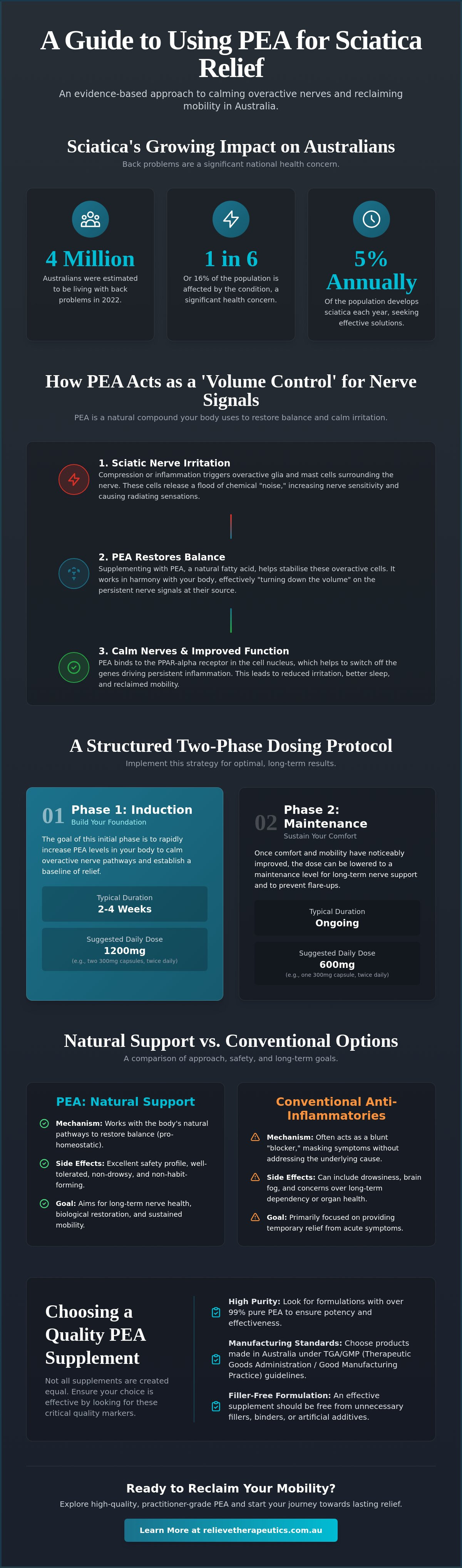
In 2022, an estimated 4 million Australians were living with back problems, and with five per cent of the population developing sciatica annually, the search for effective relief is more urgent than ever. If you are struggling with sharp, electric sensations that disrupt your sleep and limit your daily movement, you are likely looking for a solution that goes beyond temporary relief. Using PEA for sciatica Australia has emerged as a scientifically grounded approach for those who want to support nerve health without the long-term concerns associated with traditional anti-inflammatories.
We understand that the confusion surrounding supplement quality and dosage can feel overwhelming when you are already in discomfort. This practical guide will show you how to effectively use Palmitoylethanolamide (PEA) to calm overactive nerves and reclaim your mobility. We'll examine the clinical evidence behind this natural fatty acid, provide clarity on structured dosing, and help you establish a dependable routine. By focusing on biological restoration rather than a quick fix, you can move toward better sleep, improved function, and a more vibrant daily life.
Key Takeaways
- Discover the biological mechanism that allows PEA to act as a "volume control" for persistent, radiating nerve signals.
- Learn how to implement a structured two-phase dosing protocol when using PEA for sciatica Australia to ensure optimal, long-term results.
- Compare the safety, tolerability, and side-effect profile of natural nerve support against conventional prescription treatments.
- Identify critical quality markers like purity, manufacturing standards, and filler-free formulations to ensure your supplement is effective.
- Master a simple method for tracking your mobility, sleep quality, and daily comfort so you're certain your routine is working.
Understanding Sciatica and the Search for Natural Support in Australia
Sciatica is more than just a sore back. It's a sharp, radiating irritation that travels from the lumbar spine, through the glutes, and down the back of the leg. In Australia, back problems are a significant health concern, affecting roughly 16 per cent of the population. According to 2022 data, an estimated 4 million Australians live with these conditions, with roughly 5 per cent of the population developing sciatica every year. For many, the experience is defined by "electric" sensations, persistent numbness, or a dull ache that makes simple tasks like driving or sleeping feel like a challenge. It's a biological signal that the sciatic nerve is under duress, often due to compression or inflammation.
Many people are now exploring PEA for sciatica Australia as a way to address the underlying nerve irritation rather than just masking the symptoms. There's a vital distinction between acute injury relief and chronic nerve health maintenance. While an initial injury might require immediate intervention, the lingering discomfort often stems from overactive pain signals that persist long after the physical trigger has lessened. This has led to a growing interest in fatty acid amides that support the body's natural ability to regulate these signals.
The Frustration of Conventional Nerve Management
Standard chemist options often provide a "revolving door" of temporary relief. While they might dull the immediate sensation, they don't always support the nerve's long-term health. Many Australians express concern over the side effects of traditional nerve medications, such as brain fog, drowsiness, or the risk of dependency. There's a clear desire for a non-habit-forming support option that fits into a busy, active lifestyle without compromising mental clarity or daily function.
Why Natural Support is Gaining Ground
The Australian wellness landscape is shifting toward substances the body already recognises. Palmitoylethanolamide (PEA) is an endogenous fatty acid amide, meaning your own cells produce it in response to stress or injury. Unlike synthetic compounds that can overwhelm the system, PEA works in harmony with your biological pathways. Integrating this into a holistic strategy helps build a foundation for lasting comfort. To understand the mechanism better, you can explore how does PEA work for pain through the lens of modern science.
Choosing PEA for sciatica Australia represents a commitment to biological "reset" rather than a temporary fix. By calming the neuro-inflammation that drives sciatic discomfort, you can focus on the movement and rehabilitation necessary for a full recovery. It's about finding a reliable partner in your health journey that respects your body's natural chemistry while providing the targeted support needed to reclaim your mobility.
The Science of PEA: How It Targets Sciatic Nerve Irritation
Palmitoylethanolamide (PEA) is an endogenous lipid molecule, meaning it's a substance your own cells synthesise to maintain balance during times of physiological stress. When the sciatic nerve is irritated, the body produces PEA as a protective response to manage the resulting discomfort. However, in cases of chronic irritation, your natural levels may be depleted. This is where supplementing with PEA for sciatica Australia provides a significant advantage. Rather than acting as a blunt "blocker" like many pharmaceutical agents, PEA functions as a pro-homeostatic modulator. It works by "dialing down" the volume of overactive pain signals at their source.
The efficacy of PEA lies in its ability to target the glia and mast cells that surround the sciatic nerve. These cells are often the primary drivers of local neuro-inflammation. When they become overactive, they release chemicals that increase nerve sensitivity. By stabilising these cells, PEA helps reduce the chemical "noise" that leads to the sharp, electric sensations characteristic of sciatica. Clinical research, including studies on PEA for neuropathic pain, supports this targeted approach to nerve health.
The Role of the PPAR-Alpha Receptor
PEA binds directly to the PPAR-alpha receptor within the cell nucleus to switch off the genes responsible for persistent inflammatory responses. This specific biological pathway is distinct from the mechanism of standard ibuprofen or paracetamol, which primarily target the COX enzymes. By engaging with the body's "endocannabinoid-like" system, PEA supports the restoration of nerve function without the systemic load of conventional anti-inflammatories.
Micronisation: Why Particle Size Matters for Sciatica
Standard PEA is notoriously difficult for the body to absorb because its natural crystal structure is large and fat-soluble. To overcome this, high-quality supplements undergo a process called micronisation, which reduces the particle size to a few micrometres. This increased surface area allows for significantly better uptake into the bloodstream and nerve tissues. For those seeking actual results, choosing micronised palmitoylethanolamide is essential for ensuring the active ingredient reaches the irritated sciatic nerve effectively.
Understanding these technical processes helps you make an informed choice for your recovery. Selecting a specialised form of PEA for sciatica Australia ensures you are providing your body with the exact tools it needs for restoration. If you're ready to start your journey toward better nerve health, exploring our range of PEA capsules is a logical first step.
A Step-by-Step Guide: How to Use PEA for Sciatica Support
Transitioning from understanding the science to implementing a daily routine requires a structured, methodical approach. To get the most out of PEA for sciatica Australia, you must first establish a clear baseline of your current discomfort. Take a moment to record the intensity of your "electric" nerve sensations on a scale of one to ten. Note how many times your sleep is disrupted each night and how far you can walk before the radiating sensation begins. This data is essential for tracking your progress over the coming weeks, as natural biological shifts often occur gradually rather than overnight.
A reliable routine is built on the concept of saturation. Chronic nerve irritation often depletes the body's natural stores of fatty acid amides, meaning an initial "loading phase" is typically required to reset the system. This phase involves a higher daily intake to build up the compound in your tissues. Once you notice a consistent improvement in your mobility and comfort, you can transition to a maintenance phase. Consistency is the non-negotiable key to this process. Skipping doses resets your biological progress, as PEA works through cumulative effect rather than immediate, temporary blockage.
Finding Your Optimal PEA Dosage
Determining the right amount for your specific needs is a process of disciplined adjustment. Most individuals start with a robust daily intake for the first three to four weeks to ensure the PPAR-alpha receptors are sufficiently engaged. After this period, many find they can maintain their results with a lower, steady dose. For a detailed breakdown of milligram recommendations and timing, you can refer to our PEA dosage for pain guide, which provides a comprehensive framework for Australian users.
The 8-Week Roadmap for Sciatic Health
- Weeks 1-2: Initial changes are often subtle. You might notice you're sleeping more soundly or that your overall mood feels slightly more balanced as the system begins to stabilise.
- Week 4: This is typically when the "edge" starts to come off the sharp, radiating sensations. Daily movements like sitting or standing often feel less restricted.
- Week 8: By this stage, the cumulative benefits should be fully apparent. This is the ideal time to re-evaluate your baseline and decide on your long-term maintenance strategy.
Practical Tips for Daily Integration
To maximise the uptake of your capsules, always pair them with a meal containing healthy fats. Options like avocado, olive oil, or eggs help facilitate the absorption of this fat-soluble molecule. Using a weekly pill organiser is a simple but effective way to ensure zero missed doses. Finally, continue your "pain diary" for at least the first two months. Documenting small victories, such as a longer walk or a pain-free morning, provides the objective evidence you need to stay committed to your PEA for sciatica Australia protocol.
PEA vs. Conventional Options: Why Natural Support is a Preferred Choice
When managing nerve-related discomfort, many Australians find themselves weighing the benefits of relief against a heavy "side effect load." Conventional prescription nerve blocks and anti-inflammatories are often effective for acute episodes, but their long-term use can lead to systemic challenges. Common issues include significant drowsiness, gastrointestinal irritation, and a persistent "brain fog" that can interfere with work and family life. Choosing PEA for sciatica Australia offers a different path. Because Palmitoylethanolamide is a substance your body already recognises and produces, it's generally well-tolerated and lacks the harsh impact on the central nervous system associated with synthetic alternatives.
A common question arises: if a substance is natural, is it actually strong enough to handle the intense sensations of sciatica? The answer lies in the mechanism of action. While traditional blockers focus on masking the signal, PEA focuses on the source by stabilising the mast cells and glia that drive neuro-inflammation. It's not a "weak" alternative; it's a specialised modulator that works in harmony with your biology. Many people find success using PEA as a complementary support alongside their existing treatments, gradually allowing the body to regain its own internal balance.
Non-Opioid and Non-Addictive Support
The current health climate in Australia has led to an increased focus on finding a reliable non-opioid pain relief supplement. PEA fits this requirement perfectly. It is non-habit forming and does not lead to the lethargy or dependency risks often found in stronger prescription pathways. This provides a sense of security for those who need long-term nerve support but want to remain alert and active throughout their day. It's about achieving comfort without compromising your quality of life.
Discussing PEA with Your Australian GP
We always encourage a collaborative approach to health management. When you speak with your GP about PEA for sciatica Australia, it's helpful to focus on its classification as a fatty acid amide and its role in clinical trials for neuropathic support. While some general practitioners may be more familiar with traditional pharmaceutical routes, specialists and pharmacists are increasingly recognising the value of endogenous compounds. Bringing a summary of the clinical evidence can help facilitate a productive conversation about how PEA fits into your broader sciatica management plan.
Taking control of your nerve health starts with choosing high-quality, evidence-based support. If you're looking for a non-drowsy, natural alternative to support your recovery, you can order our micronised PEA capsules online to begin your structured 8-week routine.
Choosing Quality PEA Capsules in Australia
Selecting the right supplement is the final, most critical step in your recovery protocol. When searching for PEA for sciatica Australia, it's vital to look beyond the marketing claims on the front of the bottle. High-quality capsules are defined by their purity and the absence of unnecessary fillers, binders, or artificial flow agents that can interfere with absorption. Manufacturing standards are equally important. You should prioritise products that adhere to rigorous quality control measures, ensuring every capsule contains the precise milligram count required for your daily routine.
Buying from an Australian-owned specialist like Relieve Therapeutics ensures you receive high-purity PEA without the logistical hurdles of international shipping. Local sourcing provides the peace of mind that comes with Australian-based support and fast delivery to all states and territories. Since sciatic nerve support requires a consistent, multi-week commitment, bulk options like our 120 or 180-capsule bottles represent a strategic choice. They provide a continuous supply for both the loading and maintenance phases, preventing any gaps in your protocol that could reset your biological progress.
The Relieve Therapeutics Difference
We are dedicated to providing high-purity PEA that is accessible to all Australians without the need for a practitioner referral. Our clean formulations are free from common allergens and unnecessary additives, focusing entirely on the active lipid molecule your body needs. For those starting the recommended 8-week trial, our PEA 180 capsules offer the most effective value and ensure you have enough supply to see the process through to completion.
Starting Your Journey Today
Reclaiming your daily mobility and sleep quality is a process of disciplined, science-backed steps. Whether you begin with our 60, 120, or 180-count variations, you're taking a proactive stance against persistent nerve irritation. You don't have to rely on temporary fixes that cloud your mental clarity or leave you feeling lethargic. By choosing a structured approach with PEA for sciatica Australia, you're giving your body the endogenous tools it needs to "dial down" the discomfort and support long-term nerve health.
View our range of high-quality PEA capsules and start your support journey.
Reclaim Your Daily Mobility with Evidence-Based Support
Navigating the complexities of sciatic nerve health requires a shift from temporary relief to long-term biological restoration. By choosing PEA for sciatica Australia, you're opting for a substance your body already recognises to calm overactive pain signals at their source. Success depends on a high-purity, micronised formulation and a commitment to a consistent 8-week routine. This disciplined approach allows your system to reset. It paves the way for deeper sleep, improved mobility, and lasting comfort.
As an Australian owned and operated specialist, we provide pure Palmitoylethanolamide without any nasty fillers. Our bulk 180-capsule packs are designed to support you through the entire loading and maintenance phases, ensuring you have the consistent supply needed for a successful trial. We offer fast local shipping to ensure your support plan starts without delay. You don't have to accept persistent discomfort as a permanent part of your life.
Explore our high-purity PEA range and start your 8-week sciatica support plan today.
Taking this proactive step is a powerful move toward a more comfortable, active future.
Frequently Asked Questions
Is PEA effective for long-term sciatica management?
Yes, PEA is highly effective for long-term management because it acts as a biological modulator rather than a temporary blocker. By stabilising the glia and mast cells that surround the sciatic nerve, it helps maintain a state of low neuro-inflammation. This cumulative approach ensures that your nerve health is supported continuously, allowing for improved daily mobility and better sleep quality over months of use.
Can I take PEA with my current blood pressure or heart medication?
PEA is generally considered safe to use alongside most medications, including those for blood pressure or heart health, because it has no known drug-drug interactions. Since it is an endogenous substance that your own cells already produce, it doesn't typically place an additional load on your system. However, it's always a professional standard to discuss any new supplement with your GP to ensure it fits your specific health profile.
How long does it typically take to feel the benefits of PEA for nerve pain?
Most individuals begin to notice the benefits of PEA for sciatica Australia within a four to eight-week period of consistent use. While some subtle improvements in sleep or mood may occur within the first fortnight, the "edge" usually comes off the sharp, radiating sensations by the one-month mark. Consistency is vital during this period to allow the compound to reach therapeutic levels in your tissues.
Are there any known side effects of Palmitoylethanolamide?
Palmitoylethanolamide is remarkably well-tolerated and has a high safety profile with no significant side effects reported in clinical literature. Because it is a fatty acid amide naturally found in the body and certain foods, it doesn't cause the drowsiness, brain fog, or gastrointestinal distress often associated with conventional nerve medications. This makes it an ideal choice for those who need reliable support without compromising their daily function.
Why is micronised PEA better for sciatica than standard PEA?
Micronisation is essential because standard PEA consists of large, fat-soluble crystals that the body finds difficult to absorb. By reducing the particle size to a few micrometres, micronised PEA provides a much larger surface area for uptake into the bloodstream. This ensures that the active ingredient actually reaches the irritated sciatic nerve in sufficient concentrations to provide the intended biological support.
Do I need a prescription to buy PEA capsules in Australia?
You don't need a prescription to purchase PEA capsules in Australia. It is available as a listed medicine or high-quality supplement from specialised Australian-owned providers. This accessibility allows you to begin a structured support plan immediately, though we always recommend working alongside a health professional to monitor your progress and integrate PEA into a holistic management strategy.
Can I take PEA if I am already using CBD oil for pain?
Yes, you can use PEA alongside CBD oil, as they engage with different biological pathways within the body's endocannabinoid-like system. While CBD interacts with specific receptors, PEA focuses on the PPAR-alpha receptor and the stabilisation of inflammatory cells. Using them together can provide a multi-layered approach to nerve health, though many Australians find that high-purity PEA provides sufficient support on its own.
What happens if I stop taking PEA after my sciatica improves?
If you stop taking PEA after your symptoms improve, your body's "volume control" for nerve signals may slowly return to its previous state. While PEA supports the biological environment of the nerve, it doesn't always resolve the mechanical cause of sciatica, such as a disc issue. Many users choose to transition to a lower maintenance dose to ensure their comfort and mobility are sustained over the long term.