

Imagine starting your morning not with the familiar, sharp resistance in your joints, but with a fluid ease that allows you to reach for the kettle without hesitation. For many people searching for PEA for knee pain Australia, the reality of persistent discomfort often dictates the pace of the day, turning simple tasks like climbing stairs into a source of constant calculation. You've likely experienced that frustrating morning stiffness or the worry that comes with relying on traditional relief that might irritate your gastric system. It's a difficult balance to maintain when you simply want to regain your active lifestyle without the looming threat of a painful flare-up.
This guide explores how Palmitoylethanolamide (PEA) supports knee joint health by regulating the body’s natural inflammatory signals, offering a sophisticated path toward improved daily mobility. By understanding the biological role of this fatty acid amide, you can move beyond masking symptoms and begin supporting your body's internal modulation systems. We will examine the clinical evidence behind PEA, compare its safety profile to conventional options, and provide a clear framework for using it as a reliable partner in your long-term joint maintenance strategy.
Key Takeaways
- Understand why many Australians are moving away from traditional anti-inflammatories toward gentler, gastric-friendly options for sustainable joint health.
- Explore the biological mechanism of PEA for knee pain Australia, focusing on how it acts as a lipid messenger to calm overactive inflammatory signals.
- Distinguish between structural cartilage support, such as glucosamine, and the biological "thermostat" regulation provided by high-purity PEA.
- Learn the importance of a dedicated loading phase and consistent daily intake to build effective nutrient levels within your joint tissues.
- Recognise the benefits of sourcing from Australian-owned specialists to ensure fast local shipping and access to value-driven quantities like 180-count bottles.
Managing Knee Discomfort in Australia: The Search for Sustainable Support
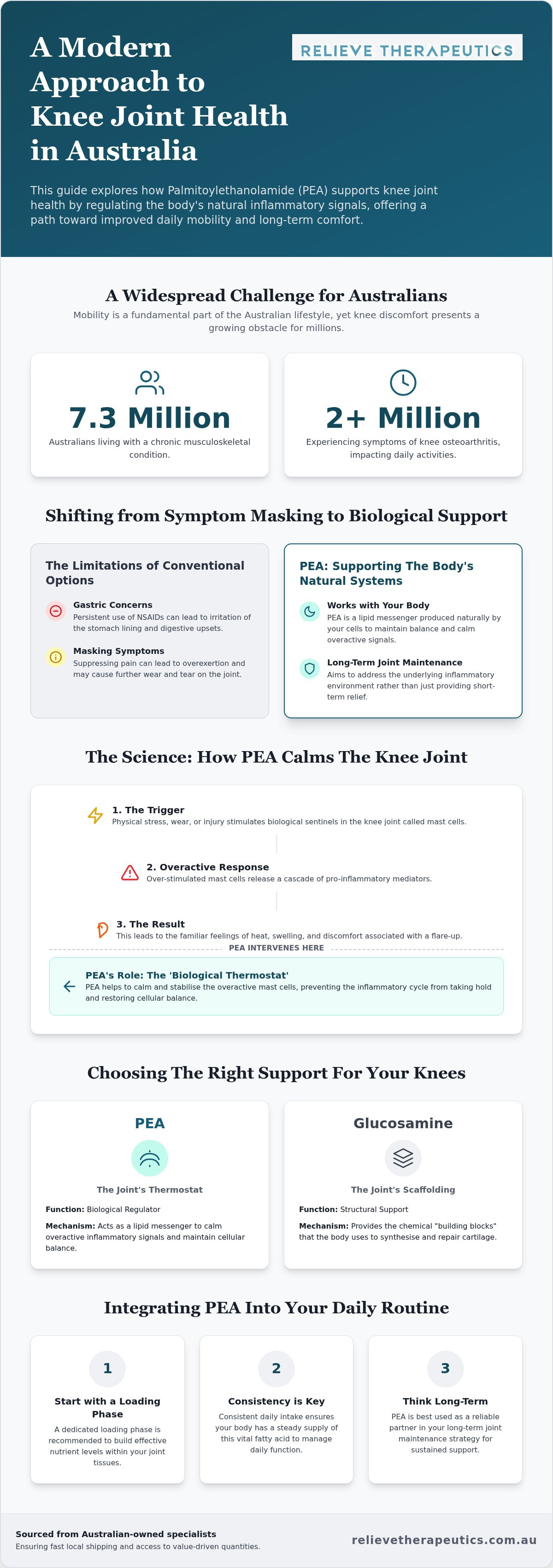
Australia’s lifestyle often centres on physical activity. Whether it’s a morning walk along the coast or a weekend spent gardening, mobility is a fundamental part of our daily identity. However, for a significant portion of the population, this mobility is increasingly compromised. Data from 2022 suggests that approximately 7.3 million Australians live with a chronic musculoskeletal condition. Among these, knee discomfort is a primary concern, with over 2 million people experiencing symptoms of knee osteoarthritis. This prevalence has led many to seek out PEA for knee pain Australia as they look for ways to maintain their quality of life without constant physical restriction.
The journey toward finding sustainable support often begins when the "quick fixes" lose their appeal. While immediate relief is necessary during acute flares, many individuals find that the standard approach to joint care feels incomplete. There is a growing desire for solutions that work in harmony with the body’s innate chemistry rather than simply overriding it. This shift reflects a broader movement toward evidence-based, natural alternatives that support long-term function and vitality.
The Limitations of Conventional Joint Care
For many Australians, the first line of defence against knee discomfort is the use of non-steroidal anti-inflammatory drugs (NSAIDs). While these are effective for short-term relief, they often present challenges when used as a long-term strategy. Persistent use can lead to significant gastric concerns, including irritation of the stomach lining and digestive upsets. This creates a difficult trade-off: managing knee pain at the expense of digestive health.
There is also the subtle risk of "masking" symptoms. When pain signals are completely suppressed by pharmaceuticals, it is easy to ignore the joint’s natural limits. This often leads to overexertion, which can inadvertently cause further wear and tear. A more balanced approach involves addressing the underlying inflammatory environment within the joint capsule. By supporting the body's own regulatory systems, it is possible to achieve comfort without the "heavy" pharmaceutical load that many people wish to avoid.
Introducing Palmitoylethanolamide (PEA) for Knee Health
To understand why this fatty acid is gaining traction, we must look at how the body manages its own repair processes. Palmitoylethanolamide (PEA) is a lipid messenger produced naturally within our cells. It acts as a biological "first responder," appearing in higher concentrations whenever the body detects physical stress, injury, or chronic discomfort. Its primary role is to maintain cellular balance and prevent inflammatory signals from becoming overactive.
In many cases of chronic knee discomfort, the body’s natural production of PEA is simply outpaced by the persistent demands of the joint environment. Supplementing with high-purity capsules allows you to replenish these levels, providing the "raw materials" your system needs to regulate its own signals. This is why PEA for knee pain Australia has become a focal point for those seeking a disciplined, evidence-based way to support joint health. Using a consistent daily supplement, such as a 180-capsule bottle for long-term maintenance, ensures that your body has a steady supply of this vital fatty acid to manage daily function with quiet, reliable confidence.
The Science of PEA: How It Supports Knee Joint Function
PEA is a lipid messenger that regulates inflammatory responses by calming overactive mast cells. Within the knee joint capsule, these mast cells act as biological sentinels. When they become over-stimulated due to wear or injury, they release a cascade of pro-inflammatory mediators that contribute to the heat, swelling, and redness we recognise as a flare-up. By choosing PEA for knee pain Australia, you're providing your body with a natural mechanism to stabilise these cells before the inflammatory cycle takes hold. Scientific reviews such as PEA in the Treatment of Pain highlight how this fatty acid helps maintain local tissue balance, preventing minor irritation from becoming a persistent problem.
This targeted action is why PEA for knee pain Australia has become a preferred option for those seeking biological support over chemical suppression. PEA also works closely with the endocannabinoid system (ECS). It acts as a supportive "entourage" molecule, meaning it doesn't bind directly to receptors but instead helps preserve levels of anandamide, one of the body's primary internal comfort molecules. Because PEA is bio-identical, it is chemically indistinguishable from what your own cells produce. This leads to a high safety profile, as the body recognises the supplement as a familiar nutrient rather than a foreign substance.
The ALIAmide Mechanism Explained
The primary way this molecule functions is through the Autacoid Local Inflammation Antagonism, or ALIA, effect. Think of this process as a biological volume dial for inflammation. When the knee joint is under stress, nerve signals can become over-excited, leading to heightened sensitivity and discomfort. The ALIA mechanism allows PEA to "dial down" the volume of these signals at the cellular source. Unlike systemic anti-inflammatories that circulate through the entire body, this approach is highly targeted to the specific tissues where cellular stress is occurring.
Absorption and Micronisation
Because PEA is a fatty acid, it is naturally lipophilic, which means it doesn't dissolve easily in water. This characteristic can make it difficult for the body to absorb effectively through the digestive tract. Particle size is the deciding factor in how well a supplement works. Choosing micronised PEA ensures that the lipid particles are small enough to pass through the digestive barrier with much higher efficiency. This improved bioavailability ensures that the active compound reaches your joint tissues where it can do its work. You can explore this further in our detailed guide on How Does PEA Work for Pain? The Science of Natural Relief in 2026. For those committed to a long-term wellness strategy, a high-purity 180-capsule supply provides the consistency needed to build and maintain these vital levels in your system.
PEA vs. Glucosamine: Choosing the Right Support for Your Knees
When Australians first experience persistent knee discomfort, glucosamine and chondroitin are often the first supplements they encounter. These compounds are frequently described as the "bricks and mortar" of joint care. They provide the structural building blocks necessary to maintain cartilage integrity and joint lubrication over time. However, many people find that while these structural supports are helpful, they don't always address the immediate discomfort or the heat associated with a flare-up. This is where PEA for knee pain Australia offers a distinct, complementary mechanism of action.
While glucosamine focuses on the physical architecture of the joint, PEA acts as a biological "thermostat." It doesn't build cartilage; instead, it regulates the inflammatory environment within the knee joint capsule. By calming the overactive signals that lead to swelling and sensitivity, PEA helps create a more stable environment where structural supplements can do their job more effectively. Using both together often forms a more comprehensive joint strategy than relying on either alone. This dual approach addresses both the physical wear and the biological response to that wear.
Cartilage Building vs. Inflammatory Control
The difference between structural building blocks and biological regulators is fundamental to long-term success. If you've been taking glucosamine for months without significant change, it's likely because the underlying inflammatory "fire" is still burning too hot. PEA is often the missing link for these individuals. It works by cooling this chronic low-grade inflammation, allowing the joint to settle and function with greater ease. Unlike structural repair, which can take several months to manifest as a physical change, regulatory signalling addresses the cellular environment more directly. This makes PEA for knee pain Australia a vital tool for those who want to support their mobility from multiple angles.
Safety Profiles and Gastric Tolerance
One of the most significant advantages of PEA is its exceptional safety profile and gastric tolerance. Many traditional joint supports, and certainly pharmaceutical anti-inflammatories, can be harsh on the digestive system. For Australians with sensitive stomachs or those concerned about long-term gastric health, PEA offers a reassuring alternative. Because it's a bio-identical fatty acid, it doesn't irritate the stomach lining or disrupt digestive function. To ensure you're getting the most out of your supplement, it's helpful to follow a structured approach. You can find detailed instructions in our guide on PEA Dosage for Pain: A Comprehensive Australian Guide to Optimal Intake. This methodical approach ensures you're supporting your knees with the precision they deserve without compromising your digestive comfort.
Practical Guidance: Integrating PEA into Your Daily Routine
Integrating PEA for knee pain Australia into your wellness routine is most effective when approached with a clear, disciplined strategy. Unlike rapid-acting pharmaceuticals that override your system, PEA works by gradually modulating cellular responses, which means the benefits are cumulative. Many individuals find success by starting with a "loading phase." This involves taking a consistent serving for the first few weeks to help build sufficient levels of the fatty acid within the joint tissues. Consistency is the most vital factor in this process. Because PEA acts as a biological messenger, it requires a steady daily presence to maintain its regulatory effect on the knee's inflammatory signals.
To maximise the efficacy of each capsule, consider the timing of your intake. Since PEA is a lipid, it is best absorbed when taken alongside a meal containing healthy fats, such as avocado, olive oil, or a handful of nuts. This simple adjustment can significantly improve bioavailability, ensuring the nutrient is effectively transported to where it's needed most. As you begin your journey, monitor your progress closely over a four to eight-week period. Look for subtle improvements in morning mobility, a reduction in stiffness after sitting, and a greater ease when navigating stairs.
Finding Your Optimal PEA Dosage
Clinical research typically suggests a dosage range between 600mg and 1200mg per day, often divided into two servings to maintain stable levels in the blood. It’s essential to manage your expectations through the "Three-Week Rule." While some notice changes sooner, most people require at least twenty-one days of consistent use before the regulatory effects become noticeable. For more specific guidance on timing and frequency, you may find our article on How to Take PEA for Nerve Pain: A Practical Australian Guide for 2026 helpful, as many of the same principles apply to joint support.
Lifestyle Synergy for Knee Health
PEA works best when supported by a lifestyle that encourages joint health. Gentle, low-impact movement is crucial for circulating synovial fluid within the knee. Activities such as hydrotherapy or daily walking help keep the joint lubricated without causing excessive stress. Proper hydration is also a key factor; water is essential for the health of the joint capsule and the surrounding connective tissues. While PEA is a gentle, natural option, always consult your GP or healthcare professional before starting a new supplement programme, especially if you are managing existing health conditions.
For those ready to commit to a long-term maintenance plan, our high-purity 180-capsule bottles provide the most convenient and cost-effective way to ensure your daily routine remains uninterrupted.
Choosing Quality: Sourcing PEA Capsules in Australia
When you decide to integrate PEA for knee pain Australia into your daily routine, the source of your supplement is as critical as the compound itself. Many international retailers offer products that vary significantly in purity, often containing unnecessary fillers or synthetic binders that can interfere with the biological activity of the lipid. Sourcing from a reputable, Australian-owned specialist ensures that you receive a product held to rigorous local standards. This local focus also eliminates the frustration of long international wait times, providing the consistent supply that is essential for maintaining optimal tissue levels.
Purity is the cornerstone of effective supplementation. A high-quality PEA capsule should be free from common allergens and harsh chemical additives, ensuring that your body receives only the active compound it needs to regulate inflammatory signals. By choosing a specialist provider, you're opting for a product that prioritises stability, safety, and long-term efficacy. This disciplined approach to sourcing allows you to manage your joint health with the quiet confidence that only professional-grade purity can provide.
The Relieve Therapeutics Range
Our range is designed to support users at every stage of their joint health journey. We provide three distinct quantity variations: 60, 120, and 180 capsules. While smaller quantities are often used to begin a loading phase, the 180-capsule bulk pack is the most logical choice for managing chronic knee discomfort over several months. It offers the best value for long-term maintenance and ensures your support journey is never interrupted by a depleted supply. For a deeper look at selecting the right volume for your needs, read our PEA 120 Capsules: The Strategic Buyer’s Guide to Sustained Natural Support.
Direct-to-Consumer Convenience
Relieve Therapeutics operates on a direct-to-consumer model to simplify your access to high-purity supplements. This approach removes the need for clinical appointments or practitioner-only restrictions, allowing you to take control of your own wellness path with ease. Our local Australian base ensures that your orders are processed efficiently and shipped quickly across all states. By maintaining a steady supply from a trusted specialist, you can focus on regaining your mobility and daily function without the stress of navigating complex pharmaceutical systems. We invite you to explore our range of PEA capsules today and take the first step toward a more comfortable, active lifestyle.
Regaining Confidence in Every Step
Choosing a sustainable path for joint health is a commitment to your future mobility. We've explored how Palmitoylethanolamide acts as a biological regulator, calming overactive inflammatory signals at the cellular level rather than simply masking discomfort. By prioritising high-purity supplements and maintaining a disciplined daily routine, you can support your body's innate ability to manage physical stress. This evidence-based approach to PEA for knee pain Australia represents a significant shift toward gentle, effective, and gastric-friendly care.
Relieve Therapeutics is an Australian-owned specialist focused on providing the high-purity dietary supplements you need for long-term vitality. Our range of 60, 120, and 180-count capsules is designed to ensure your support journey remains consistent, reliable, and uninterrupted. Order your PEA capsules from Relieve Therapeutics for fast Australian delivery and take a proactive step toward more comfortable daily movement. You don't have to let persistent stiffness define your day; with the right biological support, fluid and confident movement is well within your reach.
Frequently Asked Questions
How long does it take for PEA capsules to work for knee pain?
Most individuals notice a gradual improvement within four to eight weeks of consistent daily use. While some reports suggest subtle changes earlier, it takes time for this lipid messenger to build effective levels within your joint tissues. We recommend adhering to a disciplined loading phase for at least twenty-one days. This allows your body to accumulate enough PEA to start effectively modulating the inflammatory signals that cause discomfort during your daily activities.
Can I take PEA capsules alongside my current joint supplements like glucosamine?
Yes, PEA can be taken alongside traditional supplements such as glucosamine and chondroitin. These compounds work through different biological pathways to support your knees. While glucosamine provides the structural building blocks for cartilage maintenance, PEA acts as a regulator for the inflammatory environment within the joint. This combination offers a comprehensive approach to knee health, addressing both the physical structure and the cellular signals that contribute to stiffness.
Are there any side effects to taking PEA capsules daily for joint health?
PEA is generally very well tolerated because it is a bio-identical substance naturally produced by your own cells. Unlike many traditional options, it does not typically cause gastric irritation or digestive upset. This makes it a suitable long-term choice for Australians with sensitive stomachs. While side effects are rare, it is always professional practice to monitor your body's response and consult your healthcare provider if you have specific medical concerns or pre-existing conditions.
Is PEA a natural substance or a synthetic pharmaceutical drug?
PEA is a naturally occurring fatty acid amide found in your body and certain foods like egg yolks and soybeans. It is not a synthetic pharmaceutical drug. While the capsules provide a concentrated form to support joint health, the compound itself is recognised by your system as a familiar nutrient. This natural origin is a primary reason why many people choose PEA for knee pain Australia when seeking a gentle alternative to harsh chemicals.
Why is micronised PEA recommended over standard versions?
Micronisation is recommended because it significantly improves the bioavailability of the supplement. Because PEA is a lipid, standard large particles are difficult for the human digestive system to absorb efficiently. By reducing the particle size through micronisation, the compound can pass through the intestinal wall more effectively. This ensures that a higher concentration of the active ingredient reaches your knee joint tissues, providing more reliable support for your daily mobility and function.
Do I need a prescription from a doctor to buy PEA capsules in Australia?
No, you don't require a prescription to purchase PEA capsules in Australia. The Therapeutic Goods Administration (TGA) recognises PEA as an ingredient that can be used in listed medicines, making it available for over-the-counter purchase. This allows Australians to manage their own joint wellness journey without the need for clinical appointments. Relieve Therapeutics provides high-purity capsules directly to consumers, ensuring easy access to quality support with fast local shipping across the country.
Can PEA capsules help with morning knee stiffness?
Yes, PEA is specifically designed to support the regulation of inflammatory signals that contribute to morning stiffness. By calming overactive mast cells within the joint capsule, it helps reduce the biological resistance you feel when first waking up. Using PEA for knee pain Australia consistently can lead to a more fluid transition into your morning activities. This makes it easier to navigate stairs or begin your daily walk without the familiar sharp resistance in your joints.
How many PEA capsules should I take per day for optimal joint support?
Optimal support typically involves a daily intake of 600mg to 1200mg, which is often split into two separate servings. Taking one capsule in the morning and another in the evening helps maintain stable levels within your system throughout the day. For those managing long-term joint health, the 180-capsule bottle is the most practical choice. It ensures you have a consistent supply to complete the essential loading phase and maintain the cumulative benefits of the supplement.