

What if your body already possessed the biological "dimmer switch" needed to quiet the persistent throb of a post-surgical extraction or the rigid tension of a locked jaw? It's a common frustration for many Australians recovering from complex dental work; standard painkillers can often cause stomach irritation or feel insufficient against deep-seated nerve sensitivity. If you're exploring PEA for dental pain Australia, you're likely seeking a more refined, natural approach to managing orofacial discomfort that works in harmony with your internal chemistry.
This guide provides a clear, evidence-based look at how Palmitoylethanolamide (PEA) supports the body's response to inflammation in the gums, jaw, and facial nerves. We've designed this resource to help you understand the clinical mechanisms of this TGA-listed ingredient, the importance of high-bioavailability formulations, and how to integrate these supplements into a methodical recovery plan. By the end of this article, you'll have the confidence to navigate your options for long-term orofacial comfort with professional clarity and scientific rigour.
Key Takeaways
- Understand how Palmitoylethanolamide acts as a biological "dimmer switch" to calm overactive mast cells and hyper-sensitive nerves in the jaw.
- Discover why PEA for dental pain Australia is a gentle alternative for those who experience gastric sensitivity or stomach irritation from traditional chemist medications.
- Learn the "Dental Loading Phase" protocol to prepare your oral tissues for faster recovery before undergoing wisdom tooth or implant procedures.
- Recognise the importance of tissue saturation and why a consistent supply of 120 or 180 capsules is necessary for a complete orofacial healing cycle.
- Identify the quality advantages of sourcing TGA-listed Australian supplements to ensure high purity and reliable domestic delivery standards.
Understanding PEA for Dental and Orofacial Pain in Australia
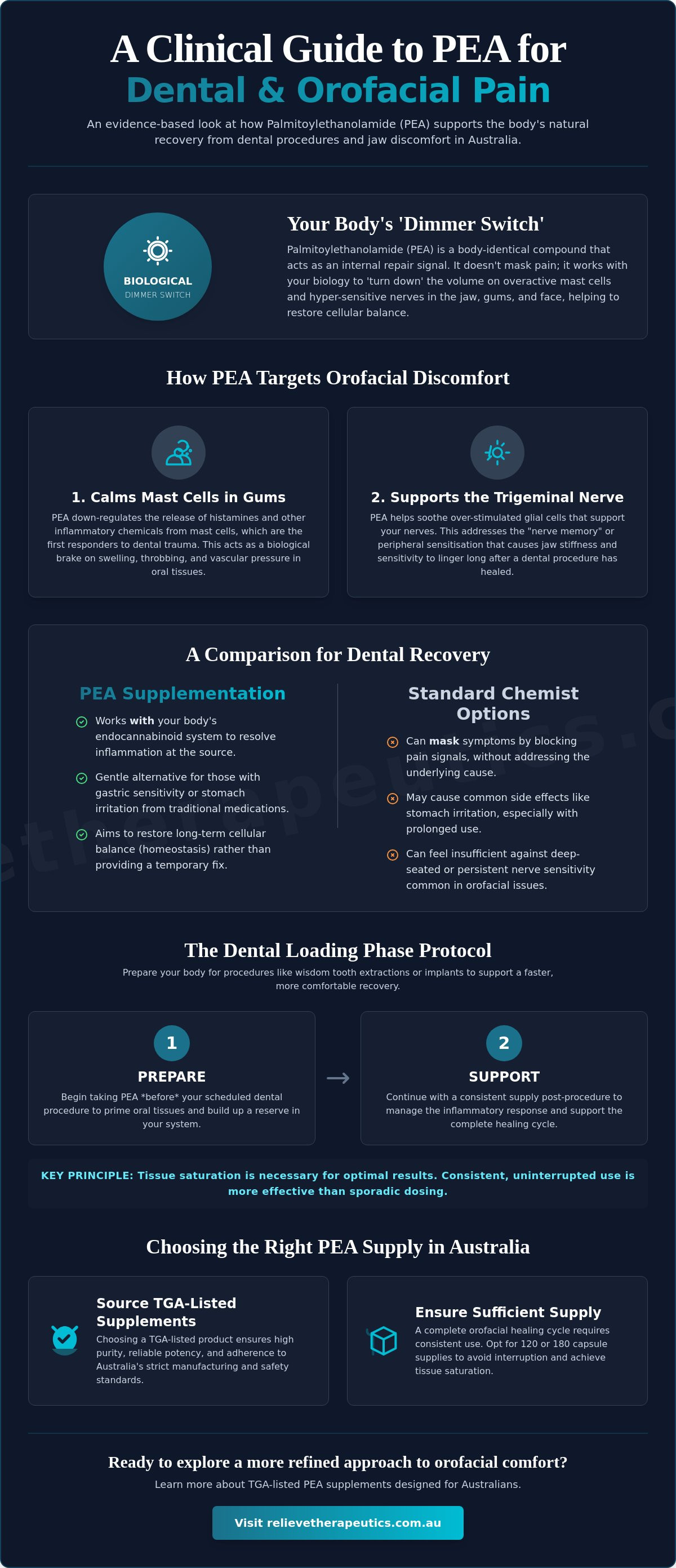
When your body encounters dental trauma, whether from a surgical extraction or chronic jaw tension, it responds by producing Palmitoylethanolamide (PEA). This lipid messenger acts as an internal repair signal. It's a body-identical compound designed to resolve inflammation at the source. For those exploring PEA for dental pain Australia, it's vital to recognise that this is a dietary supplement rather than a prescription medication. It's not an emergency fix for an acute toothache that requires a dentist's drill. Instead, it serves as a sophisticated tool for managing the underlying inflammatory fire that persists in the gums and jaw after the initial procedure is over.
The Australian healthcare landscape has seen a shift toward these natural adjuncts as patients seek ways to support their recovery without relying solely on traditional chemist medications. PEA doesn't mask symptoms. It works with your biology to dampen the hyper-active signals sent by stressed oral tissues. It's about restoring a sense of calm to the mouth and jaw area through scientific support rather than chemical suppression.
The Unique Nature of Orofacial Discomfort
Orofacial pain is notoriously difficult to manage because the mouth is one of the most nerve-dense regions of the human body. The trigeminal nerve serves as the primary highway for these signals, carrying sensations from your teeth, gums, and jaw directly to the brain. Unlike a bruised limb or a strained back muscle, oral inflammation often leads to peripheral sensitisation. This is a state where the nerves become so "wound up" that they continue to fire even after the physical injury has begun to heal. This explains why jaw stiffness and sensitivity can linger for weeks following a routine dental visit or a period of high stress.
PEA as a Natural Endocannabinoid Support
PEA is often described as an endocannabinoid-like molecule. While it's part of the same complex regulatory system that manages pain and mood, it does not have any psychoactive effects. It's entirely non-intoxicating. Because it's body-identical, your system recognises it immediately. This high level of biological compatibility allows PEA to assist in restoring homeostasis, the state of cellular balance, after the trauma of dental surgery. By supporting the endocannabinoid system, PEA helps the body "turn down" the volume of pain signals naturally. It provides a steady, disciplined approach to long-term comfort and recovery.
How PEA Targets Dental Inflammation and Nerve Sensitivity
PEA operates through a mechanism known as ALIA (Autacoid Local Inflammation Antagonism). This process is central to how the body regulates its internal defence systems. For those using PEA for dental pain Australia, this means the supplement targets the specific cells responsible for the throbbing sensation often felt after an invasive procedure. Research into PEA's anti-inflammatory and analgesic effects confirms its ability to calm overactive immune responses without the systemic burden often associated with standard chemist medications.
Beyond the immediate inflammatory response, PEA addresses the neurological component of orofacial discomfort. Glial cells, which surround and support your nerves, can become over-stimulated during dental trauma. When these cells remain in a pro-inflammatory state, they keep pain signals switched on long after the physical tissue has begun to heal. By interacting with the peroxisome proliferator-activated receptor alpha (PPAR-α), PEA signals the body to cease the production of pro-inflammatory cytokines within the periodontal environment. For a comprehensive exploration of these pathways, you can explore the full scientific breakdown of how does PEA work for pain.
Calming the Mast Cells in the Gums
Mast cells act as the first responders in your oral tissues. When bacteria or surgical tools disturb the gums, these cells release a flood of histamines and inflammatory chemicals. PEA down-regulates this release, effectively acting as a biological brake on the swelling process. When these cells are kept in a state of rest, the surrounding oral tissues experience less vascular pressure and a reduced concentration of pain-inducing chemicals.
Supporting the Trigeminal Nerve
Chronic jaw pain is frequently a result of nerve memory, where the trigeminal nerve stays hyper-sensitive even after recovery. PEA helps to stabilise these nerve pathways, preventing the cycle of peripheral sensitisation that leads to long-term stiffness. When considering PEA for dental pain Australia, it's helpful to view it as a steady support for nerve health rather than a temporary mask. If you are preparing for a major procedure, starting a high-purity supplement from Relieve Therapeutics can help prime your system for a smoother, more comfortable recovery.
PEA vs. Chemist Options: A Comparison for Dental Recovery
When Australians visit a local chemist for dental relief, they typically reach for Non-Steroidal Anti-Inflammatory Drugs (NSAIDs). While these medications provide rapid, acute relief by blocking specific enzymes, they often come with a trade-off in gastric and renal health. In contrast, PEA for dental pain Australia offers a systemic resolution. It doesn't merely mask the sensation of discomfort; it works to resolve the underlying inflammatory state. Unlike traditional painkillers, PEA is body-identical, meaning it lacks the harsh side effects often associated with long-term pharmaceutical use. Research into the clinical application of PEA for pain suggests it is a reliable, gut-friendly alternative for those who cannot tolerate standard analgesics.
One of the most significant advantages of Palmitoylethanolamide is its potential as an adjunct. It can be used alongside chemist medications to enhance the overall recovery experience. By supporting the body's natural endocannabinoid system, PEA may allow individuals to reduce their reliance on higher doses of traditional meds. This "sparing effect" is particularly valuable during the first 72 hours following a procedure when discomfort is at its peak. For a broader look at how natural compounds compare to pharmaceuticals, you can read our guide on non-opioid pain relief supplements.
The Problem with Long-Term NSAID Use in Dentistry
Traditional painkillers are effective for short-term crises, but extended use can lead to stomach irritation, "rebound" pain, and even kidney strain. Many Australians are now seeking cleaner, more sustainable alternatives for post-surgical care. PEA provides a non-addictive and non-drowsy solution that supports the body without the foggy "hangover" feeling often caused by stronger chemist options. It's a disciplined choice for those who value long-term wellness alongside immediate comfort.
Is PEA a Replacement for Dental Procedures?
It is crucial to understand that PEA is a support tool, not a cure for structural issues. It cannot treat a bacterial infection, resolve a deep cavity, or fix a cracked tooth. If you are experiencing an acute dental crisis, such as a fever or visible swelling, you must see an Australian-registered dentist immediately. PEA for dental pain Australia is best utilised for managing post-procedure inflammation, chronic jaw stiffness, and the lingering nerve sensitivity that often follows complex dental work.
Practical Guide: Using PEA for Dental Support and TMJ
Achieving optimal results with PEA for dental pain Australia requires a shift from the traditional "pill-on-demand" mindset to a more methodical, proactive strategy. Unlike fast-acting chemist medications that provide a temporary block, PEA relies on tissue saturation to exert its full effect. This means the compound must build up within your system to effectively down-regulate the mast cells and glial cells mentioned previously. For chronic jaw issues such as TMJ, most individuals observe the first meaningful shift in comfort within 2 to 4 weeks of consistent daily use. To understand the specific milligram protocols required for these outcomes, you can refer to our detailed PEA dosage for pain guide.
The Dental Recovery Protocol
For those preparing for invasive procedures like wisdom tooth removal or dental implants, we recommend a structured "Dental Loading Phase." This protocol ensures your oral tissues are primed for a smoother recovery before the first incision is made.
- Step 1: Begin a higher "loading" dose, typically 1200mg daily, at least 7 days before your scheduled dental procedure.
- Step 2: Maintain this elevated dose for 14 days post-procedure to support the resolution of acute swelling and nerve sensitivity.
- Step 3: Once the initial recovery phase concludes, gradually transition to a lower maintenance dose to manage any lingering stiffness.
Optimising Your Results
The efficiency of your recovery depends heavily on how well your body absorbs the supplement. Because PEA is a lipid (a fatty substance), taking your capsules with a meal containing healthy fats, such as avocado, eggs, or olive oil, is essential for maximum uptake. We also advise split dosing, taking one capsule in the morning and one at night, to maintain consistent cellular levels throughout a 24 hour cycle. This steady presence helps prevent the "pain peaks" that often occur when medication wears off. It is also vital to choose high quality PEA capsules that are free from unnecessary fillers or flow agents, as these can interfere with the purity of the compound. If you are ready to begin your recovery journey with a professional-grade supplement, you can buy PEA capsules from Relieve Therapeutics to ensure you are receiving a high-purity Australian product.
Choosing the Right PEA Supply in Australia
Selecting a high-purity source for PEA for dental pain Australia is a critical step in your recovery journey. While international marketplaces offer numerous options, local sourcing ensures that your supplements meet stringent Australian quality standards. Domestic supply also translates to faster shipping times, which is essential when you are timing your intake around a scheduled dental surgery or managing a flare-up of jaw tension. By choosing a reputable Australian provider, you avoid the risks of inconsistent manufacturing and ensure that the compound you ingest is bio-identical and effective.
Quality in the supplement industry is often defined by what is left out of the capsule. Many mass-market products contain flow agents, synthetic fillers, or common allergens that can interfere with the biological uptake of the active ingredient. For those seeking orofacial comfort, purity is paramount. A clean formulation allows the body to focus entirely on the ALIA mechanism and the modulation of glial cells, as discussed earlier in this guide. This methodical approach to quality ensures that your system receives the precise support required for long-term nerve and tissue resolution.
Starter vs. Bulk: 60, 120, or 180 Capsules?
Many retail brands offer very small pack sizes, sometimes as few as 21 or 42 capsules. These quantities are often insufficient for a proper dental loading and recovery phase, which typically spans several weeks. To truly support the body's endocannabinoid system, you need a consistent supply that allows for the tissue saturation mentioned in our practical guide. Consistency is the foundation of natural relief; gaps in your protocol can slow the progress of cellular homeostasis.
The PEA 60 capsules option serves as an excellent starting point for those wishing to test their personal response to the compound. However, for comprehensive post-surgical recovery or long-term TMJ support, the PEA 180 capsules supply is the most logical choice. Bulk buying aligns with the biological timeframe required for PEA to work. It ensures you have an uninterrupted supply during the critical healing window, providing better value and peace of mind.
The Relieve Therapeutics Promise
Relieve Therapeutics is deeply committed to providing pure Palmitoylethanolamide without the use of unnecessary additives. Our Australian-owned values are reflected in our transparent manufacturing and our focus on high-purity ingredients. We understand that recovering from dental trauma can be a physically and emotionally draining experience. Our simple online ordering system is designed to provide ease and reliability for those recovering at home. We act as a partner in your health journey, providing the evidence-based tools you need to manage PEA for dental pain Australia with confidence. By choosing a disciplined and science-backed supplement, you are taking a proactive step toward restoring your comfort and returning to a vibrant, pain-free Australian lifestyle.
Empowering Your Oral Recovery Journey
Managing orofacial discomfort requires a shift from temporary fixes to systemic resolution. By addressing the biological pathways of mast cells and the trigeminal nerve, you can support your body's innate healing process. Whether you're preparing for a complex extraction or seeking relief from persistent jaw tension, PEA for dental pain Australia represents a disciplined, science-backed approach to recovery. It's about restoring balance to your system without the burden of gastric irritation or the side effects often associated with traditional chemist medications.
Choosing a high-purity supplement is the final step in ensuring your system receives the exact support it needs. Our capsules contain pure PEA with no hidden fillers or additives, ensuring maximum biological compatibility. As a proudly Australian owned and operated business, we provide local shipping to support your recovery timeline. For those committed to a full saturation cycle, our 180-count value packs offer the sustained support required for long-term comfort.
Shop our range of Australian-tested PEA capsules to support your dental recovery today.
Your journey toward a more comfortable and vibrant lifestyle starts with professional-grade nutrition that respects your body's unique biology.
Frequently Asked Questions
Can PEA help with pain after a tooth extraction or dental implant?
Yes, PEA is highly effective for managing the inflammatory response following invasive procedures like extractions or implants. It works by "down-regulating" the mast cells in your gums, which reduces the throbbing sensation often felt during the first week of healing. While it isn't an immediate anaesthetic, its systemic action helps resolve the inflammatory fire in the jaw area, making it a valuable tool for a smoother long-term recovery.
How long do I need to take PEA before I see results for jaw pain?
Most individuals observe meaningful results for jaw stiffness and chronic discomfort within 2 to 4 weeks of consistent use. This timeframe allows the compound to reach necessary saturation levels within your tissues. For those using PEA for dental pain Australia, starting a loading dose before a scheduled procedure can help prime the system. This proactive approach ensures the biological "dimmer switch" is active when you need it most.
Is PEA safe to take alongside antibiotics prescribed by my dentist?
PEA is considered safe to take alongside antibiotics and other standard dental prescriptions. Because it's a body-identical lipid messenger, it doesn't typically interfere with the chemical pathways of antimicrobial medications. It acts as a supportive adjunct, focusing on inflammation while the antibiotics address the infection. However, we always recommend informing your Australian-registered dentist about any supplements you're taking to ensure coordinated care.
Can PEA replace Ibuprofen for dental swelling?
PEA acts as a biological alternative rather than a direct, high-speed replacement for Ibuprofen during an acute crisis. While NSAIDs provide rapid relief by blocking enzymes, they can cause stomach irritation; PEA offers a gentler, systemic resolution without gastric side effects. Many patients use PEA as an adjunct to reduce their reliance on higher doses of chemist meds, supporting a cleaner recovery process for the gums and jaw.
What is the best dosage of PEA for chronic TMJ issues?
For chronic TMJ issues, a daily intake of 600mg to 1200mg is often recommended to maintain cellular balance. We suggest split dosing, taking one capsule in the morning and one at night, to ensure consistent levels within your system. Taking your supplement with a meal containing healthy fats will further optimise absorption. This disciplined protocol helps stabilise the trigeminal nerve and reduces the frequency of jaw-locking episodes.
Are there any side effects when using PEA for oral inflammation?
PEA is remarkably well-tolerated with a very low risk of side effects. As a naturally occurring fatty acid amide already produced by your body, it lacks the renal and gastric toxicity associated with traditional painkillers. It's non-drowsy, non-addictive, and doesn't cause the "rebound" pain sometimes seen with over-use of chemist medications. This makes it an ideal choice for Australians seeking a safe, long-term solution for oral inflammation.
Why haven’t I heard about PEA from my local chemist for dental pain?
While PEA is gaining recognition, it's often categorised as a specialist supplement rather than a front-counter chemist staple. Many practitioners in the Australian healthcare landscape are only now beginning to integrate endocannabinoid support into standard dental recovery plans. Because it requires a saturation period rather than providing an instant fix, it is more commonly recommended by specialists focused on chronic pain management and natural orofacial comfort.
Do I need a prescription to buy PEA capsules in Australia?
No, you don't require a prescription to purchase PEA capsules in Australia. It's regulated by the Therapeutic Goods Administration (TGA) as a listed medicine, making it available over-the-counter and through specialised online retailers. This accessibility allows you to secure high-purity PEA for dental pain Australia without a prior appointment. Choosing a TGA-listed product ensures the supplement has been pre-assessed for quality and safety standards within the domestic market.