

With 3.6 million Australians currently living with chronic pain, the search for relief that doesn't involve a heavy fog of side effects has never been more urgent. If you've been searching for a natural path to manage persistent "electric shock" sensations or nerve discomfort, you've likely come across the PEA endocannabinoid supplement. This fatty acid amide is naturally produced by your body to regulate inflammation, offering a sophisticated alternative for those who feel let down by chemist-bought options that often fail to address the root of the problem.
It's frustrating to feel like your body's alarm system is stuck on high alert, especially when the legal status of alternatives like CBD remains complex and restrictive in Australia. You deserve a solution that's evidence-based, accessible, and entirely legal. This guide explains how Palmitoylethanolamide (PEA) works in harmony with your endocannabinoid system to dampen overactive pain signals and support your nervous system's health. We will explore the science behind its efficacy, clarify the legal distinctions for Australian users, and explain why choosing an ultra-micronised source is the key to restoring your daily mobility and comfort.
Key Takeaways
- Understand how Palmitoylethanolamide (PEA) acts as a bio-identical signalling molecule that your own cells produce to manage cellular injury and stress.
- Discover the biological "master switch" that allows a PEA endocannabinoid supplement to calm overactive nerves and dampen the inflammatory response.
- Learn why PEA is a legal, non-prescription alternative in Australia that provides targeted support without the regulatory hurdles or psychoactive risks associated with CBD.
- Identify how this natural approach specifically addresses the "wind-up" pain associated with persistent conditions like sciatica, carpal tunnel, and diabetic neuropathy.
- Find out why sourcing from an Australian specialist ensures you receive ultra-micronised formulations designed for superior absorption and reliable results.
What is a PEA Endocannabinoid Supplement?
To understand what a PEA endocannabinoid supplement actually is, we first need to look at how our bodies handle internal stress. Palmitoylethanolamide (PEA) is a bio-identical fatty acid amide. This means it's a lipid molecule that your cells produce naturally in response to tissue injury or inflammation. It functions as a sophisticated signalling molecule; its primary job is to tell your body to settle down and begin the repair process. While you can find trace amounts of this compound in everyday foods, these dietary sources rarely provide the concentrations needed to manage persistent nerve discomfort. Common food sources include:
- Egg yolks
- Peanuts
- Soybeans
- Alfalfa
Supplementation bridges this gap. It provides a concentrated dose that mirrors your body's own natural defence mechanisms without the need for a prescription. Because it's a substance your body already knows how to process, it avoids the harsh side effects often associated with synthetic painkillers. It's a clean, targeted approach to wellness.
The Biological Role of PEA in the Human Body
Your body is remarkably efficient at self-regulation. When you experience a physical setback, your cells produce PEA on-demand to protect the affected area. However, chronic pain creates a difficult cycle. In states of long-term discomfort, your natural PEA levels can become depleted. Your body simply cannot keep up with the constant demand for this protective molecule. Using a PEA endocannabinoid supplement is a restorative act. You are providing the raw materials your system needs to replenish its own internal reservoir and restore balance.
Why "Endocannabinoid-Like" Matters for Pain Management
You may have heard PEA described as an endocannabinoid-like substance. This classification is vital because it explains how the compound interacts with the Endocannabinoid System (ECS), which acts as the body’s master regulator for pain and mood. Unlike CBD or THC, PEA does not bind directly to the cannabinoid receptors that produce a "high". It is entirely non-psychoactive. Instead, it works alongside the ECS to enhance its efficiency and protect your nerves. Because the body already recognises and organises this molecule, it maintains an exceptional safety profile. It offers the benefits of cannabinoid support without the legal hurdles or cognitive side effects often associated with other alternatives.
How PEA Works: The Science of "Turning Off" Overactive Nerves
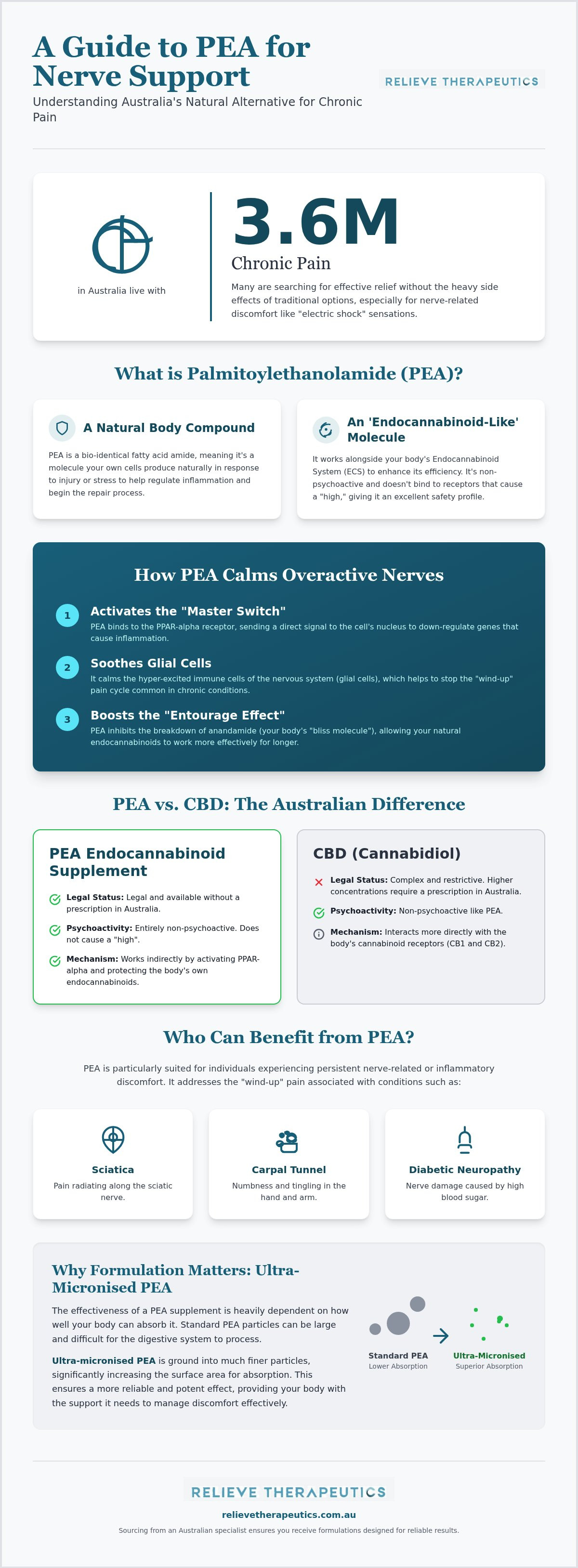
The efficacy of a PEA endocannabinoid supplement lies in its ability to speak the body's internal language. At the heart of this process is the PPAR-alpha receptor. Scientists often refer to this as the "master switch" for inflammation. When PEA binds to this nuclear receptor, it sends a direct signal to the cell's nucleus to down-regulate the expression of pro-inflammatory genes. It's a biological "stop" command that addresses the fire of inflammation at its genetic source rather than just masking the smoke.
This mechanism is particularly vital for calming "Glial cells," the immune cells of the central nervous system. In a healthy state, these cells protect and support our neurons. However, during chronic pain, they can become hyper-excited, leading to a phenomenon known as "wind-up" pain. This creates a cycle where the nerves stay in a state of high alert, even after the original injury has healed. PEA intervenes by soothing these overactive cells, helping to reset the threshold for pain signals. Nobel laureate Rita Levi-Montalcini discovered this process, defining it as the ALIA mechanism (Autacoid Local Inflammation Antagonism), which describes how PEA acts as a local regulator to prevent mast cells and microglia from causing runaway tissue damage.
PEA also facilitates what researchers call the "Entourage Effect." While it doesn't bind directly to the receptors that produce a psychoactive effect, it inhibits the breakdown of anandamide, your body's own "bliss molecule." By slowing this breakdown, PEA allows your natural endocannabinoids to circulate longer and work more effectively. This synergistic relationship enhances your body's inherent ability to manage discomfort and maintain emotional balance.
Calming the "Storm" of Neuroinflammation
There's a significant difference between the acute pain of a stubbed toe and the persistent "storm" of neuroinflammation. Acute pain is a necessary alarm, but neuroinflammation is like an alarm that's stuck in the "on" position. PEA works by reducing the release of pro-inflammatory cytokines that keep this alarm ringing. Think of it as a volume knob on a loud stereo; a PEA endocannabinoid supplement doesn't just cut the power, it gradually turns the volume down until the signals are manageable again. Peer-reviewed research has already documented anti-inflammatory, analgesic... and neuroprotective effects that support this restorative process.
The Importance of Micronisation for Absorption
The primary challenge with standard PEA is its physical structure. In its raw state, the particles are large and difficult for the human gut to absorb, leading to poor bioavailability. This is why "micronised" and "ultra-micronised" versions are considered the gold standard. By reducing the particle size to just a few micrometres, the surface area increases significantly, allowing for much more efficient uptake into the bloodstream. If you're curious about the finer technical details, you can read more about how does PEA work for pain on our dedicated science page. To ensure you're getting a formulation designed for maximum absorption, consider the specialist range at Relieve Therapeutics.
PEA vs CBD: Navigating Natural Support in Australia
Choosing between natural supports can be overwhelming, especially when the landscape of Australian regulations is constantly shifting. While CBD often dominates the conversation around the endocannabinoid system, its legal status in Australia remains a significant hurdle for many. A PEA endocannabinoid supplement offers a distinct advantage; it provides a streamlined, legal, and accessible pathway to relief without the need for a doctor's visit or a complex prescription process. Recent meta-analyses involving thousands of participants have confirmed PEA's efficacy in the treatment of chronic pain, positioning it as a scientifically robust alternative for those who find CBD inaccessible or unsuitable.
Cost is another primary factor that sets these two options apart. Prescription-grade CBD oils can be prohibitively expensive, often requiring significant ongoing financial commitments. High-quality PEA is far more cost-effective for long-term management, allowing you to maintain a consistent routine without financial strain. For those in industries with strict workplace safety standards, PEA is often the preferred choice. It contains zero THC and carries no risk of appearing on a roadside or workplace drug test. This provides peace of mind for professionals who require reliable support without compromising their employment or legal standing.
PEA also demonstrates exceptional versatility. It can often be used alongside other therapies to enhance overall results. Because it works through different biological pathways than traditional anti-inflammatories, it can provide a multi-layered approach to wellness. This makes it a valuable addition to a comprehensive health strategy, particularly for those managing complex, multi-factorial discomfort.
Is PEA a Legal Alternative to CBD in Australia?
Australians often find themselves caught in a regulatory grey area when seeking CBD. While low-dose CBD was down-scheduled, the reality in 2026 is that TGA-approved products remain scarce on pharmacy shelves. PEA is different. It is widely accessible as a high-quality dietary supplement. This "clean" profile is why many prefer it; it doesn't carry the social or legal stigma sometimes attached to cannabis-derived products. To ensure you're getting the right formulation, consult a high quality PEA capsules provider who specialises in the Australian market.
Side Effects and Safety Profile
Safety is a cornerstone of any long-term health strategy. PEA is remarkably well-tolerated and has been studied in thousands of patients with excellent results. It doesn't cause the "heaviness" or cognitive lethargy often linked to traditional painkillers. Because it's a molecule your body already produces, significant drug interactions are rare. It fits seamlessly into most wellness routines, working quietly to support your nervous system's resilience without the brain fog that can disrupt your daily life.
Targeted Benefits: Who Should Take a PEA Supplement?
With 3.6 million Australians currently living with chronic pain, identifying a specific, targeted solution is essential for long-term management. A PEA endocannabinoid supplement is most effective for those dealing with neuropathic or inflammatory conditions that haven't responded well to standard chemist-bought options. This includes individuals managing the daily constraints of carpal tunnel syndrome, diabetic neuropathy, or persistent lower back pain. While traditional anti-inflammatories often target the symptom, PEA works to support the body's underlying regulatory systems. It's particularly useful for "referred" nerve pain, where the source of the discomfort is distant from where the sensation is actually felt.
This natural fatty acid also shows significant promise for those suffering from osteoarthritis and joint stiffness. By modulating the inflammatory environment within the joint capsule, it helps to restore a degree of comfort and mobility that often feels lost. We're also seeing an increase in Australians using PEA for pelvic discomfort and endometriosis support. Because it's non-hormonal and works with your existing biological pathways, it provides a gentle yet effective way to manage complex inflammatory cycles within the pelvic region.
Support for Sciatica and Nerve Health
Sciatica can be an incredibly isolating experience, often characterised by a sharp, burning sensation that radiates down the leg. PEA specifically targets the fatty sheath surrounding the sciatic nerve, helping to reduce the inflammatory "fire" that causes these intense signals. It's important to have realistic expectations regarding the timeline; while some notice a difference quickly, most users find that it takes 2 to 4 weeks of consistent intake to see significant changes. For a deeper look at managing this specific condition, you can explore our palmitoylethanolamide sciatica guide.
Managing Fibromyalgia and Widespread Discomfort
Fibromyalgia is often linked to "central sensitisation," a state where the nervous system remains in a persistent high-alert mode. A PEA endocannabinoid supplement helps to modulate this hyper-sensitivity, effectively turning down the "gain" on pain signals across the entire body. Many users also report a welcome reduction in the fatigue that so often accompanies chronic discomfort. To ensure you're getting the most out of your routine, we recommend keeping a daily diary and following a structured PEA dosage for pain programme to track your progress over several months.
If you're ready to start your journey toward more comfortable daily movement, you can view our range of ultra-micronised PEA capsules to find the right pack size for your needs.
Choosing Your PEA Supplement: Why Relieve Therapeutics?
Selecting a PEA endocannabinoid supplement is a decision that impacts your long-term comfort and daily function. When you're managing persistent discomfort, you need more than just a product on a shelf; you need a reliable partner in your health journey. Relieve Therapeutics is an Australian-owned and operated specialist. Unlike generalist health stores that carry thousands of unrelated lines, we focus almost exclusively on high-quality Palmitoylethanolamide. This disciplined approach ensures that our stock is always fresh, our knowledge is current, and our manufacturing standards remain exceptionally high. We don't just "carry" PEA. We specialise in it.
Consistency is the foundation of any successful natural support routine. For those managing chronic conditions, gaps in supplementation can lead to a resurgence of overactive pain signals. We offer a range of sizes to ensure you always have the support you need without unnecessary stress. Our commitment to purity means every capsule contains ultra-micronised PEA, designed for the specific absorption needs of the human body. By removing the "middleman" markups often found in clinical settings, we provide direct-to-consumer pricing that makes long-term management sustainable for every Australian.
Find Your Perfect Fit: 60, 120, or 180 Capsules?
Every individual’s path to relief is unique. If you're new to the concept of supporting your endocannabinoid system, we recommend the PEA 60 capsules pack. This serves as an ideal 30-day trial, allowing you to observe how your body responds to the initial loading phase. For those who have already experienced the benefits and are moving into a sustained maintenance routine, the PEA 120 capsules offer a balanced, strategic choice. If you're committed to long-term chronic management, our 180-capsule bulk pack provides the best overall value and ensures you maintain total consistency in your daily routine.
The Relieve Therapeutics Difference
We understand that when you're in discomfort, waiting weeks for international shipping is not an option. Because we're based locally, we provide fast Australian shipping that bypasses the delays and uncertainties of international customs. Our customer support team is empathetic and knowledgeable; we understand the Australian chronic pain journey because we speak your language. We prioritise transparency, reliability, and specialist care in every interaction. This local focus allows us to maintain a steady, hopeful presence for our customers, providing a reliable source for a PEA endocannabinoid supplement that you can trust for the long term.
Restore Your Body's Natural Balance
We've explored how Palmitoylethanolamide works as a bio-identical signalling molecule to dampen inflammation and soothe a hyper-sensitive nervous system. By supporting the body's internal regulatory pathways without the side effects of traditional medication or the legal complexities of CBD, it offers a sustainable path to improved mobility. Choosing a high-quality PEA endocannabinoid supplement is a strategic step toward managing persistent nerve discomfort and reclaiming your daily vitality. It's about moving from a state of constant "wind-up" pain to a life focused on restoration and comfort.
As a specialist Australian retailer, Relieve Therapeutics provides a focused range of high-purity capsules designed for maximum absorption. Whether you're starting a trial or maintaining long-term wellness, our 60, 120, and 180-count bottles ensure you have the support you need with no prescription required. You can order your Australian-made PEA capsules today from Relieve Therapeutics to begin your journey toward restoration. You don't have to navigate chronic discomfort alone; a natural, science-backed solution is within reach and ready to support your body's innate ability to heal.
Frequently Asked Questions
Is PEA the same as CBD or hemp oil?
No, PEA is a bio-identical fatty acid amide naturally produced by your own cells, whereas CBD is a cannabinoid derived from the cannabis plant. While both interact with the endocannabinoid system, they have different chemical structures and regulatory pathways. PEA is entirely non-psychoactive, contains zero THC, and is widely available as a non-prescription supplement in Australia. It offers a clean, legal alternative for those who want to avoid the complexities of medicinal cannabis.
How long does it take for a PEA endocannabinoid supplement to start working?
Most individuals experience noticeable changes within 2 to 4 weeks of consistent daily use. Because a PEA endocannabinoid supplement works by gradually modulating the inflammatory response and replenishing cellular levels, it requires a cumulative effect to be effective. It is not an "instant fix" like some acute painkillers; instead, it provides a long-term strategy for restoring nervous system balance and dampening persistent, overactive pain signals.
Can I take PEA capsules alongside my prescription nerve pain medication?
Yes, PEA is generally considered safe to use alongside prescription nerve medications as it has no documented drug-drug interactions. Because it is a molecule your body already recognises and produces, it is exceptionally well-tolerated by the human system. However, we always recommend consulting with your healthcare professional before starting any new routine. This ensures that your supplementation plan is perfectly aligned with your specific clinical management and overall health goals.
Does PEA have any side effects like drowsiness or upset stomach?
PEA is remarkably well-tolerated and lacks the common side effects associated with traditional painkillers, such as drowsiness, lethargy, or gastrointestinal distress. Clinical studies involving thousands of participants have reported a safety profile comparable to a placebo. It does not cause the "brain fog" or heaviness that many Australians find frustrating with chemist-bought options. This makes it an ideal choice for those who need to remain alert and active throughout the day.
Why is micronised PEA considered better than standard PEA powder?
Micronisation is essential because standard PEA has large particles that the human gut finds difficult to absorb. By reducing the particle size through specialised micronisation or ultra-micronisation, the surface area increases significantly. This process ensures much higher bioavailability, meaning more of the active compound reaches your bloodstream and target tissues. Without this processing, much of the supplement would simply pass through your system unutilised, leading to poor results and wasted effort.
Is a prescription required to buy PEA supplements in Australia?
No, a doctor's prescription is not required to purchase high-quality PEA supplements in Australia. While therapeutic-grade compounded versions may require a script, supplement-grade PEA is available over-the-counter or online as a listed medicine. This accessibility makes it a convenient option for Australians who want to manage chronic discomfort naturally. It bypasses the regulatory hurdles and high costs often associated with other endocannabinoid-related therapies currently available on the Australian market.
What is the recommended daily dosage for chronic nerve support?
The standard recommended dosage for most adults is 600mg to 1200mg per day, typically split into two doses. Taking one 300mg capsule twice daily is a common starting point for many users. We suggest maintaining this consistent routine for at least 30 days to allow the PEA endocannabinoid supplement to reach therapeutic levels within your cells. This gradual approach allows your body to replenish its natural stores and provide sustained, long-term support.
Can PEA help with inflammation from sports injuries or just chronic conditions?
PEA is effective for both acute sports injuries and persistent chronic conditions. While it is widely known for its role in chronic nerve support, its ability to down-regulate pro-inflammatory cytokines makes it valuable for recovering from muscle strains or joint sprains. It supports the body's natural "on-demand" repair process, helping to resolve the initial inflammatory "storm" and preventing it from developing into a long-term issue. It is a versatile tool for any recovery kit.