

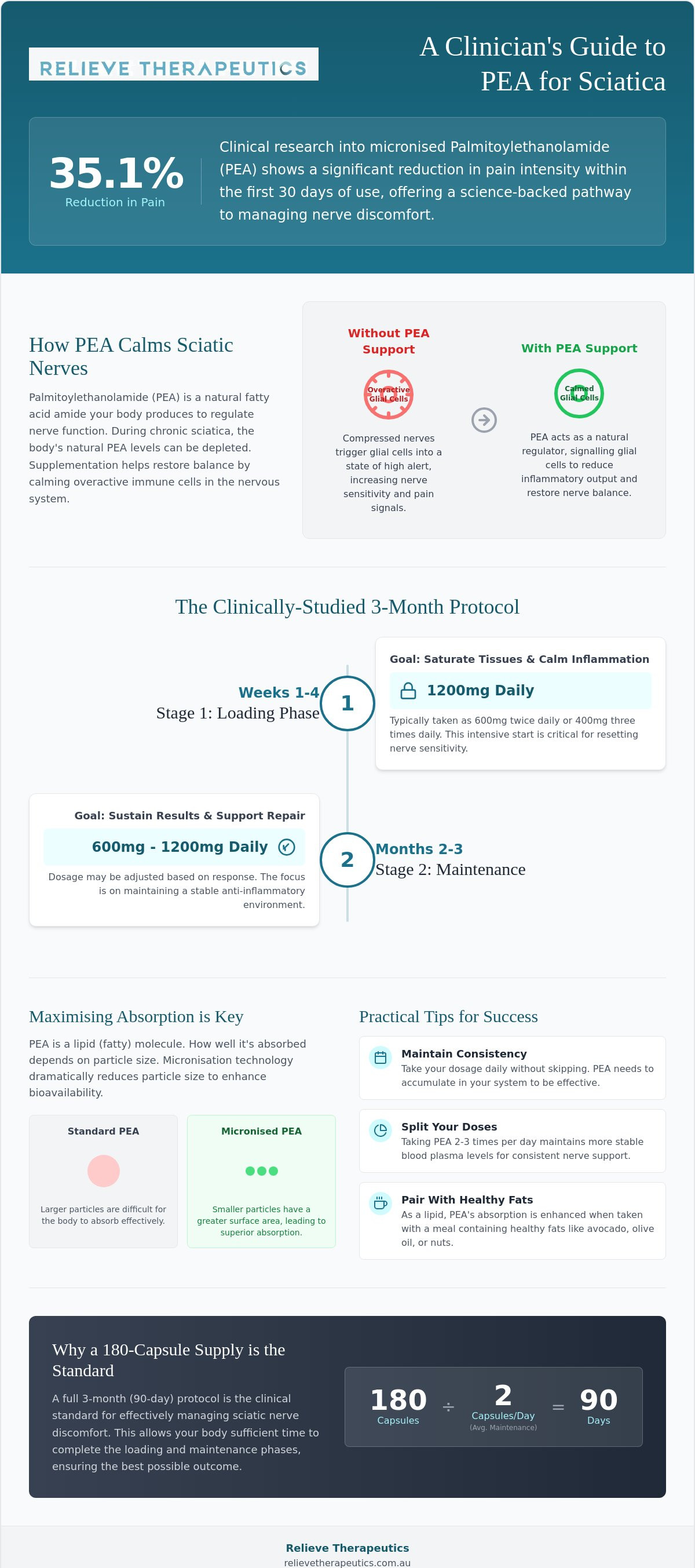
Did you know that clinical research into micronised palmitoylethanolamide has shown a 35.1% reduction in pain intensity within just the first thirty days of use? If you're living with the sharp, shooting sensations of sciatica, you understand how easily nerve discomfort can disrupt your sleep and limit your daily mobility. It's exhausting to wait for a recovery that feels like it may never arrive. Finding the optimal PEA dosage for sciatica is often the vital first step in a natural management plan designed to calm overactive nerve signals and support your body's restorative processes.
We recognise the physical and emotional toll that chronic nerve sensitivity takes on your wellbeing. This guide provides the precise, science-backed protocols used in clinical trials to help you manage discomfort with confidence and clarity. You'll discover the specific daily intake levels used in successful studies, the importance of the initial loading phase, and how to follow TGA guidelines to ensure your supplement routine is both safe and effective for your personal health journey.
Key Takeaways
- Learn how palmitoylethanolamide acts as a natural regulator to calm overactive glial cells and support long-term sciatic nerve health.
- Discover why a 1200mg PEA dosage for sciatica is the clinical standard for establishing the steady blood plasma levels needed for restoration.
- Understand the vital role of micronisation in ensuring your body can effectively absorb and utilise these lipid-based molecules.
- Master the practical timing of your routine by pairing capsules with healthy fats to significantly enhance nutrient uptake.
- Identify why a 180-capsule supply is the most logical choice for completing a full three-month loading and maintenance protocol.
What is Palmitoylethanolamide (PEA) and How Does it Support Sciatica?
Palmitoylethanolamide (PEA) is a fatty acid amide produced naturally within our bodies to regulate inflammation and provide neuroprotection. It exists as a biological repair molecule that responds to cellular stress and tissue damage. Unlike synthetic compounds that are foreign to our systems, PEA is a "nutraceutical." This term describes a substance that bridges the gap between daily nutrition and pharmaceutical support, offering a concentrated way to bolster the body's innate healing pathways. When considering a PEA dosage for sciatica, it's helpful to view it as a way to replenish a natural resource that has been exhausted by chronic irritation.
The mechanism of action for PEA is distinct from traditional pain relief. Most over-the-counter medications work by blocking specific enzymes or numbing the transmission of pain signals to the brain. While this can offer a temporary reprieve, it doesn't address the underlying inflammatory environment of the sciatic nerve. You can explore the details of how does PEA work for pain to understand how it targets the root of the discomfort. It focuses on restoring balance to the nervous system rather than simply muting the symptoms.
The Role of Glial Cells in Nerve Compression
Glial cells are the primary immune defenders of your nervous system. In a healthy state, they maintain the environment around your nerves, ensuring everything functions smoothly. However, when the sciatic nerve is compressed, these cells are "tripped" into a state of chronic alarm. They begin to overproduce inflammatory markers, which increases nerve sensitivity and leads to that familiar sharp, shooting pain. PEA acts as a biological "volume knob" for these cells. It signals them to reduce their inflammatory output, effectively calming the "alarm" and allowing the nerve to begin its recovery process.
Why Natural PEA Levels May Be Insufficient
Your body is designed to produce its own PEA, but chronic sciatica creates a state of high demand that the body often cannot meet. Persistent nerve irritation can deplete your natural reserves, leaving the nervous system vulnerable and the glial cells in a permanent state of overactivity. This is where the concept of "supplementing the gap" becomes vital. By following a structured PEA dosage for sciatica, you provide your body with the extra resources it needs to restore nerve homeostasis. Consistent palmitoylethanolamide sciatica support helps ensure your system remains resilient against the physical toll of long-term discomfort.
The Optimal PEA Dosage for Sciatica: A 3-Stage Protocol
Achieving results with palmitoylethanolamide requires more than just a random daily intake. It demands a structured approach that mirrors how the body utilises lipids for nerve repair. The standard PEA dosage for sciatica established in clinical research is 1200mg per day. This amount is typically split into smaller doses throughout the day to ensure steady blood plasma levels and consistent receptor activation. In an Australian context, this often translates to taking 400mg three times daily or 600mg twice daily. Consistency is the most critical factor here; your PEA dosage for pain must be maintained daily to allow the compound to accumulate effectively in the affected nerve tissues.
Stage 1: The Loading Phase (Weeks 1–4)
The primary goal during the first month is to saturate the tissues and "calm" the initial inflammatory fire surrounding the sciatic nerve. For many, this involves a higher daily intake of 1200mg to 1800mg, though you should always consult a healthcare professional before reaching the upper end of that range. This intensive phase is critical for "resetting" nerve sensitivity and dampening the chronic alarm state of the glial cells. A clinical review of PEA for nerve compression suggests that this saturation period is where the most significant initial shifts in comfort and mobility occur for patients with lumbar radiculopathy.
Stage 2: The Maintenance Phase (Months 2–3)
Once you've completed the initial month, the focus shifts to sustaining the anti-inflammatory environment while the nerve continues its slow healing process. During this stage, the recommended PEA dosage for sciatica typically settles between 800mg and 1200mg daily. You'll know it's time to transition to this phase when the sharp, "electric" sensations begin to soften into a more manageable, duller background presence. This phase ensures that the progress made during the loading period isn't lost as your body works toward long-term restoration. If you're planning for this three-month journey, ordering a larger supply can help maintain the necessary consistency without interruption.
Stage 3: Long-term Support
For individuals prone to recurrent sciatica flares or those with chronic nerve sensitivity, a baseline support dose of 400mg to 800mg daily may be beneficial. Australian clinical observations and international research involving approximately 6,000 patients indicate that PEA has a high safety profile for long-term use. There are no significant drug interactions or major side effects reported, making it a reliable partner for those managing chronic conditions. This stage isn't about high-intensity intervention but rather about maintaining nerve resilience and preventing the glial cells from returning to a hyper-reactive state. It provides a natural safety net for your daily mobility and comfort.
Bioavailability and Micronisation: Getting PEA to the Nerve
Standard PEA molecules are naturally large and lipid-soluble. This physical structure creates a "particle problem" where the digestive system struggles to break them down and absorb them into the bloodstream effectively. If you're following a specific PEA dosage for sciatica but the particles are too large, a significant portion of the supplement may simply pass through your system. This lack of absorption means the compound never reaches the irritated nerve tissue where it is needed most. To overcome this, the industry developed "Micronisation" and "Ultra-Micronisation" as the gold standards for nutrient delivery. These processes involve milling the PEA into incredibly fine particles, ensuring that the active compound can be dissolved and transported to the site of nerve compression more reliably.
Why Particle Size Matters for Sciatica
When the sciatic nerve is compressed by a disc or muscle, the local blood flow to that area is often restricted. This makes it even harder for nutrients and repair molecules to reach the site of the problem. Ultra-micronised PEA ensures a maximum "biological punch" because these tiny particles can navigate the body's transport systems more efficiently, even in areas with limited circulation. In contrast, cheap, non-micronised fillers often found in low-grade supplements fail to provide this targeted support. By reducing the particle size to a few micrometres, the supplement achieves a level of tissue penetration that standard powders simply cannot match.
Identifying Quality in the Australian Market
For Australians seeking effective relief, scrutinising the supplement label is essential. You should look for specific mentions of purity and micronisation status to ensure you're getting a product that actually works. Pure PEA is typically preferred over complex blends because it allows for a precise PEA dosage for sciatica without the interference of unnecessary additives or fillers that might hinder absorption. Ultra-micronised PEA represents the pinnacle of bioavailability, featuring particle sizes so refined that they bypass traditional absorption barriers to reach the nervous system with superior efficiency. This high level of refinement is what distinguishes a professional-grade supplement from a basic health food store alternative.
Choosing high quality PEA capsules ensures that you aren't wasting time or resources on products that your body cannot use. By prioritising bioavailability, you ensure that every milligram you ingest is working toward calming those overactive glial cells and supporting the long-term health of your sciatic nerve. It's a vital distinction that often determines the success of a natural management plan.
Practical Tips for Success: Timing and Consistency
Integrating a new supplement into your daily routine requires a strategic approach to ensure your body can actually use the nutrients you provide. Since palmitoylethanolamide is a fatty acid amide, its absorption is significantly enhanced when taken alongside healthy fats. Pairing your capsules with a meal that includes avocado, a drizzle of olive oil, or a handful of nuts creates a lipid-rich environment that aids transport through the digestive system. This simple adjustment ensures that your PEA dosage for sciatica is utilised to its full potential rather than simply passing through your system.
Consistency is the second pillar of a successful protocol. To maintain steady blood plasma levels and provide the nervous system with constant support, you should space your doses evenly throughout the day. Many Australians find success by setting phone alarms for 8 am, 2 pm, and 8 pm. This disciplined schedule prevents the "peaks and troughs" in concentration that can occur with irregular intake, keeping the glial cells in a sustained state of calm. To stay on track, consider these practical steps:
- Keep a Pain Diary: Track subtle improvements in your morning mobility and sleep quality over a full eight weeks.
- Monitor Your Supply: Running out of capsules mid-protocol can stall the progress your nerves have made in dampening inflammatory signals.
- Set Reminders: Use a pill organiser or digital alerts to ensure no doses are missed during the critical loading phase.
Managing Expectations: The 8-Week Rule
It is vital to understand that PEA does not function like a traditional "quick fix" medication that numbs pain within minutes. Instead, it works by modulating cellular function and restoring the body's natural endocannabinoid balance. This biological "reset" takes time. Most clinical research indicates that while some relief may be felt early on, the most significant benefits typically emerge after 60 days of continuous use. Committing to this two-month window is essential for evaluating whether the supplement is working for you. For more detailed routine tips, you can refer to our guide on how to take PEA for nerve pain.
Potential Interactions and Safety
One of the most reassuring aspects of using PEA is its excellent safety record. It is a non-psychoactive compound with no known major drug interactions, making it a popular choice for those who wish to avoid the "brain fog" or lethargy often linked to traditional nerve medications. While it is generally well-tolerated, we always recommend consulting your Australian GP before beginning a new PEA dosage for sciatica. This ensures your natural support plan aligns perfectly with your overall health requirements and any existing medications. To begin your journey with a consistent, high-quality supply, you can order pure PEA capsules directly from our Australian store.
Choosing Your Supply: Why the 180-Capsule Pack is the Sciatica Standard
When you commit to a science-backed PEA dosage for sciatica, the arithmetic of your recovery becomes a vital practical consideration. A standard clinical loading dose of 1200mg per day typically requires three individual capsules to maintain those essential blood plasma levels. Over a thirty-day period, this protocol consumes ninety capsules. Selecting the 180-capsule pack is the most logical decision for those entering the initial sixty-day loading phase. It provides exactly two months of uninterrupted support, ensuring you don't run out of supply just as your glial cells are beginning to respond to the cumulative effects of the supplement.
Bulk buying for chronic nerve conditions offers more than just simple cost-effectiveness. It provides the psychological security that your daily routine remains stable and predictable. Relieve Therapeutics is deeply committed to providing the Australian community with pure PEA that contains no unnecessary fillers, flow agents, or synthetic binders. This focus on purity ensures that every milligram in your 180-count bottle is dedicated to calming nerve sensitivity and supporting your body's natural restorative pathways. By choosing a larger quantity, you're investing in the full duration of the clinical protocol rather than a short-term trial that may end before you see results.
The Convenience of Local Australian Shipping
Buying from an Australian-owned and operated source is essential for maintaining the consistency your nervous system requires. International orders frequently encounter unpredictable customs delays or long transit times, which can force an unwanted and detrimental break in your supplement routine. Relieve Therapeutics prioritises fast, reliable delivery across the country, from metropolitan centres to regional areas. This direct-to-consumer model ensures your stock is always fresh and your supply remains consistent, allowing you to focus entirely on your recovery without the stress of global logistics.
Starting Your Journey with Confidence
The transition from the sharp, debilitating sensations of an acute sciatic flare to a state of managed, natural comfort is a gradual process. By following a disciplined PEA dosage for sciatica and choosing a high-quality supply, you're taking a proactive, evidence-based step toward regaining your daily mobility. We act as a knowledgeable guide in this journey, providing the transparency and professional-grade support you deserve. Taking control of your nerve health starts with a clear plan and the right resources to see it through. You can begin your path to restoration today with a supply designed for the long term.
Take the Next Step Toward Restored Mobility
Managing sciatica requires a shift from short-term fixes to a structured, biological approach. By implementing a consistent 1200mg PEA dosage for sciatica during your initial loading phase, you provide your nervous system with the essential lipid support it needs to dampen chronic inflammatory signals. Success depends on the quality of your supplement and the discipline of your daily routine. Prioritising ultra-micronised formulations ensures that these repair molecules actually reach the site of nerve compression; maintaining an 8-week commitment allows your body the necessary time to reset its sensitivity levels.
As a proudly Australian-owned and operated specialist, Relieve Therapeutics provides pure PEA without unnecessary fillers to support your long-term wellbeing. We focus on high-quantity packs to ensure your protocol remains uninterrupted. Secure your 3-month supply of PEA 180 Capsules here. You don't have to navigate this recovery journey alone; with the right science-backed tools, lasting comfort is within reach.
Frequently Asked Questions
What is the best time of day to take PEA for sciatica?
The most effective strategy is to take your capsules alongside a meal containing healthy fats, such as avocado, eggs, or olive oil. This approach significantly enhances the absorption of lipid-based molecules into your system. You should space your doses evenly throughout the day, perhaps at breakfast and dinner, to maintain a steady concentration in your bloodstream. This consistency ensures your nerves receive constant support during the critical recovery process.
Can I take PEA along with my prescribed nerve pain medication?
Yes, clinical observations indicate that PEA is generally safe to use alongside standard pharmaceutical treatments. It is a non-psychoactive fatty acid that does not typically interfere with the mechanisms of common nerve medications. However, you should always consult your Australian GP before combining supplements with prescribed drugs. This step ensures your management plan is perfectly tailored to your specific health profile and maintains the highest standards of safety.
How many mg of PEA should I start with for severe leg pain?
For those experiencing acute discomfort, a starting PEA dosage for sciatica of 1200mg per day is the established clinical standard. This is usually achieved by taking three 400mg capsules daily for the first four weeks. This intensive loading phase is designed to saturate the affected tissues and calm the overactive glial cells surrounding the nerve. If results are slow, some individuals increase this under professional guidance, but 1200mg remains the foundational starting point.
Does PEA help with the numbness and tingling associated with sciatica?
PEA is specifically studied for its ability to support nerve health and reduce the sensitivity that leads to paresthesia, such as tingling or "pins and needles." By regulating the inflammatory response of the cells surrounding the sciatic nerve, it helps restore normal signalling. While sharp pain often subsides first, the resolution of numbness and tingling typically follows as the nerve environment becomes less irritated and more stable over several weeks of consistent use.
How long does a 180-capsule bottle of PEA last on a standard dosage?
A 180-capsule bottle provides a full sixty-day supply when following the standard 1200mg daily loading protocol. This assumes an intake of three capsules per day. This quantity is intentionally designed to cover the critical two-month window where the most significant biological shifts occur. Once you move into a maintenance phase of one or two capsules daily, a single bottle will last even longer, providing ongoing support for your nerve resilience.
Are there any side effects I should watch out for when taking PEA?
PEA has an excellent safety record and is generally very well-tolerated by the vast majority of users. Clinical trials involving thousands of participants have reported no major adverse effects or significant drug interactions. A very small number of individuals might experience mild digestive discomfort if the supplement is taken on an empty stomach. This is why we recommend taking your capsules with food to ensure both optimal absorption and digestive comfort.
Is micronised PEA really better than standard PEA for nerve issues?
Micronisation is essential because standard PEA particles are often too large for the body to absorb efficiently. By reducing the particle size to a few micrometres, the surface area increases, allowing for much better bioavailability. For someone managing a PEA dosage for sciatica, this means more of the active compound actually reaches the irritated nerve site. Choosing micronised or ultra-micronised options ensures you are not wasting your investment on poorly absorbed supplements.
Can I stop taking PEA once my sciatic pain goes away?
While you can stop once your symptoms resolve, many Australians choose to transition to a lower maintenance dose to prevent future flares. Sciatica often has a high recurrence rate; maintaining a baseline level of PEA can help keep glial cells in a state of calm. If you decide to cease use, do so gradually while monitoring your mobility. This approach allows you to identify if your body's natural reserves are sufficient to maintain long-term comfort.