

The familiar joint supplement isn’t automatically the better fit. In the palmitoylethanolamide vs glucosamine for joints comparison, PEA is a substance the body produces in all tissues as needed in response to cellular injury, while glucosamine is a separate supplement often considered for osteoarthritis. The Australian Rheumatology Association and the Royal Australian College of General Practitioners recommend against glucosamine and/or chondroitin for osteoarthritis of the hip and/or knee.
It’s understandable to want a clear answer when joint discomfort affects everyday movement. The key distinction is that PEA and glucosamine are different substances, with different possible effects, side effects and medicine interactions. Neither should be treated as a guaranteed solution.
This article explains what PEA is, how it may relate to joint pain and when it might be considered. It also compares possible side effects and interactions of PEA and glucosamine, helping you understand the differences before deciding about supplements.
Key Takeaways
- PEA is produced by the body in response to cellular injury; learn how this differs from glucosamine and why they aren’t interchangeable.
- People with a shellfish allergy should avoid glucosamine supplements, which are usually made from shellfish.
- Glucosamine may affect blood sugar and interact with some medicines, while research on PEA and medicine interactions remains incomplete.
- For hip or knee osteoarthritis, the Australian Rheumatology Association and the Royal Australian College of General Practitioners recommend against glucosamine and/or chondroitin.
- Compare possible side effects and the conditions for which PEA may be considered to help inform your supplement decisions.
Potential side effects
The most commonly reported side effect of PEA is an upset stomach. Glucosamine can also cause unwanted effects, and people with shellfish allergies should avoid it because supplements are usually made from shellfish. In clinical trials, people taking glucosamine with chondroitin reported heartburn or abdominal pain, diarrhoea, drowsiness, headaches and allergic reactions. Effects vary, so compare the ingredients as well as the product name.
PEA is proposed to influence inflammation through cellular pathways. Laboratory studies indicate it can activate a cell receptor associated with anti-inflammatory effects. This proposed action doesn’t establish that PEA will relieve joint pain for every person. Reports suggest potential effects may take time: one source describes improvements within 2 to 8 weeks of consistent use, while another says chronic pain benefits may take one to two months. These timeframes overlap, but response can vary.
To assess a supplement’s status in Australia, look for its Australian Register of Therapeutic Goods (ARTG) listing and check that the entry matches the product and sponsor. Listed complementary medicines display an AUST L or AUST L(A) number on the label. A listing indicates regulatory status, not proof that a supplement will ease osteoarthritis symptoms. Compare the active ingredients and directions on the label, and make sure the listing details match the pack.
Australian retail prices vary by brand, formulation and pack size, so there is no single cost for PEA or glucosamine. The Pharmaceutical Benefits Scheme (PBS) subsidises listed medicines, rather than routinely subsidising supplements sold as complementary medicines. Check a medicine’s PBS status by its exact name, and don’t assume a retail supplement is subsidised.
Clinical evidence doesn’t support treating glucosamine as a reliably effective option for osteoarthritis pain and function. A 2022 analysis included nearly 4,000 people, but the participant count alone doesn’t show the size or certainty of any benefit. For hip or knee osteoarthritis, the Australian Rheumatology Association and the Royal Australian College of General Practitioners recommend against glucosamine and/or chondroitin. That guidance is a practical consideration when weighing reported effects against possible side effects.
Typical daily PEA dosage is 300 to 1,200 mg. Glucosamine products come in different labelled amounts and formulations, so compare the active ingredient and dose on each pack rather than comparing capsule counts. Follow the product directions and discuss the label with a pharmacist if you take regular medicines.
For osteoarthritis of the hip or knee, Australian guidance advises against glucosamine and/or chondroitin. PEA is promoted for joint pain, but proposed anti-inflammatory effects and reports about when benefits may occur do not establish it as an osteoarthritis treatment. Consider the condition, possible side effects and medicines together when comparing options.
Potential interactions with medicines, food and alcohol
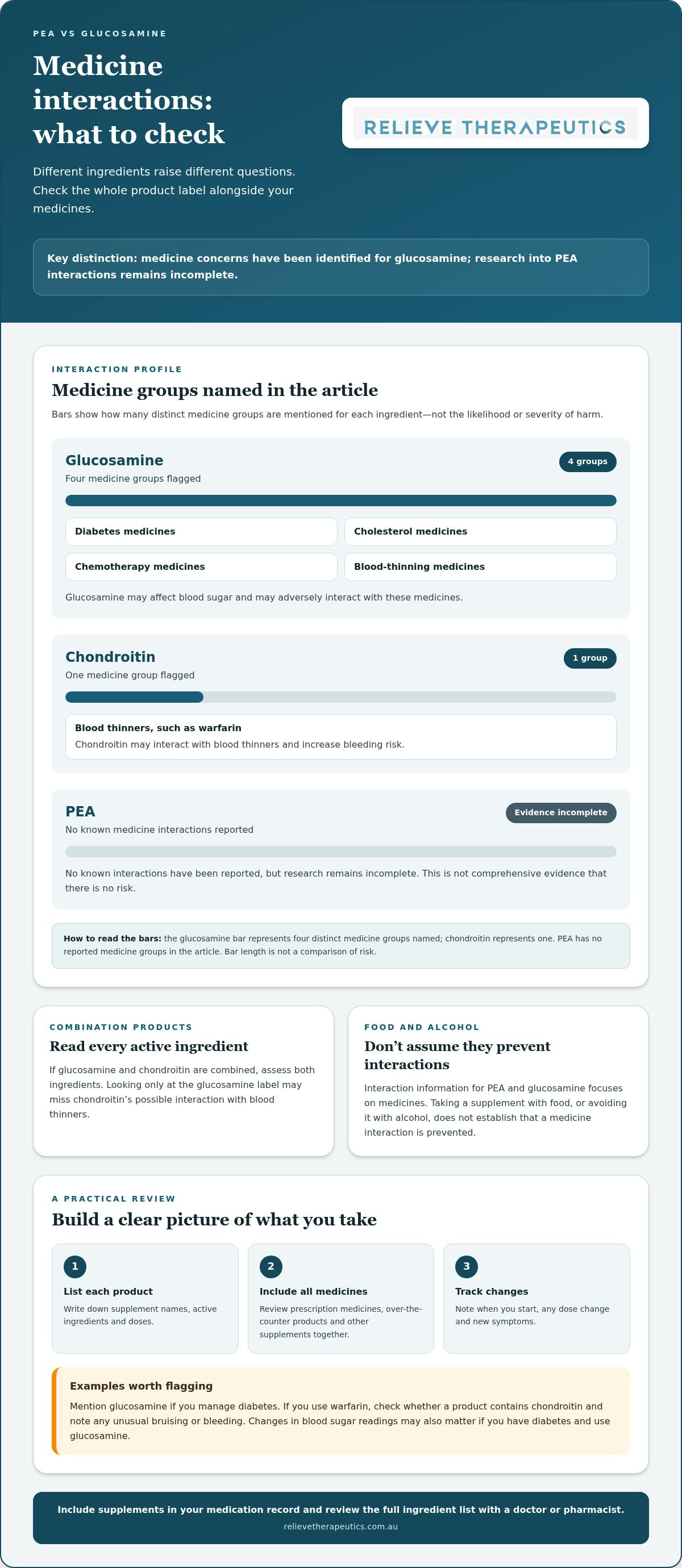
Interactions matter because supplements can affect how medicines work or increase unwanted effects. Glucosamine may affect blood sugar and may adversely interact with medicines for diabetes, cholesterol, chemotherapy and blood thinning. Reviewing regular medicines is especially important before adding glucosamine if you manage diabetes or take an anticoagulant.
Chondroitin adds another consideration. It may interact with blood thinners such as warfarin and increase bleeding risk. If you take glucosamine and chondroitin together, consider both ingredients when assessing possible interactions. Looking only at the glucosamine label won’t capture the combination’s risks, so read the active ingredients and directions on the complete product label.
No known interactions between PEA and medicines have been reported, but research into interactions remains incomplete. An absence of reported interactions is not the same as comprehensive evidence that there is no risk. Include PEA in your medication record alongside prescription medicines, over-the-counter products and other supplements. This gives a doctor or pharmacist a clearer picture of what you take.
Food and alcohol also belong in a medication discussion. They can affect how some medicines are tolerated or processed, but interaction information for PEA and glucosamine focuses on medicines. Don’t assume that taking a supplement with food, or avoiding it with alcohol, prevents a medicine interaction. Follow the product’s labelled directions and note any specific timing instructions.
A practical review can clarify the relevant risks. Write down each supplement’s name, active ingredients and dose, then compare them with every medicine and supplement you already take. For example, if you use warfarin, identify chondroitin on a combination label. If you manage diabetes, mention glucosamine. Include chemotherapy medicines and cholesterol treatments in the same review.
After starting a supplement, track changes rather than relying on memory. Note when you began taking it, any dose change and new symptoms, such as unusual bruising or bleeding while taking warfarin. Changes in blood sugar readings may also matter if you have diabetes and use glucosamine. These details help a doctor or pharmacist assess the supplement alongside your medication list.
The interaction evidence differs for PEA and glucosamine: medication concerns have been identified for glucosamine, while research into PEA interactions remains incomplete. A pharmacist or doctor can assess your medicines, health conditions and supplement ingredients together before use. This is particularly relevant if a product combines glucosamine with chondroitin or your treatment includes warfarin, diabetes medicines, chemotherapy or cholesterol medicines.
Conditions for which PEA may be considered
PEA is promoted for osteoarthritis and other joint pain in people and pets. Arthritis is therefore a common context for comparing it with glucosamine, but promotion alone does not establish clinical effectiveness. Australian guidance from the Australian Rheumatology Association and the Royal Australian College of General Practitioners recommends against glucosamine and/or chondroitin for hip or knee osteoarthritis. That recommendation concerns those supplements, not PEA.
Joint symptoms can have different causes, so the condition matters more than the supplement category. Osteoarthritis involves joint pain, but pain can also arise from other problems, such as back conditions. PEA is discussed for pain relief beyond joints, but that does not make it a treatment for every cause. With persistent back discomfort, for example, the key question is what is causing it, not simply whether PEA is marketed for pain.
PEA is also promoted for pets, as well as for people. That does not mean a human supplement should be given to an animal, or that evidence for one species applies to another. A pet with joint pain needs an assessment suited to that animal. “Joint support” can refer to products for different users and purposes, while a clinical decision depends on the condition being addressed.
Glucosamine is often discussed alongside chondroitin for osteoarthritis, while PEA is a different compound. PEA is a fatty-acid-related substance produced by the body and is promoted for osteoarthritis and other joint pain. These differences mean the comparison is not simply a choice between equivalent ingredients, but between distinct approaches. Check whether a product contains PEA alone or combines ingredients, then consider whether its label fits the reason you’re considering it.
For chronic pain, PEA may take one to two months to provide any benefit. This timeframe may be relevant when assessing a possible response, but it does not identify the cause of pain or prove a joint-specific effect. Be clear about the symptom and its impact. For example, note whether knee discomfort affects walking or whether back pain is the main concern. This helps distinguish a hoped-for change in daily function from a broad claim of pain relief.
Consider PEA in the context of the specific condition, who or what will use it, and the evidence relevant to that use. For hip or knee osteoarthritis, Australian recommendations address glucosamine and chondroitin, not PEA. For other joint pain or back-related discomfort, promotion of PEA should not be mistaken for a diagnosis or established clinical treatment. Identifying the problem first makes any supplement discussion more useful.
What palmitoylethanolamide (PEA) is
Palmitoylethanolamide, usually shortened to PEA, is produced throughout the body in response to cellular injury. It’s a naturally occurring fatty-acid-related substance, distinct from glucosamine and chondroitin. PEA is also found in egg yolks, meat, soybeans, peanuts and some other legumes. These examples show that PEA occurs naturally in the body and in foods, while capsules provide it as a dietary supplement.
Laboratory studies indicate that PEA can activate a cell receptor associated with anti-inflammatory effects. Research also describes PEA’s interaction with transient receptor potential vanilloid 1, or TRPV1, a cellular channel involved in pain signalling. PEA can activate and then desensitise TRPV1, which may result in a pain-relieving effect. These proposed mechanisms help explain scientific interest in PEA, but they don’t establish that it treats osteoarthritis or another disease.
PEA presents a formulation challenge: it’s lipophilic and almost insoluble in water. A review identifies this low solubility as a limitation to bioavailability, meaning how the compound is formulated may affect the body’s access to it. This matters when comparing supplements. The amount on a label alone does not explain how a formulation behaves in the body, and products should not be assumed equivalent based only on PEA content.
Typical daily PEA dosage is 300 to 1,200 mg. That range gives context when reading supplement labels, but it isn’t a personal dosing instruction. Check the amount per capsule and the product’s stated directions to understand what a serving provides. If a person uses other supplements or medicines, those ingredients matter too. For example, a combination product requires checking every active ingredient, rather than focusing only on the PEA amount.
PEA is promoted for osteoarthritis and other joint pain in people and pets. That should be distinguished from an established treatment claim: a dietary supplement cannot be marketed to treat or cure a disease. If you’re considering PEA for joint discomfort, distinguish a proposed biological mechanism from demonstrated clinical benefit. A label or report describing anti-inflammatory effects does not, by itself, show that PEA will improve your symptoms.
In short, PEA is a body-produced compound that also occurs in foods such as egg yolks and peanuts. Its proposed effects involve inflammation and pain signalling, while its water solubility presents a formulation consideration. Those features explain why PEA is studied and sold as a supplement, but they don’t make it interchangeable with glucosamine or prove it is helpful for every person with joint pain.
What are palmitoylethanolamide (PEA) and glucosamine, and how might they affect joint pain?
PEA and glucosamine are different supplements, so their proposed roles aren’t interchangeable. The body produces PEA in all tissues as needed in response to cellular injury. Glucosamine is considered for joint symptoms, sometimes alongside chondroitin. In a palmitoylethanolamide vs glucosamine for joints comparison, the distinction is between a compound linked to cellular signalling and a supplement commonly discussed for osteoarthritis.
Laboratory studies suggest PEA may influence inflammation through cell receptors. It can activate a receptor associated with anti-inflammatory effects, and it can activate then desensitise the TRPV1 cellular channel. This channel is involved in pain signalling. These proposed mechanisms provide a biological explanation for interest in PEA, but laboratory findings don’t by themselves establish pain relief in people with osteoarthritis.
Glucosamine is often assessed in studies with chondroitin for knee osteoarthritis. A 2022 analysis included nearly 4,000 people, while another study enrolled 164 patients with osteoarthritis-related knee pain. Those participant numbers describe the size of the research, not its results. They also don’t show that PEA and glucosamine have been compared directly in equivalent trials.
Read the evidence alongside Australian guidance. The Australian Rheumatology Association and the Royal Australian College of General Practitioners recommend against glucosamine and/or chondroitin for osteoarthritis of the hip and/or knee. This guidance applies to those supplements and conditions. It does not establish that PEA is effective or make the two substances equivalent alternatives.
For PEA, a typical daily dose is 300 to 1,200 mg. That range helps readers interpret product labels, but the stated amount doesn’t predict an individual’s response. Formulation is another consideration: PEA is lipophilic and almost insoluble in water, a limitation to solubility and bioavailability identified in a review. The labelled quantity alone can’t explain how a formulation behaves in the body.
In a palmitoylethanolamide vs glucosamine for joints comparison, consider the intended use, evidence and active ingredients. For example, a product containing glucosamine and chondroitin has different ingredients from a PEA-only supplement. If you’re considering either for joint pain, distinguish a proposed biological mechanism from clinical evidence and Australian recommendations. This helps set realistic expectations without treating a supplement’s promotion as proof that it will improve pain or function.
Relieve Therapeutics: PEA 60 Capsules
Relieve Therapeutics offers PEA capsules as a next step for readers considering a PEA supplement after comparing it with glucosamine. The range includes PEA 60 Capsules, PEA 120 Capsules and PEA 180 Capsules, with different capsule counts to suit individual preferences. These are supplement options, not a substitute for understanding the evidence, checking potential interactions or following advice about a diagnosed joint condition. If you’re weighing PEA against glucosamine, consider the active ingredients and directions on the product label alongside your health needs and current medicines. For details about the PEA capsule options, visit relievetherapeutics.com.au.
Make your next step an informed one
Approach the question of palmitoylethanolamide vs glucosamine for joints by considering your health context, medicines and priorities. Before adding a supplement, write down what you hope to improve, such as comfort during a walk or ease of movement after sitting. This gives you a practical outcome to discuss with your doctor or pharmacist, rather than relying on a broad promise of joint support.
Bring the product label and a current list of medicines and supplements to that conversation. A clinician can help weigh the ingredients, possible interactions and relevance to your joint symptoms. If you’re considering PEA and would like information about the available options, contact Relieve Therapeutics to continue your research.
Thoughtful choices start with clear questions and reliable information. Take the next step at a pace that feels right for you.
Frequently Asked Questions
What is Palmitoylethanolamide (PEA)?
Palmitoylethanolamide, or PEA, is a fatty-acid-related substance your body produces in response to cellular injury. It’s also found in foods such as egg yolks, meat, soybeans and peanuts. As a supplement, it’s available in capsules. PEA is not glucosamine: the substances differ in composition and proposed roles, so evidence about one shouldn’t be treated as evidence about the other.
And what about the downsides?
The most commonly reported side effect of PEA is an upset stomach. Glucosamine supplements are usually made from shellfish, so people with shellfish allergies should avoid them. Glucosamine and chondroitin taken together have been associated in clinical trials with effects including diarrhoea, heartburn and allergic reactions. Note any new symptoms and the supplement’s ingredients, and discuss them with a doctor or pharmacist.
How does PEA work (mechanism of action)?
PEA may affect cellular pathways involved in inflammation and pain signalling. Laboratory studies indicate it can activate a cell receptor associated with anti-inflammatory effects. It can also activate and then desensitise TRPV1, a cellular channel involved in pain signalling. These mechanisms offer a scientific explanation for studying PEA, but they don’t by themselves show that it will relieve a particular person’s joint pain.
PEA for Arthritis?
PEA is promoted for osteoarthritis and other joint pain, but promotion is not proof of clinical benefit for arthritis. Australian recommendations advise against glucosamine and/or chondroitin for osteoarthritis of the hip or knee; they do not establish PEA as an alternative treatment. If you’re considering a supplement for arthritis, distinguish the condition being addressed from general claims about joint support, and discuss your medicines and symptoms with a health professional.
What are the health benefits of palmitoylethanolamide (PEA), and is it safe?
PEA is studied for possible effects on pain and inflammation, but its proposed mechanisms do not establish that it treats or cures a disease. Its most commonly reported side effect is an upset stomach. Research on interactions between PEA and medicines is incomplete, so include it in discussions about your supplement and medication routine. This is especially useful if you take regular medicines or manage a chronic condition.
How effective is PEA for osteoarthritis or joint pain according to clinical studies?
PEA is promoted for osteoarthritis and joint pain, but the information here does not quantify its clinical effectiveness for those symptoms. A proposed effect on inflammation or pain signalling is not the same as demonstrated improvement in pain or function. For a useful assessment, focus on the outcome that matters to you, such as walking comfortably, and discuss how to evaluate it with a health professional.
Are there head-to-head studies comparing PEA with glucosamine for joint symptoms?
The glucosamine and chondroitin findings discussed here do not establish a direct comparison with PEA. A head-to-head study would assess both options under comparable conditions, using the same measures of pain and joint function. Without such a comparison, results for one supplement cannot show that it performs better than the other. Treat their proposed mechanisms and study findings as separate evidence, not as a ranking.
How quickly do PEA and glucosamine work, and how long should each be tried?
Reported timeframes for possible PEA effects range from 2 to 8 weeks of consistent use; chronic pain benefits may take one to two months. People taking glucosamine without clear improvement within a few months are advised to stop. Track a specific symptom, such as knee discomfort during a walk, so you can judge whether anything changes and discuss the result with a health professional.