

A supplement should complement pain care, not replace it. When looking for natural supplements for pain relief in Australia, start by considering the evidence and asking your doctor to check a product against your medicines and health conditions before you try it. Palmitoylethanolamide (PEA) is one option that may help with mild nerve pain and inflammation while supporting healthy nerve function.
It’s understandable to look for something that may ease discomfort, especially when pain affects sleep, movement or everyday routines. But “natural” doesn’t automatically mean suitable for everyone, and supplements can interact with medicines or be unsuitable for some health conditions.
This guide explains how to assess supplement safety and evidence, and how to consider supplements alongside conventional treatment rather than in place of it. You’ll also find a closer look at PEA for neuropathic pain, with practical points to help you make an informed choice and discuss it with your doctor.
Key Takeaways
- Compare the active ingredient and dose on a supplement label, then weigh the evidence for your type of pain rather than relying on broad claims.
- Introduce changes carefully: tracking one supplement at a time can make it easier to notice what changes and discuss your regimen with your doctor.
- For nerve-related pain, learn how PEA may fit into a broader approach to supporting nerve function and managing discomfort.
- Curcumin’s low bioavailability can affect how much reaches the bloodstream; research findings offer context, but they don’t make every turmeric product equivalent.
1. Checking supplement safety and evidence
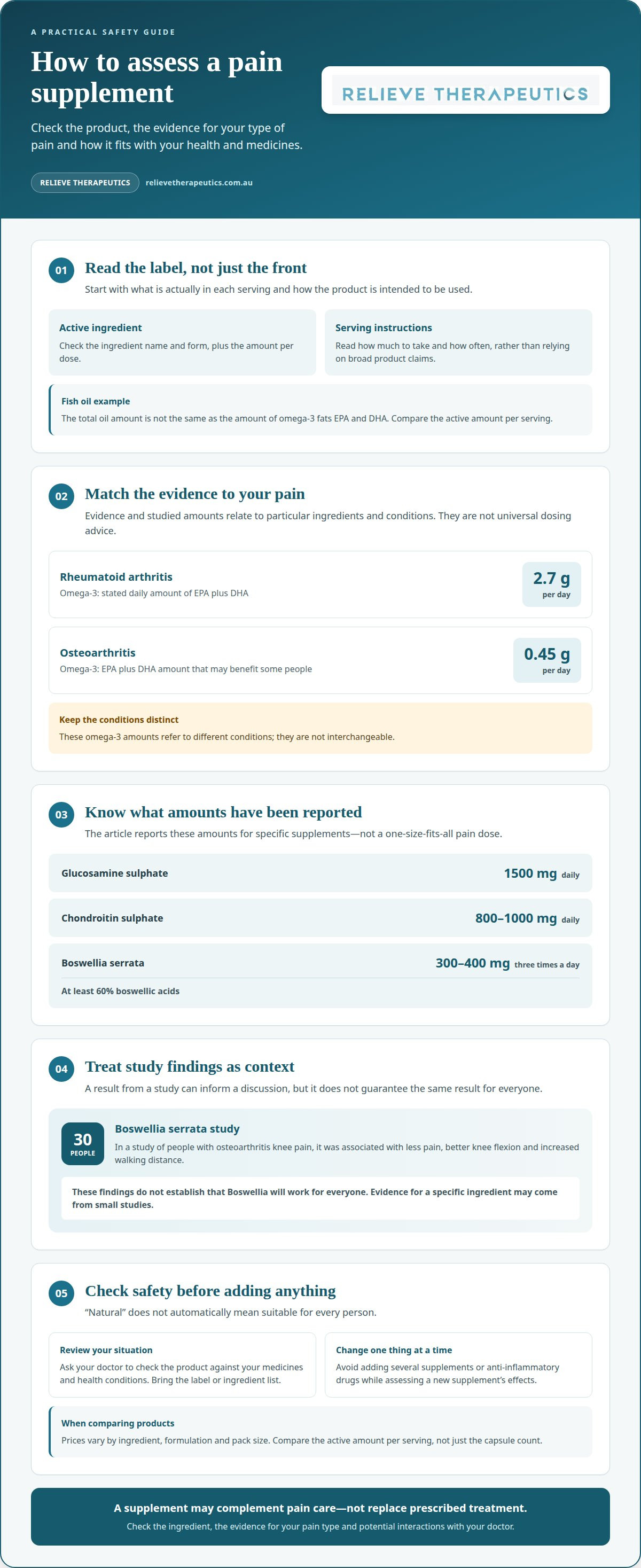
Assess a supplement by its active ingredient, amount per dose, intended use and evidence for your pain type. Check the label for the ingredient form and serving instructions. For example, fish oil provides omega-3 fats, but the label’s total oil amount isn’t the same as its EPA and DHA content.
Can omega-3 supplements help with joint or inflammatory pain? They may be relevant to inflammatory joint pain. The stated daily amount is 2.7 grams of EPA plus DHA for rheumatoid arthritis, while 0.45 grams may benefit people with osteoarthritis. These figures describe different conditions, so they aren’t interchangeable.
Are glucosamine and chondroitin effective for osteoarthritis pain? These supplements are used for osteoarthritis, but their dosage alone can’t tell you whether they’ll ease your pain. Consider the evidence for your condition and the specific formulation, rather than assuming that combining them is more effective.
What doses of natural supplements have been studied for pain relief? Reported amounts include:
- Glucosamine sulphate: 1500 mg daily.
- Chondroitin sulphate: 800 to 1000 mg daily.
- Boswellia serrata: 300-400 mg three times a day, with at least 60% boswellic acids.
These amounts relate to specific supplements, not a universal dose for pain relief.
What are the risks and medication interactions of natural pain-relief supplements? A supplement can interact with medicines or be unsuitable for a particular health condition. Before starting one, ask your doctor to review your medicines and health history. Avoid adding several supplements or anti-inflammatory drugs while assessing a new supplement’s effects. Changing one thing at a time makes it easier to identify what may affect your symptoms.
Where can I buy natural pain-relief supplements in Adelaide, and what do they cost? Adelaide pharmacies, health-food retailers and Australian online stores sell supplements. Prices vary by ingredient, formulation and pack size, so compare the active amount per serving, not just the capsule count.
Evidence for a specific ingredient may come from small studies and should be weighed alongside the evidence for your condition. In a study of 30 people with osteoarthritis knee pain, Boswellia serrata was associated with less pain, better knee flexion and increased walking distance. These findings do not establish that it will work for everyone.
2. Combining supplements with conventional treatments
Supplements and standard pain treatments have different roles. Conventional care can address an identified cause and provide a treatment plan; a supplement may be an addition, not a replacement for prescribed care. Keep your current plan in mind when considering a new product, including medicines, existing supplements and any health conditions.
How do natural supplements compare with standard pain treatments? They aren’t interchangeable. Medicines and other conventional treatments are selected to manage a condition or its symptoms, while evidence and effects for supplements vary by ingredient and type of pain. Any combined approach needs to account for potential interactions and preserve prescribed treatment.
Before trying a complementary treatment, consult your doctor so they can review it alongside your medicines and health conditions. Bring the supplement label or ingredient list, and explain what pain you hope to address. Include non-prescription medicines and products you take occasionally. This gives your doctor a clearer picture of potential interactions and helps avoid overlooking a relevant ingredient.
Keep the trial straightforward. Don’t add several supplements at once or combine a new supplement with anti-inflammatory drugs while assessing its effects. Changing several things together makes it difficult to tell which change may relate to a difference in symptoms. Note the product, when you started it, and any changes in pain or daily function. Share those observations with your doctor.
Some combinations have been considered for particular symptoms. Magnesium diglycinate, for example, may assist with muscle spasms, cramps and pain when used with PEA. That does not make the combination suitable for everyone; review both ingredients together before adding either to your routine. Explore PEA as a complementary option as part of an informed discussion about your pain plan.
Keep conventional treatment steady unless your doctor advises a change. If pain worsens or new symptoms appear after introducing a supplement, record what changed and seek medical advice. A clear timeline helps distinguish the effects of treatment, supplements and changes in symptoms.
3. Neuropathic pain
Nerve-related pain calls for a different conversation from joint pain. Tell your doctor where you feel it, how it affects daily activities, and when it changes. For example, note whether discomfort interferes with walking, sleep or everyday tasks. These details help you describe your experience clearly and support a discussion about suitable care.
Palmitoylethanolamide (PEA) is naturally produced in the body in response to pain and inflammation. PEA supplements may help relieve mild nerve pain and inflammation while supporting healthy nerve function. This makes PEA an option to learn about when considering supplements for neuropathic pain. It doesn’t replace assessment of the cause or a treatment plan.
Keep a brief symptom record before and during any change to your routine. Write down where you feel pain, how it feels, and which activities are affected. Note when you start a supplement and any changes you notice afterwards. A clear record can help you describe patterns to your doctor, rather than relying on memory during an appointment.
Discuss PEA with your doctor in the context of your current medicines and health conditions. Bring the product label, including its ingredients and serving directions. Ask how it could fit alongside your existing care, and agree on what changes to monitor. Reviewing the full list is especially useful if you already use other supplements or treatments.
Set a practical goal for reviewing whether an approach is useful. For instance, track whether nerve-related discomfort affects a chosen daily activity less often or changes how you manage it. Don’t assess a supplement by its “natural” label alone. Consider its intended use, ingredient information and the outcome you’re monitoring. Record when symptoms change and share the details with your doctor.
4. What does research say about turmeric or curcumin for pain?
Turmeric is a spice; curcumin is one of its active compounds. Turmeric contains 2 to 6% curcumin, while some joint supplements contain up to 95%. These figures describe different formulations, so comparing products by the word “turmeric” alone can be misleading. Check the label for curcumin content and the form used.
Bioavailability is another consideration. Only 2 to 3% of curcumin reaches the bloodstream because it has low bioavailability. BCM-95 is described as an enhanced-absorption turmeric extract with anti-inflammatory properties. An absorption-focused formulation differs from turmeric used in food, so read the ingredient details rather than assuming they deliver the same amount.
A 2021 review of 15 randomised controlled trials found curcumin as effective as or better than NSAIDs for osteoarthritis pain and stiffness. That finding concerns the studies reviewed; it doesn’t establish that every turmeric product has the same formulation or effect. For osteoarthritis or rheumatoid arthritis, a stated curcumin amount is 500 mg twice daily. Discuss this with your doctor before using it, especially alongside medicines.
If you’re testing turmeric in food, use it consistently and track changes in a specific activity, such as walking or getting up from a chair. A suggested observation period is three to six months, but avoid changing several supplements at once. Note the product, how often you use it and any difference in symptoms. This record helps you judge whether the approach seems useful and gives your doctor details to discuss.
For natural supplements for pain relief in Adelaide, ingredient, formulation and intended use all matter. Explore supplement options as you compare approaches, and discuss any new product with your doctor before adding it to your routine.
Trying turmeric in your daily diet for three to six months is suggested to assess whether it helps. Foods identified as options that can help fight inflammation include ginger, garlic, turmeric, fatty fish, walnuts, almonds, berries, broccoli, avocados and green tea.
Among patients who report pain relief, about one glass of cherry juice a day is the amount most drink.
Relieve Therapeutics: PEA 60 Capsules
Relieve Therapeutics offers PEA 60 Capsules for people considering PEA as a supplement option for mild nerve pain and inflammation. PEA may support healthy nerve function, but it should be considered alongside your existing care, not as a replacement for prescribed treatment.
Choose from PEA 60 Capsules, PEA 120 Capsules or PEA 180 Capsules, with each option reflecting a different capsule count. Before adding PEA to your routine, discuss it with your doctor, particularly if you take medicines or use other supplements. They can consider your health conditions and current treatment when reviewing whether it fits your situation.
For more information, visit relievetherapeutics.com.au.
Make your next step a considered one
Choose a next step that keeps your care practical and personal. Before adding a supplement, decide what to discuss with your doctor: how it may fit your current treatment, which symptoms matter most, and what changes would be useful to monitor. That conversation can help turn broad interest in natural supplements for pain relief in Adelaide into a focused decision for your circumstances.
If PEA is relevant to your interest in nerve-related discomfort, take time to understand the available option and consider it alongside your existing care. Relieve Therapeutics offers PEA capsules as a supplement, not a replacement for your doctor’s advice or prescribed treatment.
Contact Relieve Therapeutics to discuss your options, and take the next step with care and confidence.
Frequently Asked Questions
Which natural supplements have evidence for pain relief?
Evidence depends on the ingredient and type of pain. Curcumin has been studied for osteoarthritis symptoms, while PEA may help with mild nerve pain and inflammation. These examples don’t mean every formulation has the same evidence. Match the research to your symptoms, check the product’s active ingredients, and discuss with your doctor whether it fits your care.
How can I check whether a supplement is safe and TGA-listed in Australia?
Search the Therapeutic Goods Administration’s public register using the product’s exact name, then compare the listing with the label, including its ingredients and sponsor. A matching listing helps verify the product’s regulatory status, but doesn’t establish that it suits your health needs. Check the pack’s warnings and directions, and show the label to your doctor or pharmacist if you take medicines or have a health condition.