

A natural option isn’t automatically safer. Natural supplement alternatives to painkillers may suit some people, but supplements can still cause side effects or interact with medicines. The right choice depends on the type of pain, your health and what you already take.
It’s understandable to look for ways to manage discomfort while limiting reliance on pain medicines. Supplements may be worth discussing as part of a broader plan, but they shouldn’t replace prescribed treatment without medical advice. This article explains when natural pain relief may be appropriate, how boswellia and curcumin are used, and which risks and interactions to discuss with a clinician. A supplement’s natural origin doesn’t remove the need to consider its evidence, formulation and role in your care.
Key Takeaways
- Match a natural approach to the type and duration of pain, rather than treating all discomfort the same way.
- Learn how boswellia is studied for joint symptoms and why its use may require time.
- Understand how curcumin formulations and study doses vary before considering it as an option.
- Discuss your medicines, health conditions and possible supplement interactions with a clinician before making changes.
1. When is Natural Pain Relief a Good Choice?
Natural supplements may be considered alongside other care for ongoing discomfort, but they don’t replace assessment of new, severe or worsening pain. For some people, natural supplement alternatives to painkillers may form part of a broader plan, depending on the cause of pain, health conditions and current medicines. Acute, low-to-moderate pain is often treated with over-the-counter analgesics and non-steroidal anti-inflammatory drugs (NSAIDs). Supplements have different evidence and uses, so they aren’t interchangeable with these medicines.
Ginger has been studied for inflammatory conditions and may also be considered for menstrual cramps. People may consider it for migraine symptoms, too, but it shouldn’t replace migraine care. Doses of ginger ranging from 510–1,000 mg daily have been used in randomised controlled trials, according to Arthritis UK. A separate rheumatoid arthritis study examined 1,500 mg of ginger powder, while a review found that two grams daily for at least five days could modestly reduce exercise-related muscle pain.
Food choices can support an overall approach to inflammation. Oily fish, walnuts and flaxseed provide omega-3 fatty acids, while vegetables, fruit and whole grains add varied nutrients. Resveratrol, found in foods such as grapes, is another compound studied for inflammatory processes; a food source isn’t equivalent to a concentrated supplement. If you’re preparing for surgery, disclose supplements to your treating team, as they may affect care planning.
In Australia, supplement prices vary by ingredient, formulation and pack size. Private health insurance contributions depend on your policy and how the product is classified, so cover isn’t uniform. Check your policy details before choosing a product rather than assuming a supplement will cost the same as, or be covered like, a medicine.
Natural supplement alternatives to painkillers aren’t a single treatment category with one level of evidence. The ingredient, formulation and type of pain all matter. Before considering a supplement, discuss your symptoms and medicines with a clinician or pharmacist, then ask whether that specific product fits your care plan.
2. Boswellia for osteoarthritis and rheumatoid arthritis
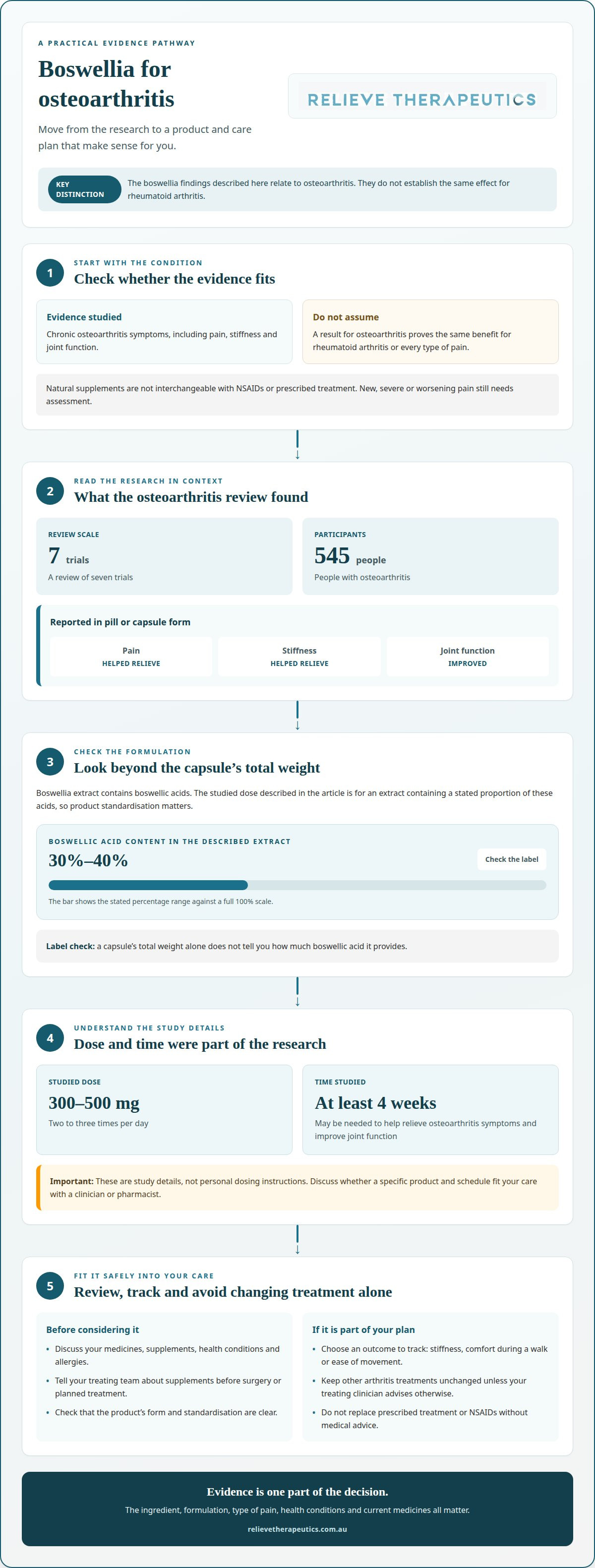
Boswellia is used in some herbal supplements. Its extract contains boswellic acids and has been studied for inflammation, mobility and joint symptoms. For people managing chronic osteoarthritis, research offers a reason to examine this ingredient, but it doesn’t establish that boswellia works for every type of arthritis. The form and concentration also matter when comparing products.
The authors of the seven-trial review found that boswellia in pill or capsule form helped relieve pain and stiffness and improve joint function among 545 people with osteoarthritis. This finding relates to osteoarthritis; it shouldn’t be assumed to demonstrate the same effect for rheumatoid arthritis. The two conditions have different causes, so evidence for one cannot automatically answer questions about the other.
For an extract containing 30% to 40% boswellic acids, a studied dose is 300 mg to 500 mg two to three times per day. Boswellia may need to be taken for at least four weeks to help relieve osteoarthritis symptoms and improve joint function. These details show why the extract’s standardisation and the instructions on its label matter. A capsule’s total weight alone doesn’t tell you how much boswellic acid it provides.
Before considering boswellia, define the outcome you want to track, such as stiffness, comfort during a walk or ease of movement. Keep other arthritis treatments unchanged unless your treating clinician advises otherwise. Boswellia isn’t a direct substitute for NSAIDs or prescribed treatment, and adding a supplement should fit your broader care plan. If you’re exploring a different supplement category, PEA capsules are another option to discuss as part of that conversation.
3. Curcumin from turmeric
Turmeric is a spice with anti-inflammatory properties, while curcumin is its best-known active compound. Curcumin supplements have been studied for pain relief and joint health, including arthritis symptoms. A review of 29 randomised controlled trials found curcumin helped reduce inflammation and pain in patients with five types of arthritis. For people considering natural supplement alternatives to painkillers, this evidence is relevant, but it doesn’t show that every formulation works alike.
Study doses ranged from 120 mg to 1,500 mg per day, depending on the formulation. The Arthritis Foundation recommends 500 mg of curcumin in pill form twice a day. These figures aren’t interchangeable instructions: extracts and delivery formats differ. Check the stated curcumin amount on the label, rather than relying only on the total weight of a turmeric capsule or powder.
Turmeric used in food and concentrated curcumin supplements serve different purposes. Adding turmeric to a meal provides flavour, not a measured supplement dose. If you’re considering natural supplement alternatives to painkillers, note the product name and curcumin content, then discuss them with your clinician in light of your health conditions and medicines.
Patients may also encounter capsaicin in over-the-counter creams, including products containing 0.025% to 0.1% capsaicin. It’s applied to the skin, unlike curcumin, which is commonly taken as a supplement. The intended route and type of pain differ, so neither option should delay assessment of persistent or worsening symptoms.
4. Risks, interactions and medical advice
A natural origin doesn’t remove the need to assess safety. A supplement can cause unwanted effects or interact with medicines, especially when you take several products together. Before starting one, write down your medicines, supplements, allergies and relevant health conditions. Include occasional products, such as pain relievers, and mention upcoming surgery or other planned treatment.
Some interactions depend on the ingredient. Willow bark can have effects similar to aspirin, so people taking blood thinners or allergic to aspirin should consult a doctor before using it. Feverfew is mainly used to help prevent migraines and might interact with blood-thinning medicines. These examples show why an interaction check should consider the exact ingredient, not just a product’s “natural” label.
In Australia, herbal medicines are generally not regulated as strictly as conventional medicines, according to Royal Hospital for Women. The Therapeutic Goods Administration (TGA) oversees medicines, but this general distinction doesn’t mean every herbal product has the same evidence or quality profile. Read the ingredient and amount information carefully, and ask a pharmacist or clinician how the product fits your circumstances.
Keep prescribed therapy stable unless your prescriber advises a change. A supplement shouldn’t delay care for a new symptom, worsening pain or a condition that needs assessment. If you notice a reaction after starting a product, stop taking it and seek appropriate medical advice. Bring the packaging or ingredient list, as the exact formulation can help identify possible causes and interactions.
For a useful review, ask whether the supplement could affect your current medicine, whether it suits your condition, and what symptoms should prompt follow-up. This is especially relevant before combining herbal products with pain medicines or before a procedure. Explore supplement options as one part of an informed discussion about your pain-care plan.
Relieve Therapeutics
Relieve Therapeutics offers PEA capsules for people considering supplement options as part of a broader approach to pain. PEA, or palmitoylethanolamide, is the ingredient in its focused range, available as PEA 60 Capsules, PEA 120 Capsules and PEA 180 Capsules. These options provide different capsule counts, not a substitute for medical assessment or prescribed treatment.
If you’re considering PEA, discuss it with your clinician or pharmacist alongside your symptoms, health conditions and current medicines. That conversation can help you assess whether a supplement fits your care plan and what information to review before choosing a capsule format. Relieve Therapeutics keeps its offering centred on PEA capsules, giving readers a clear place to explore this supplement category.
For questions about the PEA capsule range, contact Relieve Therapeutics.
Make your next step an informed one
Choosing natural supplement alternatives to painkillers starts with understanding what you want to address and what you already take. Write down your main concern, current medicines and questions about supplements. Bring that information to a clinician or pharmacist so you can discuss suitability, possible interactions and how a supplement might fit alongside your existing care.
There’s no need to make changes to prescribed treatment on your own. A considered approach gives you space to weigh the evidence, your health needs and practical preferences before deciding what to do next. If you’d like to learn more about PEA supplements, contact Relieve Therapeutics.
Frequently Asked Questions
Pain Medications: More Harm than Good?
No. Pain medicines aren’t automatically more harmful than helpful. Their benefits and risks depend on the medicine, why you take it, your health and other treatments. Someone with a health condition or several medicines may need a different safety assessment from someone using a medicine briefly. Don’t stop prescribed treatment without discussing your options with the prescriber.
When is Natural Pain Relief a Good Choice?
It may be worth discussing when you’re managing ongoing symptoms and want to consider options alongside your current care. The type of pain matters: a supplement studied for joint discomfort may not suit a headache or sudden injury. Before starting one, note your symptoms and current medicines, then discuss the intended use and possible interactions with a clinician or pharmacist.
Which natural supplements have evidence for pain relief?
Research has examined ginger, curcumin and boswellia for different pain or inflammatory conditions. For example, the authors of a seven-trial review reported benefits for osteoarthritis symptoms with boswellia capsules. Evidence for one ingredient or condition doesn’t establish effectiveness for another. Compare the study population, supplement formulation and symptom measured before deciding whether a research finding applies to you.
How effective are turmeric, ginger, omega-3, magnesium and willow bark for pain?
Evidence differs by ingredient and the type of pain studied. Curcumin from turmeric and ginger have been examined for inflammation and pain, while boswellia research includes osteoarthritis symptoms. The information here doesn’t establish equivalent pain relief from omega-3 or magnesium supplements. Willow bark has aspirin-like effects, so its potential use needs particular care if you have an aspirin allergy or take blood-thinning medicine.
What are the risks and side effects of supplements used for pain relief?
Risks depend on the ingredient, your health and other medicines. Willow bark may have effects similar to aspirin, and feverfew may interact with blood-thinning medicines. Allergies and existing conditions also matter. In Australia, herbal medicines are generally not regulated as strictly as conventional medicines, according to Royal Hospital for Women. Read product information and discuss relevant concerns with a health professional.
Which supplements interact with painkillers, blood thinners or other medicines?
Willow bark and feverfew warrant particular attention if you take blood thinners: willow bark can have aspirin-like effects, while feverfew might interact with these medicines. Interactions depend on the specific product and your medication list. Tell your doctor or pharmacist about supplements, over-the-counter painkillers and prescribed medicines before combining them, and don’t change a prescribed dose without clinical advice.