

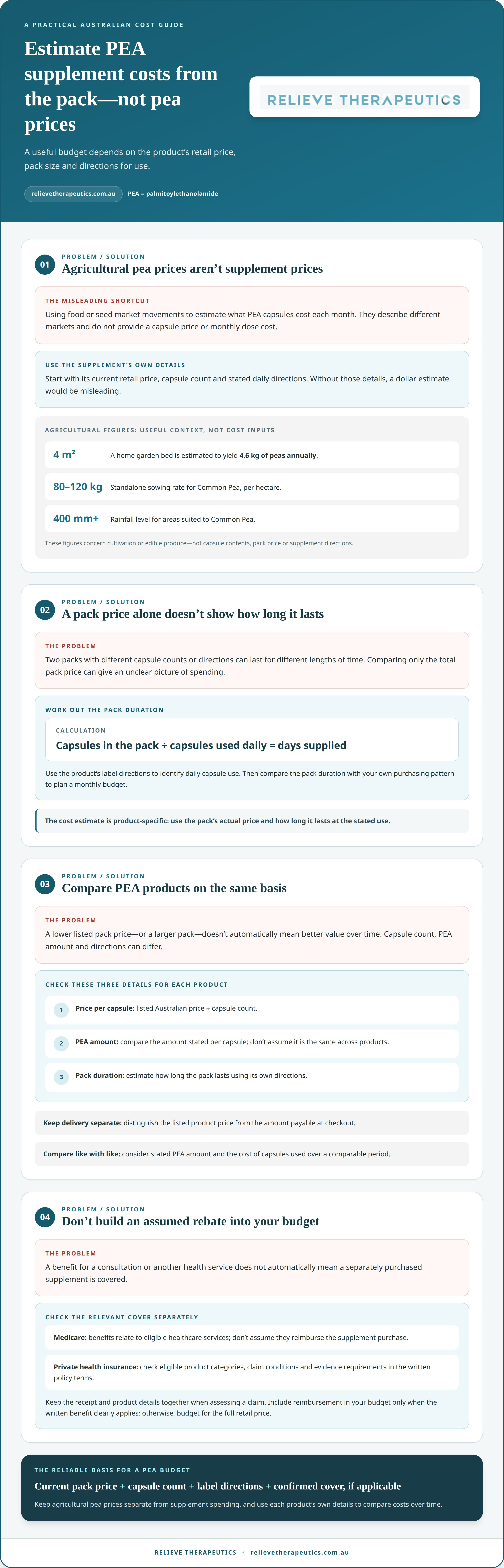
Pea seed prices don’t tell you the monthly cost of a PEA supplement in Australia. These are different markets: agricultural peas are sold as food or seed, while a supplement’s cost depends on its pack price and how long the pack lasts. That distinction matters when pea-market fluctuations seem like a shortcut to estimating the cost of PEA per month in Australia.
It’s reasonable to want a simple monthly figure when planning an ongoing purchase. But changes in Australian pea prices don’t calculate supplement spending. Your budget depends on the supplement’s pack price, capsule count and directions for use. Seed-price fluctuations may offer context about the agricultural market, but they aren’t a direct guide to what a PEA supplement will cost each month.
Key Takeaways
- Separate agricultural pea and seed prices from supplement spending; they describe different markets and don’t provide a direct monthly cost comparison.
- Work out a supplement’s monthly use from its pack size and daily directions, rather than assuming market movements determine what you’ll spend.
- Check how Medicare and private health insurance treat supplements before factoring any possible cover into your budget.
- Compare pack sizes and the amount used over time to understand value, while recognising that bulk seed prices don’t establish a supplement discount.
What is the monthly cost of common PEA doses in Australia?
Australian pea seed prices alone can’t provide a reliable monthly supplement cost. PEA, or palmitoylethanolamide, is the supplement ingredient; agricultural peas are a separate market. Your monthly cost depends on the retail price and how long the pack lasts when used according to its directions. Without those details, a dollar estimate would be misleading.
To estimate the cost, divide the pack price by the number of days it lasts at the product’s stated daily use. Check the label for the daily capsule directions, then calculate how many days the pack supplies. For a monthly budget, compare that duration with your purchasing pattern. This gives you a product-specific estimate instead of a figure borrowed from food or seed prices.
Australian pea-market figures show why the distinction matters. Those figures describe peas sold as food or seed, not PEA capsules, so they cannot be used to calculate a supplement’s monthly cost.
Growing peas offers another example, but not a supplement-cost proxy. A 4 m² home garden bed is estimated to yield 4.6 kg of peas annually. That yield concerns edible produce and depends on cultivation, not the contents or directions of a PEA supplement. Likewise, a seed price can change with the agricultural market without providing a capsule price or monthly dose cost. To budget for PEA, use the supplement’s actual pack price and label directions. Keep agricultural pea prices separate from that calculation, and compare products using the same measure: how long each pack lasts at its stated use.
The standalone sowing rate for Common Pea is 80-120 kg per hectare, while Common Pea is suited to areas receiving 400mm+ rainfall. These cultivation details describe agricultural requirements, not supplement pricing or capsule use, and therefore do not supply the missing inputs for a monthly PEA cost estimate.
Are PEA supplements covered by Medicare or private health insurance in Australia
For budgeting, don’t assume Medicare or private health insurance will reimburse a PEA supplement. Treat it as an out-of-pocket expense unless your policy’s written terms explicitly provide a benefit for that product. A benefit for a health appointment doesn’t automatically mean a separately purchased supplement is covered.
Medicare and private health insurance have different benefit arrangements. Medicare benefits relate to eligible healthcare services, while private health cover depends on your policy and the type of claim. A supplement purchase is different from a consultation, prescription or other health service, so don’t count a benefit for a related service as reimbursement for the product.
For private cover, check the policy’s eligible product categories, claim conditions and evidence requirements. Wording may distinguish supplements from pharmacy purchases and practitioner services. The product name on a receipt may also matter if claims are assessed against specific categories. General information about health benefits doesn’t establish that a particular supplement qualifies.
Keep the receipt and product details together if you’re assessing a claim. Compare the product category and receipt requirements with your policy, and include reimbursement in your budget only if the benefit clearly applies. If the terms don’t identify PEA or an applicable supplement category, budget for the full retail price rather than an expected rebate. This keeps your estimate grounded in what you pay, not a possible reimbursement.
For example, a policy may cover consultations without covering supplements. These are separate claim questions, even if a practitioner has discussed the product. General information about extras also doesn’t confirm cover for a specific purchase. Read the relevant benefit wording and claim conditions before including reimbursement in your budget. Assess Medicare and private health cover separately, since a benefit under one doesn’t establish a benefit under the other.
What Australian brands sell PEA, and how do their prices compare?
To compare PEA products, start with the label and current Australian retail price. Palmitoylethanolamide products can differ in capsule count and PEA amount per capsule, so a lower pack price alone doesn’t show which option costs less over time. Compare the same details for each product before judging value.
For a consistent comparison, divide each pack price by its capsule count, then consider how many capsules the label directs you to take daily. This shows the cost per capsule and how long the pack lasts at the stated use, making comparisons clearer than looking at total pack prices alone.
- Price per capsule: divide the listed Australian price by the pack’s capsule count.
- PEA amount: compare the amount stated per capsule, rather than assuming all capsules contain the same amount.
- Pack duration: use the product directions to estimate how long the pack lasts.
A larger pack may cost less per capsule but still be less suitable if the directions differ. Compare products on the same basis: the stated PEA amount and the cost of capsules used over a comparable period. Keep delivery charges separate from the listed product price so you can see both the product cost and the amount payable at checkout.
Australian pea seed prices aren’t a reliable way to rank PEA supplements. Seed and food prices concern agricultural peas; supplement comparisons depend on capsule price, pack count and directions. To estimate the cost of PEA per month in Australia, use current product prices and calculate how long each pack lasts at its stated use. This makes product differences easier to assess without confusing agricultural prices with supplement costs.
Are there cheaper alternatives or bulk-buy discounts for PEA in Australia?
Buying a larger pack can lower the unit cost when a seller offers a genuine discount, but pack size alone doesn’t prove savings. Compare the total price with the capsule count and directions for use. That shows whether the pack suits your budget and expected use, rather than relying on its headline price.
Australian agricultural pea prices aren’t a cheaper substitute for PEA supplements. Common Pea seed is sold in 25 kg increments, but seed is intended for planting, not capsule use. Yellow split peas and lentils are foods, not direct replacements for a supplement. Their prices therefore can’t establish a lower-cost way to obtain the same product.
Before choosing a pack, compare three details: price, capsule count and label directions. A bigger pack may last longer, but its value depends on how it fits the stated use. Include delivery charges in your budget, since the final amount paid may differ from the displayed product price.
- Compare unit value: divide the pack price by its capsule count.
- Estimate duration: use the label directions to work out how long the pack lasts.
- Assess the total: include delivery and any clearly stated discount conditions.
A discount for buying several packs may not suit you if you won’t use them within a reasonable period. Buying extra also ties up more of your budget at once. If you’re new to a product or still deciding whether its format suits your routine, a smaller pack may be easier to assess. Bulk seed offers don’t indicate supplement discounts because they concern a different product and market.
For a like-for-like comparison, review PEA capsule options and assess each pack using its price, capsule count and directions. This keeps the decision focused on supplement value, rather than agricultural prices or assumed bulk savings.
Relieve Therapeutics
Relieve Therapeutics offers PEA capsules in 60-, 120- and 180-capsule packs, giving you pack-size options when considering ongoing use. To estimate how a pack fits your budget, compare its current price with the capsule count and the product directions. This provides a clearer basis for assessing how long a pack may last, without using agricultural pea prices as a substitute for supplement pricing.
The right pack size depends on your intended use and purchasing preferences. Compare the total price with the capsule count instead of relying on pack size alone. This makes the calculation more useful for your budget.
For questions about the available PEA capsule packs, contact Relieve Therapeutics.
Make your next decision with clarity
Before buying regularly, consider how the purchase fits alongside your household expenses. Set a sustainable spending limit and use your purchase records to check whether the cost remains comfortable over time. The cost of PEA per month in Australia is a planning figure shaped by your routine and spending choices, not a fixed amount for everyone.
Your next step can be a deliberate one. Consider whether PEA suits your priorities and how an ongoing purchase would sit within your budget. If you want to discuss PEA or the available capsule options, contact Relieve Therapeutics. Keep your decision grounded in the information that matters to you, and revisit it if your circumstances change. A clear budget and a considered choice can make the way forward feel more manageable.
Frequently Asked Questions
How much does PEA (palmitoylethanolamide) cost per month in Australia?
Your monthly cost depends on the current pack price and how long it lasts when used according to the product directions. To estimate your cost of PEA per month in Australia, divide the amount paid by the number of months the pack covers, including any delivery charge. If your use changes, recalculate based on the new pack duration rather than relying on an earlier estimate.
What are typical Australian prices for PEA capsules, powder, and creams?
PEA capsules, powders and creams are different formats, so their prices aren’t directly comparable. For capsules, compare the current price with the capsule count and product directions. For a powder or cream, use the listed quantity and directions to estimate how long it may last. A useful comparison considers both the amount of product and its intended use.