

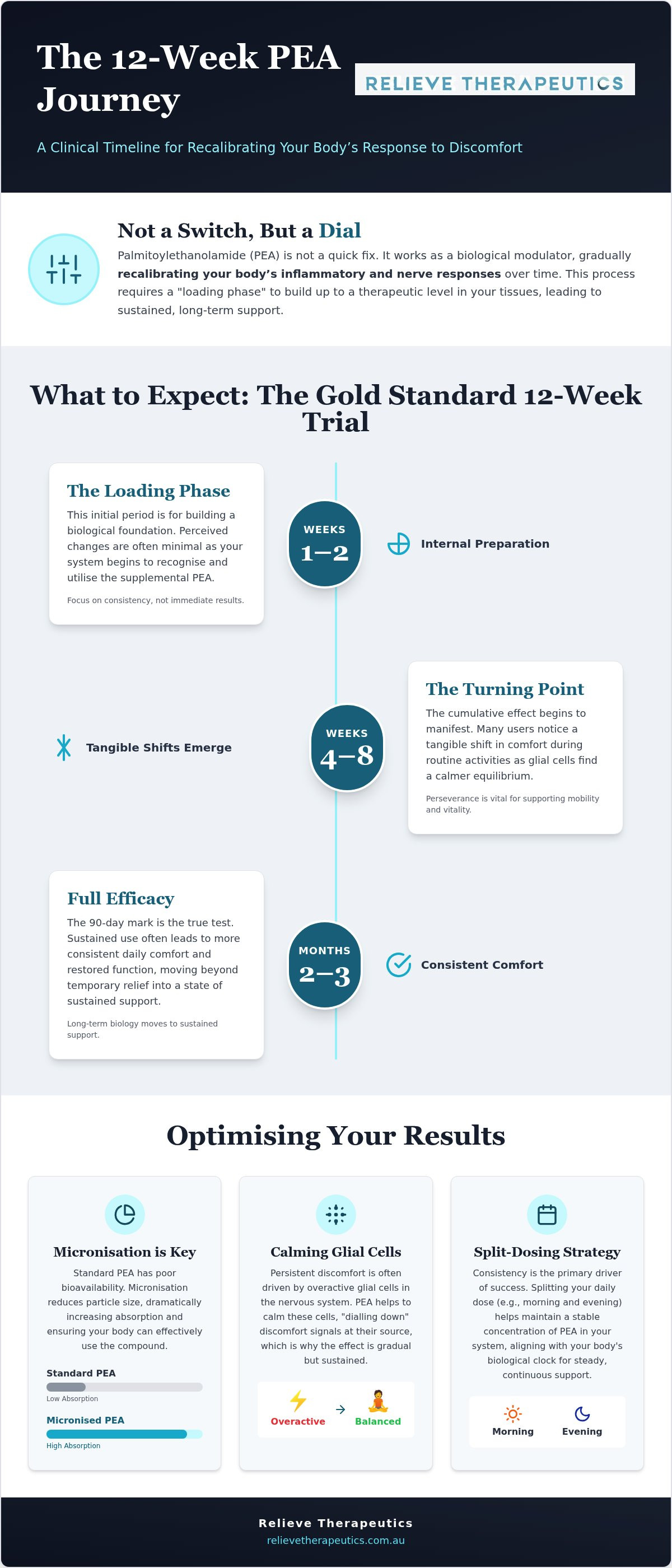
Palmitoylethanolamide is not a temporary "switch" you flip for instant relief; it is a biological "dial" that gradually recalibrates your body’s inflammatory response over a 12-week cycle. When dealing with unpredictable nerve sensations and the frustration of slow-acting treatments, the most pressing question is naturally: how long does PEA take to work? It’s understandable to feel cautious about starting a new regimen when you’ve already spent months or years seeking a reliable way to manage persistent physical discomfort.
We believe in providing clinical clarity over marketing hype to help you regain confidence in your health choices. This guide explores the sophisticated science behind Palmitoylethanolamide, outlining the realistic timeline required for cellular saturation and systemic support. You will discover why the initial "build-up" phase is critical, how to manage your expectations during the first month, and the practical steps you can take to optimise your results for long-term comfort, restored vitality, and improved daily function.
Key Takeaways
- Understand how PEA acts as a biological "dial" to naturally recalibrate your body’s inflammatory response at a cellular level.
- Discover exactly how long does PEA take to work by following the 12-week trial period essential for achieving systemic saturation.
- Learn why micronisation is the key to overcoming the natural absorption challenges of standard Palmitoylethanolamide.
- Master the split-dosing strategy to maintain consistent support and ensure your routine aligns with your body’s biological clock.
- Identify why a three-month supply is the most reliable way to support your progress without the risk of running out during the build-up phase.
Understanding the Biological Clock: How PEA Interacts with Your Body
Palmitoylethanolamide is a fatty acid amide that your body naturally produces to maintain cellular harmony. It is found in every tissue in your body, acting as a protective mechanism that is activated during times of physical stress or inflammation. However, during periods of prolonged discomfort, your natural production may not keep up with the biological demand. Palmitoylethanolamide is a lipid messenger that helps balance the body's inflammatory response. By supplementing with high-purity PEA, you are essentially providing your cells with the raw materials they need to restore equilibrium. It functions as a biological modulator, which means it works with your internal systems to refine and stabilise responses rather than simply overriding them.
The Cumulative Effect of PEA
When people ask how long does PEA take to work, they are often comparing it to fast-acting synthetic options. Most traditional treatments act as immediate blocks, providing a temporary reprieve that fades as the substance leaves your system. PEA operates on a different timeline altogether. It requires a "loading phase" where levels must reach a specific biological threshold within your tissues before you notice a shift in daily comfort. This process of cellular recalibration is slow, steady, and methodical. It isn't an instant "on-off" switch. Instead, it is about gradually shifting the baseline of your physical state so that your body can manage discomfort more effectively on its own.
Glial Cells and the 'Slow Burn' of Relief
Persistent discomfort is often driven by overactive glial cells. These cells act as the immune system of your central nervous system, but they can become "stuck" in a pro-inflammatory state. This hyperactivity keeps the volume of discomfort signals turned up long after the initial cause has passed. PEA works by calming these cells at a microscopic level, essentially dialling down the noise. Because this involves changing cellular behaviour rather than just masking a signal, it takes time. You can learn more about this biological mechanism in our guide on how does PEA work for pain. This "slow burn" approach is why consistency is the most important factor in your success. You are not just managing a symptom; you are supporting a biological environment that fosters long-term restoration, vitality, and daily function.
The PEA Timeline: What to Expect from Day 1 to Month 3
Understanding how long does PEA take to work helps you navigate the 12-week "Gold Standard" trial period with patience and clinical clarity. While some individuals report subtle shifts within the first few days, the vast majority of clinical benefits are delayed. This delay reflects the time required for your body to accumulate sufficient levels of the fatty acid amide to effectively influence glial cell activity. Consistency is the primary driver of your success. Missing doses disrupts the steady-state concentration needed for cellular recalibration. We recommend tracking improvements in daily function, such as the ability to walk further or sleep more soundly, rather than focusing solely on the intensity of physical sensations.
Weeks 1–2: The Loading Phase
During the first fortnight, expectations should remain grounded. This is the loading phase. You are building a biological foundation. Perceived changes are often minimal or non-existent at this stage. However, some users notice early signs of integration, such as a slight reduction in the "sharpness" of sensations or a subtle improvement in mood. It's a period of internal preparation where your system is beginning to recognise and utilise the supplemental intake.
Weeks 4–8: The Turning Point
This interval is frequently the turning point in the journey. By week four, many people begin to notice a tangible shift in their comfort during routine activities. It is also the "danger zone" for many users. Because results aren't instantaneous, it's tempting to stop the regimen prematurely. Perseverance during this mid-phase is vital for supporting mobility and overall vitality. The cumulative effect of the supplement is finally starting to manifest as your glial cells begin to find a calmer equilibrium.
Months 2–3: Achieving Full Efficacy
The 90-day mark is the true test of Palmitoylethanolamide's supportive role. By month three, sustained glial cell modulation often leads to more consistent daily comfort and restored function. This long-term approach allows your biology to move beyond temporary relief into a state of sustained support. Ensuring you have a PEA 180 capsules supply is a practical way to manage this timeline without interruption. Consistent intake over this full period provides the clearest picture of how the supplement supports your individual health journey.
If you are ready to start your 90-day journey, you can explore our range of high-purity capsules designed for long-term support.
Why Particle Size and Bioavailability Influence Your Results
Bioavailability is the silent factor that determines how long does PEA take to work for each individual. Because Palmitoylethanolamide is a lipophilic (fat-loving) substance, it is naturally resistant to dissolving in the water-based environment of the digestive tract. Standard, non-processed PEA tends to form large, crystalline structures that the gut struggles to break down efficiently. This poor solubility often leads to much of the compound passing through the system without being absorbed into the bloodstream. Choosing a micronised version addresses this fundamental biological hurdle. Micronised PEA particles are smaller than a red blood cell to enhance uptake, ensuring the active lipid actually reaches your target tissues.
The Science of Micronisation
Micronisation is a specialised manufacturing process that reduces large lipid crystals into fine particles. This dramatic increase in surface area allows for more efficient interaction with intestinal membranes. When assessing high quality PEA capsules, particle size is often the most critical indicator of efficacy. Smaller particles mean faster biological action. By improving the rate of absorption, micronisation helps your body reach the necessary therapeutic threshold more reliably, potentially shortening the initial loading window and providing a clearer path to daily comfort.
Optimising Absorption with Dietary Fats
While the quality of the capsule is paramount, your daily routine also plays a significant role in absorption rates. Since PEA is a lipid, its transport is naturally enhanced when taken alongside other healthy fats. We recommend consuming your dose with a meal that includes avocado, olive oil, or oily fish. These fats act as a carrier, assisting the movement of the supplement through the stomach and into the small intestine where it can be absorbed. Avoiding the common mistake of taking the supplement on an empty stomach ensures you aren't inadvertently extending your timeline. By synchronising high-purity ingredients with smart dietary habits, you gain more control over how long does PEA take to work within your unique biological framework.
Optimising Your Routine: How to Support the Efficacy of PEA
To get the most out of your regimen, consider the split-dosing strategy. Taking half your daily intake in the morning and the remaining half at night helps maintain steady blood levels of the lipid messenger. This consistent presence is a key factor in determining how long does PEA take to work for your specific needs. It prevents the "peaks and troughs" that can occur with a single large dose, ensuring your glial cells receive sustained support throughout a 24-hour cycle.
Finding your ideal intake is equally vital. You should refer to our comprehensive PEA dosage for pain framework to understand how to adjust your routine based on your physical requirements. Beyond the supplement itself, lifestyle factors like restorative sleep and proper hydration work in tandem with cellular support. Dehydration and sleep deprivation can heighten your system's sensitivity, potentially masking the progress you are making.
The "Journaling Method" is a practical tool for those on the 12-week journey. Because the shift in comfort is often gradual, it can be difficult to notice changes from one day to the next. By recording your progress weekly, you can look back and see the slow movement of the biological "dial". Note down your ability to complete daily tasks, your sleep quality, and your general vitality levels. This practice turns subjective feelings into objective data, giving you the confidence to persevere.
Consistency is King
Consistency is the foundation of cellular recalibration. If you miss a dose, there is no need to panic, but you should return to your schedule as soon as possible. An "on-again, off-again" approach is counterproductive. It essentially resets the 12-week clock by preventing the compound from reaching the necessary saturation point in your tissues. Setting a firm routine ensures the restorative process keeps moving forward without interruption.
Managing Your Expectations
It's essential to distinguish between "relief" and "support". Natural supplements like Palmitoylethanolamide are designed to support your body's internal balancing acts rather than providing a temporary chemical block. Every Australian's biology is unique. Some respond within weeks, while others require the full 90-day period. If you find your results aren't meeting expectations after a consistent three-month trial, we recommend consulting a healthcare professional to discuss your broader wellness plan.
To ensure you have enough supply for a consistent routine, order our high-purity PEA capsules today and start your journey toward sustained comfort.
Sustaining Long-Term Comfort with Relieve Therapeutics
Relieve Therapeutics understands the physical and emotional toll of long-term discomfort. We are dedicated to providing the Australian community with high-purity Palmitoylethanolamide through a platform built on transparency and reliability. Since the answer to how long does PEA take to work relies so heavily on the 12-week biological cycle, we have structured our offerings to match this timeline. Our 60, 120, and 180-count capsules are designed to support you through every stage of cellular recalibration. This journey is a marathon rather than a sprint, requiring a partner who values substance and scientific rigor over quick-fix promises.
Local Australian shipping is a cornerstone of our service. Maintaining your 12-week cycle without interruption is critical for success. A single gap in your regimen can disrupt the steady-state concentration required for glial cell modulation. By operating locally, we ensure your capsules arrive promptly, allowing you to focus on your wellness journey without the stress of international delays or supply chain uncertainties. We are here to ensure your path to restored vitality remains consistent and supported.
The Value of the 180-Count Supply
Choosing the 180-count bottle is the most strategic decision for those beginning their trial. It provides the peace of mind that comes with having a consistent supply for the entire 90-day period. This bulk option is not just cost-effective; it is a commitment to the biological process. Having your full supply on hand removes the risk of running out during the critical build-up phase. This approach aligns with our role as a trustworthy specialist, focusing on the long-term outcomes that matter most to your daily function and vitality.
Join the Relieve Therapeutics Community
We are committed to integrity and purity in every capsule we produce. Our focus remains on high-quality ingredients that bridge the gap between laboratory science and your personal wellness. You are not just purchasing a supplement; you are accessing local Australian support from a team that understands your unique health journey. We believe in providing the tools you need to reclaim your comfort with confidence and professional care. Our goal is to be a reliable ally as you work toward a more comfortable and active lifestyle.
Ready to start your 12-week trial? Order your PEA capsules today.
Empowering Your Path to Sustained Comfort
Achieving optimal results with Palmitoylethanolamide requires a fundamental shift in perspective. It involves moving away from the expectation of an instant fix and embracing a 12-week biological cycle of cellular restoration. By prioritising high-purity micronised capsules and maintaining a disciplined split-dosing routine, you provide your system with the steady support it needs to recalibrate overactive glial cell activity. Understanding exactly how long does PEA take to work allows you to navigate the initial loading phase with patience and clinical clarity.
We are here to support your progress with pure Palmitoylethanolamide capsules, fast shipping across Australia, and empathetic, expert-backed guidance. Your journey toward restored vitality and daily function is a commitment to your long-term wellness. With the right strategy and a consistent supply, you can move forward with confidence in your choice of natural support. It's time to take the next step toward a more comfortable and active lifestyle.
Start your 12-week journey with our PEA 180 Capsules
Frequently Asked Questions
How long should I trial PEA before deciding if it works for me?
You should trial Palmitoylethanolamide for at least 12 weeks before evaluating its efficacy. This three-month "Gold Standard" trial period allows for the necessary cellular saturation and glial cell modulation to occur. Because consistency is vital, many Australians choose the 180-count bottle to ensure they have an uninterrupted supply during this critical phase. Evaluating the supplement's impact too early may lead to a premature conclusion regarding its supportive role in your wellness journey.
Will I feel anything immediately after taking my first PEA capsule?
It is unlikely that you will experience an immediate sensation after your first capsule. Unlike fast-acting synthetic options that temporarily block signals, PEA acts as a biological modulator. It works by gradually recalibrating your body's internal inflammatory response at a cellular level. This process is methodical and cumulative. The benefits build over time rather than occurring in a single, instant burst of relief following the initial dose.
Can I speed up the results by taking a higher dose initially?
Increasing your dose beyond the recommended guidelines will not necessarily speed up the biological timeline. While a loading phase is important for building saturation, your body's glial cells require a specific amount of time to recalibrate. Taking excessive amounts won't bypass the 12-week biological clock. Instead of increasing the dose, focus on the split-dosing strategy and taking your capsules with healthy fats to optimise the absorption process.
What are the first signs that PEA is beginning to work?
The first signs are often subtle shifts in your daily function rather than a sudden change in physical intensity. You might notice that you are sleeping more soundly, moving with greater ease during morning routines, or feeling less fatigued after physical activity. These small improvements indicate that the supplement is successfully integrating with your biology. When considering how long does PEA take to work, tracking these changes in a weekly journal is a practical way to monitor progress.
Does the effectiveness of PEA wear off over time?
There is no evidence to suggest that the effectiveness of PEA diminishes over time. Because it is a fatty acid amide naturally produced by your own cells, your body does not typically develop a tolerance to it in the way it might with certain medications. In fact, many users find that sustained use helps maintain a stable baseline of comfort and vitality. It supports long-term homeostasis within the central nervous system without losing its supportive impact.
Is it safe to take PEA for more than three months?
Yes, Palmitoylethanolamide is considered safe for long-term use beyond the initial three-month trial. As a naturally occurring lipid messenger found in human tissue, it is well-tolerated by the body over extended periods. Many individuals continue their regimen indefinitely to maintain the cellular balance achieved during the loading phase. If you have specific health concerns, it is always wise to discuss long-term supplementation with your healthcare professional to ensure it aligns with your broader plan.
How does PEA compare to other natural options in terms of speed?
PEA is often slower than topical options but offers a more systemic approach to wellness. While some natural extracts provide temporary surface-level comfort, PEA targets the underlying glial cell activity. This makes it a more sustainable option for those seeking long-term support. It focuses on restoration and biological balance rather than providing a quick fix. This targeted approach is why the 12-week timeline is essential for achieving the best possible outcomes.
What should I do if I don't feel any difference after 4 weeks?
If you haven't noticed a shift after four weeks, the most important step is to remain consistent with your daily routine. Week four is often the turning point where saturation is still building within your system. Many people stop prematurely just as the biological dial is beginning to move. Ensure you are split-dosing and taking your capsules with a meal containing healthy fats. The true test of efficacy only occurs at the 90-day mark.