

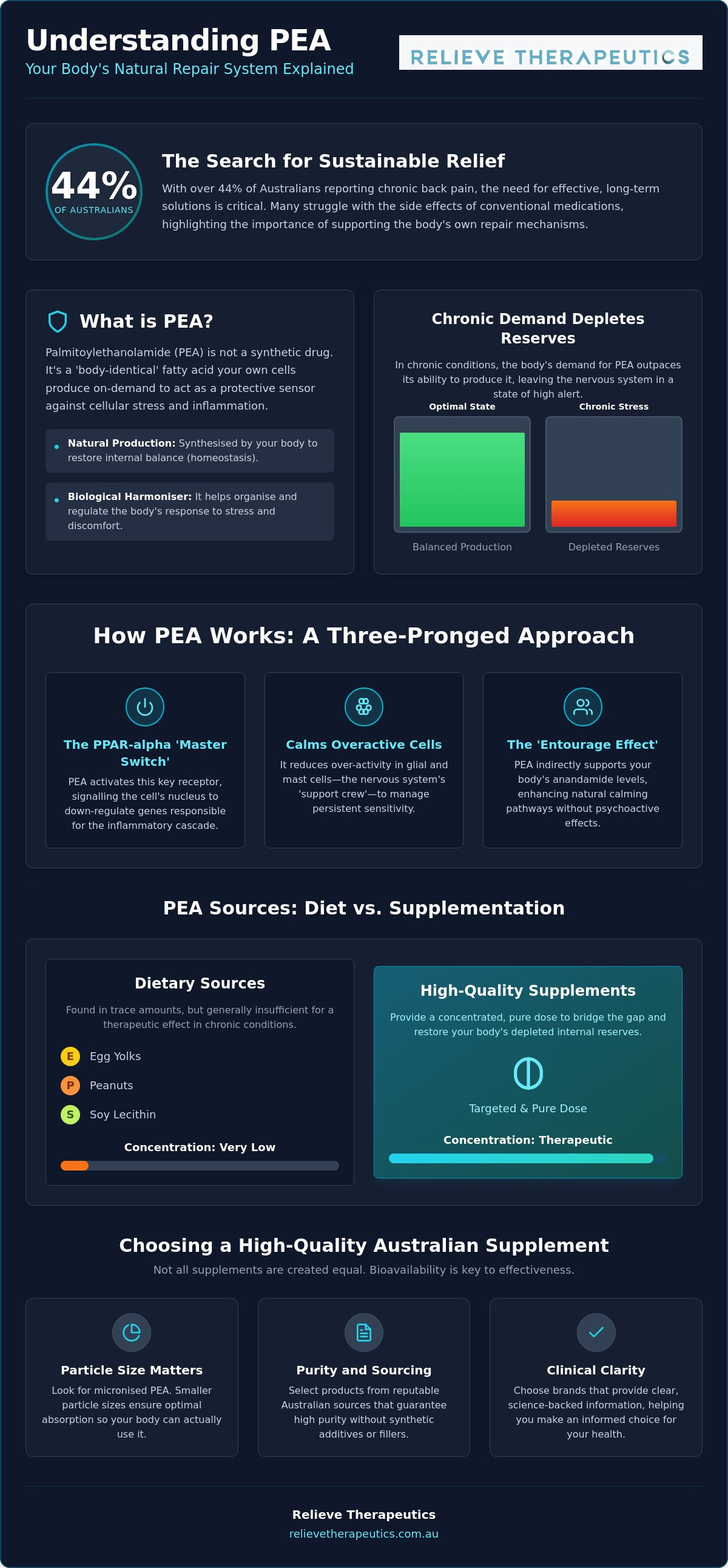
Your body is already programmed to produce its own internal repair signals, yet when chronic discomfort takes hold, these natural reserves often run dry. With over 44% of Australians now reporting back pain as a chronic condition, the search for sustainable relief has never been more urgent. Palmitoylethanolamide, or PEA, isn't a synthetic drug designed to mask symptoms; it's a fatty acid your cells create on-demand to restore balance. If you've been searching for a way to manage physical stress without the heavy side effects of prescription medications, understanding how does pea work in the body is the first step toward reclaiming your daily vitality.
It's exhausting to navigate technical jargon like "endocannabinoids" while worrying if your supplements are actually being absorbed or simply wasted. We understand that you want clinical clarity, not more marketing hype. This guide breaks down the science of the PPAR-alpha receptor and explains how this body-identical compound calms overactive glial cells. You'll gain the knowledge to choose a high-quality Australian supplement that aligns with your biology, ensuring you invest in a solution that truly supports your internal repair systems.
Key Takeaways
- Learn why Palmitoylethanolamide is a body-identical fatty acid produced on-demand to act as a protective biological sensor for cellular stress.
- Understand how does pea work in the body by activating the PPAR-alpha receptor, a biological 'master switch' that helps organise your internal repair signals.
- Discover the 'entourage effect' that supports your internal anandamide levels without the psychoactive effects or side effects of prescription medications.
- Gain insight into how PEA protects nerve integrity and reduces neuroinflammation to manage the underlying causes of chronic discomfort.
- Identify why particle size matters and how to select high-quality Australian supplements that ensure optimal absorption and bioavailability.
Understanding Palmitoylethanolamide: Your Body’s Natural Repair Molecule
To truly grasp the clinical value of this compound, you must first view it as a native component of your own biology. Palmitoylethanolamide (PEA) is a bioactive fatty acid amide that belongs to the N-acylethanolamine family. Unlike many pharmaceutical interventions that introduce foreign chemicals to the system, PEA is produced 'on-demand' by your own cells. It acts as a protective biological sensor. Whenever your tissues experience physical stress, injury, or persistent inflammation, your body synthesises this molecule to counteract the damage and promote recovery.
However, a critical gap often exists between what the body needs and what it can produce. In many chronic states, the persistent demand for repair signals outpaces your cells' ability to synthesise enough PEA. This biological depletion leaves the nervous system in a state of high alert. Understanding how does pea work in the body reveals why supplementing this natural molecule can be so effective. It essentially restores your internal reserves to their optimal levels, allowing the body to resume its natural maintenance routines.
The Role of PEA as a Biological Harmoniser
Scientists often describe PEA as a 'pleiotropic' molecule. This term highlights its ability to exert multiple beneficial effects across different biological systems simultaneously. Its primary function is to maintain homeostasis, or internal balance, within the nervous system. When your body is in a state of equilibrium, inflammatory signals are switched on and off with precision. PEA acts as the regulator for this process. It helps organise the body's response to stress by dampening the overactive signals that lead to long-term discomfort and sensitivity. When you look at how does pea work in the body, you see it functions as a natural volume knob for the immune system.
Natural Sources vs. Supplementation
While your body produces its own supply, you can also find trace amounts of PEA in common foods. Egg yolks, peanuts, and soy lecithin are the most notable dietary sources. Despite their presence in a balanced diet, the concentration found in these foods is typically too low to provide a therapeutic effect for chronic conditions. Relying solely on dietary intake is often insufficient when your biological 'repair kit' is already depleted. This is why many Australians turn to high quality PEA capsules to bridge the gap. These targeted supplements provide a concentrated, pure dose that mimics your body's natural production, allowing your system to return to a state of calm and comfort without the need for synthetic additives.
The Biological Mechanism: How PEA Interacts with Your Receptors
A central question for many Australians exploring natural health is how does pea work in the body at a microscopic level. Unlike standard medications that often block a single pathway, PEA functions as a sophisticated modulator. Its primary target is a nuclear receptor called PPAR-alpha. Think of this receptor as a control centre located deep within your cells. When PEA binds to it, it sends a signal to the cell's nucleus to down-regulate the genes responsible for the inflammatory cascade. Scientific literature often highlights its potent anti-inflammatory properties, which stem from this foundational interaction.
The PPAR-alpha ‘Master Switch’
Nuclear receptors are essentially the guardians of gene expression. When you activate the PPAR-alpha 'master switch', you are instructing your body to stop overproducing inflammatory proteins. This process is vital for long-term health management because it addresses the source of the issue rather than just the sensation. It helps your system return to a baseline state of calm. For those looking to support this biological process, choosing high-purity Australian capsules ensures your cells receive the exact molecule required for this regulation.
Beyond the master switch, PEA also interacts with the support staff of your nervous system. Glial cells are the 'janitors' that maintain your neurons. In chronic states, these cells can become overactive, leading to persistent sensitivity. PEA steps in to reduce this over-activity. Simultaneously, it modulates mast cells, which are the primary responders responsible for releasing histamine and other inflammatory markers during tissue stress.
Calming the Nervous System’s Alarm Signal
Traditional chemist-bought painkillers often work by masking pain signals once they've already been sent. PEA takes a different approach by 'quieting' the neurons before they reach a state of over-excitement. It helps reset the threshold of your nervous system, making it less reactive to minor triggers. This regulatory effect is known as the Alia mechanism. The Alia mechanism is defined as the process by which PEA regulates mast cell activation to prevent the release of inflammatory markers. By stabilising these cells, PEA helps maintain a steady, hopeful environment for your nerves to recover naturally.
The Endocannabinoid Connection and the ‘Entourage Effect’
While PEA is often grouped with cannabinoids, it occupies a unique biological niche. Scientists categorise it as a 'cannabimimetic' compound. This means it mimics certain actions of the endocannabinoid system without binding directly to the CB1 receptors found in the brain. Consequently, it does not produce a 'high' or any psychoactive effects. Understanding how does pea work in the body involves looking at its synergy with your internal chemistry. It essentially acts as a support system for your body's own regulatory molecules, enhancing their efficacy through what is known as the 'entourage effect'.
The entourage effect describes how PEA increases the binding affinity of other cannabinoids to their respective receptors. It makes your system more efficient at using the tools it already possesses. Research into the pharmacology of palmitoylethanolamide suggests that this indirect action is a cornerstone of its neuroprotective and soothing properties. Unlike CBD, which is a plant-derived phytocannabinoid, PEA is a body-identical molecule. Your system already recognises it, processes it, and knows exactly how to utilise it for cellular repair.
Boosting Your Internal ‘Bliss Molecule’
One of the most fascinating aspects of PEA's function is its relationship with Anandamide, often called the 'bliss molecule'. Anandamide is a natural endocannabinoid responsible for regulating mood, comfort, and relaxation. Under normal conditions, an enzyme called FAAH (Fatty Acid Amide Hydrolase) breaks down Anandamide shortly after it is produced. PEA serves as a clever biological decoy. It 'distracts' the FAAH enzyme, which prefers to break down PEA first. This allows more Anandamide to circulate naturally in your system for longer periods, providing sustained support for your well-being and internal balance.
Why PEA is a Legal and Safe Alternative in Australia
For Australians seeking natural support, the regulatory landscape is an important consideration. PEA is classified by the Therapeutic Goods Administration (TGA) as a listed medicine or dietary supplement. This allows you to purchase high-purity capsules over-the-counter without the hurdles of a prescription. It offers a reliable, non-psychoactive alternative to other scheduled compounds that remain difficult to access. If you want to explore the deeper technicalities of this relationship, our PEA endocannabinoid supplement guide provides an exhaustive reference for the latest clinical findings. Choosing a TGA-compliant option ensures you are using a compound that meets strict safety standards while aligning perfectly with your body's natural repair mechanisms.
From Science to Support: How PEA Targets Nerve and Joint Health
When we examine how does pea work in the body, the most profound effects are often found in the delicate structures of the nervous system. PEA provides essential neuroprotective support. It helps maintain the integrity of the myelin sheath, which is the fatty insulation that protects your nerves. When this sheath is compromised, nerve signals can become erratic, leading to persistent discomfort. By reducing neuroinflammation, PEA addresses the underlying biological triggers rather than just masking the sensation. It's a methodical process of restoration. This is why consistent daily intake is vital. Your body requires a steady supply to rebuild its natural defences and organise its internal repair systems effectively.
This biological approach is particularly beneficial for those experiencing the 'wear and tear' cycle associated with ageing or physical stress. Understanding how does pea work in the body reveals that it doesn't just act as a temporary fix. Instead, it supports the long-term health of your cartilage and connective tissues by dampening the inflammatory markers that lead to degradation. Over time, this helps preserve the structural health of your joints and nerves while supporting your daily vitality.
Targeting Neuropathic Discomfort
Neuropathic issues, such as sciatica or tingling in the extremities, are often driven by a process called peripheral sensitisation. This occurs when your pain fibres become hyper-responsive to even minor stimuli. PEA helps desensitise these fibres by calming the overactive immune cells that surround them. It essentially resets the 'alarm' threshold of your nervous system. For those seeking targeted advice on managing these specific symptoms, our guide on palmitoylethanolamide sciatica offers practical steps for natural nerve support.
Supporting Joint Mobility and Flexibility
Joint health depends heavily on the quality of the synovial fluid, which lubricates your cartilage and facilitates smooth movement. Persistent inflammation can thin this fluid and increase friction within the joint. PEA works to cool down systemic inflammation, which in turn supports the health of the synovial environment. This leads to improved mobility and a noticeable reduction in daily stiffness. Many Australians now choose PEA as a reliable, long-term alternative for joint maintenance. To begin supporting your mobility naturally, you can view our range of high-purity PEA capsules, available in 60, 120, and 180-count packs for convenient management.
Optimising Your Results with High-Quality PEA in Australia
Understanding the biological mechanisms is essential, but the practical success of your journey depends on overcoming the 'bioavailability challenge'. PEA is a large, fat-soluble molecule. Because it is lipophilic, it doesn't dissolve easily in the watery environment of the digestive tract. This can lead to poor absorption if the supplement isn't formulated correctly. To truly influence how does pea work in the body, the molecule must be small enough to pass through the intestinal wall and enter the bloodstream. Without this critical step, even high doses may fail to reach the target receptors in your nervous system.
The Importance of Micronisation
Particle size is the most significant factor in PEA efficacy. Standard PEA consists of large crystals that the body struggles to process. Micronisation is a technical process that breaks these crystals down into much smaller particles. This increases the total surface area available for absorption. Ultra-micronised PEA is considered the gold standard in clinical research because it offers the highest level of bioavailability. By reducing the particle size to just a few micrometres, the molecule reaches your receptors more efficiently, ensuring that your internal repair signals are activated as intended.
Choosing the Right Supply for Your Journey
When selecting a supplement, transparency and purity are non-negotiable. Look for products that offer at least 99% purity and are free from unnecessary fillers. For those just beginning, a PEA 60 capsules pack provides an ideal window for initial assessment. It allows you to monitor how your body responds over the first few weeks. However, managing chronic conditions often requires a more strategic approach. A 180-capsule supply is frequently more effective for long-term maintenance, providing the consistency needed for biological restoration.
To ensure you get the most out of your supplement, use this checklist for Australian buyers:
- Purity: Ensure the product is lab-tested for high-level purity.
- Particle Size: Opt for micronised or ultra-micronised formulations.
- Local Shipping: Support Australian-owned businesses for faster, more reliable delivery.
- Value: Look for bulk options that support long-term management goals.
Finally, remember that biological changes take time. PEA isn't a quick fix; it's a foundational support system. To see lasting results, your PEA dosage for pain must be consistent. By providing your body with a steady supply of high-quality, ultra-micronised PEA, you give your cells the best possible chance to restore balance and vitality. This disciplined approach ensures that you aren't just masking discomfort but actively supporting your body's native repair systems.
Empower Your Natural Repair Systems
Understanding how does pea work in the body provides the clinical confidence to choose a solution that respects your native biology. By activating the PPAR-alpha receptor and supporting your internal endocannabinoid levels, PEA helps organise your system's response to chronic physical stress. It's not about masking signals; it's about restoring the natural balance your cells were designed to maintain. This evidence-based approach addresses the source of discomfort while supporting the long-term integrity of your nerves and joints.
Choosing a high-purity, micronised formulation ensures these biological benefits are actually realised. Order your high-purity PEA capsules from Relieve Therapeutics today. We provide pure Palmitoylethanolamide without unnecessary fillers, backed by specialised Australian support and fast local shipping. Our range is available in 60, 120, and 180-count variations to suit your specific management goals. Taking this step toward better health is a powerful investment in your future vitality. We're here to support you as you rediscover the freedom of daily comfort.
Frequently Asked Questions
Is Palmitoylethanolamide the same as CBD?
No, PEA and CBD are distinct molecules with different biological profiles. While both interact with the endocannabinoid system, PEA is a body-identical fatty acid that your cells already produce on-demand. It doesn't bind strongly to CB1 receptors, meaning it provides therapeutic support without any psychoactive effects or a 'high'. This makes it a reliable, non-prescription alternative for Australians seeking natural relief without the regulatory hurdles of scheduled substances.
How long does it take for PEA to start working in the body?
Most individuals notice the benefits within one to three weeks of consistent daily use. Because PEA works by restoring your body's natural repair signals, the effect is cumulative rather than instantaneous. It's essential to maintain a steady intake to allow the molecule to reach therapeutic levels in your tissues. This methodical approach helps organise your internal repair systems for long-term comfort and stability.
Does PEA have any side effects?
PEA is generally considered to have a high safety profile with very few reported side effects. Clinical studies involving thousands of participants have shown it is well-tolerated even during long-term use. Because it's a molecule already found in your body and common foods like egg yolks, it doesn't typically cause the gastrointestinal or cognitive issues often associated with many traditional medications.
Can I take PEA with my other medications?
There are no known major drug-drug interactions associated with PEA in current clinical literature. It is often used alongside other treatments to provide multi-modal support for nerve and joint health. However, we always recommend consulting with your healthcare professional before starting any new supplement. This is particularly important if you're managing complex conditions or taking specific prescription medications.
Why does my body stop producing enough PEA?
Your body typically produces PEA to counteract tissue stress or injury. However, during chronic states of discomfort, the persistent demand can outpace your cells' ability to synthesise enough of the molecule. This biological depletion is a primary reason why people search for how does pea work in the body to bridge the gap and restore their internal reserves to optimal levels.
Is PEA a natural or synthetic supplement?
PEA is a natural, body-identical compound produced by all mammals. While the supplements we provide are manufactured to ensure high purity and micronisation, the molecule itself is identical to the one your cells create. This allows your system to recognise and utilise the supplement as a native repair signal, supporting your biology without introducing foreign synthetic chemicals into your system.
What is the best time of day to take PEA for optimal absorption?
For optimal absorption, it's best to take your capsules with a meal containing some healthy fats. Since PEA is a lipophilic, or fat-soluble, molecule, dietary fats help facilitate its transport across the gut wall. Consistency is more important than the specific hour of the day. Choosing a regular time, such as breakfast or dinner, helps you maintain the steady levels required for biological success.
Does PEA work better for nerve pain or joint pain?
PEA is uniquely effective for both nerve and joint discomfort because of its pleiotropic nature. When considering how does pea work in the body, it's clear that it targets glial cell over-activity for nerve issues while simultaneously cooling down systemic inflammation in the joints. This dual action makes it a versatile choice for Australians managing multi-faceted physical challenges and seeking to restore their daily mobility.