

Australian ownership is a useful clue, not a guarantee of a trustworthy supplement. Understanding why you might buy supplements from an Australian company starts with separating who owns the brand from where its ingredients come from and where the product is made. Clear information about all three gives you a more grounded basis for assessing a brand.
It’s reasonable to value local accountability, but an Australian address or ownership claim alone doesn’t reveal a product’s ingredient origins or quality controls. Look for transparent sourcing, clear country-of-origin information and claims the business can support.
This guide explains how to assess those details, what Australian ownership can and can’t tell you, and how to evaluate origin information without treating one label as proof of quality. Use it as a practical framework for making an informed choice.
Key Takeaways
- Assess a supplement brand on its quality controls and substantiated claims, not its Australian identity alone.
- Separate where ingredients come from, where the product is made and where the brand operates.
- Use country-of-origin details to understand product provenance and how clearly a brand explains its supply chain.
- If you’re considering PEA capsules, compare Relieve Therapeutics’ available capsule sizes with your needs.
What Makes an Australian Supplement Brand Trustworthy?
Australian ownership alone doesn’t establish a supplement’s safety or quality. Consider manufacturing controls, verifiable claims and clear product information together.
Australian manufacturing requirements
In Australia, dietary supplements are regulated as listed medicines, according to the Australian Bureau of Statistics. This describes a regulatory category, not a guarantee that every product is identical or suitable for everyone. Manufacturing controls and product-specific information still matter.
Does an Australian-made supplement automatically outperform an imported one? No. Assess the ingredients, manufacturing information and quality evidence rather than relying on the country label. A Brisbane address may identify a brand’s office or dispatch point, but it doesn’t show by itself that manufacturing happens there. Look for a clear distinction between where a product is made and where a business operates.
Checking brand and manufacturing legitimacy
Start with the label and product claims. The Australian Competition and Consumer Commission (ACCC) says businesses must substantiate claims about their products and services. Claims about ingredients, purity or benefits should be specific and understandable, not just broad promises of superior quality.
For consumer protections and returns, read the seller’s written policy and distinguish a change-of-mind return from a concern about the product. Keep the order confirmation and packaging details. The ACCC’s substantiation principle also applies when assessing marketing claims. A return policy is not proof of manufacturing quality.
Check the ingredient list for potential allergens and consider whether any ingredient could interact with medicines you take. A label cannot establish personal suitability. If you’re concerned about interactions, take the ingredient information to a pharmacist or other health professional.
Comparing ingredients, testing and certifications
Compare the active ingredients, amounts per serve and other listed ingredients across products. Look for testing information that says what was tested and whether testing concerned the finished product or an ingredient. A certification is useful only when its scope and relevance to that product are clear.
Prices vary with formulation, ingredient sourcing, testing and pack size, so there’s no reliable typical price comparison here between Australian-made and imported brands. Delivery costs and timing within Australia depend on factors such as dispatch location, destination and carrier. Review the details at checkout rather than assuming local ownership means local manufacture or delivery.
Australian and international ingredient sourcing
An Australian brand may source ingredients locally, internationally or from a mix of suppliers. Ingredient origin and manufacturing location are separate details: a product made in Australia can contain imported ingredients. Look for wording that distinguishes the source of key ingredients from the country where the finished supplement is made or packaged.
Traceability matters because product fraud can threaten consumer health and the reputation of Australian industry. Useful sourcing information explains where an ingredient comes from and how it moves through the supply chain. For example, a brand might identify a botanical ingredient’s country of origin rather than describing the whole product only as Australian.
Assess sourcing by reading the ingredient panel alongside the product information. Note the active ingredient, other ingredients, and any stated origin or processing details. Broad phrases such as “natural” or “locally made” don’t fully explain ingredient provenance. Look for precise wording that makes the distinctions clear.
How can you find Australian supplements that suit your needs and dietary requirements? Start with the ingredient list and serving directions, then check for anything you need to avoid, such as a listed allergen or unsuitable excipient. Match the formula to your needs, not simply to its country-of-origin wording.
For dietary restrictions, product-specific details are more useful than a general brand statement. If you avoid a particular ingredient, look for clear information about whether it’s in the finished product. If the label doesn’t resolve your concern, a pharmacist or health professional can help interpret the ingredient list in light of your medicines and circumstances.
Australian sourcing can support local supply chains, while international sourcing may provide access to ingredients not produced locally. Neither origin alone proves quality. Compare sourcing transparency, ingredient details and the finished product’s stated origin. This gives you a balanced basis for deciding whether it aligns with your preferences.
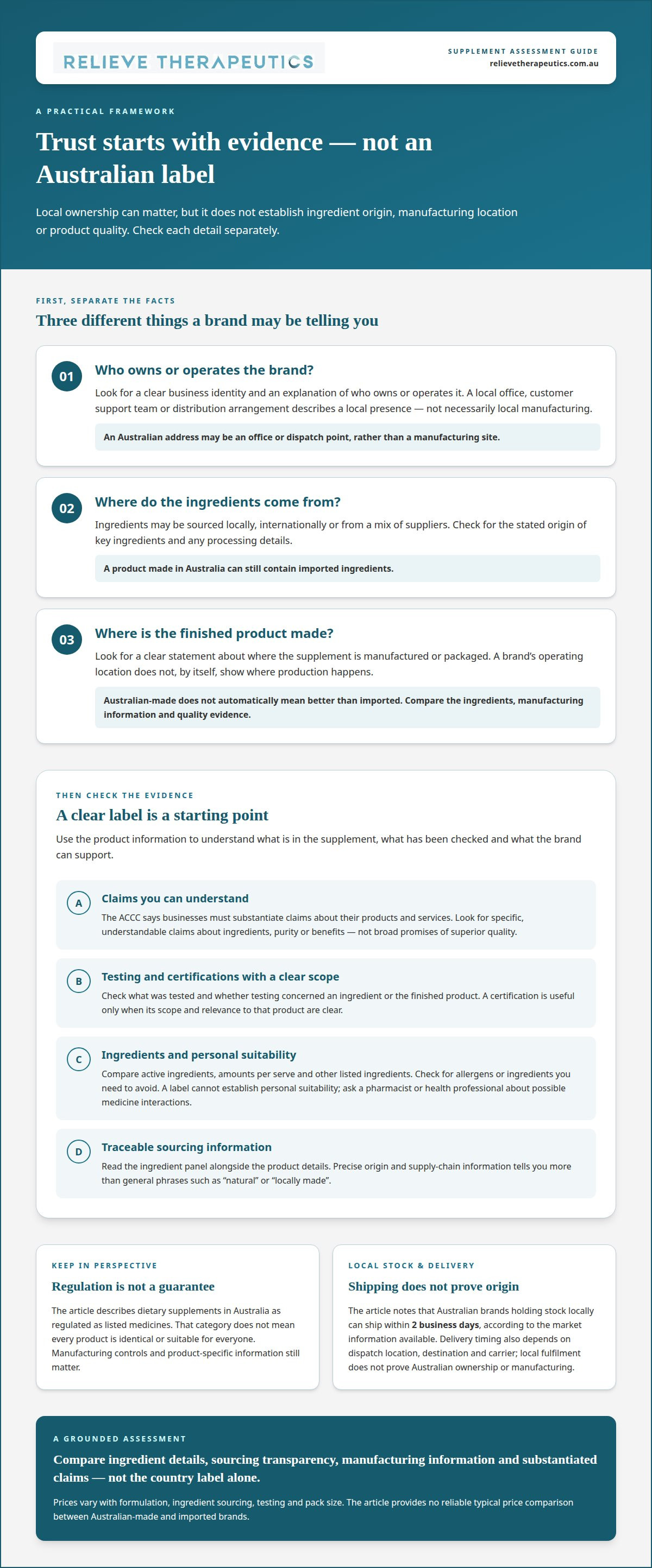
Australian ownership and operation
Australian ownership, Australian operations and Australian manufacturing mean different things. A locally owned brand may use an overseas manufacturer, while an international business may operate an Australian sales office. Treat these as separate details, not interchangeable proof of where a supplement’s ingredients come from or where it is made.
To understand ownership, look for a clear business identity and an explanation of who owns or operates the brand. Then distinguish this from its manufacturing arrangements. For example, an Australian-owned business might state that its products are manufactured overseas. That gives a more complete picture than an Australian flag or local-sounding brand name alone.
Operations refer to the work a business conducts in Australia. A local office, customer support team or distribution arrangement can indicate a local presence, but each describes a different function. Check which role the business identifies. An Australian address, for instance, may be an office or dispatch point rather than a manufacturing site.
Local stock can affect fulfilment without proving Australian ownership. Australian brands holding stock locally can ship within 2 business days, according to the market information available. That timing relates to local stock and shipping, not ingredient origin or production standards. The location of inventory is another distinct detail to assess.
Why buy supplements from an Australian company? Local ownership may make a business’s identity easier to understand, while local operations can clarify how it serves Australian customers. Neither point alone establishes product quality. Read these details alongside ingredient and manufacturing information for a more complete picture.
Still weighing why buy supplements from an Australian company? Separate three claims: who owns the brand, where it operates, and where the finished product is made. “Australian owned” doesn’t automatically mean “made in Australia”, and Australian manufacture doesn’t mean every ingredient is locally sourced. Clear distinctions help you choose based on the details that matter to you.
Many Australian supplement manufacturers operate under quality and safety requirements intended to support product consistency and quality control. Partnering with a private label supplement manufacturer can avoid the need to establish a company’s own R&D operation. More than 40,000 Daigous operate across Australia.
Country-of-origin information
Country-of-origin details distinguish an ingredient’s source from the finished supplement’s production location. A product may contain an internationally sourced ingredient, then be manufactured or packaged in Australia. These are separate parts of the supply chain, so one “Australian” description may not explain every stage.
Provenance and traceability matter because product fraud can threaten consumer health and the reputation of Australian industry. Clear origin information shows where ingredients come from and how they relate to the finished product. For example, a label might identify an ingredient’s source country while separately stating where the capsules were made.
Read the product label and accompanying information for specific descriptions. Look for distinctions between:
- The origin of key ingredients, such as a botanical extract.
- The location where the finished supplement is manufactured.
- Where the product is packaged or dispatched.
These details answer different questions. An Australian dispatch address, for instance, identifies a fulfilment location, not necessarily the ingredient source or manufacturing site.
Broad phrases such as “Australian brand” describe a connection to Australia, but don’t necessarily explain where ingredients originate. Likewise, “made in Australia” and “Australian ingredients” aren’t interchangeable. Assess each claim in context and look for product-specific wording rather than inferring the whole supply chain from a flag or business address.
If an ingredient’s origin matters to your decision, follow its description through the available product information. A useful explanation connects the named ingredient with its source and clarifies whether it’s used in the finished product. Information about packaging or dispatch alone doesn’t answer the sourcing question.
Country-of-origin information is one part of a broader assessment, not a stand-alone measure of quality. Compare it with the ingredient list, manufacturing details and the brand’s explanation of traceability. This gives you a clearer picture of what “Australian” refers to and how openly a supplement brand describes its supply chain.
Relieve Therapeutics
Relieve Therapeutics offers a focused range of Palmitoylethanolamide (PEA) capsules for people considering this supplement. After assessing ownership, ingredient sourcing and country-of-origin details, you can use the product information to decide whether a PEA supplement suits your preferences and needs. The range includes PEA 60 Capsules, PEA 120 Capsules and PEA 180 Capsules, giving you different capsule counts to consider. Review the label and product details alongside the sourcing information discussed above. That helps keep your decision grounded in the specific product, rather than Australian ownership alone. For questions about the range, contact Relieve Therapeutics.
Choose with clarity and confidence
Understanding why you might buy supplements from an Australian company is most useful when it leads to a considered choice, not an assumption based on a label. Decide which factors matter most to you, such as ingredient origin, manufacturing location or the business’s Australian presence. Then consider whether the product information answers your questions clearly and aligns with your preferences.
If you’re considering PEA, Relieve Therapeutics offers a focused range of capsules. Review the product information and consider your individual needs before choosing a supplement. Make an informed choice based on the details that matter to you.
Contact Relieve Therapeutics if you’d like to discuss the PEA capsule range. Take your next step at a pace that feels right for you.
Frequently Asked Questions
What are the benefits of buying supplements from an Australian company?
Buying from an Australian company may make it easier to understand who sells a product and where to direct a question about its label or claims. The practical value depends on the business’s transparency, not its Australian identity alone. Keep the product name and packaging details handy if you need to clarify an ingredient or report a concern.
What does TGA-listed or AUST L mean on Australian supplements?
“AUST L” identifies a listed medicine in Australia. Dietary supplements are regulated as listed medicines by the Therapeutic Goods Administration (TGA), according to the Australian Bureau of Statistics. The marking concerns the product’s regulatory listing, not where the company is owned, where ingredients were sourced, or where the product was made. It also doesn’t establish whether a supplement suits your individual needs.