

If you’re tired of chronic pain side effects that disrupt work, sleep, concentration or everyday activities, your concerns deserve to be heard. It can be difficult to tell whether fatigue or other changes relate to pain, treatment or another health issue. You don’t have to work it out alone.
A useful review starts with a clear conversation, not an assumption that one approach suits everyone. This guide explains how pain symptoms and treatment effects can overlap, what to note before speaking with your GP or pharmacist, and how to discuss possible changes without stopping prescribed treatment on your own.
You’ll also learn how to weigh different support options, including PEA as a complementary supplement rather than a replacement for prescribed care. Understanding the product, its potential role and the questions to raise can help you make informed decisions with a healthcare professional.
Key Takeaways
- If you’re tired of chronic pain side effects, a simple symptom record can help you describe what’s changing and when.
- Patterns can guide a conversation, but they can’t establish on their own that a treatment caused a symptom.
- Compare support options by their intended role, practical demands, possible downsides and the guidance they may require.
- Prepare for a GP or pharmacist review by noting your concerns, daily goals and questions about monitoring or alternatives.
- PEA may be considered as a complementary supplement. Review its formula and discuss its place in your care plan.
Tired of chronic pain side effects? Start by separating pain from treatment effects
Persistent pain can make everyday decisions harder. Add an unwanted treatment effect, and it may be difficult to know what to do next. If you’re tired of chronic pain side effects, that uncertainty is understandable. Changes to your health and daily routine deserve attention, even when their cause isn’t immediately clear.
Chronic pain continues or recurs over time, but there isn’t one symptom pattern that describes everyone’s experience. Causes, effects and treatment approaches vary; the Chronic Pain Overview offers broader context. Your experience may also shift from day to day, making it harder to distinguish the effects of pain from those of treatment.
Fatigue, for example, could be connected with disrupted sleep, the effort of coping with pain, a treatment effect or another health issue. These possibilities can overlap. Timing and circumstances are useful details to discuss, but they can’t establish the cause on their own.
“Timing and context matter. A symptom that appears after a treatment change is useful information to discuss, but it doesn’t prove the treatment caused it.”
Why pain, fatigue and treatment effects can overlap
Pain can interrupt sleep, and poor sleep may make daily demands harder to manage. Mood, changes in routine and treatment may also affect energy or concentration. No single factor necessarily explains what you’re experiencing. If a symptom is new, changing or concerning, seek clinical assessment rather than trying to diagnose its cause yourself.
When describing a change, note what else was happening: how pain affected your sleep, whether your routine had shifted and whether treatment had recently changed. This context gives a GP or pharmacist a fuller picture to consider alongside your health history. It helps focus the discussion without turning an observation into a conclusion.
What “side effects” can mean in everyday life
An unwanted effect isn’t only a symptom on a list. It may mean struggling to concentrate at work, sleeping poorly, moving around less comfortably or finding usual routines harder. The same treatment can affect people differently, so your own experience matters. Explain the practical impact to help your clinician understand what you want to address.
You don’t need to feel guilty about raising a concern or worry that you’re being difficult. Reporting what has changed is useful when reviewing your care. Be as specific as you can about what feels different and how it affects your day, even if you’re unsure whether pain, treatment or something else is responsible.
A suspected side effect isn’t proof of what caused a symptom, so avoid making a treatment change based on guesswork. Describe what you’ve noticed, then discuss possible explanations and appropriate next steps with a healthcare professional. This gives your concerns a place in the conversation while allowing for careful assessment.
How to make sense of chronic pain side effects without guessing
If you’re tired of chronic pain side effects, it can be tempting to look for one explanation straight away. A brief, consistent record can make an appointment more focused, especially when symptoms fluctuate or several treatments are involved. It won’t tell you what caused a symptom, but it can help you explain what you’ve noticed.
A symptom record is a tool for clearer discussion, not a way to diagnose yourself. A pattern may be worth raising with your GP or pharmacist, but timing alone can’t prove that a medicine caused an effect. Pain, sleep, other health changes and treatment can overlap, so consider the pattern alongside your individual circumstances.
What to note before a healthcare appointment
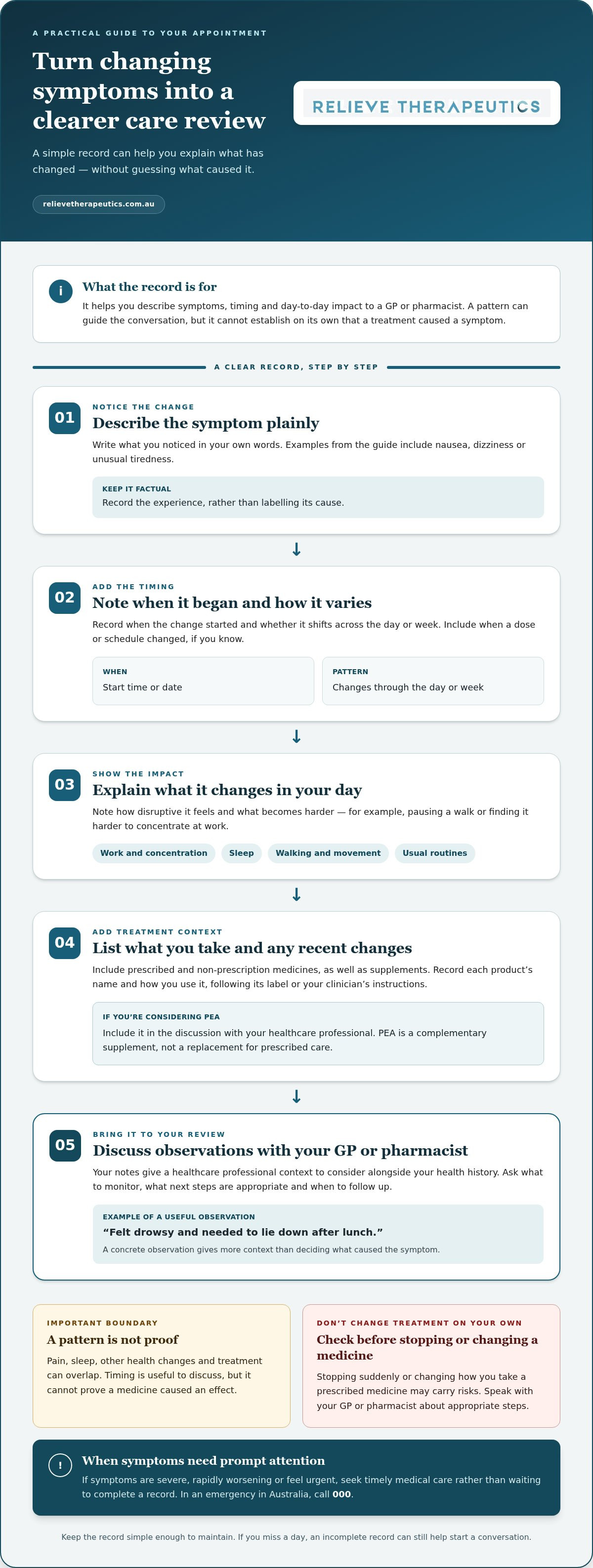
Keep the record simple enough to maintain. A notebook or phone note can capture useful details without making symptom tracking another burden. For each change, consider noting:
- Symptom: Describe what you noticed in plain language, such as nausea, dizziness or unusual tiredness.
- Timing: Record when it began and whether it varies across the day or week.
- Severity and impact: Note how disruptive it feels and what it changes, such as needing to pause a walk or finding it harder to concentrate at work.
- Treatment context: List relevant medicines and any recent changes, including when a dose or schedule changed if you know.
Include non-prescription medicines and supplements as well as prescribed treatments. Record each product’s name and how you use it, following its label or your clinician’s instructions. This gives your healthcare professional a more complete view of what you take and helps them consider possible overlaps. If you’re considering PEA, include it in the discussion and review information about PEA supplements.
Use concrete observations rather than trying to label the cause. For instance, “felt drowsy and needed to lie down after lunch” gives more context than “the medicine made me tired”. If you miss a day of tracking, don’t worry. An incomplete record can still help start a conversation.
Why not to change prescribed treatment on your own
Stopping a prescribed medicine suddenly or changing how you take it may carry risks, depending on the treatment and your circumstances. Before making a change, speak with your GP or pharmacist about what you’ve recorded and ask what steps are appropriate. You can also ask what to monitor and when to follow up.
If symptoms are severe, rapidly worsening or feel urgent, seek timely medical care rather than waiting to complete a diary or for a routine appointment. In an emergency in Australia, call 000. Your notes can support a review, but getting prompt care takes priority.
Compare chronic pain support options by benefit, burden and fit
If you’re tired of chronic pain side effects, compare options by their intended role, practical demands and fit with your circumstances. A treatment review, non-drug support and a complementary supplement aren’t interchangeable. They may form parts of a broader plan when considered with a healthcare professional.
| Option | Intended role | Practical burden | Possible downsides and guidance |
|---|---|---|---|
| Clinician-led treatment review | Review current care in light of symptoms, goals and health circumstances. | Requires time to discuss concerns and consider follow-up or monitoring. | Any change may have risks or trade-offs. Discuss options with the treating professional before changing prescribed treatment. |
| Non-drug supports | Support function and day-to-day wellbeing; options may include movement, sleep support or psychological strategies. | May involve regular practice, appointments or adapting activities to your needs. | Suitability and experience vary. A healthcare professional can help consider what’s appropriate for your circumstances. |
| Complementary supplements | May be considered as an addition to existing care, rather than a replacement for it. | Requires checking the product’s directions and accounting for it in your overall care plan. | Evidence and formulations vary; interactions and adverse effects are possible. Discuss use with a GP or pharmacist. |
Reviewing current treatment with a clinician
A treatment review is a chance to explain which effects are hardest to live with, what you hope to manage better and what matters most in daily life. A GP, pharmacist or treating professional can consider this alongside your health circumstances and existing care. There isn’t one adjustment that suits everyone. Use the conversation to understand possible options, trade-offs and monitoring rather than deciding on a change alone.
Considering non-drug and complementary support
Movement, sleep support and psychological strategies may be worth discussing if they suit your needs and goals. A supplement is a separate option to assess, not automatically a safer or more effective one. Its evidence, potential interactions, adverse effects and practical fit all matter. This guide to non-opioid pain relief supplements can help you explore the category while keeping expectations measured.
Use the comparison as a conversation aid, not a ranking. Ask which option addresses your main concern, what effort or monitoring it involves, and how it fits alongside your current care. Combining approaches may suit some people, but adding a supplement doesn’t mean stopping prescribed treatment. A GP or pharmacist can help you consider the whole plan and identify questions that need a tailored answer.
Prepare for a chronic pain side-effect review with your GP or pharmacist
If you’re tired of chronic pain side effects, a clear plan can make a conversation with your GP or pharmacist more manageable. You don’t need to arrive with a diagnosis or a preferred solution. Explain what’s affecting you, hear what may be relevant and agree on informed next steps together.
Before the appointment, bring your symptom notes and a current list of prescribed medicines, non-prescription medicines and supplements. If you can, note what you most want to improve, such as being more alert at work or sleeping with fewer interruptions. A specific goal helps keep the discussion focused on what matters in your daily life.
A simple checklist for the appointment
- Describe the concern: Explain what has changed, when you noticed it and how it affects your usual activities.
- Share your records: Show your notes and list of medicines and supplements, including any recent treatment changes.
- State your goals: Say what you’d like to manage better, while recognising that your clinician can help weigh what’s realistic and appropriate.
- Agree on next steps: Ask what to monitor, when to follow up and how to get advice if the situation changes.
This isn’t a demand for a particular treatment. It’s a structured way to bring your experience into the review and help your healthcare professional understand the trade-offs you’re facing.
Questions that can make the conversation clearer
Open questions can help explore the possibilities without assuming a cause. Ask whether the symptom could relate to treatment, pain itself or another issue that needs assessment. If you’re considering a change, ask which steps require professional guidance. Before you leave, clarify what to monitor, when to follow up and who to contact if you have further concerns.
- Could anything in my current care or health history help explain this change?
- Are there other possible causes that should be assessed?
- What should I avoid changing without speaking with you first?
- What changes should prompt me to seek further care, and how soon?
If you’re considering a complementary option such as a supplement, include it in the conversation. A GP or pharmacist can consider it alongside your existing care, medicines and health circumstances. You can explore PEA supplement options to understand the product before discussing whether it fits your plan.
When symptoms need prompt attention
Don’t wait for a routine appointment if symptoms are severe, sudden or rapidly worsening. Seek urgent medical help. In an emergency in Australia, call 000; don’t delay to finish reading or complete your notes. For concerns that aren’t an emergency but still need timely advice, contact a healthcare professional promptly.
Could PEA fit your chronic pain plan? Know the evidence and limits
If you’re tired of chronic pain side effects, it’s understandable to look at other options. Palmitoylethanolamide (PEA) is a dietary supplement that may be considered as a complementary part of a plan. It isn’t a cure, prescription medicine or substitute for clinical care, and it shouldn’t replace prescribed treatment. Whether it’s appropriate depends on your health circumstances, current medicines and goals.
What the PEA evidence can and cannot tell you
Research into PEA may offer useful information, but study findings can’t predict exactly how an individual will respond. Study design, participants and the conditions examined all affect how results should be interpreted. A reported outcome isn’t a promise that PEA will help you or proof that it’s suitable for every kind of persistent pain.
PEA is discussed in relation to biological processes involved in pain, but a proposed mechanism isn’t the same as evidence of a guaranteed benefit. For more background on this distinction, read about how PEA works for pain. A GP or pharmacist can help you consider available information alongside your existing care and health history.
Product details and sensible precautions
Relieve Therapeutics PEA capsules provide 600 mg PEA, 150 mg Quercetin and 30 mg Luteolin per serving. The recommended use is two capsules daily, providing 600 mg PEA total. These details describe the product; they don’t establish how you personally might respond or whether it’s suitable for you.
PEA isn’t side-effect-free. Possible mild effects include gastrointestinal discomfort, headache and dizziness. Discuss potential interactions and any supplement use with a healthcare professional, particularly if you take medicines or have other health considerations. People who are pregnant or nursing should consult a healthcare professional before use.
The capsules are ultra-micronised and produced in a GMP-certified Australian facility. Each batch is third-party quality-control tested for purity, potency and heavy metals. These are product-quality details, not evidence of an effect on pain or a guarantee of an individual outcome. Keep your GP or pharmacist informed if you’re considering adding a supplement to your plan.
If, after discussing the potential fit and precautions with a healthcare professional, you’d like to review the product, explore Relieve Therapeutics PEA capsules. Consider them as one option within a broader plan, not a replacement for prescribed care or follow-up.
Make your next pain-care conversation count
Being tired of chronic pain side effects doesn’t mean you have to accept uncertainty or make a rushed decision. Choose the concern you most want addressed, identify what you’d like daily life to feel more manageable, and bring that priority to your GP or pharmacist. A clear goal gives the conversation a practical focus and keeps decisions connected to what matters to you.
If PEA is an option you’re considering, treat it as one question within your wider care plan, not a standalone answer. Review the product information and discuss whether it fits your circumstances and existing care. You can explore Relieve Therapeutics PEA capsules as part of that consideration.
You’re entitled to raise concerns, ask for explanations and take part in decisions about your care. When you’re ready, explore Relieve Therapeutics PEA capsules and bring any questions about adding PEA to your GP or pharmacist.
Frequently Asked Questions
Can chronic pain itself make you feel tired, even without medicine side effects?
Yes, persistent pain can contribute to tiredness even if you’re not experiencing a medicine side effect. Pain may interrupt rest or make ordinary tasks take more effort, which can leave you feeling drained. Fatigue can also have other causes, so don’t assume pain is the only explanation. If it’s new, worsening or interfering with daily life, discuss it with your GP.
Should I stop taking pain medicine if I think it is causing side effects?
Don’t stop or change prescribed pain medicine without first getting advice from your prescriber or pharmacist. The risks of an abrupt change depend on the medicine and your circumstances. Contact your GP or pharmacist, explain what you’re experiencing and ask what to do next. If symptoms are severe or urgent, seek timely medical care rather than waiting for a routine review.
Can side effects start after I have taken a treatment for a while?
Yes, an unwanted effect may become noticeable after you’ve been taking a treatment for some time. A change in dose, another medicine or supplement, or a shift in your health may be relevant, but timing alone can’t confirm the cause. Note when the symptom appeared and what else changed, then discuss the details with your GP or pharmacist.
How can I tell whether fatigue is from chronic pain or treatment?
You may not be able to distinguish the cause reliably on your own. If you’re tired of chronic pain side effects, note when fatigue occurs, how it affects you and whether it varies with sleep, pain or treatment timing. Share that information with a healthcare professional, who can consider other health factors and your full medication list. A pattern can guide assessment, but it isn’t a diagnosis.
Can I discuss supplements with my pharmacist while taking pain medicine?
Yes. A pharmacist can help review a supplement alongside your medicines and consider whether potential interactions or side effects need attention. Bring the supplement packaging or a clear list of its ingredients, plus the names of your prescription and non-prescription medicines. Include how you take them. This gives the pharmacist more useful information than a product name alone and supports a more informed discussion.
Is PEA a replacement for prescribed chronic pain treatment?
No. PEA is a dietary supplement and shouldn’t replace prescribed medicine, clinical care or a treatment plan. If you’re considering it, discuss its suitability with a healthcare professional, particularly if you take other medicines or have health concerns. They can help you weigh the option within your care plan. Don’t stop prescribed treatment because you’re thinking about trying a supplement.
What should I bring to an appointment about chronic pain side effects?
Bring a current list of medicines and supplements, including non-prescription products, and any notes about the changes you’ve noticed. If available, take the packaging or a photo of the label so ingredients and directions are clear. It can also help to write down your main question and one daily activity you hope to manage better. These details give the appointment a practical focus.