

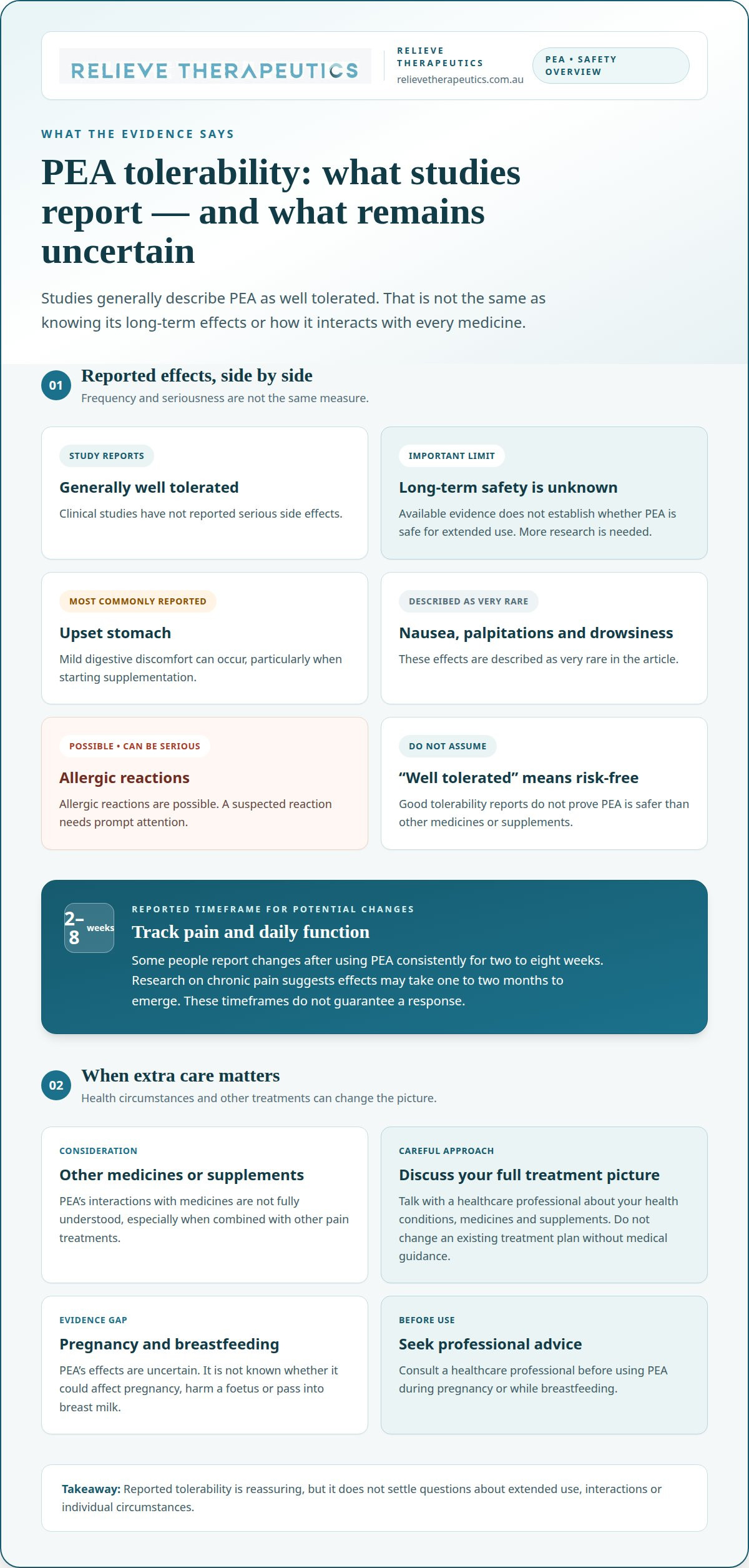
PEA is generally well tolerated, but available evidence does not establish whether it is safe for long-term use. Studies have not reported serious side effects, although mild digestive discomfort can occur. More research is needed to understand the effects of extended use. PEA is a fatty acid amide produced naturally by the body and found in foods such as egg yolks, soybeans and peanuts.
Questions about using a supplement for ongoing pain are understandable: what does it do, how long might it take to notice a difference, and how can it be used carefully? This guide explains how PEA may influence pain, the conditions it has been studied for, and what is known about safety, dosage and gradual dose increases. It also covers why your health circumstances and other medicines matter when considering PEA, helping you make a more informed decision.
Key Takeaways
- PEA may influence pain pathways, and research has examined its use for chronic and neuropathic pain.
- Clinical studies generally report good tolerability, but mild digestive discomfort can occur and long-term effects need further study.
- PEA has been considered for several pain conditions; its potential benefits depend on the condition and the evidence behind it.
- Dosage and gradual increases matter. Learn how to interpret common dosing guidance and use it safely alongside other treatments.
How does PEA work (mechanism of action)?
Palmitoylethanolamide (PEA) is a fatty acid amide that may influence pain and inflammation through several biological pathways. In a neuropathic pain model, removing the PPAR-α receptor was associated with the loss of PEA’s effects, suggesting that PEA may act on this receptor.
PEA may also influence glial cells, which help regulate nervous-system responses involved in chronic pain. It can stabilise mast-cell membranes and suppress the production of pro-inflammatory mediators. These proposed actions help explain why researchers have studied PEA as an adjunct to, rather than a replacement for, standard pain care.
A 2017 systematic review examined 28 clinical trials of PEA for chronic and neuropathic pain. Most randomised controlled trials included in the review found improvements in pain management and measures of general wellbeing. Separate research has reported reduced neuropathic pain in cancer patients using PEA alongside standard pain medication. These findings are promising, but study results do not establish that PEA works for every patient or pain condition.
Potential benefits may take time to appear. Research on PEA for chronic pain suggests that effects may take one to two months to emerge, so an immediate change is not the only way to assess a response. Tracking pain and daily function can help show whether a treatment is making a practical difference.
PEA’s interactions with medicines are not fully understood. Before use, discuss your health conditions, medicines and supplements with a healthcare professional, especially if you plan to combine PEA with other pain treatments. Do not change an existing treatment plan without medical guidance.
In Australia, dietary supplements are not formally tested to guarantee their contents. TGA regulation should not be taken as proof that every supplement’s contents have been independently confirmed.
PEA’s effects during pregnancy and breastfeeding are uncertain. It is not known whether PEA could affect pregnancy or harm a foetus, or whether it passes into breast milk. Consult a healthcare professional before using it in either situation.
PEA: A Natural Pain Killer?
PEA’s reported tolerability is relevant when considering ongoing pain management, but it does not resolve questions about long-term use. Effects may take time: some people report changes after using it consistently for two to eight weeks.
Reported tolerability and side effects
Tolerability describes how people respond to PEA during treatment, including any unwanted effects. Clinical studies generally describe PEA as well tolerated, with no serious side effects reported in those studies. Mild digestive discomfort can occur, particularly when starting supplementation. The two-to-eight-week period reported for potential effects also offers a practical timeframe for tracking changes in pain and daily function.
Common and serious side effects
Side effects are unwanted responses that may occur while taking PEA. Upset stomach is the most commonly reported; nausea, palpitations and drowsiness are described as very rare. Allergic reactions are also possible and can be serious, so a suspected reaction needs prompt attention. Reports of good tolerability do not establish long-term safety. More research is needed to understand the effects of extended use.
Effects on mast cells and glial cells
Mast cells and glial cells are involved in inflammatory and nervous-system responses associated with pain. PEA may stabilise mast-cell membranes and suppress the production of pro-inflammatory mediators. It may also influence glial cells, which play a role in chronic pain and neuroinflammation. These proposed effects offer a biological explanation for studying PEA in neuropathic pain, but do not prove clinical benefit for every person.
Long-term safety comparisons
The available evidence does not establish a direct long-term safety comparison between PEA, common pain medicines and other supplements. A useful comparison needs to account for the specific medicine or supplement, dose, duration and a person’s health circumstances. PEA’s generally reported tolerability is not proof that it is safer than another option. Discussing all medicines and supplements with a healthcare professional can help assess potential risks when considering ongoing use.
Conditions for which PEA may be considered
PEA is a naturally occurring fatty acid amide studied as a supplement for chronic pain. Its proposed role relates to pain and inflammation, but evidence varies by condition. Chronic pain is the clearest area of use described in the available research. Potential benefits for insomnia and mental health problems are less well defined, so they should not be treated as established uses. The cause and symptoms of a condition matter when considering whether PEA is relevant.
Some studies have examined inflammatory joint pain in rheumatoid arthritis and nerve pain linked to diabetes. One study reported reduced inflammatory joint pain in patients with rheumatoid arthritis. Research on painful diabetic neuropathy reported reduced nerve-related pain and recommended considering PEA in pharmacological treatment guidelines. These findings relate to specific conditions. They do not establish PEA as a replacement for prescribed care or as an effective option for everyone with joint or nerve pain.
Neurological and neuropsychiatric conditions need careful distinction. A systematic review included 17 outputs concerning neurological disturbances and 15 concerning neuropsychiatric disturbances. Those categories show the range of outcomes assessed, not proof that PEA treats a specific neurological or mental health diagnosis. For example, a review category alone cannot establish efficacy for insomnia, anxiety or another individual condition. The strength and relevance of evidence depend on the condition and the outcomes measured.
PEA is also discussed in relation to the endocannabinoid system, but this connection does not make it a cannabinoid medicine or establish treatment benefits on its own. Its classification as a fatty acid amide helps explain why researchers investigate its biological activity, including effects related to inflammation. For a practical decision, identify the main symptom, its likely cause and your current treatment plan. A healthcare professional can consider these factors, possible side effects and other medicines before PEA is added to your care.
Daily dosage and titration
Palmitoylethanolamide, or PEA, is a fatty acid amide sold as a dietary supplement. Published dosing guidance varies with the condition, formulation and clinical context. For nerve pain, a commonly suggested range is 300 mg to 1200 mg per day. Follow the directions on the product label or the plan recommended by your healthcare provider.
One suggested starting schedule is one 400 mg capsule three times daily. If this hasn’t helped after a couple of weeks, some guidance describes increasing to two 400 mg capsules three times daily. Another gradual approach is adding an extra capsule every 4-5 days. These examples are not interchangeable instructions: the right schedule depends on the intended dose and individual circumstances.
A maximum daily dose of 2400 mg per day is described in the supplied dosing guidance. Don’t treat that figure as a target or increase your dose independently. Some people may reduce their dose after an initial trial and maintain the effect. Changes should be guided by the response, any side effects and advice from a healthcare provider.
Consistency matters when assessing a supplement. PEA may take one to two months to show potential benefits for chronic pain, so record symptoms and daily function during use. If you miss a dose, do not take a double or extra dose to compensate. Follow the product directions, and discuss your full list of medicines and supplements with a healthcare professional before starting or changing your use of PEA.
Capsules are commonly described in 300 mg or 400 mg strengths, while some guidance notes that taking PEA four or more times per day may improve absorption. These details don’t establish one controlled regimen for everyone. For available capsule formats, review PEA capsule options and use the product directions alongside personalised clinical advice.
Relieve Therapeutics: PEA 60 Capsules
Relieve Therapeutics offers PEA 60 Capsules for readers considering a PEA supplement as part of their pain-management discussion. Capsule options also include PEA 120 Capsules and PEA 180 Capsules, giving you a choice of bottle size.
These products provide PEA capsules for consumer use. They don’t replace prescribed treatment or personalised clinical advice. If you’re weighing dosage, ongoing use or combining PEA with medicines, discuss your plan with a healthcare professional and follow the directions for your chosen product. This can help you consider PEA in the context of your health and current treatment.
To explore the capsule options, visit Relieve Therapeutics online.
Make your next step a considered one
If you are asking whether PEA is safe for long-term use, the available evidence does not establish its safety over extended periods. Consider how a supplement fits with your health needs, medicines and broader pain-management plan, rather than treating it as a stand-alone solution.
Before starting or continuing PEA, discuss your goals and concerns with a healthcare professional. A clear plan can help you assess whether it is appropriate, how to monitor your response and when to review its place in your routine. This conversation can also help you consider whether PEA is safe for long-term use alongside your current treatments.
If you’d like information about PEA capsules, contact Relieve Therapeutics. Taking a measured, informed approach can help you move forward with greater clarity.
Frequently Asked Questions
What is Palmitoylethanolamide (PEA)?
PEA is a fatty acid amide in the N-acylethanolamine class. It is present at high concentrations in the central nervous system, where researchers study its biological activity. PEA is also available as a dietary supplement in capsule or powder form. This distinction matters: a supplement is not the same as a prescription medicine, and its use should be considered alongside your health needs and existing care.
Does PEA interact with foods or drinks?
No interactions between PEA and foods or drinks are known. Available information does not identify a particular meal or beverage that must be avoided with PEA. If you notice symptoms after taking it with a specific food, record what you ate and when the symptoms appeared. Share that information with a healthcare professional, especially if you have food allergies or dietary restrictions.
Does PEA interact with medicines (drug interactions)?
Interactions between PEA and medicines are not fully understood, so a complete interaction profile cannot be assumed. Before adding it to a regimen that includes pain medicines, prescription treatments or other supplements, discuss the full list with your healthcare professional. This is particularly important if you plan to combine PEA with an existing pain treatment: do not reduce or stop prescribed medicine without guidance from the clinician managing your care.
How long does it take to see an effect after starting PEA?
Some people may need four to six weeks after starting PEA before noticing benefits. Response times vary, so a daily record can make gradual changes easier to recognise. Note pain levels, sleep and activities that matter to you, such as walking or preparing meals. Bring those observations to a healthcare appointment to review whether PEA is helping your day-to-day function.
What Does the Research Say?
A systematic review examined 47 randomised controlled trials and extracted 48 eligible outputs on PEA in patient populations. The review followed PRISMA 2020 reporting guidelines and included outcomes across different types of disturbance and biomarkers. Those figures describe the scope of the review, not proof that PEA works for every condition. Study design, measured outcomes and the condition being treated all matter when interpreting findings.
What are the most common side effects of PEA?
Upset stomach is the most commonly reported side effect; mild digestive discomfort may also occur when starting PEA. Nausea, palpitations and drowsiness are reported very rarely, and allergic reactions can be serious. Reports of tolerability alone do not establish whether PEA is safe for long-term use. If a new or concerning symptom develops, pause use and discuss it with a healthcare professional.