

Could a supplement help with nerve-related discomfort, and how can you tell whether online claims are reliable? If you’re researching PEA for nerve pain Australia, it’s understandable to want clear answers. Persistent discomfort can affect sleep, movement and everyday routines, while the evidence and product information online can be difficult to assess.
Palmitoylethanolamide, or PEA, has been studied for pain. However, research findings don’t guarantee it will help every person, or show how it compares with other care options. A careful review means considering what studies suggest and where their limits lie, rather than relying on confident marketing claims.
This guide explains how to assess the evidence, check Australian supplement information and prepare useful questions for your GP, pharmacist or treating clinician. You’ll find practical points to check on product labels and questions to raise about possible benefits, uncertainties and risks in the context of your health. The aim is to support an informed decision without changing prescribed treatment on your own.
Key Takeaways
- Research on PEA may offer useful context, but study findings don’t guarantee a benefit for your symptoms. Check who was studied, the formulation and the outcomes measured.
- When considering PEA for nerve pain Australia, distinguish supplement research from clinician-led assessment and prescribed care.
- Check the product label for clear ingredient and serving information. Verify any claimed Australian regulatory status against current official information for the specific product.
- Ask your GP, pharmacist or treating clinician whether PEA is appropriate for you and what to monitor alongside your existing care.
- Relieve Therapeutics offers PEA capsules in 60-, 120- and 180-capsule supplies. Consider the product information alongside your needs and professional advice.
PEA for nerve pain in Australia: what the term means and what it does not
Persistent nerve-related symptoms can interfere with sleep, movement and everyday routines. It’s understandable to look for other options, but supplement claims need careful scrutiny. Confident wording can sound like proof when it isn’t. If you’re searching for PEA for nerve pain Australia, start by separating what PEA is, what researchers hypothesise and what clinical evidence can establish.
PEA is short for palmitoylethanolamide, a naturally occurring fatty acid amide that is also studied as a supplement ingredient. For an overview of its chemistry and research history, see Palmitoylethanolamide (PEA). A dietary supplement is not the same as a prescription medicine or clinical treatment. Its availability does not establish that it is suitable or effective for a particular person.
What do people mean by nerve pain or neuropathic pain?
Neuropathic pain describes pain associated with damage or dysfunction in the nervous system. People may report burning, tingling, numbness or electric-shock-like sensations, but these experiences aren’t a diagnosis. Similar symptoms can have different causes, so a description alone can’t confirm that pain is neuropathic or identify its source.
Arrange an assessment with a GP or appropriate clinician if symptoms persist, are severe or change. A clinician can consider your health history and symptoms, investigate possible causes and discuss care suited to your circumstances. Don’t use a supplement claim as a substitute for that assessment.
What is PEA, and what can a supplement claim establish?
PEA is being studied for its possible effects on pain and inflammation. One proposed explanation is that it may influence pathways involving the endocannabinoid system and glial cells, which are involved in nervous system activity. This is a biological hypothesis, not proof that taking a PEA supplement will relieve nerve pain.
Put simply: a proposed mechanism explains how an effect might occur; clinical evidence is needed to show whether people experience a meaningful benefit. A label or online claim tells you what a seller says about a product, but it can’t establish an individual outcome. Check product status and claims against current Australian information rather than assuming they apply based on the ingredient name alone.
This article provides general information, not an individual diagnosis or treatment advice, and it can’t guarantee an outcome. Don’t stop or change prescribed care without first speaking with your health professional.
What research on PEA for nerve pain can, and cannot, show
Research into PEA covers different pain conditions, formulations and study methods. That range may be useful, but it also makes broad claims easy to overstate. A finding in one group of people, or for one type of pain, doesn’t establish that PEA will help everyone with nerve-related symptoms.
Evidence summary: Human research has investigated PEA for pain, but findings from particular conditions and study designs can’t establish a reliable benefit for every cause of neuropathic pain.
How to read the evidence without overstating it
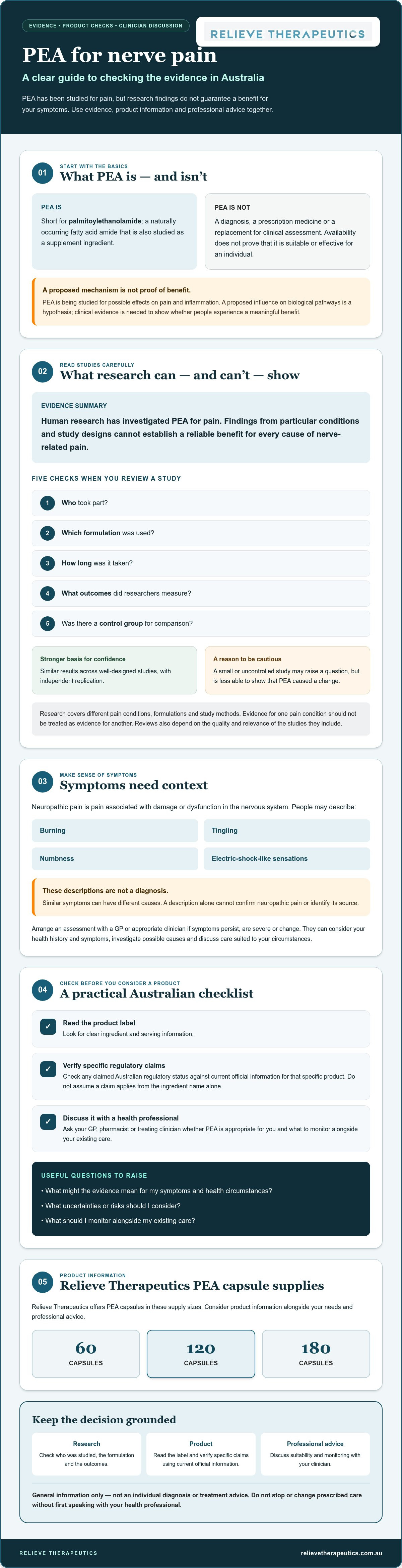
When reviewing a study, check who took part, which formulation was used, how long it was taken, what outcomes researchers measured and whether participants were compared with a control group. A small or uncontrolled study may identify a question worth exploring, but it is less able to show that PEA caused an observed change.
Independent replication matters too. Similar results across well-designed studies provide a stronger basis for confidence than one favourable result. Reviews can bring studies together, but their conclusions depend on the quality and relevance of the research they include. Evidence for one pain condition shouldn’t be treated as evidence for another.
The source information available for this section doesn’t identify specific human trials with verifiable details such as participant group, formulation, duration and measured outcomes. Those details, along with study counts, effect sizes and publication dates, should be checked against original papers and reputable reviews before being reported. Without that verification, precise claims could give a false impression of certainty.
Mechanism research is not the same as a proven outcome
Laboratory and animal research can help researchers investigate how PEA might influence biological pathways. These studies can support a hypothesis, but they don’t show on their own whether a supplement improves symptoms in people or whether an effect applies to a particular nerve condition.
For a plain-language discussion of proposed pathways, read about the science of how PEA works for pain. Treat explanations of possible mechanisms as context, not a promise of relief. When considering PEA for nerve pain Australia, ask a health professional how relevant the human evidence is to your diagnosis and existing care.
If you’re comparing supplement options after that discussion, you can review the PEA capsule supplies available from Relieve Therapeutics. Product information doesn’t establish an expected clinical outcome.
PEA and other nerve-pain care: compare evidence, not promises
Nerve-pain care isn’t a contest between one option and another. The right approach depends on the likely cause of symptoms, your health history and a clinician’s assessment. Medicines, non-medicine strategies and supplements have different purposes and evidence behind them. A comparison should help you ask better questions, not rank treatments.
| Care option | Evidence and intended role | Questions to ask |
|---|---|---|
| Clinician-led assessment and prescribed care | Assessment helps investigate possible causes and guide a plan based on your circumstances. Prescribed care is distinct from choosing a supplement for yourself. | What might be causing my symptoms? What is the aim of this care, and when should we review it? |
| Non-medicine strategies | These may form part of an individual care plan. Their suitability and role depend on the person and the clinical context. | Which strategies are appropriate for me, and how will we assess whether they’re useful? |
| Self-selected supplements, including PEA | Research findings depend on the condition, product and study design. A supplement’s availability or proposed mechanism doesn’t establish that it will benefit your symptoms. | Does the research match my diagnosis and the product I’m considering? Could it affect my existing care? |
How does supplement evidence differ from established nerve-pain care?
Evidence isn’t interchangeable. A supplement study may examine a specific formulation and group of participants, while a clinician considers your symptoms and medical history when discussing care. Don’t assume findings for one product or pain condition apply to another. Ask your GP, pharmacist or treating clinician how a proposed supplement fits with your current plan.
Don’t stop, delay or alter prescribed treatment because of supplement information. Speak with the health professional responsible for your care before making changes.
Which questions help put a PEA study in context?
Before drawing conclusions from a study, ask whether it involved people with a diagnosis like yours, a comparable participant group and the same formulation you’re considering. Check what benefits and adverse effects were measured, how long participants were followed and whether the results apply to your situation. For a broader framework, see this science-based guide to supplements for neuropathy.
If you’re exploring PEA for nerve pain Australia, you can review the available PEA capsule supplies as product information to discuss with a health professional, not as a substitute for personalised care.
How Australians can assess PEA product information and discuss it safely
Start with your health question, not the supplement claim. If you’re considering PEA for nerve pain in Australia, follow a practical sequence: clarify the diagnosis with a clinician, read the specific product label, check current Australian regulatory information, then discuss suitability with your GP or pharmacist.
What should Australians check on a supplement label?
Read the label and product information for the ingredient name, serving directions, warnings, supplier details, and batch or expiry information. Make sure you’re checking the details for the exact product you may use. Don’t infer quality, absorption or therapeutic effectiveness from terms such as “high strength” or from an ingredient description alone.
In Australia, check current information on the Therapeutic Goods Administration (TGA) website, including the Australian Register of Therapeutic Goods (ARTG), where relevant. Don’t assume a product is listed, or that a general statement about PEA confirms the status of a particular product. If the label or regulatory information is unclear, ask a pharmacist or contact the supplier for clarification.
What should I ask a GP or pharmacist before considering PEA?
Bring the product label or a clear photo of it. Tell your health professional about all supplements and medicines you take, any allergies and relevant health conditions. Ask whether this specific product is appropriate alongside your current care and the diagnosed cause of your symptoms. Personal suitability, possible interactions and dosing need product-specific and individual clinical advice.
It may help to agree on what changes to monitor, when to review the plan and what symptoms should prompt further care. Don’t stop, delay or alter prescribed treatment based on supplement information. For additional practical context, read this practical guide to taking PEA for nerve pain, then discuss any questions with a health professional.
- Diagnosis: What is the likely cause of my symptoms?
- Product: Does this label provide enough information to assess the product?
- Plan: What should I monitor, and when should we review it?
After checking the product information and discussing whether PEA is appropriate, you can review Relieve Therapeutics’ PEA capsule information and take any remaining product questions to your health professional.
Choosing a PEA supplement in Australia: informed next steps
Considering a supplement is a personal decision, best made after you’ve clarified the health question and discussed your symptoms with a health professional. For PEA for nerve pain Australia, assess the evidence, check the specific product information and ask your GP, pharmacist or treating clinician whether it may be appropriate for you.
- Clarify: Understand what’s known about the cause of your symptoms and what you hope to address.
- Assess: Consider how closely the available research matches your diagnosis and the product under consideration.
- Check and discuss: Review the current label and relevant Australian product information, then raise questions with a health professional.
When does reviewing a PEA product make sense?
Reviewing a product may be a reasonable next step once you’ve had an assessment and discussed supplements with a health professional. Relieve Therapeutics is an Australian retailer offering PEA capsules in 60-, 120- and 180-capsule supplies. These quantities describe pack sizes only. They don’t show which option is suitable for you or establish an expected health outcome.
For broader product-evaluation criteria, see the Australian buyer’s guide to high-quality PEA capsules. Read product information independently and check that it relates to the exact product you’re considering. Don’t infer ingredients, quality or regulatory status from general statements about PEA.
What are sensible next steps if nerve pain persists?
Book a follow-up with your GP or treating clinician if symptoms persist, worsen or interfere with daily life. Seek urgent medical assessment for sudden or severe symptoms. A clinician can help determine whether further investigation or a change to your care plan is needed. Don’t delay assessment while trying a supplement, or change prescribed treatment without professional advice.
Supplements don’t replace diagnosis or individualised care. If you’d like to consider the PEA supplies from Relieve Therapeutics, review their current product information and discuss any questions with your health professional before deciding.
Make your next step an informed one
Deciding whether to consider PEA starts with a clear understanding of your symptoms and the evidence relevant to your situation. Research findings don’t guarantee a benefit, and a proposed biological mechanism isn’t proof of a clinical outcome. Check product labels and Australian regulatory information for the specific supplement rather than relying on general claims about PEA.
If you’re exploring PEA for nerve pain Australia, speak with your GP, pharmacist or treating clinician about how it may fit with your diagnosis and existing care. Don’t stop or change prescribed treatment without their advice.
Relieve Therapeutics is an Australian retailer focused on Palmitoylethanolamide supplements, with PEA capsule supplies in 60, 120 and 180 counts. Review the current product information and note any questions you’d like to raise with a health professional.
Review the PEA capsule range and product information, then take the time you need to make a considered decision. Clear information and professional guidance can help you choose a next step with confidence.
Frequently Asked Questions
Is PEA proven to help nerve pain?
PEA isn’t proven to treat every type of nerve pain. Judge any potential benefit against relevant human studies, including their design, quality, participants and the specific condition researched. Findings for one diagnosis can’t automatically be applied to another. Discuss the evidence with your GP or pharmacist, and distinguish research findings from product advertising. A proposed biological explanation alone doesn’t establish that a supplement will improve your symptoms.
Can I take PEA with my nerve-pain medication?
Whether PEA is suitable alongside your medication depends on your health circumstances, the medicines you take and the specific product. Don’t assume there are no interactions. Show the product label to your GP or pharmacist before using it, particularly if you take multiple medicines or manage ongoing health conditions. Don’t stop, reduce or change prescribed treatment based on supplement information. Your prescribing clinician can advise how a supplement may fit with your care plan.
How much PEA should I take for nerve pain?
There isn’t one dose that can be recommended for everyone. Research protocols and product directions may differ, and appropriate advice depends on the individual and the specific product. Read and follow the current directions on its label, and ask your GP or pharmacist before starting or changing how you use a supplement. They can consider your circumstances and care plan. General dosage information isn’t a personalised recommendation.
What is the difference between neuropathic pain and other pain?
Neuropathic pain is associated with damage or dysfunction in the nervous system, while pain can also arise from other causes. People may report burning, tingling or electric-shock-like sensations, but symptoms alone can’t identify the cause or confirm a diagnosis. A health professional can assess your symptoms and circumstances. Arrange an appointment if pain persists, worsens or affects daily life, so you can discuss appropriate assessment and care.
Is PEA regulated in Australia?
Australian requirements depend on the individual product and its regulatory classification, so don’t assume every PEA supplement has the same status. Check current Therapeutic Goods Administration (TGA) information and verify details for the exact product you’re considering. A general statement about PEA doesn’t confirm that a particular supplement is listed or approved. If its status or label information is unclear, ask a pharmacist or contact the supplier for clarification.
Can PEA replace prescribed treatment for nerve pain?
No. Don’t stop, reduce or delay prescribed treatment because of information about a supplement. Care for nerve pain should take account of its cause and your individual health circumstances. Before adding PEA or making any change to your care plan, speak with the clinician who prescribed your treatment or ask a pharmacist. They can help you consider whether the specific product is suitable alongside your existing care.
What should I check before buying PEA capsules in Australia?
Check the full ingredient information, serving directions, warnings, supplier details and current regulatory information for the specific product. Compare marketing claims with relevant evidence, and don’t treat capsule quantity, confident wording or a proposed mechanism as proof of effectiveness. If you’re unsure whether the product suits you, show its label to your GP or pharmacist. Relieve Therapeutics is an Australian retailer offering PEA capsules in 60-, 120- and 180-capsule supplies.
To review the available options, see Relieve Therapeutics’ PEA capsule range and product information, then discuss any questions with your health professional.