

Could a supplement studied for pain help with interstitial cystitis? If bladder pain, urgency or frequent trips to the toilet are affecting your sleep, work or everyday plans, it’s understandable to look for additional support. Interest in PEA for interstitial cystitis support is growing, but evidence for PEA in this specific condition remains limited.
It also matters what’s causing the symptoms. Cystitis can be related to an infection, while interstitial cystitis or bladder pain syndrome (IC/BPS) describes ongoing bladder-related pain and urinary symptoms that aren’t necessarily caused by infection. The right approach depends on an accurate assessment, not symptoms alone.
This article explains what research on PEA may suggest, and what it can’t yet establish about IC/BPS. You’ll learn how PEA might fit, if appropriate, within a broader clinician-guided plan, and find practical questions to discuss with a health professional. We’ll also look at how to assess supplement claims carefully, so interest in a possible option doesn’t replace diagnosis or established care.
Key Takeaways
- Persistent bladder symptoms can have different causes, so an assessment helps distinguish interstitial cystitis or bladder pain syndrome from infection.
- PEA for interstitial cystitis support is an area of interest, but proposed biological mechanisms don’t establish that it improves symptoms in people with IC/BPS.
- Compare options by their purpose and evidence, and treat supplements as possible complementary choices rather than replacements for diagnosis or care.
- Before an appointment, note your symptom patterns, how long they’ve been present, and any medicines, supplements or previous assessments.
- Relieve Therapeutics offers PEA capsules in 60-, 120- and 180-capsule supplies. Discuss supplement use with your health professional.
Interstitial cystitis symptoms: why identifying the cause comes first
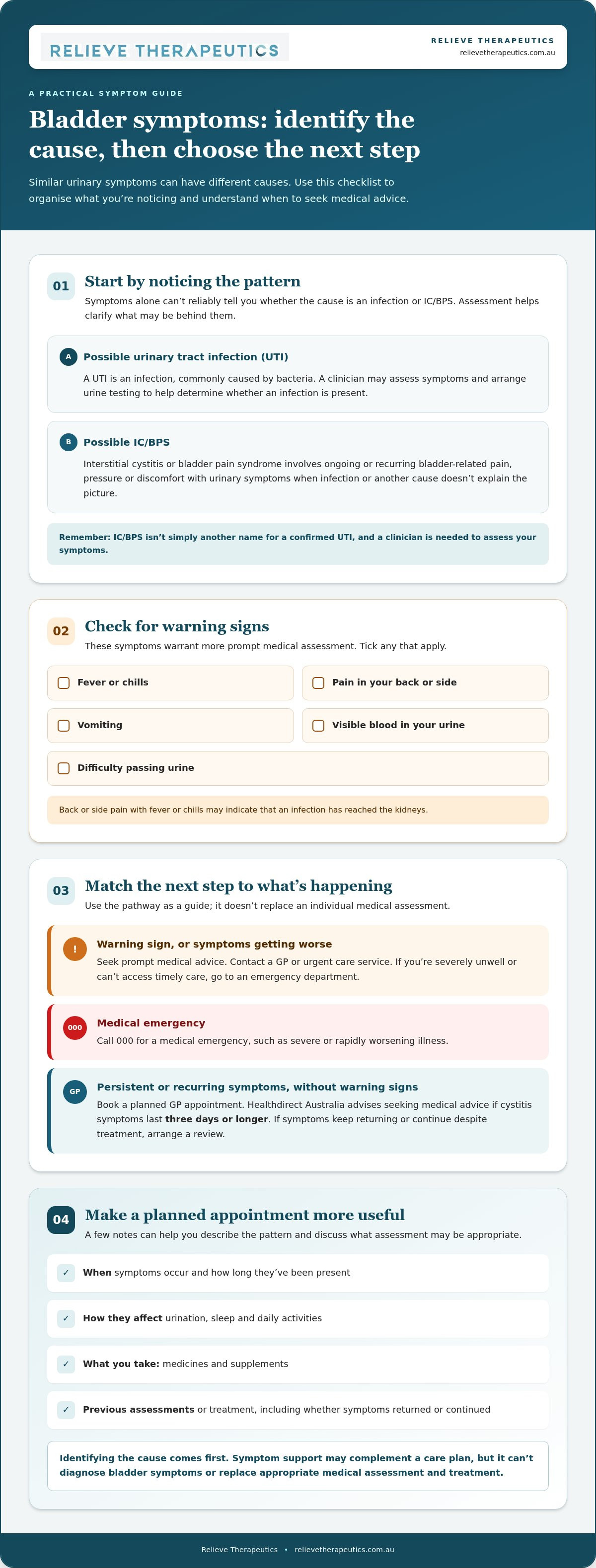
Urgency that interrupts a meeting, frequent trips to the toilet or bladder discomfort that makes sleep difficult can wear you down. When symptoms persist, it can be hard to know whether you’re dealing with an infection or something else. That distinction matters: similar urinary symptoms can have different causes, and the next step depends on what’s behind them.
Interstitial cystitis, also called bladder pain syndrome (IC/BPS), refers to ongoing bladder-related pain, pressure or discomfort with urinary symptoms when a bacterial infection or another cause doesn’t explain the picture. It isn’t simply another name for a confirmed urinary tract infection (UTI). The overview of Interstitial cystitis describes the condition’s symptoms and diagnostic considerations, but a clinician is needed to assess an individual’s symptoms.
Symptom support may complement a care plan, but it can’t diagnose the cause of bladder symptoms or replace appropriate medical assessment and treatment.
How interstitial cystitis differs from an uncomplicated UTI
A UTI is an infection, commonly caused by bacteria, and a clinician may assess symptoms and arrange urine testing to help determine whether one is present. IC/BPS involves persistent or recurring bladder symptoms that aren’t necessarily due to infection. The pattern varies between people, and the conditions can feel similar, so symptoms alone can’t reliably tell you which one you have.
Healthdirect Australia advises seeking medical advice if cystitis symptoms last three days or longer. If symptoms keep returning or continue despite treatment, arrange a review rather than assuming the original explanation still applies. Assessment can help identify infection or consider other causes, such as bladder or pelvic conditions, before you decide on supplements or other symptom support.
When bladder symptoms need prompt medical attention
Some symptoms warrant more prompt assessment than an ongoing pattern of urgency or discomfort. Fever, chills, pain in your back or side, vomiting, visible blood in your urine, or difficulty passing urine can signal a problem that needs timely medical review. Back or side pain with fever or chills may indicate that an infection has reached the kidneys.
- Seek prompt medical advice if any of these warning signs occur, or if symptoms are worsening. Contact a GP or an urgent care service; if you’re severely unwell or can’t access timely care, go to an emergency department.
- Call 000 for a medical emergency, such as severe or rapidly worsening illness.
- Book a planned GP appointment for persistent or recurring symptoms without warning signs. Keep track of when they occur and how they affect urination, sleep and daily activities.
Identifying the cause creates a safer foundation for considering PEA for interstitial cystitis support. It also helps ensure that a possible complementary option doesn’t distract from assessment or delay care for an infection or another condition.
PEA for interstitial cystitis support: mechanisms are not proof of benefit
Palmitoylethanolamide (PEA) is a fatty acid amide that occurs naturally in the body and is studied in pain and inflammatory research. This provides a scientific reason to investigate it, not proof that taking a supplement will ease bladder pain, urgency or frequency. PEA is not an established treatment for interstitial cystitis or bladder pain syndrome (IC/BPS).
What PEA research can explain, and what it cannot
Researchers have explored how PEA interacts with pathways involved in inflammation and pain signalling. One area of interest is peroxisome proliferator-activated receptor alpha (PPAR-α), a receptor involved in regulating cellular processes. These mechanisms may help explain why PEA is studied in pain research, but biological plausibility alone can’t show whether people with IC/BPS experience meaningful symptom relief.
For a broader explanation of proposed mechanisms, see how PEA works for pain. General pain research, including studies involving other conditions, isn’t equivalent to a trial in people diagnosed with IC/BPS. The NIDDK overview of interstitial cystitis describes this as a distinct condition with its own clinical features and care considerations.
Evidence that PEA may help with other pain conditions cannot establish that it is effective for interstitial cystitis. That distinction is central to assessing claims about PEA for interstitial cystitis support.
What evidence would support an interstitial cystitis claim?
The most relevant evidence would come from well-described human studies enrolling people diagnosed with IC/BPS. When assessing a study or a claim based on it, check whether participants had the condition, what PEA was compared with, how many people took part and how long they were followed. Those details help you judge how relevant the findings are.
Study design matters too. A controlled trial that compares PEA with a placebo or another appropriate comparator can help distinguish a treatment effect from changes that might occur over time or alongside other care. Smaller or uncontrolled studies may offer early clues, but they’re less able to establish cause and effect. Laboratory and animal findings can inform research questions; they can’t demonstrate benefit for people with IC/BPS.
Look for outcomes that matter in daily life, such as bladder pain, urgency, frequency, sleep and quality of life. It’s also useful to know whether researchers tracked unwanted effects and other treatments participants used. If a report doesn’t describe its study population, comparator, duration or relevant outcomes, its relevance to IC/BPS is difficult to assess.
If you and your treating health professional decide to explore PEA as a complementary option, you can view Relieve Therapeutics PEA capsules as part of that discussion, not as a proven IC/BPS treatment.
PEA and other interstitial cystitis options: compare evidence, not promises
Different options serve different purposes. Assessment helps clarify the likely cause of symptoms; prescribed treatment may address a diagnosed condition; supportive strategies may help with day-to-day symptom management. A complementary supplement such as PEA has a different role, and its evidence for interstitial cystitis or bladder pain syndrome (IC/BPS) needs to be judged on its own merits.
The useful comparison is between each option’s evidence and role, not between what is “natural” and what is “conventional”.
| Option | Purpose and role | Evidence type and key limitation |
|---|---|---|
| Clinician-led assessment | Investigates possible causes and guides next steps. | Clinical history, examination and tests may inform diagnosis; assessment alone doesn’t guarantee a single cause is identified straight away. |
| Prescribed care, where appropriate | Targets a diagnosed infection or other condition, or forms part of an IC/BPS care plan. | Depends on the diagnosis and treatment chosen; a treatment for bacterial infection isn’t a treatment for every cause of bladder symptoms. |
| Symptom-management strategies | May support comfort and daily function as part of an individual care plan. | Approaches and response vary; general strategies aren’t a substitute for assessment or treatment of an underlying cause. |
| Complementary supplements, including PEA | May be discussed as an addition to broader care, if appropriate. | General pain research or a proposed mechanism doesn’t establish benefit for IC/BPS specifically. |
Established care and complementary support have different roles
A clinician considers the symptom pattern and whether another cause needs specific treatment before discussing ongoing bladder pain management. Suspected infection needs assessment; if an infection is diagnosed, a supplement isn’t an alternative to indicated treatment. Supportive approaches may be considered alongside clinical care, with choices shaped by symptoms, preferences and medical history. PEA, if considered, belongs in that broader discussion rather than in place of it.
For patient education about IC/BPS and its management, the Interstitial Cystitis Association is one source to explore. Its information can help you understand the range of care discussions, but it doesn’t determine which approach is appropriate for you.
Questions to ask when assessing PEA evidence
Start by checking whether a study included people diagnosed with IC/BPS or examined a different pain condition. Then look for outcomes that matter to patients, such as changes in pain or urinary symptoms, and note the study’s design and limitations. Ask whether results have been replicated independently. Background on PEA endocannabinoid science can explain proposed biology, but it isn’t evidence of benefit for IC/BPS.
These checks can make conversations about PEA for interstitial cystitis support more grounded. If you’re considering a supplement, share its details with your treating health professional and discuss how it fits alongside your current care. You can also review Relieve Therapeutics PEA capsules as an option to discuss, without assuming they treat IC/BPS.
How to discuss PEA for bladder pain with your health professional
A focused appointment can help you discuss PEA without losing sight of the bigger questions: what may be causing your symptoms, what care you’re already receiving, and whether a supplement is suitable for you. You don’t need to arrive with a conclusion. A clear record and a few questions can make the conversation more useful.
Prepare a clear record of symptoms and current care
Before your appointment, gather details that may help your health professional understand the pattern. Note when symptoms began, how they change over time and whether they affect sleep, work or other daily activities. Include relevant assessments and treatments, even if they happened some time ago.
- Describe the pattern. Record when urgency, frequency or discomfort occurs, how long it tends to last, and any changes you’ve noticed. Note what seems to make symptoms better or worse, without assuming it identifies the cause.
- List current care. Write down medicines and supplements you take, including how often you use them, as well as relevant diagnoses. Include recent treatment changes.
- Bring available records. If you have recent test results or details of previous assessments, take them along. Your clinician can help interpret what they mean in the context of your symptoms.
Discuss supplement suitability and monitoring
Once your diagnosis and current care are clear, ask whether PEA is appropriate to consider in your circumstances. Share the exact supplement information you’re reviewing, rather than relying on broad claims about PEA or pain. Your health professional can consider your medical history and medicines, and advise whether there are individual risks or possible interactions to discuss.
- “Has PEA been studied in people with my diagnosis, or mainly in other pain conditions?”
- “Could it be unsuitable alongside my medicines or health conditions?”
- “If we decide it’s reasonable to consider, what symptoms or changes should I monitor, and when should I seek reassessment?”
Agree on how you’ll review any decision and what to do if symptoms change. Don’t stop prescribed treatment or delay an assessment to trial a supplement. If you develop new or worsening symptoms, contact your health professional rather than assuming they’re part of your usual pattern.
These questions can make a conversation about PEA for interstitial cystitis support more specific and balanced. They also keep the focus on your diagnosis, safety and daily experience, not on promises a supplement may not be able to support.
If you’d like to review the available options before discussing them with your health professional, explore Relieve Therapeutics PEA capsules.
Considering Relieve Therapeutics PEA capsules as one part of your plan
After reviewing the evidence, the practical question is whether a PEA supplement belongs in your care discussion. Relieve Therapeutics is an Australian retailer of PEA capsules, not a clinical service or prescription provider. Its range includes 60-, 120- and 180-capsule supplies. These counts describe pack sizes only; they don’t indicate different clinical effects or establish which option, if any, is suitable for you.
For people exploring PEA for interstitial cystitis support, that distinction matters. A product being available doesn’t show that it has been proven to help bladder pain syndrome, and interest in PEA shouldn’t take the place of understanding the diagnosis and care options.
What a PEA supplement can and cannot represent
PEA capsules are a supplement option, not a diagnosis, an individually tailored treatment plan or a guaranteed outcome. Evidence about PEA in other areas of pain research can’t, by itself, establish a benefit for interstitial cystitis. Claims about this condition need relevant, condition-specific evidence.
Your treating health professional can help consider whether a supplement is appropriate in light of your diagnosis, health history and current medicines. Share the product details you’re considering and ask about any individual risks. Don’t use a supplement to self-diagnose, replace prescribed care or delay assessment of new or worsening symptoms.
A considered next step for Australian readers
A measured decision can begin with three checks: clarify the diagnosis with a health professional, assess whether the available research actually relates to interstitial cystitis, and discuss whether a supplement is suitable for your circumstances. Keeping those steps distinct helps separate product information from evidence of clinical benefit.
If you’re assessing a PEA product, consider what information is provided about its contents and how to use it, and take any questions to your treating professional. The guide to high quality PEA capsules in Australia offers general product-evaluation information; it shouldn’t be read as evidence that PEA treats IC/BPS.
PEA may be something to discuss, but the decision should sit within a broader, clinician-guided approach. If you’d like to view the available capsule supply options, explore Relieve Therapeutics PEA capsules.
Take your next step with confidence
Persistent bladder symptoms can make planning feel difficult, but your next step doesn’t need to involve choosing a supplement straight away. A conversation with your health professional can help clarify what support is appropriate and which questions still need answers. Bring the concerns that matter most to you, whether that’s disrupted sleep, difficulty getting through work or uncertainty about what your symptoms mean.
If you’re considering PEA for interstitial cystitis support, treat it as a question to explore rather than an expected outcome. Discuss the evidence, your individual circumstances and how any decision would sit alongside your existing care. A careful, shared approach leaves room to revisit the plan as your needs change.
For a closer look at the available PEA capsules, explore Relieve Therapeutics PEA capsules. Whatever you decide, informed questions and clinician-guided care can help you move forward with greater clarity.
Frequently Asked Questions
Is PEA proven to treat interstitial cystitis?
No, PEA hasn’t been established as a treatment for interstitial cystitis or bladder pain syndrome. Research into pain or inflammation in other settings doesn’t demonstrate that it improves bladder symptoms. If you’re considering PEA for interstitial cystitis support, look for evidence involving people diagnosed with this condition and discuss the limits of that evidence with your health professional before making decisions about your care.
Can interstitial cystitis be mistaken for a urinary tract infection?
Yes, the conditions can cause overlapping symptoms, including urgency, frequent urination and discomfort, so symptoms alone may not identify the cause. Ongoing symptoms don’t necessarily mean an infection is still present, while a new infection can occur in someone with a history of bladder pain. A clinician can assess the pattern and decide whether testing or another step is appropriate.
Can I take PEA alongside my current medicines for bladder pain?
Whether PEA is suitable alongside your particular medicines depends on your circumstances. Don’t assume a supplement is interaction-free because it’s sold without a prescription. Give your doctor or pharmacist the supplement’s packaging or ingredient information, plus a complete list of prescription medicines, over-the-counter products and other supplements you use. They can consider your circumstances and advise you; don’t change prescribed medicines without their guidance.
What should I discuss with my doctor before trying PEA for bladder pain?
Ask whether your diagnosis is clear, whether PEA has been studied in people with that diagnosis, and whether it suits your health history and current medicines. You could also ask what symptoms to track and when to arrange a review. For instance, if pain or night-time urination changes, agree on how to report that rather than deciding on your own that the supplement is helping or not helping.
Does PEA research for other types of pain apply to interstitial cystitis?
Not directly. Findings from another pain condition may help researchers form questions, but they can’t show that people with interstitial cystitis will experience the same effects. Check who took part in a study, what condition was investigated and which outcomes were measured. Evidence is more relevant when it directly studies people with interstitial cystitis or bladder pain syndrome and reports bladder-related outcomes.
When should I seek medical care for bladder symptoms?
Arrange a medical review for persistent, recurring or worsening urinary symptoms, even if you’ve previously been assessed. Seek prompt care if symptoms come with fever, chills, back or side pain, vomiting, visible blood in urine or difficulty urinating. These signs need timely attention rather than a supplement trial. If you’re severely unwell or it’s an emergency, call 000 or attend an emergency department.