

For Australians considering palmitoylethanolamide, no significant side effects have been reported, although some people experience mild digestive discomfort when starting it. A daily dose of 300 to 1200 mg may be effective for nerve pain, but the right amount depends on the form and strength of the supplement. Capsule dosing is worth understanding before deciding what may suit your needs.
Living with chronic or nerve pain can make everyday choices more complicated, especially when you’re weighing a supplement alongside other treatments. Here at Relieve Therapeutics, this guide explains conditions associated with persistent nerve pain, possible PEA side effects, and how capsule strengths and dosing relate. You’ll find practical considerations to help you make an informed decision, without assuming one dose suits everyone.
Key Takeaways
- Learn which chronic and neuropathic pain conditions are discussed in connection with PEA, and why the type of pain matters.
- Understand the possible side effects and why it’s important to consider PEA alongside your existing treatments.
- Compare PEA forms and dosing considerations to better understand how a suitable approach is determined.
- See how capsule strengths and gradual dose adjustments can shape a practical routine.
Conditions associated with chronic and neuropathic pain
Chronic pain persists over time, while neuropathic pain involves the nerves. Understanding the distinction can help people in Newcastle considering palmitoylethanolamide describe their discomfort. Pain may also have inflammatory features, and symptoms can involve more than one pattern. Describing where the pain occurs and how it feels gives you a clearer starting point for discussing care.
Nerve and inflammatory pain
Neuropathic pain can feel like burning, tingling or sharp discomfort. Inflammatory pain is associated with inflammation in body tissues. PEA is discussed in relation to both, but that doesn’t mean the same approach applies to every cause of pain. Conditions associated with these patterns include sciatica, arthritis and back pain. Your symptoms and their underlying cause are important considerations.
PEA as a chronic pain option
Some people consider PEA as a dietary supplement for ongoing discomfort. Conditions discussed in relation to PEA include fibromyalgia, migraine, trigeminal neuralgia and multiple sclerosis, as well as nerve pain. These examples can help readers researching palmitoylethanolamide in Newcastle understand the range of conditions being discussed, but they don’t establish that PEA treats or cures them. A supplement is one consideration within a broader approach to persistent pain.
Is palmitoylethanolamide approved or regulated by the TGA in Australia? PEA is available without a prescription. However, this alone does not establish TGA approval for a particular product. The ingredient and the regulatory status of an individual product are separate considerations.
What evidence supports palmitoylethanolamide for pain or inflammation? PEA has been examined in hundreds of studies. The body of research is relevant, but the number of studies alone doesn’t show how strong the evidence is for each condition. The condition, study quality and outcomes measured all matter when interpreting findings.
Are there any side effects?
Reported side effects appear limited, but people can respond differently when starting a supplement. PEA’s proposed effects on glial cells are another reason it is discussed in relation to pain.
Reported effects and interactions
Reported effects are experiences observed or described during PEA use, while interactions concern using it alongside other treatments. Some people experience mild digestive discomfort when starting PEA. No significant side effects have been reported, but that doesn’t guarantee everyone will respond in the same way.
Using PEA alongside other treatments should be considered in the context of the full medication plan. However, combining treatments means considering the full medication plan rather than viewing PEA in isolation. Discuss changes to an existing treatment plan with a doctor, particularly when prescription pain relief is involved.
PEA is also proposed to affect glial cells, which support and regulate activity in the nervous system. This proposed action is relevant because glial activity is discussed in connection with pain signalling. It offers one possible explanation for interest in PEA, but doesn’t establish that it will relieve an individual’s symptoms.
Potential side effects
Mild digestive discomfort is a potential side effect reported by some people starting PEA. The absence of significant reported side effects doesn’t mean digestive symptoms should be ignored. Noting when discomfort begins and how it relates to taking PEA can help you consider whether it may be connected to the supplement or another change.
Timing matters, too. Reports describe possible pain improvement within one week, while maximum results may take up to 3 months. For nerve pain, improvement may be noticed within 2 to 8 weeks of consistent use. These different timeframes describe reported responses, not a single expected schedule for everyone.
If you’re considering PEA alongside CBD, an NSAID or a prescription pain reliever, discuss all your treatments with your doctor before changing your plan. This context matters when assessing possible interactions and interpreting digestive symptoms or changes in pain over time.
PEA dosage and forms
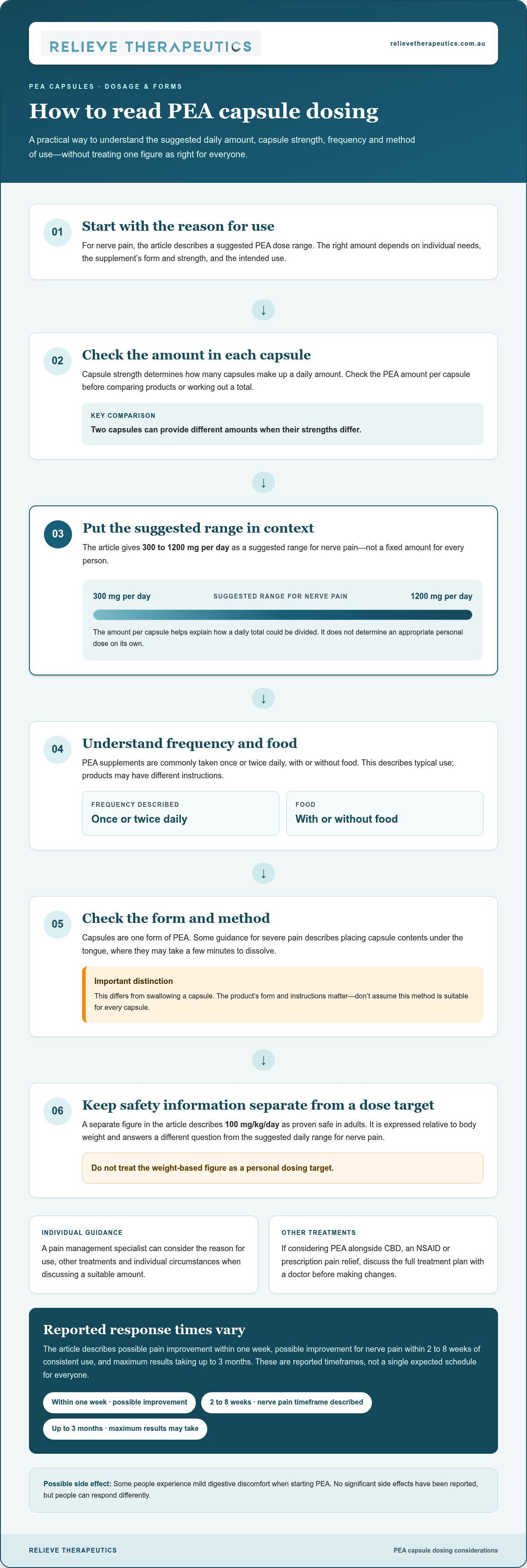
For nerve pain, a suggested PEA dose is 300 to 1200 mg per day. This is a broad range, not one fixed amount for every person. The intended use, daily routine and capsule strength all affect how a total dose is divided. A pain management specialist can give personalised guidance based on individual needs.
PEA supplements are commonly taken once or twice daily, with or without food. This describes typical use, not a rule that every product is taken in the same way. Check the amount of PEA in each capsule before comparing daily totals. Two capsules can provide different amounts if their strengths differ.
A separate figure describes 100 mg/kg/day as proven safe in adults. This is expressed relative to body weight, unlike the 300 to 1200 mg daily range suggested for nerve pain. Safety information and a suggested pain dose answer different questions. Don’t treat the weight-based figure as a personal dosing target.
Capsules are one form of PEA used as a supplement. For severe pain, some guidance describes placing capsule contents under the tongue, where they may take a few minutes to dissolve. This differs from swallowing a capsule, so the product’s form and instructions matter. Don’t assume this method is suitable for every capsule.
When comparing forms, consider the amount per capsule, the intended method of use and the total daily amount. These details show how a suggested dose fits into a routine. A pain management specialist can also consider the reason for use, other treatments and individual circumstances when discussing a suitable amount.
Keep the figures in context: 300 to 1200 mg per day is a suggested range for nerve pain, while once- or twice-daily use describes frequency. Neither detail alone determines an appropriate dose. Together, the amount per capsule, timing and method of use clarify what a dosing plan involves.
Capsule strengths and dosing
Capsule strength determines how many capsules make up a daily amount. The dosing examples below use 300 mg capsules; don’t assume every capsule contains that amount. Check the strength on the product label and calculate the total from the amount per capsule, not the bottle count.
One suggested schedule starts with 300 mg once daily for 3 days, then 300 mg twice daily for 3 days. Another schedule increases after the first 6 days to 300 mg at 8am and 600 mg at 8pm. These are distinct examples, not instructions to combine or follow both.
A further approach suggests one 300 mg capsule in the morning with food and one in the evening with food. If pain remains, the example increases to two 300 mg capsules twice daily. After pain decreases, it suggests reducing to one capsule twice daily. Each change alters the total daily amount, so track the dose rather than counting capsules alone.
Other dose limits appear in the guidance: increase to a maximum of 1,200 mg daily, while a separate statement describes up to 4,800 mg per day if pain remains inadequately controlled after a month. These are different recommendations and shouldn’t be treated as one routine. Discuss a dosing plan with a pain management specialist before adjusting your amount.
For practical comparison, bottle count and capsule strength answer different questions. A 60-, 120- or 180-capsule bottle indicates quantity, not milligrams per capsule. Relieve Therapeutics offers PEA 60 Capsules, PEA 120 Capsules and PEA 180 Capsules. Review the PEA capsule options to compare bottle quantities, then use the stated capsule strength when calculating a daily total.
Relieve Therapeutics: PEA 60 Capsules
Relieve Therapeutics offers PEA capsules in 60-, 120- and 180-capsule quantities for people considering PEA as part of their supplement routine. These bottle sizes describe capsule counts, not the amount of PEA in each capsule, so use the product label when comparing a serving with a dosing plan discussed with a health professional.
PEA 60 Capsules may suit someone wanting a smaller bottle quantity, while the 120- and 180-capsule options provide different counts. Choosing a bottle size doesn’t determine an appropriate dose or establish that PEA is suitable for a particular condition. Keep those decisions separate, and consider your intended routine and the label information.
For information about the capsule options, visit relievetherapeutics.com.au.
Make your next step informed
If you’re considering palmitoylethanolamide in Newcastle, think about your priorities as well as the dose. Consider what you hope to change in daily life, such as sleep, movement or comfort during routine activities. These practical measures can help you explain your needs and notice meaningful changes over time.
Whether PEA is suitable for you depends on your circumstances and current treatment plan. Discuss your questions with a health professional, especially before changing medicines or combining treatments. This can help you weigh your options carefully.
For information about Relieve Therapeutics, visit the website. A thoughtful, informed approach can help you move forward with greater confidence.
Frequently Asked Questions
How Does PEA Help with Nerve Pain?
PEA may help by influencing inflammatory mediators and pain pathways involved in nerve-related discomfort. It is discussed for conditions such as sciatica and diabetic neuropathy, but responses can differ between people and conditions. If nerve pain affects your sleep, walking or daily tasks, note those changes when discussing options with a health professional. This adds practical context beyond pain intensity alone.
How does it work?
PEA is thought to act partly through PPAR-α, a receptor involved in regulating inflammatory processes. It may also influence pain signalling, which is why researchers study it in relation to inflammation and nerve discomfort. These mechanisms describe how PEA may act in the body; they don’t show that it will address every cause of pain or replace assessment of an underlying condition.
How to take PEA?
The product recommendation is to take 2 capsules daily, providing 600 mg of PEA, with or without food. A typical dosage range is 300 mg to 1,200 mg per day, divided into two or three doses. Follow the directions for the product you use, and discuss the dose with a health professional if you take other medicines or have an existing health condition.
What is Palmitoylethanolamide (PEA)?
Palmitoylethanolamide, or PEA, is a naturally occurring fatty-acid amide found in the body and used in dietary supplements. It isn’t a prescription medication. Supplement capsules provide PEA as an ingredient for people considering it as part of their health routine. The amount per serving and any additional ingredients depend on the specific product label, so read that information before use.
Who Can Benefit from PEA?
People experiencing ongoing discomfort may consider PEA in relation to conditions including fibromyalgia, arthritis, back pain, nerve pain, migraine, trigeminal neuralgia, multiple sclerosis or sciatica. These are conditions for which PEA may help, not a guarantee of benefit or a cure. The cause of symptoms and the person’s current care plan are important context when considering a supplement.
Who Should Take PEA?
Whether PEA is appropriate depends on your health circumstances and current medicines. If you’re pregnant or nursing, have a pre-existing medical condition, or take other medications, consult a healthcare professional before using it. Share the product label and your medication list during the discussion so they can consider the ingredients alongside your wider treatment context.