

Could a supplement studied for nerve pain still have little reliable evidence for trigeminal neuralgia? That distinction matters when facial pain is severe or recurring and everyday activities become difficult. Research on palmitoylethanolamide for trigeminal neuralgia may sound promising, but findings from broader neuropathic-pain research don’t automatically apply to this specific diagnosis.
It’s understandable to look for additional options when pain keeps returning. Yet trigeminal neuralgia has its own clinical features, and evidence for other forms of nerve pain isn’t proof that PEA works for it. A 2024 trial examined post-extraction trigeminal neuropathy, a related but distinct condition. Its results can’t establish PEA’s effectiveness for trigeminal neuralgia.
This article separates what research suggests from what it hasn’t established. You’ll learn how trigeminal neuralgia differs from broader neuropathic pain, what the available PEA evidence can and can’t tell us, and what to discuss with an Australian health professional before considering a supplement or changing your care. The aim is a clear, measured view that avoids overstating claims or overlooking established treatment.
Key Takeaways
- Facial pain can have different causes, so an accurate diagnosis helps guide care.
- Research on palmitoylethanolamide for trigeminal neuralgia needs to be distinguished from studies of other forms of nerve pain.
- Understand how PEA fits alongside established clinical management, rather than treating it as a substitute.
- Before making changes, prepare to discuss your symptoms, medicines, supplements and treatment goals with your health professional.
- PEA capsules are dietary supplements, not a proven treatment for trigeminal neuralgia. This article outlines the available capsule options without making condition-specific claims.
What is trigeminal neuralgia, and why does the diagnosis matter?
Trigeminal neuralgia is a nerve-pain condition affecting the trigeminal nerve, which carries sensation from the face to the brain. It commonly causes sudden, severe pain on one side of the face, often described as sharp, stabbing or electric-shock-like. Facial pain has many possible causes, though, and similar sensations alone can’t confirm this diagnosis.
The trigeminal nerve has three main branches, supplying sensation to the forehead and eye area, the cheek and upper jaw, and the lower jaw. Trigeminal neuralgia most often affects one or more of these areas on one side. Knowing which parts of the face are involved can help a clinician assess the pattern, but it isn’t enough to identify the cause by itself. The Trigeminal Neuralgia overview describes the condition’s symptoms, possible causes and approaches to diagnosis.
How trigeminal neuralgia can present
Pain often comes in brief, intense attacks that may last from a few seconds to around two minutes. Some people also experience a background ache or burning sensation between attacks, or periods when symptoms ease. These patterns vary, so there isn’t one experience that applies to everyone.
An attack may be set off by ordinary sensations or movements, such as lightly touching the face, chewing, talking, brushing teeth or a breeze. Triggers, affected areas and attack frequency differ between people. A symptom list can give a health professional useful context, but it shouldn’t be used to diagnose yourself. Dental problems and other nerve or facial-pain conditions can also cause discomfort.
Why diagnosis and clinical review come first
A clinician considers the pain’s location, quality, duration and triggers, along with your medical history and examination findings. They may assess whether another condition could explain the symptoms and decide whether further investigation is appropriate. This matters because evidence for one type of facial or nerve pain doesn’t automatically apply to another.
Research relevant to palmitoylethanolamide for trigeminal neuralgia needs to be judged against studies involving people with this specific diagnosis. Results from a different condition may provide background, but they don’t establish that PEA is effective for trigeminal neuralgia. A clear diagnosis is the first step in interpreting any such evidence responsibly.
If you’re experiencing facial pain, discuss it with your treating GP, neurologist or pain specialist. Bring a brief record of where the pain occurs, how long attacks last, what seems to trigger them and any symptoms between episodes. This can make the conversation more specific. This article is educational only; it can’t diagnose your symptoms or guide individual treatment. Don’t use it to replace clinical review or change prescribed care.
What does research say about palmitoylethanolamide for trigeminal neuralgia?
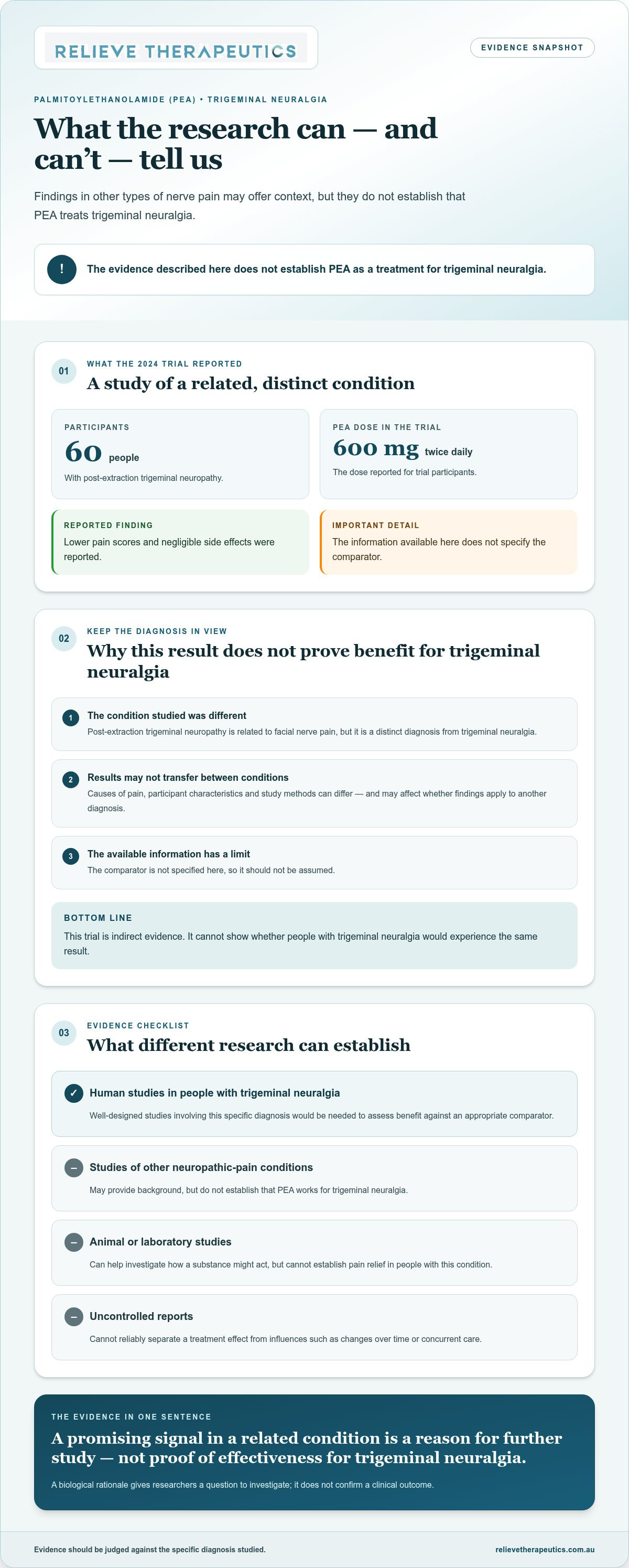
The evidence described here does not establish that PEA treats trigeminal neuralgia. The key distinction is between research in people diagnosed with this condition and research into other types of nerve pain. A biological rationale or a finding in a related condition may justify further study, but it isn’t proof of clinical benefit for trigeminal neuralgia.
Direct evidence versus evidence from other nerve-pain conditions
The research identified for this review includes a 2024 randomised clinical trial involving 60 people with post-extraction trigeminal neuropathy. Participants received PEA at 600 mg twice daily, and the study reported lower pain scores with negligible side effects. This is relevant to research on facial nerve pain, but post-extraction trigeminal neuropathy is a distinct diagnosis, not trigeminal neuralgia. The information available here doesn’t specify the comparator, so it shouldn’t be assumed.
That study therefore provides indirect evidence only. It can’t show whether people with trigeminal neuralgia would experience the same result. Findings from studies of other neuropathic-pain conditions have the same limitation: differences in the cause of pain, participant characteristics and study methods can affect whether results apply to a particular diagnosis.
Animal or laboratory studies may help researchers investigate how a substance could act, but they can’t establish that it relieves pain in people with trigeminal neuralgia. Uncontrolled reports also can’t reliably separate a treatment effect from other influences, such as changes over time or concurrent care.
What PEA research can and cannot establish
PEA is studied for its possible involvement in biological processes related to pain and inflammation. That proposed rationale gives researchers a question to investigate, not proof of a clinical outcome. To demonstrate benefit for trigeminal neuralgia, well-designed human studies would need to recruit people with that diagnosis and assess outcomes against an appropriate comparator. The evidence described here doesn’t provide that direct confirmation.
Study size and design matter, too. A small trial in a neighbouring condition can offer an early signal, but it can’t establish how dependable or applicable a result is for a different diagnosis. Nor does a reported outcome determine the right option for an individual. For context on established approaches and research into the condition, the US National Institute of Neurological Disorders and Stroke provides Trigeminal Neuralgia Treatment and Research.
A plausible research rationale is not the same as demonstrated clinical benefit for trigeminal neuralgia. For background on proposed pathways, a general guide to how PEA works for pain can help explain the research rationale, but it can’t establish effectiveness for this diagnosis. If you want to explore PEA as a dietary supplement, Relieve Therapeutics offers capsule options in 60-, 120- and 180-capsule quantities. This is product information, not a treatment recommendation. Explore PEA capsule options.
How does PEA compare with established trigeminal-neuralgia care?
These options belong to different evidence categories. Clinical treatments are assessed for trigeminal neuralgia itself; supportive measures may help a person manage daily life; supplements such as PEA have a separate evidence base. A proposed biological effect doesn’t make a supplement equivalent to a treatment recommended for this diagnosis.
| Category | What it means | How to interpret it |
|---|---|---|
| Established clinical management | Guidelines identify anticonvulsant medicines, including carbamazepine and oxcarbazepine, as first-line options. A specialist may discuss surgical procedures if medicines don’t provide adequate relief or aren’t tolerated. | These are clinical decisions made for an individual diagnosis and health history. They aren’t interchangeable with supplement use. |
| Supportive care | Practical support may help a person manage the effects of pain on routines, eating, sleep and wellbeing, alongside clinical care. | Support can be valuable, but it doesn’t establish that a supplement treats the underlying condition. |
| Supplements | PEA is a dietary supplement studied in various pain contexts. The evidence discussed in this article does not establish it as a treatment for trigeminal neuralgia. | Research in other pain conditions is indirect and can’t be treated as proof for this diagnosis. |
How to interpret standard-care and supplement evidence
Clinical guidance is based on evidence for managing trigeminal neuralgia, while supplement studies may involve different diagnoses, methods and outcomes. The European Academy of Neurology’s guideline identifies carbamazepine and oxcarbazepine as first-line treatments, with surgical options considered in some cases when medication is unsuccessful or unsuitable. The US National Institute of Neurological Disorders and Stroke also outlines clinical approaches in its Trigeminal Neuralgia Treatment and Research resource.
This comparison isn’t a recommendation to start, stop or change any medicine. The right plan depends on clinical assessment, symptom pattern, other health conditions and a person’s response to care. Those decisions belong with the treating clinician, who can explain potential benefits, risks and alternatives in context.
Where PEA fits in the evidence picture
For palmitoylethanolamide for trigeminal neuralgia, the central limitation is the lack of diagnosis-specific evidence. Findings from broader neuropathic-pain research may support further investigation, but they don’t show that PEA improves trigeminal-neuralgia symptoms. Even a plausible mechanism can’t tell us whether a supplement produces a meaningful clinical outcome in this condition.
PEA may be of research interest, but it shouldn’t be presented as a proven trigeminal-neuralgia therapy or a replacement for prescribed care. Evidence about supplements for neuropathy has a broader scope, and results from those conditions may not transfer to trigeminal neuralgia. If you’re considering a supplement, discuss it with your treating GP, neurologist or pain specialist, particularly alongside your current care. Don’t delay or alter prescribed treatment based on supplement information.
What should you discuss with your clinician before considering PEA?
A useful appointment starts with the full picture, not just the supplement you’re considering. Your GP, neurologist or pain specialist can review whether your diagnosis and current care plan still fit your symptoms, then consider PEA in light of your health circumstances and medicines. Bring the product label or packaging details if you have them, so the discussion can be specific.
Questions to take to an appointment
Before your visit, jot down details that may help guide the discussion:
- Diagnosis: What diagnosis explains my facial pain, and does it need review?
- Medicines and supplements: What prescription medicines, over-the-counter products and supplements do I take, and could PEA be unsuitable alongside any of them?
- Symptoms: Where and when does pain occur? What triggers it, how long does it last, and how does it affect daily activities?
- Goals: What change would matter to me, and how would we assess it?
If your clinician supports trying a supplement, ask what outcome to monitor and when to review whether it’s helping. A simple symptom record may make that conversation clearer. Don’t stop, delay or alter prescribed treatment based on supplement information. Discuss possible interactions and personal suitability with a qualified health professional, especially if you have other health conditions or use several medicines.
How to assess supplement information in Australia
Check the product label for its stated ingredients, directions and relevant warnings. You can also use current Therapeutic Goods Administration (TGA) information to understand the product’s status in Australia. If a product is listed on the Australian Register of Therapeutic Goods (ARTG), that status shouldn’t be taken as proof that it has been shown to treat trigeminal neuralgia. Product status and condition-specific clinical evidence are different questions.
Be cautious of claims that promise a cure, guaranteed relief or a proven result for a named disease. For palmitoylethanolamide for trigeminal neuralgia, the evidence discussed in this article does not establish PEA as a treatment. A clinician can help weigh the limited evidence against your diagnosis, current care and personal circumstances.
General information about how to take PEA for nerve pain may help you understand common use questions, but it can’t provide personalised dosing advice. Take those questions to your health professional rather than adapting a regimen from general information. If you want to explore PEA dietary supplements, Relieve Therapeutics offers PEA capsules in 60-, 120- and 180-capsule supplies. Explore PEA capsule options.
How can you explore PEA capsules without mistaking them for treatment?
After reviewing the evidence, keep two questions separate: what research has established about trigeminal neuralgia, and what a retailer offers as a dietary supplement. Relieve Therapeutics sells PEA capsules. Product information describes a supplement, not a recommendation to treat facial pain with PEA.
What Relieve Therapeutics offers
The available options are PEA 60 Capsules, PEA 120 Capsules and PEA 180 Capsules. These names identify capsule quantities only. They don’t establish a suitable dose, length of use, particular formulation or expected clinical result. Consider product details separately from research findings, and don’t interpret any of these options as a proven treatment for trigeminal neuralgia.
Before considering any supplement, read its product information carefully. Review the details stated on the label, such as listed contents, directions and warnings. If anything is unclear, bring that information to your health professional rather than making assumptions based on the capsule count or studies of other pain conditions.
- PEA 60 Capsules: a supply containing 60 capsules.
- PEA 120 Capsules: a supply containing 120 capsules.
- PEA 180 Capsules: a supply containing 180 capsules.
Those quantities describe the product format, not how much to take or whether it’s appropriate for you. They also don’t indicate that one option is more effective than another. Decisions about using a supplement should take account of your diagnosis, medicines and health circumstances.
A measured next step for readers
If you’re weighing up palmitoylethanolamide for trigeminal neuralgia, keep your treating GP, neurologist or pain specialist involved. Ask them to consider the product information alongside your current care and explain any concerns about suitability. Don’t delay, stop or change prescribed care because of supplement information. Product details can inform a discussion, but they can’t replace diagnosis, clinical advice or established care.
Exploring a supplement doesn’t commit you to using it. You can review the capsule options, note any questions and discuss them with a qualified health professional. This keeps the decision grounded in your circumstances rather than a broad claim or a result from research on a different condition.
To review product information, explore Relieve Therapeutics PEA capsules. Treat it as a description of dietary supplements, not evidence that PEA treats trigeminal neuralgia or a substitute for clinician-led care.
Make your next step an informed one
Living with recurring facial pain can make it tempting to act quickly on a confident supplement claim. A steadier approach is to decide what you need to know before making a change: whether the information applies to your diagnosis, whether a supplement fits alongside your current care, and what would prompt you to revisit that decision. These are useful questions to discuss with your treating health professional.
For palmitoylethanolamide for trigeminal neuralgia, keeping curiosity separate from certainty helps protect your choices. Research can raise worthwhile questions without providing a clear answer for every diagnosis. You don’t need to interpret those limits alone, and supplement information shouldn’t take the place of clinical advice or prescribed care.
To review PEA product information separately from treatment decisions, explore Relieve Therapeutics PEA capsules. Take your time, keep your clinician involved, and choose your next step with confidence grounded in clear information.
Frequently Asked Questions
Is palmitoylethanolamide proven to help trigeminal neuralgia?
No. The evidence reviewed for palmitoylethanolamide for trigeminal neuralgia doesn’t establish that PEA treats this diagnosis. Research involving related facial nerve conditions is not the same as a trial in people with trigeminal neuralgia. If you encounter a claim that PEA is proven for this condition, check whether it cites a well-designed study specifically involving people diagnosed with trigeminal neuralgia, rather than broader nerve-pain research.
Can PEA replace prescribed treatment for trigeminal neuralgia?
No. PEA shouldn’t replace prescribed treatment or delay a review of persistent or changing symptoms. Stopping some medicines suddenly can cause problems, and your prescriber can advise whether a change is appropriate. If you’re interested in supplements, raise it with your treating GP, neurologist or pharmacist before using one. Bring the product label and a current medicines list so they can consider the details together.
How does palmitoylethanolamide work for nerve pain?
Researchers are investigating how PEA may influence biological pathways involved in pain signalling and inflammation. Proposed actions include interactions with PPAR-alpha, a receptor involved in regulating cellular processes. This is a possible explanation for research interest, not proof of how PEA affects a person’s symptoms. Mechanistic findings don’t tell us whether a supplement improves trigeminal neuralgia or what amount would be appropriate for an individual.
Is PEA safe to take with trigeminal-neuralgia medication?
There isn’t enough information here to confirm that PEA is safe alongside every trigeminal-neuralgia medicine. Suitability can depend on the medicine, dose, other supplements, health conditions and individual circumstances. Don’t assume that a supplement is interaction-free because it’s sold without a prescription. Ask your doctor or pharmacist to review the exact product label and your full medicines list before combining products, and seek their advice if you notice an unexpected reaction.
What is the difference between trigeminal neuralgia and other nerve pain?
Trigeminal neuralgia is a specific facial nerve-pain diagnosis, while neuropathic pain is a broader term for pain arising from damage or disease affecting the nervous system. Nerve pain elsewhere in the body may have a different cause, pattern and clinical management. For example, evidence from a study of pain after dental extraction doesn’t automatically apply to trigeminal neuralgia. A clinician assesses facial pain in context rather than relying on one symptom alone.
What should I ask my doctor before trying PEA?
Ask whether your diagnosis or care plan needs reassessment, whether PEA is suitable with your medicines and health history, and what change would count as a meaningful outcome. You could also ask how to monitor symptoms and when to review the decision if your clinician supports a trial. Take the product label, a medicines list and notes about symptom changes to help make the discussion practical and specific.
Does evidence for PEA in neuropathic pain apply to trigeminal neuralgia?
Not automatically. Neuropathic-pain research can involve different diagnoses, causes, study designs and outcome measures, so results may not transfer to trigeminal neuralgia. Treat findings from another condition as indirect evidence, not confirmation of benefit. To judge whether a result is relevant, check who took part, what condition they had, how PEA was compared and whether the study measured outcomes that matter to people with trigeminal neuralgia.