

Could PEA have a role in endometriosis care, or do supplement headlines run ahead of the evidence? If you’re looking into palmitoylethanolamide endometriosis research, it’s reasonable to want clear answers, particularly when studies use different formulations or combine PEA with other ingredients.
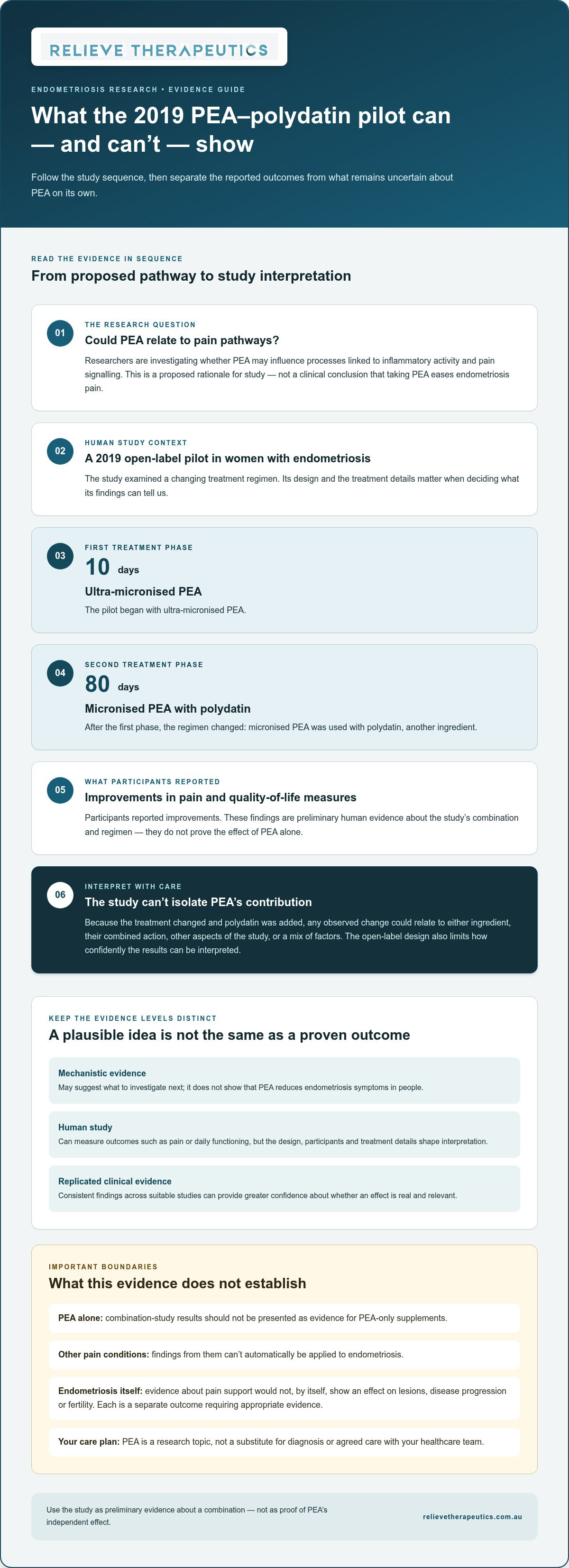
The endometriosis-specific evidence needs careful interpretation. A 2019 open-label pilot in women with endometriosis examined ultra-micronised PEA for 10 days, followed by micronised PEA with polydatin for 80 days. Because the treatment changed and polydatin was added, the findings can’t show what PEA alone may have contributed.
This article explains what researchers have investigated, what the available evidence can and can’t tell you, and how to discuss PEA with your health professional. It also explains why a supplement should not replace your current endometriosis care.
Key Takeaways
- Separate proposed explanations for PEA’s effects from outcomes actually measured in people with endometriosis.
- Understand why research on PEA combined with polydatin can’t establish the effect of PEA alone.
- Use palmitoylethanolamide endometriosis research to prepare focused questions for your healthcare team.
- Bring a current list of medicines and supplements, along with your treatment priorities, to the discussion.
- Consider 60-, 120- and 180-capsule PEA options as supplement choices, not replacements for endometriosis care.
Palmitoylethanolamide and endometriosis: why the research question matters
Persistent pelvic pain can affect work, sleep, relationships and daily plans. Searching for trustworthy information can be tiring, particularly when a biological idea is presented as if it were a proven treatment. A careful look at palmitoylethanolamide endometriosis research starts by separating what scientists are investigating from what clinical evidence has established.
Palmitoylethanolamide (PEA) is a fatty-acid amide that occurs naturally in the body and is also studied as a supplement. The Palmitoylethanolamide (PEA) Wikipedia overview provides general background on its biology, not an endometriosis treatment guideline. In this article, “investigational supplement” means a substance being examined for a possible health effect, not a treatment proven to manage endometriosis. It is separate from individualised care provided through a person’s healthcare team.
What is the connection researchers are investigating?
Researchers are asking whether PEA could be relevant to pain pathways involved in endometriosis. The proposed rationale relates to how the body regulates inflammatory activity and pain signalling. That gives researchers a question to test, not a clinical conclusion. Evidence about a biological pathway, including laboratory research, may suggest what to investigate next, but it doesn’t show that taking PEA reduces endometriosis symptoms in people.
Different types of evidence answer different questions. Laboratory work may help explain a possible mechanism. A study involving people can assess outcomes such as pain or daily functioning, but its design, participants and treatment details affect how confidently the results can be interpreted. Neither a plausible mechanism nor a research project title proves a health benefit.
Why endometriosis-specific evidence matters
Results from studies of other pain conditions can’t automatically be applied to endometriosis. Conditions differ, and even when a pain pathway appears relevant in more than one setting, that doesn’t establish that a supplement will work in the same way for endometriosis-related symptoms. The key questions are what researchers studied in people with endometriosis and which outcomes they measured.
Endometriosis-related pain can have several contributors and may vary between individuals. Symptoms, treatment history and personal priorities differ, too. Evidence about pain support would not, by itself, show that PEA affects endometriosis lesions, changes disease progression or improves fertility. Each of those is a separate outcome requiring appropriate evidence.
This sets a useful boundary: PEA is a research topic, not a substitute for diagnosis or an agreed care plan. To interpret the endometriosis-specific studies, look at whether they tested PEA alone or alongside another ingredient, and consider what their limitations mean for the findings.
How PEA might relate to endometriosis pain, and what remains uncertain
PEA is being investigated because researchers are interested in whether it may influence processes linked to inflammation and pain signalling. That proposed connection offers a reason to study PEA in endometriosis, but it doesn’t show that taking it will ease pelvic pain. For a broader overview of proposed PEA mechanisms, consult the dedicated PEA mechanism guide. Here, the focus is on what those ideas can and can’t establish for endometriosis.
Mechanism, hypothesis and clinical outcome are different evidence levels
Mechanistic evidence describes a possible explanation for how a substance might act in the body. It can help researchers decide what to test, but a biological effect is not the same as a meaningful improvement in symptoms. When assessing a health claim, consider these three distinct steps:
- Hypothesis: a proposed link between PEA and a process involved in pain.
- Human study: research measuring outcomes in people. Its design and comparison group shape how results can be interpreted.
- Replicated clinical evidence: consistent findings across suitable studies, which can provide greater confidence about whether an effect is real and relevant.
Each step answers a different question. Even a change in a biological marker would not, on its own, establish less pain, better daily function or an effect on endometriosis itself. This distinction helps prevent a plausible explanation from being mistaken for a treatment claim when reading palmitoylethanolamide endometriosis research.
Why the PEA-and-polydatin combination needs careful interpretation
Combination research examines more than one active component. The 2019 open-label pilot in women with endometriosis used ultra-micronised PEA for 10 days, then micronised PEA with polydatin for 80 days. Participants reported improvements in pain and quality-of-life measures, but the open-label design and changing regimen limit what can be concluded about the cause of those changes. This study of PEA and polydatin for endometriosis pain provides preliminary human evidence about a combination, not proof of PEA’s effect alone.
When two ingredients are used together, an observed outcome could relate to either ingredient, their combined action, other aspects of the study or a mix of factors. Unless a trial is designed to separate those contributions, it can’t show how much PEA alone may have mattered. Results from PEA-plus-polydatin research should not be presented as evidence for PEA-only supplements.
If you’re considering a PEA supplement, discuss the evidence and its suitability with your healthcare professional. Relieve Therapeutics PEA capsules are a retail supplement option. Keep that product decision separate from findings about combination studies, and don’t use a supplement as a replacement for your existing endometriosis care.
What does the endometriosis research on PEA and polydatin tell us?
The research includes different types of evidence, which shouldn’t be treated as one study. A published pilot examined a PEA-and-polydatin regimen in women with endometriosis. Separately, an Endometriosis Research listing describes a clinical trial project involving people scheduled for laparoscopic treatment of possible endometriosis. A project listing describes what researchers planned to investigate; it doesn’t, by itself, confirm that a trial was completed or that results were published.
Citation-ready summary: A 2019 open-label pilot study in women with endometriosis assessed ultra-micronised PEA followed by micronised PEA combined with polydatin, measuring pain and quality-of-life outcomes.
What the listed clinical trial appears to investigate
The Endometriosis Research listing identifies a randomised, double-blind trial project focused on PEA with polydatin and pain-related symptoms, including dysmenorrhoea, among participants scheduled for laparoscopic treatment of possible endometriosis. That group is not necessarily the same as a group with confirmed endometriosis. Whether participants had the condition would depend on the study’s eligibility criteria and diagnostic findings. The listing alone doesn’t establish the trial’s status or provide a primary results paper.
| Study or listing | Question and population | Intervention | Outcomes and evidence limits |
|---|---|---|---|
| Published 2019 pilot | Could a PEA-based regimen be associated with changes in symptoms among women with endometriosis? | Ultra-micronised PEA for 10 days, then micronised PEA with polydatin for 80 days. | Reported pain and quality-of-life measures. It was open-label, and the changing combination means the contribution of PEA alone can’t be isolated. |
| Endometriosis Research project listing | Describes a trial concerning pain and dysmenorrhoea in participants scheduled for laparoscopy for possible endometriosis. | PEA and polydatin combination. | The listing doesn’t establish completion, results, sample size, follow-up or a primary publication. |
The published pilot’s findings are available in the primary publication on PEA and polydatin. The study reported improvements in chronic pelvic pain, deep dyspareunia, dysmenorrhoea and quality of life. Because it had no control group and changed the regimen partway through, those observations can’t establish that PEA caused the changes or predict what an individual might experience.
How to judge the strength and relevance of findings
When assessing a trial, look in the primary paper for its comparator, participant numbers, outcomes, follow-up period and limitations, rather than relying on its title. Check whether participants had confirmed endometriosis, whether pain was measured consistently and whether results were compared with placebo or another appropriate control. Without those details, a promising research signal isn’t enough to change care recommendations.
For palmitoylethanolamide endometriosis research, the distinction is practical: a combined-ingredient study may justify further investigation, but it doesn’t establish the effect of PEA alone or show that it changes lesions, disease progression or fertility.
How to discuss PEA for endometriosis with your healthcare team
You don’t have to make a decision about a supplement on your own. A health professional familiar with your endometriosis care can help you weigh the limited evidence against your diagnosis, symptoms, current treatments and priorities. The aim is an informed conversation, not a promise that PEA will help.
Before an appointment, note what you hope to address, such as pain during your period, discomfort with sex or the effect of symptoms on work and sleep. Bring a current list of medicines and supplements, including how you use them, and note any changes to your care plan. This gives your clinician a clearer picture than discussing PEA in isolation.
Questions to take to an appointment
Ask questions that connect the research to your circumstances. For example, ask whether the available palmitoylethanolamide endometriosis evidence applies to your diagnosis and symptoms, and whether any precautions or interactions are relevant to your medicines or health circumstances. A qualified health professional can help you consider suitability. This section isn’t a dosing guide.
- Does the research involve people with circumstances similar to mine?
- How would a PEA supplement fit alongside my existing endometriosis care?
- Are there possible interactions or precautions to consider with my medicines or other supplements?
- What should I monitor, and when should we review whether my care plan needs attention?
Be clear about what matters most to you, whether that’s daily function, symptom management or avoiding changes that conflict with your treatment priorities. Ask your clinician to explain uncertainties in plain language. If you’re unsure what a study tested, distinguish PEA used alone from formulations that included polydatin or another ingredient.
Track symptoms without assuming cause or benefit
If you and your healthcare professional decide to explore a supplement, agree on what information would be useful to review. A brief record can help you describe patterns without treating one better or worse day as proof of an effect.
- Note pain patterns and when symptoms occur, including any relationship to your menstrual cycle.
- Record changes in daily function, such as sleep, work or activities you needed to modify.
- Include relevant changes to prescribed treatment, other supplements or your routine.
Review the record with your care team rather than drawing conclusions from an isolated change. Symptoms can vary, and several factors may shift at once. A diary can support a more grounded conversation, but it can’t establish what caused a difference. Don’t stop or change prescribed treatment based on this article, or start a supplement without discussing suitability with a qualified health professional.
After discussing whether a supplement is appropriate, you can explore Relieve Therapeutics PEA capsules as a product option. This information is separate from clinical evidence and isn’t a claim that PEA treats endometriosis.
Considering Relieve Therapeutics PEA capsules as part of an informed next step
After reviewing the evidence and discussing your circumstances with a qualified health professional, you can decide whether a PEA supplement is something you want to consider. Relieve Therapeutics is an Australian retailer of PEA capsules. Its products are supplement options, not a substitute for an endometriosis diagnosis, prescribed care or personalised clinical advice.
Keep the evidence in view as you weigh that decision. The endometriosis-specific pilot discussed earlier examined PEA alongside polydatin for part of the study, so its findings don’t establish what a PEA-only supplement may do. Research can help frame questions, but it can’t promise an individual outcome. The phrase palmitoylethanolamide endometriosis describes a topic under investigation, not proof that PEA treats the condition.
Choose an informed next step, not a promised outcome
A considered decision brings together the quality and limits of the available evidence, your health circumstances and guidance from someone familiar with your care. Before choosing, consider what you want to understand. You might ask whether a study relates to your diagnosis, whether it tested PEA alone or in a combination, and how a supplement would fit with your existing care plan.
Don’t stop or change prescribed treatment on the basis of an article or supplement information. If your clinician advises that a supplement is appropriate to explore, follow their guidance and the product’s own directions. Capsule quantity alone doesn’t tell you how a product should be used, what amount may be suitable or how long to take it. Those questions need individual advice, not assumptions based on a study protocol.
It may also help to decide what you’d want to discuss at a follow-up, such as changes in symptoms, daily activities or other treatments. If your circumstances change or you have concerns, bring them to your care team. This supports an informed choice without assuming that any change has a particular cause.
Explore the available PEA capsule quantities
Relieve Therapeutics offers PEA capsules in 60-, 120- and 180-capsule quantities. These are capsule-count options only. The number in a container doesn’t indicate a recommended amount, duration or suitability for endometriosis. Consider the options as retail choices after reviewing the evidence and discussing whether PEA is appropriate for you with a health professional.
If you’ve made an informed decision to explore the product options, view Relieve Therapeutics PEA capsules. The available capsule quantities are product choices, not a claim that PEA treats endometriosis or a recommendation to replace your current care.
Make your next step a considered one
Use what you’ve learned to shape a conversation that reflects your needs. Before deciding whether to explore palmitoylethanolamide endometriosis research further, write down what you want support with and what you’d need to know to make an informed choice. A health professional can help you weigh those questions alongside your diagnosis and current care.
If you decide a PEA supplement is worth considering, keep that decision separate from claims about treating endometriosis. Relieve Therapeutics is an Australian retailer focused on Palmitoylethanolamide supplements, with capsule quantities of 60, 120 and 180. Choosing to explore a product is a personal decision, not a reason to pause or replace prescribed care.
Explore Relieve Therapeutics PEA capsules to view the available options. Take your time, keep your care team involved, and let evidence and your own priorities guide the next step.
Frequently Asked Questions
Does palmitoylethanolamide help with endometriosis?
Available information on palmitoylethanolamide endometriosis includes research interest, but a project listing alone doesn’t demonstrate benefit. A listing describes an investigation, not verified clinical results. Published findings also need to be interpreted in light of a study’s design and limitations. PEA isn’t established here as an endometriosis treatment. Discuss your diagnosis, symptoms and options with your healthcare team before considering a supplement.
Has PEA been studied specifically for endometriosis?
The Endometriosis Research listing describes a project examining PEA with polydatin in relation to pain and dysmenorrhoea. It identifies a research question, not a complete account of what happened. The listing alone doesn’t confirm whether the trial was completed, whether results were published or what outcomes were observed. Before quoting results, sample size or conclusions, look for the primary study publication and compare it with the project record.
What is the difference between PEA alone and PEA with polydatin?
PEA alone refers to research examining PEA without polydatin as a study component. Combination research examines more than one component. If a study tests both together, its findings can’t automatically show which component contributed to an outcome. Attribution depends on the design, including whether it can compare their effects separately. A result from a PEA-and-polydatin study isn’t proof that PEA alone works for endometriosis.
Can PEA replace endometriosis medication or treatment?
No. This article doesn’t recommend replacing prescribed treatment with a supplement. Discuss endometriosis care with a qualified health professional who can consider your diagnosis, symptoms, treatment history and current plan. If you’re thinking about changing medication or adding PEA, seek advice before making a change. Decisions about supplements should be considered alongside your broader care, rather than based on general information alone.
Is PEA approved as an endometriosis treatment in Australia?
That regulatory question requires checking current information from Australia’s Therapeutic Goods Administration (TGA), so this article doesn’t make a definitive approval claim. A product being sold as a supplement doesn’t, by itself, establish that it’s approved as an endometriosis treatment. Product classification and permitted claims depend on applicable regulatory details. Check current TGA information for the specific product and indication, and ask a health professional if you’re unsure what it means.
Can I take PEA with my current endometriosis medicines?
Whether PEA is suitable alongside your medicines depends on your circumstances and the specific treatments you use. Before taking it, show a qualified health professional the supplement you’re considering and a complete list of your current medicines and other supplements. Include any recent treatment changes. They can help assess your situation; general information can’t confirm that PEA is appropriate for everyone or rule out possible concerns.
How should I assess claims about PEA and endometriosis?
Start by checking whether a claim relies on research in people or only on a proposed biological explanation. Then see whether the study examined PEA alone or combined it with another ingredient, and whether participants had endometriosis. Look for a published paper that reports the methods, measured outcomes and limitations. Promotional language can leave out these details, so use the underlying research rather than a headline to judge how relevant a claim is.