

The fastest route back to training may not start with trying to suppress inflammation. Pain and swelling can disrupt sport and everyday movement, so it’s understandable to look for a natural anti-inflammatory for sports injuries. But acute inflammation is part of the body’s response to injury, and supplements shouldn’t replace appropriate care or assessment.
This guide explains what may support recovery, what the evidence can and can’t tell you, and how to choose a sensible next step. We’ll cover early priorities, including when to seek assessment, then compare food, topical products and supplements as distinct approaches. You’ll also learn how to evaluate information about PEA without assuming it’s a proven treatment for sports injuries. If pain is severe, movement is significantly limited, or symptoms aren’t improving, getting assessed matters more than relying on a product. The aim is to keep appropriate care central while weighing natural options carefully.
Key Takeaways
- Consider whether symptoms suggest an acute injury, post-exercise muscle soreness or persistent pain, as each may call for a different response.
- Assess a natural anti-inflammatory for sports injuries by its intended use and relevant human evidence, not simply its natural origin.
- Separate everyday nutrition and recovery support from claims that a food, topical product or supplement reduces injury-related inflammation.
- Before adding a supplement, review your medicines and health circumstances. A GP or pharmacist can help if you’re pregnant, managing a condition or taking medicines.
- PEA is a supplement to research, not an established sports-injury treatment. Relieve Therapeutics offers capsules in 60, 120 and 180-capsule supplies.
Natural anti-inflammatory for sports injuries: what should you do first?
A natural anti-inflammatory for sports injuries may mean food choices, topical products or supplements that someone hopes will support comfort or recovery. These are supportive approaches, not a way to diagnose an injury or guarantee healing. Start by considering what happened, how severe the symptoms are, and whether you can move and use the affected area normally.
Inflammation is part of the body’s response to injury. The broad term Anti-inflammatory agents covers approaches that may affect inflammation, but that doesn’t mean every option is suitable or needed after a sports injury. A supplement decision comes later, if at all. First assess and protect the injury; treat supplements as optional, not first-line care.
Is post-training soreness the same as a sports injury?
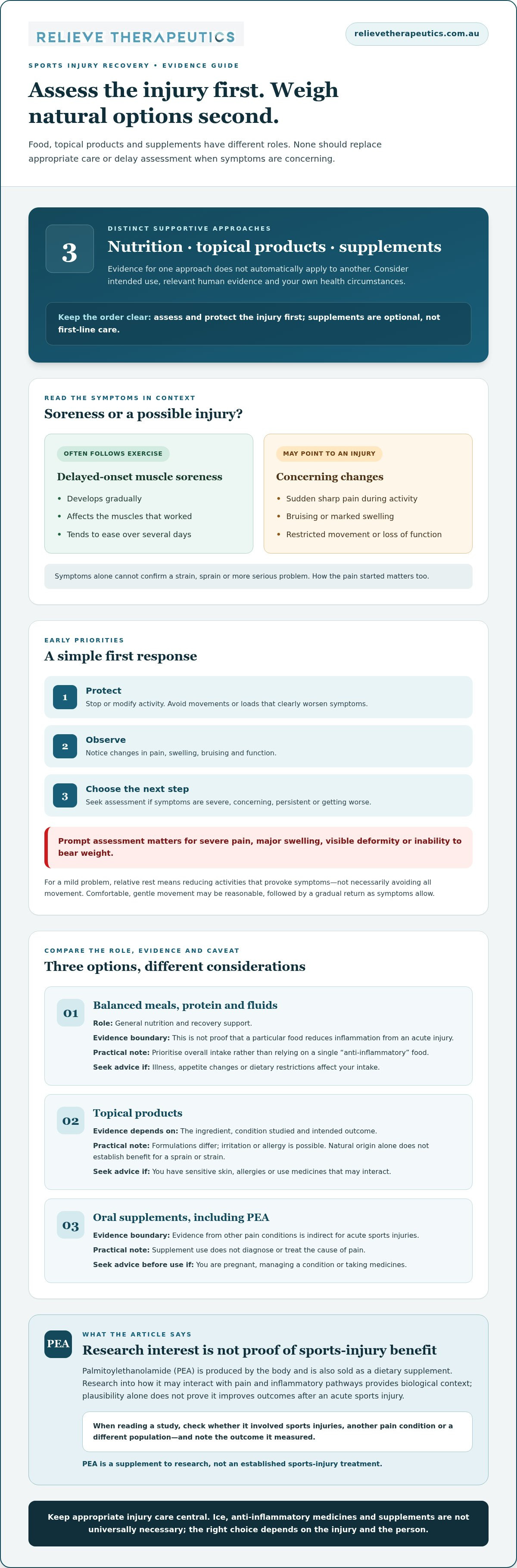
Delayed-onset muscle soreness often follows unfamiliar or demanding exercise. It tends to develop gradually, affect the muscles that worked and ease over several days. Sudden sharp pain during activity, bruising, marked swelling or restricted movement may point to an injury rather than ordinary post-training soreness.
Symptoms alone can’t confirm whether you have a strain, sprain or a more serious problem. How the pain started matters too: a twist, collision or sudden loss of balance raises different concerns from general muscle tenderness after a hard session. Seek prompt assessment for severe pain, major swelling, visible deformity or inability to bear weight. Persistent or recurring pain also deserves attention rather than being repeatedly masked.
What belongs in the first response to a new injury?
Stop or modify the activity that triggered the pain. Continuing to train through worsening symptoms can aggravate the area, while a clinical assessment can help clarify what care is appropriate. The need for assessment depends on factors such as the force involved, the body area affected and whether your function has changed.
For a mild problem, relative rest means reducing activities that provoke symptoms, not necessarily avoiding all movement. Comfortable, gentle movement may be reasonable, followed by a gradual return as symptoms allow. A clinician can advise whether a specific injury needs a more structured plan.
- Protection: Avoid movements or loads that clearly worsen symptoms.
- Observation: Notice changes in pain, swelling, bruising and function.
- Next steps: Seek assessment if symptoms are severe, concerning, persistent or getting worse.
Ice, anti-inflammatory medicines and supplements aren’t universally necessary. The right choice depends on the injury and the person. Don’t let trying a natural product delay assessment when symptoms suggest a more serious injury. Once the immediate situation is clear, weigh supportive options against the evidence and your health circumstances.
Which natural anti-inflammatory options have evidence for sports injuries?
Food, topical products and oral supplements serve different purposes, and evidence for one shouldn’t be assumed to apply to another. A balanced diet supports general recovery, but that doesn’t prove a particular food reduces inflammation from an acute injury. Similarly, findings from chronic-pain studies or other groups may not predict results for an injured athlete.
Can food or topical options support recovery?
Regular meals that provide enough energy and protein, alongside adequate hydration, help meet general training and recovery needs. They’re a foundation, not a targeted treatment. Topical products vary in ingredients and evidence; a product’s natural origin alone doesn’t establish that it will help a sprain or strain. Check for allergies or skin sensitivity, and seek advice if you’re unsure about interactions with medicines.
For broader context on injury care, see Harvard Health’s Treating Sports Injuries. Keep that care separate from optional products intended to support comfort.
Where might supplements such as PEA fit?
Palmitoylethanolamide (PEA) is a compound the body produces and is also sold as a dietary supplement. Research into how it may interact with pain and inflammatory pathways provides biological context, but plausibility isn’t proof that it improves outcomes after an acute sports injury. When reading a study, check whether it involved sports injuries, another pain condition or a different population, and note the outcome it measured. For mechanism background, read how PEA works for pain.
Use this comparison to frame the evidence, not as a ranking of treatments:
| Option | Evidence relevance | Practical caveat | When to seek advice |
|---|---|---|---|
| Balanced meals, protein and fluids | General nutrition and recovery support; not proof of reduced injury inflammation | Prioritise overall intake rather than relying on a single “anti-inflammatory” food | If illness, appetite changes or dietary restrictions affect your intake |
| Topical products | Depends on the ingredient, condition studied and intended outcome | Formulations differ; irritation or allergy is possible | If you have sensitive skin, allergies or use medicines that may interact |
| Oral supplements, including PEA | Evidence from other pain conditions is indirect for acute sports injuries | Supplement use doesn’t diagnose or treat the cause of pain | Before use if pregnant, managing a condition or taking medicines |
If you’re researching PEA after weighing the evidence and your personal circumstances, Relieve Therapeutics offers PEA capsules in 60, 120 and 180-capsule supplies. Explore PEA capsule options as a supplement category, not a proven sports-injury treatment.
PEA, turmeric, and other options: how to compare the evidence fairly
A product’s natural origin doesn’t guarantee that it works, is safe for everyone or suits a particular injury. Turmeric, curcumin and palmitoylethanolamide (PEA) are discussed in relation to inflammation and pain, but those broad topics don’t establish a benefit for an acute sprain, strain or exercise-related injury. When considering a natural anti-inflammatory for sports injuries, ask whether the research matches the injury and outcome you care about.
What evidence would make a supplement claim more convincing?
Human clinical studies are generally more relevant than laboratory or animal research alone. Then look at the details: how participants were assigned, how many took part, how long the study ran, what outcomes were measured and whether researchers disclosed conflicts of interest. A change in a pain score or inflammation marker isn’t the same as evidence of tissue healing, restored function or a safe return to sport.
Evidence from another condition can suggest a research question, but it can’t prove a supplement benefits a sports injury. If studies involve chronic pain or a different population, their relevance to a new sprain or strain is indirect. Without suitable, directly comparable research, it isn’t sound to rank ingredients as “best” or claim one is effective.
How should readers interpret PEA research?
PEA is a compound produced by the body and also sold as a dietary supplement. To assess a study, identify the condition and population studied, the formulation used and the outcome reported. A finding in a chronic-pain population, for example, shouldn’t be transferred directly to acute sports injuries. Biological explanations may be of interest, but they don’t replace injury-specific evidence.
Apply the same standard to turmeric or any other ingredient. Ask whether the research tested the ingredient itself, whether participants had the injury in question and whether the measured benefit relates to pain, function or recovery. If those details aren’t clear, the claim may go beyond what the study can support.
- Study fit: Does the research concern the same injury and population?
- Outcome: Was it pain relief, a marker, function or return to sport?
- Quality: Were the methods, participant numbers, duration and conflicts reported?
Evidence quality and product quality are separate questions: a well-made supplement isn’t automatically proven for a particular injury. For practical points to consider when assessing PEA products, read this guide to high-quality PEA capsules. Keep the conclusion measured: research may support further investigation without establishing PEA as a sports-injury treatment.
How to use natural options safely alongside sports-injury care
A cautious approach keeps injury care in the lead and any natural anti-inflammatory for sports injuries in a supporting role. Before adding a supplement or topical product, follow a simple sequence: assess the injury, consider your health circumstances and medicines, make one change, then monitor what happens. This helps avoid piling on options while the cause of pain still needs attention.
- Assess: Consider how the injury happened, how symptoms are changing and whether you need professional care.
- Review: Check your medicines, allergies, health conditions and any advice already given about the injury.
- Choose and monitor: If an option seems suitable, introduce one change at a time and note symptoms and function.
If you’re pregnant, managing a health condition or taking medicines, discuss a supplement with your GP or pharmacist first. This can help identify suitability or interaction concerns. Supplements should never delay assessment, recommended rehabilitation or treatment already prescribed for you.
When should an athlete seek medical assessment?
Seek urgent medical care for severe or worsening pain, substantial swelling, visible deformity, numbness or an inability to use the affected limb. These signs need proper assessment; an online article can’t determine the cause or severity. Persistent symptoms, pain that keeps returning or repeated injuries also warrant individual advice, particularly if they’re limiting everyday movement or training.
Don’t use a supplement trial as a reason to wait when symptoms are concerning. The priority is to understand what care the injury may need.
How can you monitor a new supportive option?
Keep a brief record of pain, swelling, movement, everyday function and training load. Note other changes too, such as a new medicine or a change in activity. A pattern in a diary can help inform a conversation with a health professional, but it doesn’t prove that a supplement caused an improvement or a reaction.
Introduce one new option at a time if you’re trying to understand tolerability. Starting several supplements together makes it harder to identify which change may be linked to an effect. If you notice a concerning reaction, stop using the new option and seek advice. Don’t alter prescribed treatment or your return-to-activity plan without appropriate guidance.
Once injury care and personal suitability have been considered, you can explore PEA as a supplement option without treating it as an established sports-injury treatment. Explore PEA capsules as one possible next step in your research.
Considering PEA for sports-injury support: informed next steps
PEA is a dietary supplement some people research when exploring a natural anti-inflammatory for sports injuries. It isn’t an established treatment for sports injuries, and the information here doesn’t establish that it heals sprains or strains, speeds return to sport or replaces injury-specific care. Keep the question focused: does the evidence relate to your injury, and is the supplement suitable for you?
What should you know before considering PEA?
Research findings need to be judged by the condition studied, the participants, the PEA formulation and the outcomes measured. Evidence relating to another pain condition doesn’t confirm a benefit for an acute sports injury. No dose, duration or expected recovery result can be recommended here. For general background, see this guide to PEA dosage guidance, and treat it as general information rather than personal medical advice.
Before choosing any supplement, consider your health circumstances and medicines. If you’re pregnant, managing a condition or taking medicines, discuss suitability with your GP or pharmacist. A supplement should not delay assessment, a recovery plan or treatment recommended for your injury.
What is a sensible next step?
Start with the injury. If you have concerning or persistent symptoms that haven’t been assessed, prioritise that conversation and follow guidance suited to your diagnosis and recovery. Then weigh supplement information against your own circumstances. You can note the research question, intended outcome and any uncertainties to discuss with a health professional.
Relieve Therapeutics offers PEA capsules in 60, 120 and 180-capsule supplies. These are options for readers who want to explore PEA as a supplement, not evidence that it treats sports injuries or a promise of a particular result.
If you’ve considered the evidence and personal suitability, explore the Relieve Therapeutics PEA range as an information-led next step. Using a supplement is optional; appropriate assessment and injury care remain central to recovery.
Make your next recovery decision with confidence
The most useful natural anti-inflammatory for sports injuries is not necessarily a supplement. Start with the injury and appropriate care, then assess food, topical products or supplements according to the evidence for your situation. PEA is an option to research, but the information here doesn’t establish it as a treatment for sports injuries. Consider personal suitability and seek advice if you’re taking medicines, managing a condition or pregnant.
Relieve Therapeutics is an Australian retailer focused on PEA dietary supplements, with capsule supplies of 60, 120 and 180 capsules. If you’ve considered the evidence and want to explore the range, explore Relieve Therapeutics PEA capsules. Keep your recovery plan grounded in appropriate injury care, and take each next step at a considered, informed pace.
Frequently Asked Questions
What is the best natural anti-inflammatory for a sports injury?
There isn’t one natural option that’s best for every sports injury. The right first step depends on what happened, how severe the symptoms are and whether you need assessment. A natural anti-inflammatory for sports injuries may mean food, a topical product or a supplement, but evidence for one option doesn’t automatically apply to another. Treat these as possible supportive approaches, not substitutes for diagnosis or appropriate injury care.
Can natural supplements help with sports injuries?
Some supplements are studied for pain or inflammation, but that doesn’t establish that they help a particular sports injury. Check whether research involved people with the same injury, the same type of supplement and an outcome that matters, such as function or return to sport. Supplements may also have side effects or interact with medicines. They shouldn’t delay assessment, rehabilitation advice or treatment recommended for your injury.
Is PEA effective for muscle strains or sprains?
PEA isn’t established as a treatment for muscle strains or sprains. Research into PEA may concern other pain conditions or different groups of people, so those findings can’t confirm an effect on acute sports injuries. Consider the condition studied, the formulation and the outcomes measured before drawing conclusions. If you’re considering PEA, review the evidence and discuss whether it’s suitable for you with a GP or pharmacist, particularly if you take medicines.
Should I use ice or heat for a new sports injury?
Neither ice nor heat is necessary for every new sports injury. A cold pack wrapped in cloth may provide short-term comfort for some people, but don’t apply ice directly to skin or use it if you have reduced sensation without professional advice. Heat may not suit a newly swollen or bruised area. Protect the injury from aggravating activity, and seek assessment for severe pain, substantial swelling or reduced function.
Can I take supplements alongside anti-inflammatory medicines?
Check with a GP or pharmacist before combining a supplement with anti-inflammatory medicines. The answer depends on the specific supplement, medicine, dose and your health circumstances, and some combinations may increase the risk of side effects or interactions. Don’t stop or change prescribed medicine to try a supplement. Bring the product label or ingredient information to your appointment so the health professional can review what you’re considering.
When should I see a doctor about a sports injury?
Seek urgent medical care for severe or worsening pain, substantial swelling, visible deformity, numbness or inability to use or bear weight on the affected limb. These symptoms need assessment rather than a remote guess or supplement trial. Arrange an individual assessment if pain persists, keeps returning or limits everyday movement or training. A clinician can help determine what care may be appropriate and whether further investigation is needed.
How long does a sports injury usually take to heal?
Recovery time varies with the type and severity of the injury, the body area involved and individual health factors. Mild soreness may settle differently from a significant sprain or strain, so a single timeline can’t reliably predict your recovery. Follow advice suited to your injury and increase activity gradually as symptoms and function allow. If improvement stalls, symptoms worsen or pain repeatedly returns, seek an assessment rather than pushing through.