

If you’re asking, “can you take PEA and turmeric together?”, the careful answer is that there’s no well-established interaction between them, but research on using the combination is limited. That uncertainty matters if you’re managing discomfort or taking medicines. The available information doesn’t establish whether the effects of combining them are predictable.
It’s understandable to see claims that PEA and turmeric may offer complementary support. They’re different substances, though, and turmeric in food isn’t the same as a concentrated turmeric or curcumin supplement. High-dose turmeric supplements have also been linked to rare reports of liver injury, so the product form and your health history deserve attention.
This article separates what’s known from what remains uncertain, including whether the combination has proven benefits or a confirmed safety profile. You’ll learn what medicines and health factors to discuss with your doctor or pharmacist, and what to check on supplement labels. The aim is to help you make a cautious, informed decision with a healthcare professional, without changing prescribed treatment on your own.
Key Takeaways
- If you’re wondering “can you take PEA and turmeric together?”, available information doesn’t establish a specific interaction or confirm the combination is safe for everyone.
- PEA and curcumin are different ingredients. Evidence about either one alone can’t establish the effects of taking them together.
- Check whether your turmeric is a food ingredient or a concentrated supplement, and note the full ingredient list and serving size for a health professional to review.
- Tell your doctor or pharmacist about your medicines, especially anticoagulant or antiplatelet medicines, and any relevant health conditions before starting a supplement.
- Use a practical checklist to prepare for a discussion with a qualified professional. Don’t change prescribed treatment based on supplement claims.
Can you take PEA and turmeric together? The short, evidence-aware answer
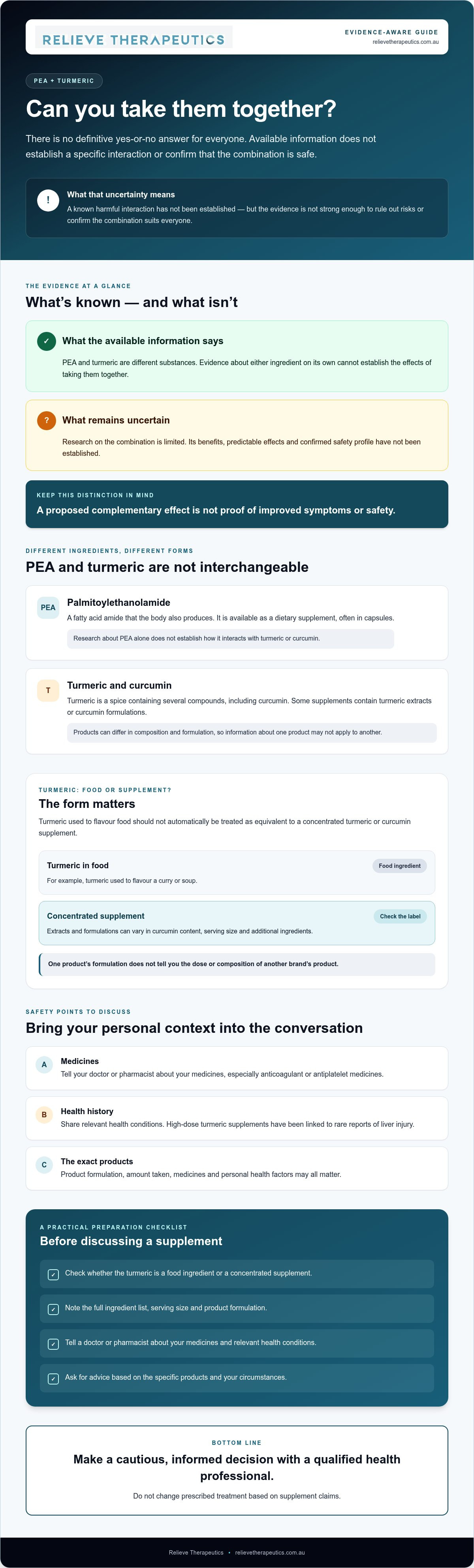
Available information doesn’t establish a specific interaction between PEA and turmeric or prove that taking them together is safe. That doesn’t mean a harmful interaction is known to occur. It means the evidence isn’t strong enough to rule out risks or confirm that the combination suits everyone. So, if you’re asking “can you take PEA and turmeric together?”, there isn’t a definitive yes-or-no answer that applies to every person.
The evidence gap in one sentence: research on PEA and turmeric individually can’t establish the safety or benefits of taking them in combination. Keep that distinction in mind when reading claims that the ingredients work better together. A proposed complementary effect isn’t proof of improved pain, inflammation or another health outcome.
What is known about PEA and turmeric when used together?
Direct evidence on taking these two supplements together appears limited. PEA, short for palmitoylethanolamide, is a fatty acid amide that the body also produces. Palmitoylethanolamide (PEA) is described in more detail in this overview. Turmeric contains curcuminoids, including curcumin, but the ingredients aren’t interchangeable. Information about either ingredient on its own can’t tell us exactly how the pair may affect a particular person.
That’s why claims of “synergy” should be treated cautiously. A plausible explanation for how two substances might act differently doesn’t demonstrate that combining them improves symptoms or is risk-free. Product formulation, amount taken, medicines and personal health factors may all matter.
Why turmeric in food is different from a supplement
Turmeric used to flavour a curry or soup is a food ingredient. It shouldn’t automatically be treated as equivalent to a concentrated turmeric or curcumin supplement. Supplements can contain extracts in capsules or other formulations, and their curcumin content and serving sizes can vary. Some products may also use formulations intended to change absorption.
Check the specific label rather than assuming all turmeric products are alike. Note whether it lists turmeric powder, an extract or curcumin, and record the serving size and any additional ingredients. One product’s formulation doesn’t tell you the dose or composition of another brand’s product. If you’re considering a concentrated supplement alongside PEA, bring both ingredient lists to a doctor or pharmacist for individual advice.
How PEA and turmeric differ, and why that matters for interaction questions
PEA and turmeric are distinct substances, so research about one can’t answer every question about the other. PEA is a fatty acid amide that the body naturally produces and that’s also sold as a dietary supplement. Turmeric is a spice containing several compounds, including curcumin. Their different compositions matter when interpreting research and checking supplement labels.
Research on each ingredient separately doesn’t establish the safety of taking PEA and turmeric together. Even if an ingredient has been studied on its own, that doesn’t show what happens when it’s combined with another supplement or how the combination may affect someone taking medicines.
| Ingredient | Common form | Evidence relevant to this question | Key uncertainty |
|---|---|---|---|
| PEA | Dietary supplement, often in capsules | Studied individually for various health questions, including pain. | Evidence about PEA alone doesn’t establish how it interacts with turmeric or curcumin. |
| Turmeric and curcumin | Turmeric as a food or supplement; curcumin in some extracts and formulations | Research and safety information may relate to a particular form or product. | Products can differ in composition and formulation, so findings may not apply across products or to a PEA combination. |
What is PEA, and what evidence applies to it?
Palmitoylethanolamide, or PEA, is a fatty acid amide made naturally in the body and also available in supplement form. Researchers have explored its biological roles, including its relationship with processes in the nervous system. These proposed roles aren’t the same as proof of a particular clinical outcome, and they don’t tell us whether combining PEA with turmeric is appropriate for you.
For a closer look at PEA research, read an article on how PEA works for pain. Relieve Therapeutics is an Australian retailer of PEA capsules, not a source of individual medical advice.
What is curcumin, and why do turmeric products vary?
Curcumin is one compound found in turmeric, not another name for every turmeric product. A supplement may contain turmeric powder, an extract or a particular curcumin formulation, and the amount and other ingredients can vary. Don’t assume findings about one formulation apply to another. The National Center for Complementary and Integrative Health offers an overview of the science on turmeric’s safety.
Check the label for the ingredient form, serving directions and other components. If you’re considering combining supplements, bring both labels to your doctor or pharmacist so they can assess the specific products and your circumstances.
Could combining PEA and turmeric cause problems? Medicines and risk factors to check
Evidence about taking PEA and turmeric together is limited, so a personal safety check matters more than assuming the combination is harmless. Your medicines, health conditions and the exact products you’re considering can all affect the advice. In particular, concentrated turmeric or curcumin supplements deserve careful review if you take medicines that affect blood clotting.
Turmeric supplements may raise concerns for people using anticoagulant or antiplatelet medicines, often described as blood thinners. This is a reason to ask your doctor or pharmacist about your situation, not a reason to stop or adjust a prescribed medicine. The US National Center for Complementary and Integrative Health provides authoritative safety information on turmeric, including discussion of supplement-related risks.
Which medicines should you mention to a pharmacist or GP?
Share a complete list of prescription medicines, over-the-counter medicines and supplements, including products you use only occasionally. Mention blood-thinning medicines specifically before using a concentrated turmeric or curcumin supplement. Don’t leave out pain relief products, vitamins or herbal remedies. Their ingredients may be relevant to a pharmacist’s assessment.
Bring the packaging or a clear photo of each label. The amount of turmeric extract, curcumin and other ingredients can differ between products, so advice about one formulation may not fit another. If you’re unsure whether a product matters, include it in the list and ask.
When should you seek individual advice before combining supplements?
Ask a GP or pharmacist before starting if you’re pregnant, have a gallbladder condition or a history of liver problems, or have a planned operation or other procedure. These factors can change whether a supplement is appropriate and whether timing needs to be considered. Concentrated extracts aren’t automatically equivalent to turmeric used in meals.
Turmeric supplements have been associated with rare reports of liver injury. Seek prompt medical assessment if you develop unexpected or severe symptoms after taking a supplement, rather than trying to diagnose the cause yourself. Take the product label with you if possible.
Don’t start, stop or change prescribed medicines or supplements without professional advice. If you’re weighing up PEA and turmeric, tell your healthcare professional what you hope to take, how often and in what form. That gives them a clearer basis to consider your medicines, health history and the specific ingredients together.
How to assess PEA and turmeric together: a practical checklist
If you’re still asking “can you take PEA and turmeric together?”, use this checklist to prepare for an individual conversation with your Australian pharmacist or GP. There’s no need to work it out alone, especially if you take medicines or have an ongoing health condition.
- Record both products. Write down the product names, how much you take and how often. Include any other supplements you use.
- Read the full labels. Note each active ingredient, the amount per serve, directions and other ingredients. For turmeric, check whether the product lists turmeric powder, an extract, curcumin or formulation-specific ingredients.
- List your medicines and health factors. Include prescription and over-the-counter medicines, relevant health conditions and any planned procedures. Don’t leave out products you use only occasionally.
- Ask a qualified health professional to review the full combination. Take the packaging or clear photos of both labels so they can consider the actual products alongside your health history.
What to check on both supplement labels
Labels can help identify what you’re considering, but their directions aren’t personalised medical advice. Formulations and amounts may differ between products, so don’t assume one label’s dose or ingredient profile applies to another product. A general PEA dosage guide may provide context about PEA use, but it can’t determine an appropriate dose for you or assess a turmeric combination.
What to ask your Australian pharmacist or GP
Bring your product list and ask whether each supplement is appropriate with your medicines and health history, and whether any ingredient warrants particular caution. Ask what unexpected symptoms should prompt you to stop a supplement and seek advice. Make sure the professional reviews the proposed combination, not just PEA or turmeric in isolation.
If a clinician considers trying the supplements appropriate, ask whether introducing one change at a time would help you keep track of any effects. Don’t use this approach to adjust prescribed treatment or delay advice about a concerning symptom. Follow the plan agreed with your healthcare professional.
Once you’ve discussed whether PEA is suitable for you, you can review the available PEA capsule options from Relieve Therapeutics. Check the current product label, and rely on your healthcare professional for advice about your personal use.
Making an informed decision about PEA and turmeric
There isn’t enough direct evidence to confirm that taking PEA and turmeric together is safe or beneficial for everyone. That doesn’t make the combination automatically unsafe, either. The sensible next step is an individual review, especially if you take regular medicines or manage a health condition. Your circumstances and the specific products matter more than broad online claims.
When it may be sensible to pause and seek advice
Before adding a supplement, check with your GP or pharmacist if you take medicines, have an ongoing health concern or are pregnant. Seek specific advice before using concentrated turmeric or curcumin products, as their ingredients and formulations can differ from turmeric used in food. A health professional can consider both supplements alongside your medical history and current treatment.
Keep prescribed care in place unless the clinician responsible for it advises otherwise. Supplements aren’t a replacement for prescribed treatment or personalised health advice, and you shouldn’t stop or change a medicine to make room for a supplement. If you’re unsure, pausing before you start gives you time to get advice based on the actual product labels.
Where PEA fits into your next steps
If a healthcare professional agrees PEA may be suitable for you, Relieve Therapeutics is an Australian retailer offering PEA capsules in 60, 120 and 180-capsule supplies. Check the current product label for its ingredients and directions, and ask your clinician or pharmacist how it fits with your individual plan. The retailer supplies PEA supplements; it doesn’t provide clinical care or individual medical advice.
You can also read a guide to high-quality PEA capsules for general information about what to consider when reviewing PEA products. Use it as background, not as a substitute for a professional’s assessment of suitability or use.
Take your time. Write down the products you’re considering, share the list with your healthcare professional and ask them to review the combination as a whole. That gives you a more grounded way to decide whether to proceed, wait or avoid a particular supplement, without relying on assumed benefits or changing prescribed treatment on your own.
Make your next step an informed one
If you’re still asking “can you take PEA and turmeric together?”, the evidence doesn’t provide a definitive answer about the combination’s safety or benefits. PEA and curcumin are different ingredients, and evidence about either one alone can’t confirm how they work together. Your medicines, health history and the specific turmeric product all matter.
Before adding a concentrated turmeric or curcumin supplement, ask your GP or pharmacist to review it alongside your medicines and any PEA product you’re considering. Share the labels, and don’t change prescribed treatment without professional advice.
After discussing suitability with your healthcare professional, you can explore Relieve Therapeutics, an Australian retailer specialising in PEA dietary supplements, with capsule supplies in 60, 120 and 180-capsule options. Explore Relieve Therapeutics’ PEA capsules.
A measured approach can help you make a choice that fits your circumstances. Take your time, ask questions and move forward with confidence.
Frequently Asked Questions
Can you take PEA and turmeric together?
There’s no definitive answer that applies to everyone. Available information doesn’t establish a specific interaction between PEA and turmeric or prove the combination is safe. That doesn’t mean a risk is impossible. Your medicines, health history and the product formulation matter, particularly if turmeric is a concentrated supplement rather than a food ingredient. Ask a GP or pharmacist to review both labels before combining them.
Is it safe to take PEA with curcumin?
Research hasn’t established that taking PEA with curcumin is safe for everyone. Curcumin is a compound found in turmeric, and supplements can differ in concentration and formulation. Evidence about PEA or curcumin used separately can’t confirm the effects of taking them together. Before starting the combination, discuss the specific products with a pharmacist or GP, especially if you take regular medicines or have a health condition.
Can turmeric supplements interact with blood thinners?
There may be safety concerns with concentrated turmeric or curcumin supplements for people taking anticoagulant or antiplatelet medicines, sometimes called blood thinners. The relevance depends on your medicine and the supplement’s ingredients and formulation. Ask your pharmacist or GP before using one, and share the product label. Don’t stop or change a prescribed blood-thinning medicine without advice from the clinician managing your treatment.
Does turmeric in food have the same risks as a turmeric supplement?
No, turmeric in a meal isn’t automatically equivalent to a concentrated supplement. Supplements may contain extracts or curcumin formulations, and their amounts and other ingredients can vary. Advice or research about one product may not apply to another. If you’re considering a supplement, check the label and discuss it with a health professional, particularly if you take medicines or have a relevant health condition.
Should I take PEA and turmeric at different times of day?
There’s no established timing schedule that makes this combination safe or prevents possible interactions. Taking PEA and turmeric at separate times doesn’t necessarily remove a risk, particularly one related to your medicines or health history. Check the directions on each product, but don’t treat them as personalised advice. Ask a pharmacist or GP whether either product is suitable and how to follow their advice.
Can I take PEA and turmeric with prescription medication?
Possibly, but it depends on the medicine, your health and the exact supplements. Tell your GP or pharmacist about all prescription medicines, over-the-counter products and supplements you use. Mention concentrated turmeric or curcumin in particular if you take anticoagulant or antiplatelet medicine. Bring the labels for review, and don’t alter prescribed treatment or start a supplement without getting advice relevant to your circumstances.
What should I do if I feel unwell after taking PEA and turmeric?
If you feel unwell after taking the supplements, seek advice from a health professional and tell them what you took, how much and when. Keep the packaging or ingredient list available. Don’t take another dose until you’ve received appropriate advice, and don’t change prescribed medicines without consulting your clinician. For severe symptoms or an emergency in Australia, call 000.